Jump to Content
Plastic Resins Market - Size, Share, Industry Trends, and Forecasts (2025-2035)
Plastic Resins Market:
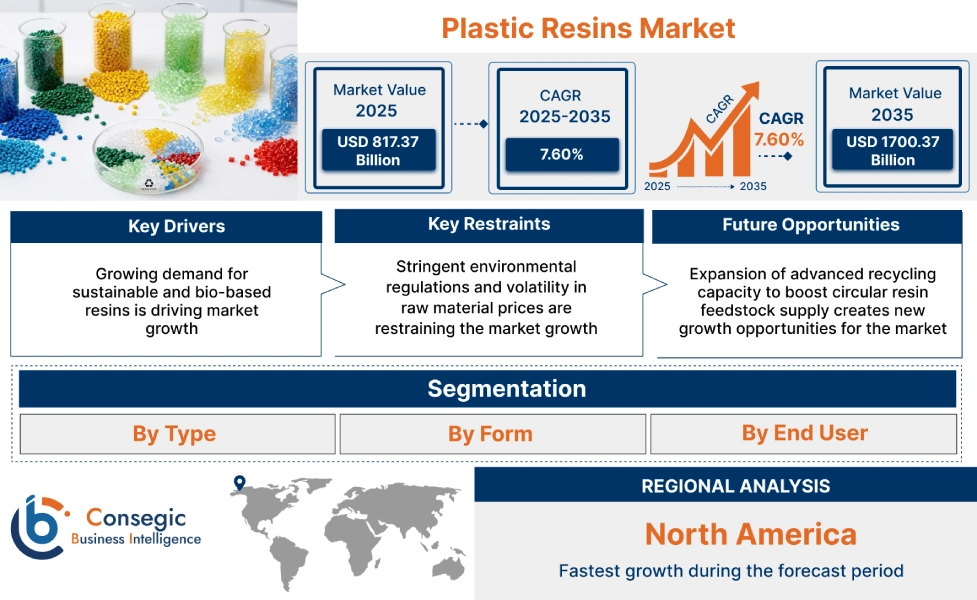
Plastic Resins Market size is estimated to reach over USD 1700.37 Billion by 2035 from a value of USD 759.64 Billion in 2024 and is projected to grow by USD 817.37 Billion in 2025, growing at a CAGR of 7.60% from 2025 to 2035
Plastic Resins Market Scope & Overview:
Plastic resins refer to polymer materials that are used as the main raw material in the manufacture of plastic products. They come in different forms, including polyethylene, polypropylene, polyvinyl chloride, polystyrene, and engineering plastics. The plastic resins have found extensive use in the packaging, automotive, construction, electrical, consumer, and healthcare sectors due to their strength, flexibility, and lightness.
The plastic resins market is driven by the growing demand for packaged goods and the use of light materials in the automotive and construction industries. Industrialization and urbanization are factors in the growing demand for plastic products. Advances in polymer processing technology and the development of bio-based and recyclable plastic resins are also driving the plastic resins market.
How is AI Impacting the Plastic Resins Market?
AI employs machine learning to analyze production data and optimize processes for the production of plastic resin. Also, AI helps manufacturers monitor raw material usage, energy consumption, and process conditions in real time, which improves efficiency and reduces production waste. In addition, AI also enables predictive maintenance of equipment, which is important for minimizing downtime and ensuring a steady flow of resin. Moreover, AI enables demand forecasting and supply chain optimization through the analysis of market trends and customer behavior.
Plastic Resins Market Dynamics - (DRO):
Key Drivers:
Growing demand for sustainable and bio-based resins is driving market growth
The plastic resins market is growing as the use of sustainable and eco-friendly resin solutions is being adopted by manufacturers and end-use industries. The increasing regulatory pressures to cut down plastic waste and carbon emissions are encouraging resin manufacturers to develop bio-based and mass-balanced resin solutions using renewable or recycled feedstocks. The governments of regions such as Europe and North America are imposing stricter environmental regulations, thereby encouraging companies to opt for greener alternatives and circular economy strategies. The growing demand for sustainable materials in the packaging and automotive industries is also encouraging this trend.
- For example, in May 2024, BASF SE has expanded its biomass balance portfolio to include ISCC PLUS and REDcert-certified chemical intermediates such as 1,4-butanediol and tetrahydrofuran, which help resin manufacturers replace fossil-based feedstock with renewable resources and lower the carbon footprint of their products.
Thus, the growing demand for sustainable and bio-based resin solutions is fueling the plastic resins market.
Key Restraints:
Stringent environmental regulations and volatility in raw material prices are restraining the market growth
The plastic resins are mainly produced from petrochemicals like crude oil and natural gas. Hence, the prices of raw materials have a huge impact on the plastic resins market. This volatility creates pricing uncertainty and affects long-term supply contracts across industries.
In addition, stringent environmental regulations regarding plastic usage, waste management, and recycling are limiting market expansion. Governments across several countries are implementing bans and restrictions on single-use plastics, increasing compliance costs for manufacturers. The increasing environmental concerns and the need for biodegradable materials are also influencing the demand for traditional plastic resins.
Thus, the volatility in raw material prices and the environmental regulations are acting as factors that restrict the growth of the plastic resins market.
Future Opportunities:
Expansion of advanced recycling capacity to boost circular resin feedstock supply creates new growth opportunities for the market
The rising interest in circular economy projects and the legislative ambitions to enhance the recycled content in plastics is anticipated to open up substantial growth opportunities for the plastic resins market. The use of recycled and chemically recycled resins is on the rise among plastic manufacturers and converters in the packaging, consumer products, and industrial markets to fulfill their sustainability pledges and reduce their overall carbon footprint. The latest recycling technologies, which involve the breakdown of used plastics into molecular feedstocks, are helping to increase the types of plastics that can be recycled and are expected to provide high-quality recycled resin for various applications.
- For example, in July 2025, ExxonMobil announced that its chemical recycling facility in Baytown, Texas, was expanded with the addition of a second recycling line, which will enable the recycling facility to recycle more than 100 million pounds of plastic waste as of May 2025 to produce feedstock for the production of new plastics.
Thus, the expansion of advanced recycling capacity and the emerging availability of certified circular polymers are expected to fuel adoption in the packaging and industrial sectors, thereby providing future opportunities for the plastic resins market.
Plastic Resins Market Segmental Analysis:
By Type:
Based on type, the plastic resins market is segmented into polyethylene (PE), polypropylene (PP), polyvinyl chloride (PVC), polystyrene (PS), polyethylene terephthalate (PET), engineering plastics, bioplastics, and other resins.
Trends in the Type:
- The growing need for lightweight and robust materials in the packaging industry is fueling the use of polyethylene and polypropylene.
- The growing concern for sustainability and the implementation of circular economy practices is accelerating the adoption of bioplastics and recyclable resin materials.
Polyethylene (PE) accounted for the largest revenue share in the year 2024.
- Polyethylene is extensively used in packaging, films, containers, pipes, and household items owing to its flexibility, strength, and resistance to chemicals.
- In addition, its applicability in different grades such as HDPE and LDPE makes it suitable for use in the industrial and consumer markets.
- In addition, the growing need for flexible and rigid packaging products in the food and beverage industry is also fueling the use of polyethylene.
- Moreover, its cost-effectiveness and ease of processing make it a preferred resin material in various industries.
- Therefore, the wide applicability and cost-effectiveness of polyethylene are contributing to its dominance in the market.
Bioplastics are anticipated to register the fastest CAGR during the forecast period.
- Bioplastics are growing popular due to rising concern for the environment and government regulations to control the disposal of conventional plastic waste.
- In addition, bioplastics are biodegradable and have a lower carbon footprint than conventional plastics, which are made from petroleum.
- Further, the rising awareness among consumers about sustainable packaging is pushing companies to use biodegradable and compostable plastics.
- In addition, improvements in the properties and processing of bioplastics are making them more commercially viable.
- Therefore, increasing sustainability initiatives and regulatory support are anticipated to boost the bioplastics segment during the forecast period.
By Form:
Based on form, the plastic resins market is segmented into virgin and recycled.
Trends in the Form:
- The increasing government regulations to reduce plastic waste and promote circular economy practices are driving the demand for recycled resins.
- The increasing demand for high-performance materials in the packaging, automotive, and construction industries is driving the demand for virgin resins.
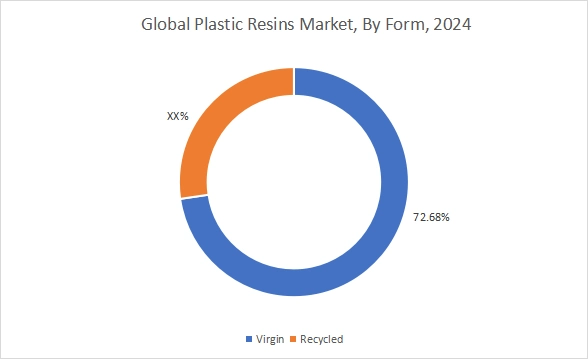
Virgin accounted for the largest revenue share of 72.68% in the year 2024.
- Virgin plastic resins are largely used because of their superior strength, durability, and material properties.
- These resins possess high purity and reliability of performance, making them ideal for high-performance applications such as food packaging and medical devices.
- Furthermore, industries with stringent quality standards and government regulations tend to opt for virgin resins to ensure safety and quality.
- In addition, the increasing demand for lightweight and high-strength materials in the automotive and consumer goods industries is driving the growth of this market.
- Furthermore, the well-established supply chain and high production capacity are also driving the dominance of virgin resins in the market.
- Thus, consistent performance characteristics and wide application areas are driving the dominance of virgin resins.
Recycled is anticipated to register the fastest CAGR during the forecast period.
- Recycled plastic resins are being increasingly used to reduce environmental impact and dependence on fossil fuels for raw materials.
- These resins assist manufacturers in achieving sustainability objectives and adhering to government regulations regarding the reduction of plastic waste.
- In addition, the growing demand for environmentally friendly and sustainable products is also encouraging organizations to adopt recycled materials in packaging and products.
- Furthermore, advances in recycling technologies are also improving the quality and usability of recycled resins in various sectors.
- In addition, organizational initiatives to reduce carbon footprint and improve ESG performance are also accelerating the adoption of recycled plastic resins.
- Therefore, increasing sustainability initiatives and regulatory support are anticipated to boost the recycled resin segment during the forecast period.
By End User:
Based on End User, the plastic resins market is segmented into packaging, building & construction, automotive & transportation, electrical & electronics, consumer goods, agriculture, and medical & healthcare.
Trends in the End User:
- The rising demand for flexible and rigid packaging solutions in the food, beverage, and e-commerce sectors is fueling the use of plastic resins in packaging.
- The rising interest in light materials to enhance fuel efficiency in the automotive & transportation sector is propelling the use of resin in vehicle parts.
Packaging accounted for the largest revenue share in the year 2024.
- Packaging has wide usage due to the widespread use of plastic resins in bottles, films, containers, caps, and pouches.
- Plastic resins are robust, light, moisture-resistant, and economical, making them the preferred choice for flexible as well as rigid packaging applications.
- In addition, the growing trend of e-commerce and changing lifestyles are contributing to the rising demand for protective and convenient packaging solutions.
- Furthermore, the growing consumption of packaged foods and beverages is leading to a steady demand for polyethylene, polypropylene, and PET resins.
- In addition, the growing trend of e-commerce and changing lifestyles are contributing to the rising demand for protective and convenient packaging solutions.
- Thus, high consumption volume and versatile material properties are driving dominance in packaging applications.
Automotive & Transportation is anticipated to register the fastest CAGR during the forecast period.
- The automotive & transportation sector is growing owing to the increasing demand for lightweight materials, which improves fuel efficiency and reduces emissions.
- Plastic resins are widely used in interior trims, dashboard parts, bumpers, and under-the-hood applications owing to their high strength-to-weight ratio.
- Additionally, the rising production of electric vehicles is increasing demand for advanced engineering plastics for battery housings and electrical components.
- Further, regulatory norms aimed at reducing vehicle emissions are encouraging manufacturers to replace metal parts with high-performance plastic materials.
- Furthermore, ongoing innovation in engineering plastics such as polycarbonate and ABS is expanding their application scope in transportation.
- Therefore, as per the market analysis, the increasing focus on lightweight vehicles and emission reduction is anticipated to boost the automotive & transportation segment during the forecast period.
Regional Analysis:
North America, Europe, Asia Pacific, the Middle East and Africa, and Latin America are the regions of coverage.
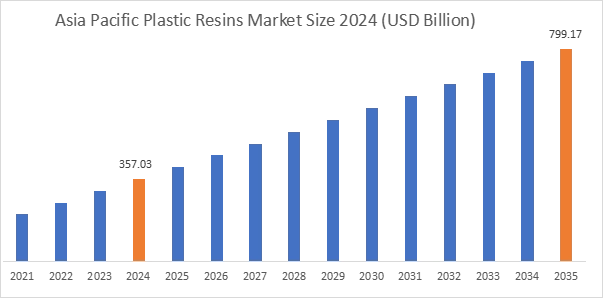
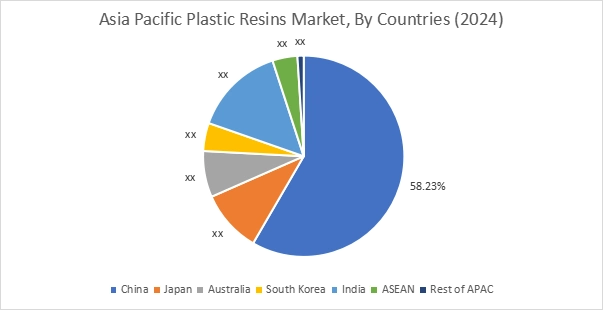
Asia Pacific region was valued at USD 357.03 billion in 2024. Furthermore, it is expected to reach USD 384.16 billion in 2025 and exceed USD 799.17 billion by 2035. Out of which, China accounted for the highest revenue share of 58.23% during the base year of 2024. Asia Pacific plastic resins market is driven by the increasing demand for packaging materials, the automotive sector, and large-scale manufacturing in China, India, South Korea, and Southeast Asia. The increasing demand for consumer goods, construction materials, and electronics is driving the demand for polyethylene, polypropylene, and engineering plastics.
- For instance, the International Organization of Motor Vehicle Manufacturers reported in 2025 that China, Japan, India are the leading vehicle-producing countries globally. Thus, higher vehicle production volumes are increasing demand for lightweight plastic components and advanced resins in the region, thereby, driving market growth.
In North America, the plastic resins market is experiencing the fastest growth with a CAGR of 13.28% over the forecast period. North America plastic resins market growth is supported by high packaging demand, shale-based petrochemical feedstock availability, and strong automotive and construction activity in the US and Canada. The growth of domestic resin production capacity and development in advanced polymer technology are enhancing the stability of the supply chain, thereby fueling the growth of the market.
- For example, in November 2025, the U.S. Energy Information Administration announced a 6% rise in natural gas liquids production, which is a key factor in the production of ethylene and polyethylene. This is enhancing resin production and subsequent plastic processing in the region.
The plastic resins market in Europe is fueled by initiatives for the automotive industry’s lightweighting, sustainable packaging, and recycling in Germany, France, and Italy. The industry is adopting recyclable and bio-based resin types to meet the EU’s circular economy regulations, thus fueling innovation and resin growth.
The Latin America plastic resins market is fueled by the increasing consumption of packaging materials, agricultural films, and infrastructure development in the region. Expansion of food processing and beverage industries is increasing demand for flexible and rigid plastic packaging materials, thereby driving resin consumption.
Middle East & Africa plastic resins market growth is supported by petrochemical capacity expansion and downstream plastic conversion investments in Saudi Arabia and the UAE. The integration of refining and petrochemical plants is improving the availability of base polymers for application in manufacturing sectors, thus driving the market.
Top Key Players & Market Share Insights:
The plastic resins market is a highly competitive market, with major players in the market providing a wide range of commodity and specialty resins to the domestic as well as international markets. The major players in the plastic resins market are using different strategies such as capacity expansion, sustainable product development, innovation in polymer processing technology, and new product development to maintain their position in the plastic resins market. The companies are also focusing on bio-based and circular resin solutions to cater to the evolving regulatory requirements and the growing demand for sustainable materials in the packaging, automotive, construction, and consumer goods sectors. The key players operating in the plastic resins market are:
- ExxonMobil Corporation(US)
- SABIC(Saudi Arabia)
- Dow Inc.(US)
- LyondellBasell Industries (Netherlands)
- INEOS Group (UK)
- BASF SE (Germany)
- China Petrochemical Corporation (Sinopec) (China)
- PetroChina Company Limited (China)
- Formosa Plastics Corporation (Taiwan)
- LG Chem (South Korea)
Recent Industry Developments:
- In October 2025, Braskem unveiled a new generation of bio-based and circular plastic resins at K 2025 in Düsseldorf, Germany. The launch includes bio-PE films and bio-based HDPE and LDPE solutions designed to expand sustainable packaging and consumer applications.
- In May 2025, UBQ Materials introduced UBQ Masterbatch, a circular thermoplastic material produced from household waste. The product is designed to replace conventional oil-based resins and support manufacturers in reducing carbon footprint without altering existing production lines.
Plastic Resins Market Report Insights:
| Report Attributes | Report Details |
|---|---|
| Study Timeline | 2019-2035 |
| Market Size in 2035 (USD Billion) | USD 1700.37 Billion |
| CAGR (2025-2035) | 7.60% |
| By Type |
|
| By Form |
|
| By End User |
|
| By Region |
|
| Key Players |
|
| Report Coverage |
|
Key Questions Answered in the Report
How big is the plastic resins market? −
The plastic resins marketsize is estimated to reach over USD 1700.37 Billion by 2035 from a value of USD 759.64 Billion in 2024 and is projected to grow by USD 817.37 Billion in 2025, growing at a CAGR of 7.60% from 2025 to 2035.
Which segmentation details are covered in the plastic resins report? +
The plastic resins report includes specific segmentation details for type, form, End User, and regions.
Which is the fastest segment anticipated to impact the market growth? +
In the plastic resins market, the bioplastics segment is anticipated to be the fastest-growing segment during the forecast period due to increasing regulatory measures aimed at reducing conventional plastic waste.
Who are the major players in the plastic resins market? +
The key participants in the plastic resins marketare ExxonMobil Corporation (US), SABIC (Saudi Arabia), Dow Inc. (US), LyondellBasell Industries (Netherlands), INEOS Group (UK), BASF SE (Germany), China Petrochemical Corporation (Sinopec) (China), PetroChina Company Limited (China), Formosa Plastics Corporation (Taiwan), LG Chem (South Korea), and others.
What are the key trends in the plastic resins market? +
The plastic resins market is being shaped by several key trends including rising demand for sustainable and bio-based plastics, increasing focus on recycled resin adoption, and growing usage in lightweight automotive and construction applications.
Overview
Reputation & Certifications


Our Services
- Market Intelligence & Forecasting
- Custom Research Solutions
- Market Entry Strategy
- Competitive Intelligence
- Customer Insights
- Industry Innovation Analysis
- Investment Advisory