Jump to Content
Postal Automation System Market Size & Industry Share - Growth Trends & Forecasts (2026 - 2034)
Postal Automation System Market Size:
The Postal Automation System Market is expected to expand from 617.65 (US$M) in 2025 to 660.27 (US$M) in 2026, and is forecast to surpass 1,126.01 (US$M) by 2034, growing at a CAGR of 6.9% between 2026 and 2034, according to a recent report from Consegic Business Intelligence.
Postal Automation System Market Scope & Overview:
Postal automation systems refer to the use of technology and machinery to streamline and optimize the processing, sorting, and delivery of mail and parcels. These systems are crucial for postal services to handle the large volume of mail and packages efficiently, ensuring timely delivery and reducing human error. Additionally, these systems are essential for modernizing postal services by integrating advanced technologies including automated sorting machines, optical character recognition (OCR), barcode recognition, and label recognition. Moreover, these automated systems offer a wide range of benefits, including increased efficiency, cost reduction, and improved accuracy. The aforementioned benefits of postal automation systems are major determinants for increasing their deployment in E-commerce, retail, government, transportation, and other industries.
How is AI Impacting the Postal Automation System Market?
AI is impacting the postal automation system market by introducing intelligence and efficiency into every stage of mail and parcel processing. AI-powered computer vision and machine learning algorithms are enabling systems to accurately read and sort a wide variety of packages and letters, including those with handwritten or damaged addresses, which was previously a challenge. This technology also optimizes sorting routes and logistics in real-time by analyzing data on traffic, weather, and delivery density. Furthermore, AI is enhancing customer-facing services through chatbots and predictive delivery updates. The result is a significant increase in sorting speed, a reduction in errors, and a more streamlined and cost-effective operation.
Postal Automation System Market Insights:

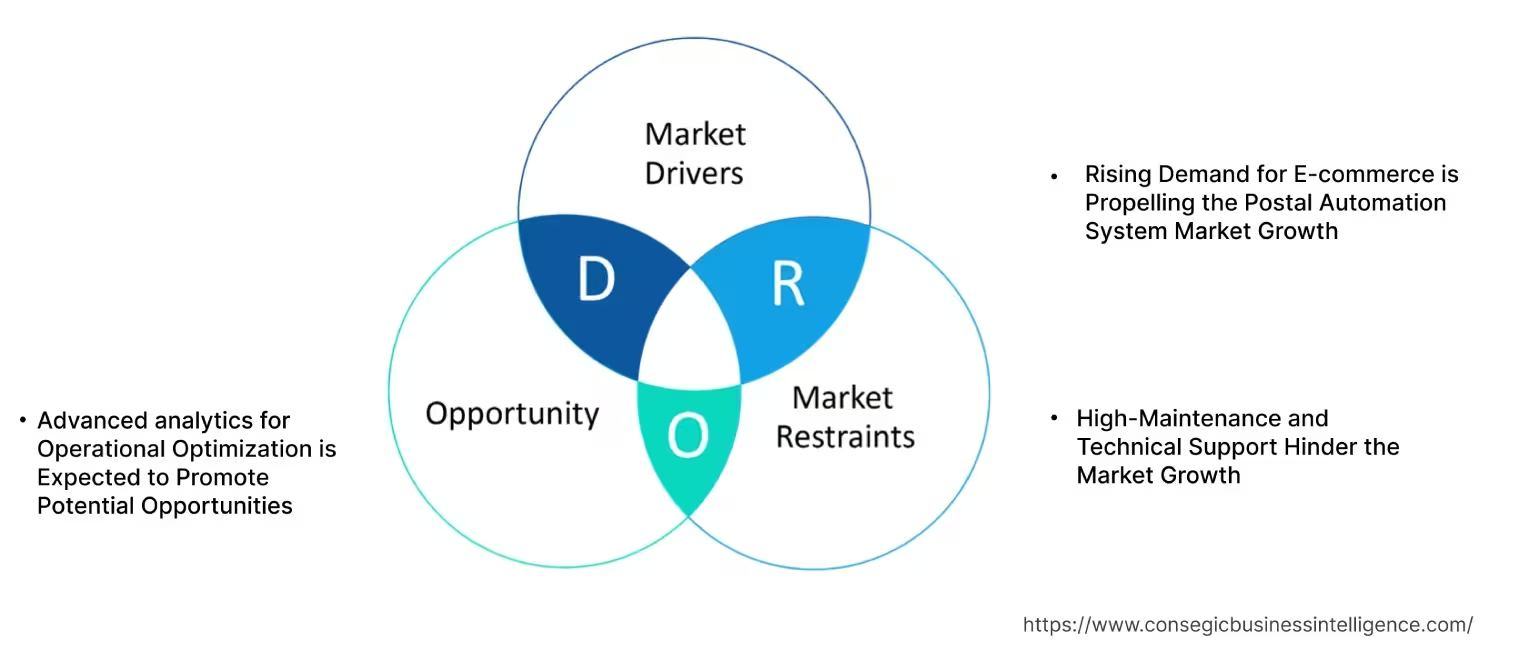
Postal Automation System Market Dynamics - (DRO) :
Key Drivers:
Rising Demand for E-commerce is Propelling the Postal Automation System Market Growth
The surge in online shopping has increased the volume of parcels that postal services process and deliver. This growth in e-commerce drives the need for automated systems to efficiently handle, sort, and deliver packages at high speeds, meeting customer expectations for fast delivery. Additionally, as consumers increasingly expect quick and reliable delivery, the need for automation systems becomes crucial as these enable rapid and accurate sorting of parcels.
In July 2023, the United States Postal Service (USPS) unveiled USPS Ground Advantage, a domestic shipping service with Amazon Buy Shipping. It provides first-class package service, parcel-select ground, and parcel-select cubic shipping methods. This system enhances Amazon Buy Shipping by enhancing the speed and accuracy of sorting processes.
- For instance, in November 2023, research published in Stroke, a journal of the American Stroke Association, highlighted alarmingly USPS Ground Advantage, a domestic shipping service with Amazon Buy Shipping. It provides first-class package service, parcel-select ground, and parcel-select cubic shipping methods. This system enhances Amazon Buy Shipping by enhancing the speed and accuracy of sorting processes.
Therefore, as e-commerce continues to grow, the need for speed and accurate postal service increases, proliferating the postal automation system market trend.
Key Restraints :
High-Maintenance and Technical Support Hinder the Market Growth
Advanced automation systems are comprised of various high-tech components that work together seamlessly. The advanced functionalities make diagnosing and repairing any faults or breakdowns in this kind of machine quite complicated. Specialized technical expertise is often required to address issues, which leads to increased operational costs as companies need to employ or contract highly skilled technicians. Additionally, regular preventive maintenance is important in ensuring that automation systems run smoothly and help in preventing expected breakdowns through periodic inspections, equipment calibration as well as servicing. Corrective maintenance is usually essential when problems are encountered, which includes replacing faulty parts or addressing system malfunctions.
Hence, high maintenance and technical support are restraining the postal automation system market share.
Future Opportunities :
Advanced analytics for Operational Optimization is Expected to Promote Potential Opportunities
Data analytics is used to evaluate the performance of sorting systems, identify inefficiencies, and predict maintenance needs. By analyzing data from sorting machines and human operators, postal services optimize sorting processes, reduce errors, and minimize delays. Additionally, integrating artificial intelligence, machine learning, and robotics in big data analytics provides valuable insights into postal operations, enabling operators to optimize routes, improve sorting processes, and enhance predictive analysis.
- In January 2022, FedEx introduced DoraSorter, an AI-powered intelligent sorting robot that uses advanced data analytics and AI to optimize sorting operations. It is designed to improve the efficiency and accuracy of parcel handling for operational demand.
Therefore, leveraging advanced data analytics along with AI and robotics technology is boosting the postal automation system market opportunities.
Postal Automation System Market Segmental Analysis :
By Component :
Based on components the market is segmented into hardware, software, and service.
Trends in the component:
- Service providers are offering tailored solutions that cater to the specific needs of postal operators including end-to-end management of automation systems from installation and ongoing support.
- The shift towards cloud-based solutions and software-as-a-service models is a prominent trend. It offers greater scalability, flexibility, and ease of integration with other systems.
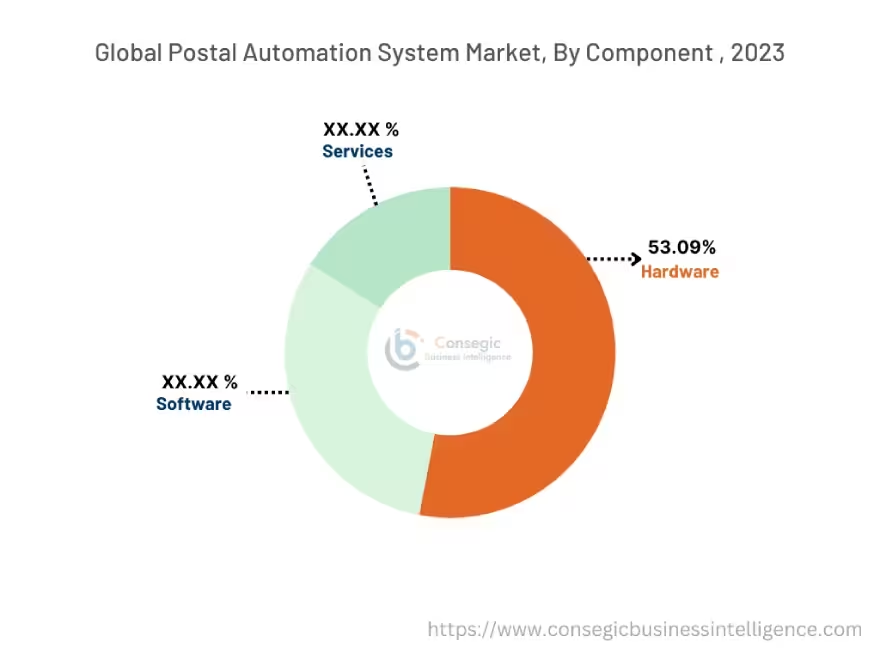
The hardware component segment accounted for the largest revenue share of 53.09% in the year 2023.
- Hardware components a physical equipment and machinery used to automate various processes in postal and logistics operations.
- It includes sorting machines, robotics, internet of things services, and smart sensors.
- In November 2021, Honeywell introduced an Automated Storage and Retrieval System designed to optimize parcel sorting efficiency and accuracy. It features artificial intelligence, robotics, smart sensors, and machine learning to enable warehouse and distribution operators to process efficiently.
- Thus, the advanced machinery with sorting machines and smart sensors are driving the global postal automation system market demand.
The software component segment is anticipated to register the fastest CAGR during the forecast period.
- Software component encompasses various digital tools and platforms designed to enhance the efficiency, accuracy, and functionality of postal operations.
- The software solutions are increasingly being developed to enhance customer experience in postal service.
- Additionally, it enables customers to track, monitor the parcels, receive updates, and interact with postal services, emphasizing improved customer interaction.
- In January 2021, Quadient launched Inspire Flex Release 15 (R15), a software solution aimed at improving customer communication and engagement in postal operations. The platform leverages advanced data analytics and AI to optimize customers across multiple channels.
- Consequently, as per the analysis, the software segment is expected to proliferate in the global postal automation system industry.
By Technology :
Based on technology, the market is segmented into Barcode Recognition, Optical Character Recognition (OCR), Radio Frequency Identification (RFID), Label Recognition, and Sorting Machine.
Trends in the technology:
- Label recognition technology incorporates image processing techniques to handle varying label designs and conditions, this trend leads to improvements in handling label damage and obscurity.
- Radio Frequency Identification (RFID) technology is increasingly being integrated with IoT devices to provide more comprehensive tracking and monitoring solutions. This trend of integration supports real-time data collection and analysis.
The sorting machine technology segment accounted for the largest revenue share in the year 2023.
- A sorting machine is important for handling large volumes of mail and parcels.
- These machines use conveyor belts to move items through various stages of sorting processes.
- In August 2023, Falcon Autotech enhanced DTDC's parcel sorting system, which can handle 6000 parcels per hour and operate efficiently. The cross-belt is designed to automate key sorting processes in DTDC's warehouse.
- Hence, the ability of sorting machines to handle large volumes of parcels is fueling the postal automation system market.
The barcode recognition technology segment is anticipated to register the fastest CAGR during the forecast period.
- Barcode recognition is a technology used to read and interpret barcodes, which are visual patterns of parallel lines and spaces that encode information.
- The barcode reader, or scanner emits a light beam that reflects off the barcode. The sensor detects the reflected light, converting the variations in light intensity into electrical.
- Additionally, it is a crucial technology for automating the identification and tracking of products and information, offering efficiency, accuracy, and cost-effectiveness across various industries.
- For instance, Zebra Technologies launched DS3600 Series Ultra-Rugged Barcode Scanners, which include enhancements for improved scanning performance and durability. The DS3600 series is designed to read barcodes from various surfaces and under different conditions, including damaged or poorly printed barcodes.
- Thus, according to the market analysis, barcode recognition helps in automating the identification and tracking of parcels, which is consequently driving the postal automation market demand.
By End-User :
Based on end-user the market is segmented into retail, government, e-commerce, financial services, education, transportation, and others.
Trends in the End-user:
- Retailers are increasingly integrating barcode recognition systems across both online and offline channels to streamline inventory management and enhance the customer experience.
- Financial institutions use postal automation systems to manage and process large volumes of financial documents including account statements, loan applications, and transaction records.
- The trend, towards, Automation systems streamlining the distribution of internal mail and packages within educational institutions, improving administrative efficiency.
The E-commerce end-user segment accounted for the largest revenue share in the year 2023 and is anticipated to register the fastest CAGR during the forecast period.
- E-commerce companies are driving demand for automated postal systems to enhance the efficiency of fulfillment centers.
- Automation helps in faster sorting, packing, and dispatching of orders, which is crucial for customer experience.
- Additionally, e-commerce adopts warehouse operations for seamless receiving, storing, shipping, and accounting of the parcels.
- In March 2022, Swisslog and Berkshire Grey collaborated to introduce AI-enabled robotic solutions to global warehouse operations. This partnership reflects leveraging cutting-edge technology to address the growing demand for modern logistics and e-commerce environments.
- Consequently, as per the analysis, the surge in E-commerce companies to sort and manage high-volume parcels is driving the postal automation system market.
Regional Analysis:
The regions covered are North America, Europe, Asia Pacific, the Middle East and Africa, and Latin America.
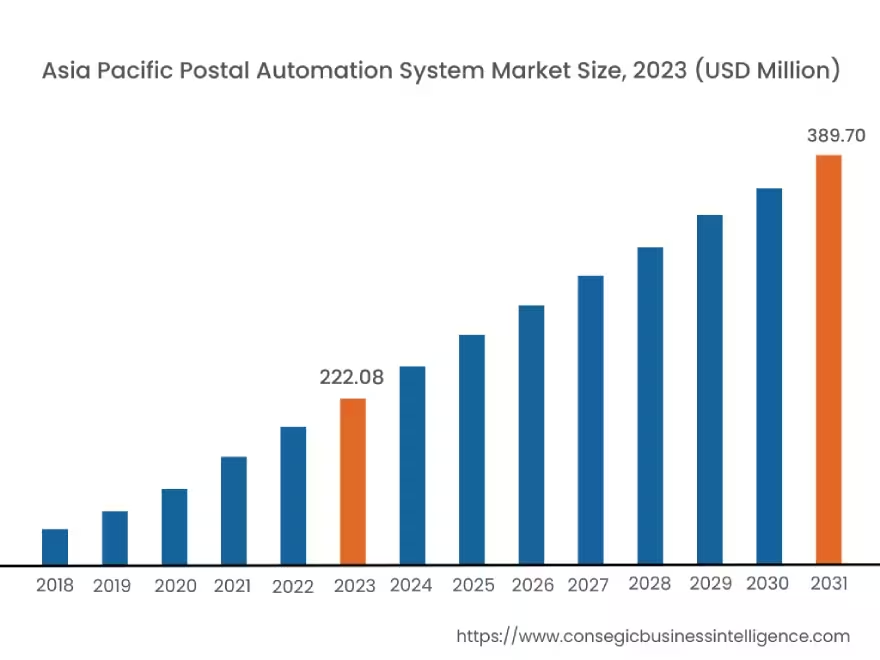
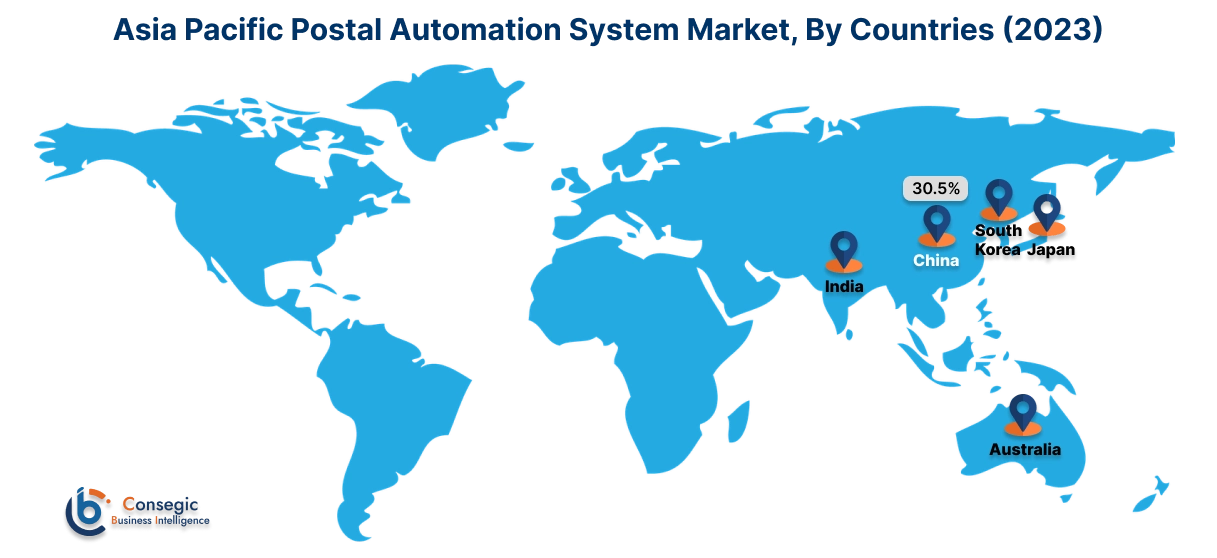
Asia Pacific region was valued at USD 222.08 Million in 2023. Moreover, it is projected to grow by USD 234.05 Million in 2024 and reach over USD 389.70 Million by 2031. Out of this, China accounted for the maximum revenue share of 30.5%. According to the postal automation system market analysis is poised to dominate the market in the future, driven primarily by the rapid growth of e-commerce and significant government investments in modernizing logistics infrastructure. Countries including China, India, and Japan are witnessing a surge in online shopping which has increased the volume of parcels that postal services need to process.
In June 2023, JD Logistics launched phase 2 of its Kunshan Asia No.1 Intelligent Logistics Park in Jiangsu province, China. The center is equipped with cutting-edge integrated warehousing and sorting capabilities with 4.5 million parcels per day. It utilizes machine learning algorithms and robotics to optimize parcel sorting and distribution, aiming to reduce delivery times and increase efficiency.
North America is estimated to reach over USD 495.60 Million by 2031 from a value of USD 290.87 Million in 2023 and is projected to grow by USD 305.78 Million in 2024. North American region, particularly the United States and Canada, leads in the adoption of advanced postal automation systems. The region's focus on technological innovation and rapid expansion of E-commerce has significantly increased the volume of parcels leading to a greater need for automated sorting and processing systems. This combination of technological advancement and strong e-commerce has positioned North America as the leading region in the global postal automation system market.
- In June 2021, Pitney Bowes (US) introduced ParcelPoint Smart Lockers, an intelligent locker and parcel management solution, designed to automate package delivery. These lockers use advanced software to manage and track parcels, offering secure, contactless pickup options for consumers.
Europe is a significant player in the postal automation system market fueled by enhanced logistics infrastructure and the increasing demand for efficient parcel delivery services.
The Middle East and Africa region is witnessing gradual growth in the postal automation system market, propelled by the increasing modernization of postal services and rising E-commerce.
Latin America is emerging in the postal automation system market due to the growth of e-commerce and the need to modernize logistics across the region. Countries including Brazil, Mexico, and Argentina are witnessing significant growth in online shopping creating new opportunities for industry.
Top Key Players & Market Share Insights:
The postal automation system market is highly competitive with major players providing parcel automation to the national and international markets. Key players are adopting several strategies in research and development (R&D), product innovation, and end-user launches to hold a strong position in the postal automation system market. Key players in the postal automation system industry include-
- Honeywell International Inc. (US)
- Dematic (US)
- Fluence Automation (US)
- Siemens (Germany)
- NEC Corporation (Japan)
- Zebra Technologies (US)
- Toshiba Corporation (Japan)
- Beumer Group (Germany)
- Interroll (Germany)
- Vanderlande Industries (Netherland)
- SOLYSTIC (France)
- Opex Corporation (US)
Recent Industry Developments :
Product Launches:
- In March 2024, Fortna launched the OptiSweep robotic solution, designed to enhance parcel handling and sorting efficiency in distribution centers. This cutting-edge technology incorporates advanced robotics and AI to automate the sorting of packages, aiming to improve operational speed and accuracy.
- In March 2024, Pitney Bowes unveiled a series of enhanced tracking and return capabilities. These new features are designed to provide more robust tracking solutions and streamline the return process for retailers and e-commerce businesses.
Business Expansion:
- In October 2023, Amazon announced the expansion of its automated fulfillment centers, incorporating an advanced sorting and packaging system. These facilitate robotics and automation technology to handle a large volume of orders efficiently.
Postal Automation System Market Report Insights :
| Report Attributes | Report Details |
| Study Timeline | 2021-2034 |
| Market Size in 2034 | USD 1,126.01 Million |
| CAGR (2026-2034) | 6.90% |
| Base Year | 2025 |
| By Technology |
|
| By Component |
|
| By End-User |
|
| By Region |
|
| Key Players |
|
| North America | U.S. Canada Mexico |
| Europe | U.K. Germany France Spain Italy Russia Benelux Rest of Europe |
| APAC | China South Korea Japan India Australia ASEAN Rest of Asia-Pacific |
| Middle East and Africa | GCC Turkey South Africa Rest of MEA |
| LATAM | Brazil Argentina Chile Rest of LATAM |
| Report Coverage |
|
Key Questions Answered in the Report
What is a postal automation system? −
Postal automation systems refer to the use of technology and machinery to streamline and optimize the processing, sorting, and delivery of mail and parcels. These systems are crucial for postal services to handle the large volume of mail and packages efficiently, ensuring timely delivery and reducing human error.
How big is the postal automation system market? +
Postal Automation System Market size is estimated to reach over USD 1,500.00 Million by 2031 from a value of USD 876.46 Million in 2023 and is projected to grow by USD 921.74 Million in 2024, growing at a CAGR of 6.9% from 2024 to 2031.
What is the key market trend? +
The shift towards cloud-based solutions and software-as-a-service models is a prominent trend. It offers greater scalability, flexibility, and ease of integration with other systems.
Who are the major players in the postal automation system market? +
The key players in the postal automation system market are Honeywell International Inc. (US), Pitney Bowes Inc. (US), Toshiba Corporation (Japan), Dematic (US), Fluence Automation (US), Siemens (Germany), NEC Corporation (Japan), Beumer Group (Germany), Interroll (Germany), Vanderlande Industries (Netherland), SOLYSTIC (France), Opex Corporation (US), Zebra Technologies (US) and others.
Overview
Reputation & Certifications


Our Services
- Market Intelligence & Forecasting
- Custom Research Solutions
- Market Entry Strategy
- Competitive Intelligence
- Customer Insights
- Industry Innovation Analysis
- Investment Advisory