Jump to Content
Probiotic Ingredients Market - Size, Share, Industry Trends, and Forecasts (2025-2035)
Probiotic Ingredients Market 2025 - 2035:
- The Global Probiotic Ingredients Market stood at USD 3.17 billion in 2025.
- The market is anticipated to expand at a CAGR of 8.52% from 2025 to 2035.
- The global market is projected to reach USD 7.18 billion by 2035.
- Asia Pacific accounted for the largest share of the Probiotic Ingredients Market in 2024.
Market Scope & Overview:
Probiotic ingredients are live microorganisms added to food products, beverages, dietary supplements, and pharmaceutical products to promote digestive health and overall well-being. Probiotic microorganisms include various types of Lactobacillus, Bifidobacterium, and Saccharomyces. Probiotic ingredients are commonly used in various food products, dairy products, dietary supplements, and infant nutrition products.
The growth of the probiotic market is attributed to the increasing awareness of the health benefits of probiotic microorganisms and the need for preventive healthcare. The increasing demand for functional foods and dietary supplements is also contributing to the growth of the probiotic market. Advances in microbial research and development are also contributing to the growth of the probiotic market.
Market Size & Forecast
- 2024 Market Size: USD 2.92 Billion
- 2025 Market Size: USD 3.17 Billion
- 2035 Projected Market Size: USD 7.18 Billion
- CAGR (2025–2035): 8.52%
- Largest Market in 2025: Asia Pacific
How are Tariffs Impacting the Probiotic Ingredients Market?
Tariffs on imported fermentation equipment, microbial cultures, and raw materials have increased production costs for probiotic ingredient manufacturers. In addition, trade barriers for food and nutraceutical ingredients have impacted cross-border supply chains and export market competitiveness. Additionally, tariffs on dietary supplement components have affected pricing strategies and product sourcing decisions. Further, changing trade policies will support regionalized supply of probiotic strains and manufacturing inputs, thereby changing supply chain strategies and investment plans for the probiotic ingredients market.

Market Dynamics - (DRO):
Key Drivers:
Rising digestive health disorders driving demand for probiotic ingredients
The probiotic ingredients market is growing, driven by the rising incidence of digestive health disorders worldwide. Digestive health disorders, including irritable bowel syndrome, inflammatory bowel disease, and other gastrointestinal disorders, are becoming increasingly prevalent, driven by changes in dietary habits, stress, and lifestyle factors.
- For example, according to the National Institutes of Health (NIH), irritable bowel syndrome affects about 10–15% of adults in the United States, highlighting the growing prevalence of digestive health conditions.
Therefore, digestive health concerns are creating a need for probiotic ingredients.
Key Restraints:
Stability issues and strict regulatory requirements are restraining the market growth
Probiotic ingredients include live microorganisms, and they are sensitive to temperature, moisture, and processing conditions. Therefore, it is challenging to ensure stability in the production, storage, and transportation of probiotic ingredients. This can affect product shelf life and effectiveness. Regulatory approval for probiotic products is also strict in several countries. Companies must provide scientific evidence for safety and health claims. The approval process takes time and increases development costs.
Therefore, stability challenges and regulatory requirements are restraining the probiotic ingredients market expansion.
Future Opportunities:
Adoption of clinically tested multi-strain probiotic formulations creates new growth opportunities for the market
The rising consumer demand for digestive health products is creating new growth opportunities in the probiotic ingredients market. Food, supplement, and nutraceutical companies are increasingly using clinically validated probiotic strains to develop targeted health products. The multi-strain probiotic formulation helps to improve the efficacy of gut health and enables manufacturers to create differentiation in functional food and supplement products.
- For example, in December 2024, BioGaia has introduced BioGaia Gastrus PURE ACTION, a probiotic formulation with the patented strains of L. reuteri DSM 17938 and L. reuteri ATCC PTA 6475, for supporting digestive health and reducing discomfort associated with the gut.
Therefore, the clinically tested multi-strain probiotic formulation is expected to create new product innovation and application development.
Market Segmental Analysis:
By Ingredient Type:
Based on ingredient type, the probiotic ingredients market is segmented into bacteria and yeast.
Trends in the Ingredient Type:
- The growing consumer interest in digestive health is boosting the market for probiotic bacteria.
- The growing use of probiotic formulations in dietary supplements and functional foods is supporting market expansion.
Bacteria accounted for the largest revenue share in the year 2024.
- Bacterial strains such as Lactobacillus and Bifidobacterium are commonly used as probiotics. These bacteria support gut health.
- The bacteria support balanced gut microbiota, which is important for digestion and immunity.
- In addition, growing consumption of probiotic dairy foods and supplements is contributing to segment growth.
- Furthermore, the availability of substantial clinical data on bacterial probiotics is boosting the market.
- Thus, as per the probiotic ingredients market analysis, high use in food and supplement products is driving dominance of bacterial ingredients.
Yeast is anticipated to register the fastest CAGR during the forecast period.
- Probiotic yeast such as Saccharomyces boulardii is used in digestive health supplements. It helps prevent gastrointestinal disorders.
- These yeast strains are stable under various processing conditions. This improves product shelf life.
- Additionally, increasing research on yeast-based probiotics is supporting segment growth.
- Further, rising demand for alternative probiotic strains is accelerating adoption.
- Therefore, as per the market analysis, expanding research and product innovation are expected to boost the yeast segment during the forecast period.
By Form:
Based on form, the probiotic ingredients market is segmented into powder and liquid.
Trends in the Form:
- The increasing demand for stable probiotic formulations is driving the use of powdered ingredients.
- The growing consumption of probiotic beverages is supporting demand for liquid formulations.
Powder accounted for the largest revenue share in the year 2024.
- Powdered probiotics are widely used in dietary supplements and functional foods. They offer longer shelf life.
- These formulations are easier to transport and store. This supports large-scale production.
- Additionally, powdered probiotics are commonly used in capsules, tablets, and sachets.
- Further, increasing demand for probiotic supplements is boosting segment growth.
- Thus, as per the probiotic ingredients market analysis, stability and ease of formulation are driving dominance of powdered probiotics.
Liquid is anticipated to register the fastest CAGR during the forecast period.
- Liquid probiotics are used in beverages and liquid dietary supplements. They support convenient consumption.
- These formulations allow faster absorption in the digestive system.
- Moreover, the increasing demand for probiotic drinks and functional beverages is also boosting the segment’s growth.
- Further, the increasing demand for ready-to-consume health products is also boosting the demand for probiotics.
- Therefore, as per the market analysis, growing popularity of probiotic beverages is expected to boost the liquid segment during the forecast period.
By Application:
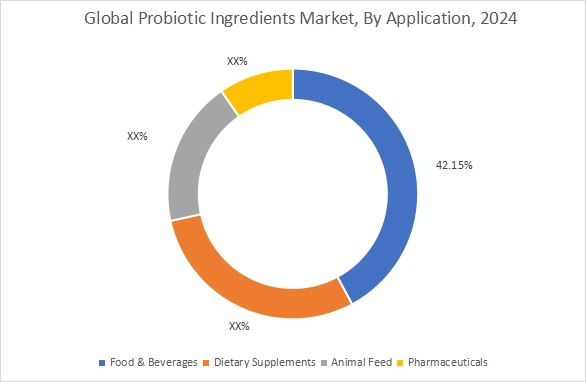
Based on application, the probiotic ingredients market is segmented into food & beverages, dietary supplements, animal feed, and pharmaceuticals.
Trends in the Application:
- The increasing demand for functional foods is boosting the demand for probiotics in the food and beverages sector.
- The increasing demand for preventive healthcare is boosting the demand for probiotic dietary supplements.
Food & Beverages accounted for the largest revenue share of 42.15% in the year 2024.
- Probiotic ingredients are widely used in yogurt, fermented milk, and functional beverages. They support digestive health.
- These products help maintain healthy gut microbiota. This improves overall wellness.
- Moreover, increasing consumer awareness of the importance of gut health is boosting the segment’s growth.
- Further, the increasing demand for fortified and functional food products is boosting the demand for probiotics.
- Thus, as per the probiotic ingredients market analysis, strong demand for functional food products is driving dominance of the food & beverages segment.
Dietary Supplements are anticipated to register the fastest CAGR during the forecast period.
- Probiotic supplements are used to improve digestive balance and immune function. They are available in capsules and tablets.
- Consumers prefer supplements for convenient daily intake. This supports segment growth.
- Additionally, rising health awareness is increasing supplement consumption.
- Further, expanding product availability through online and retail channels is accelerating adoption.
- Therefore, as per the market analysis, increasing focus on preventive healthcare is expected to boost the dietary supplements segment during the forecast period.
Regional Analysis:
North America, Europe, Asia Pacific, the Middle East and Africa, and Latin America are the regions of coverage.
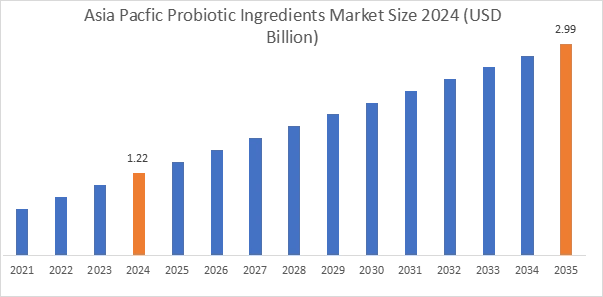
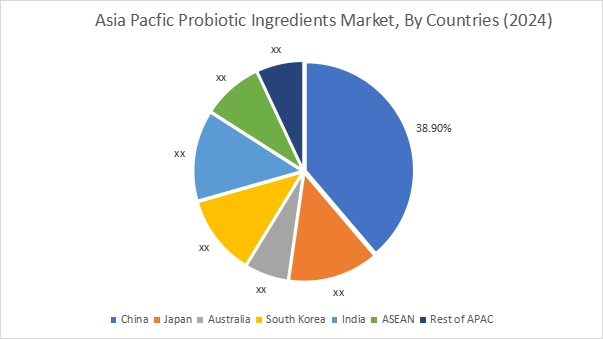
In 2024, Asia Pacific accounted for the highest market share at 41.70% and was valued at USD 1.22 Billion, and is expected to reach USD 2.99 Billion by 2035. In Asia Pacific, China accounted for the highest market share of 38.90% during the base year of 2024. The growth of the Asia Pacific probiotic ingredients market is driven by the consumption of functional foods, the growth of the dairy processing industry, and the increasing awareness of the health benefits of probiotic products in the region, covering countries such as China, Japan, South Korea, and India. Probiotic food and beverage manufacturers are using probiotic microorganisms in products such as yogurt, fermented beverages, and dietary supplements to meet the growing need for probiotic products for gut health.
- For instance, a study published in the Cambridge University Journal of Dairy Research noted that the growth of the dairy industry in Asian countries, including India and China, is driven by the growth in population and the urbanization of the population in the region. Expansion of dairy production and fermented dairy consumption is increasing the use of probiotic cultures in functional food products across the region.
In North America, the probiotic ingredients market is experiencing the fastest growth over the forecast period. North America probiotic ingredients market growth is supported by strong demand for dietary supplements, expanding functional food categories, and increasing consumer focus on digestive and immune health in the United States and Canada. The food industry and nutraceutical companies are adding probiotics to capsules, drinks, and other foods to meet the increasing demand for preventive healthcare, thus fueling market growth.
- For example, according to the S. Centers for Disease Control and Prevention, 57.6% of U.S. adult citizens have taken at least one dietary supplement in the last 30 days, which indicates that there is a huge market for health supplements in North America.
The probiotic ingredients market in Europe is fueled by initiatives for the automotive industry’s light weighting, sustainable packaging, and recycling in Germany, France, and Italy.
Latin America probiotic ingredients market growth is supported by expansion of the dairy processing industry and increasing consumption of yogurt and fermented beverages in Brazil and Argentina.
Middle East & Africa probiotic ingredients market growth is supported by growing functional food consumption and expanding food processing sectors in the UAE, Saudi Arabia, and South Africa.
Top Key Players & Market Share Insights:
The global probiotic ingredients market is highly competitive, with major biotechnology, nutrition, and food ingredient companies supplying probiotic cultures and microbiome-based solutions to domestic and international markets. Key players are adopting several strategies in research and development, strain innovation, strategic collaborations, and new product launches to maintain a strong position in the probiotic ingredients industry. The key players operating in the probiotic ingredients market are:
- Novozymes A/S (Denmark)
- Danone S.A. (France)
- DSM-Firmenich (Netherlands)
- Nestlé S.A. (Switzerland)
- Lallemand Inc. (Canada)
- Probi AB (Sweden)
- Kerry Group plc (Ireland)
- BioGaia AB (Sweden)
- Yakult Honsha Co., Ltd. (Japan)
- DuPont de Nemours, Inc. (U.S.)
Recent Industry Developments:
- In April 2025, dsm-firmenich launched new nutrition and gut health solutions at Vitafoods Europe 2025, including the latest microbiome and probiotic ingredients. This is an expansion of the company’s portfolio of scientifically backed probiotic and microbiome-targeted nutritional ingredients.
- In May 2024, Lallemand Health and dsm-firmenich have announced new synbiotic solutions that are blends of human milk oligosaccharides and probiotics to support early-life nutrition and the development of the microbiome in infants. This is an expansion of the clinically backed probiotic ingredients used in functional nutrition products.
Probiotic Ingredients Market Report Insights:
| Report Attributes | Report Details |
|---|---|
| Study Timeline | 2019-2035 |
| Market Size in 2035 (USD Billion) | USD 7.18 Billion |
| CAGR (2025-2035) | 8.52% |
| By Ingredient Type |
|
| By Form |
|
| By Application |
|
| By Region |
|
| Key Players |
|
| Report Coverage |
|
Key Questions Answered in the Report
How big is the probiotic ingredients market? −
The probiotic ingredients market size is estimated to reach over USD 7.18 Billion by 2035 from a value of USD 2.92 Billion in 2024 and is projected to grow by USD 3.17 Billion in 2025, growing at a CAGR of 8.52% from 2025 to 2035.
Which segmentation details are covered in the probiotic ingredients report? +
The probiotic ingredients report includes specific segmentation details for ingredient type, form, application, and regions.
Which is the fastest segment anticipated to impact the market growth? +
In the probiotic ingredients market, the dietary supplements application segment is anticipated to be the fastest-growing segment during the forecast period due to increasing consumer awareness regarding gut health.
Who are the major players in the probiotic ingredients market? +
The key participants in the probiotic ingredients market are Novozymes A/S (Denmark), Danone S.A. (France), DSM-Firmenich (Netherlands), Nestlé S.A. (Switzerland), Lallemand Inc. (Canada), Probi AB (Sweden), Kerry Group plc (Ireland), BioGaia AB (Sweden), Yakult Honsha Co., Ltd. (Japan), DuPont de Nemours, Inc. (U.S.), and others.
What are the key trends in the probiotic ingredients market? +
The probiotic ingredients market is being shaped by several key trends including increasing demand for functional foods and beverages, growing focus on digestive and immune health, and rising adoption of probiotics in personalized nutrition and health supplements.
Overview
Reputation & Certifications


Our Services
- Market Intelligence & Forecasting
- Custom Research Solutions
- Market Entry Strategy
- Competitive Intelligence
- Customer Insights
- Industry Innovation Analysis
- Investment Advisory