Jump to Content
Protective Relay Market - Size, Share, Industry Trends, and Forecasts (2025-2032)
Protective Relay Market Size:
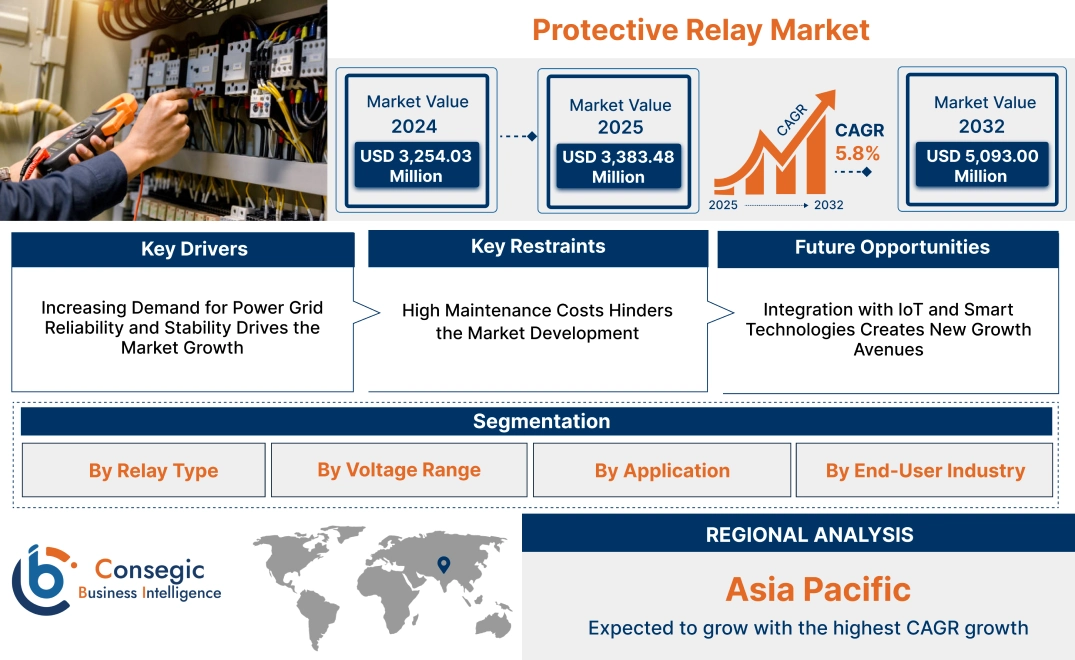
Protective Relay Market size is estimated to reach over USD 5,093.00 Million by 2032 from a value of USD 3,254.03 Million in 2024 and is projected to grow by USD 3,383.48 Million in 2025, growing at a CAGR of 5.8% from 2025 to 2032.
Protective Relay Market Scope & Overview:
A protective relay is a device used in electrical power systems to detect faults and abnormal conditions, ensuring system safety by triggering circuit breakers to isolate affected sections. These devices play a critical role in maintaining the reliability and stability of power generation, transmission, and distribution networks.
Available in various types such as electromechanical, digital, and microprocessor-based models, they are equipped with advanced functionalities for precise fault detection and response. Protective devices are designed to provide real-time monitoring, ensuring quick action to minimize damage and downtime during electrical disturbances.
End-users include utility companies, industrial plants, and infrastructure operators who prioritize safety and efficiency in power systems. These devices are essential for modern power networks, enhancing operational reliability and safeguarding equipment.
Protective Relay Market Dynamics - (DRO) :
Key Drivers:
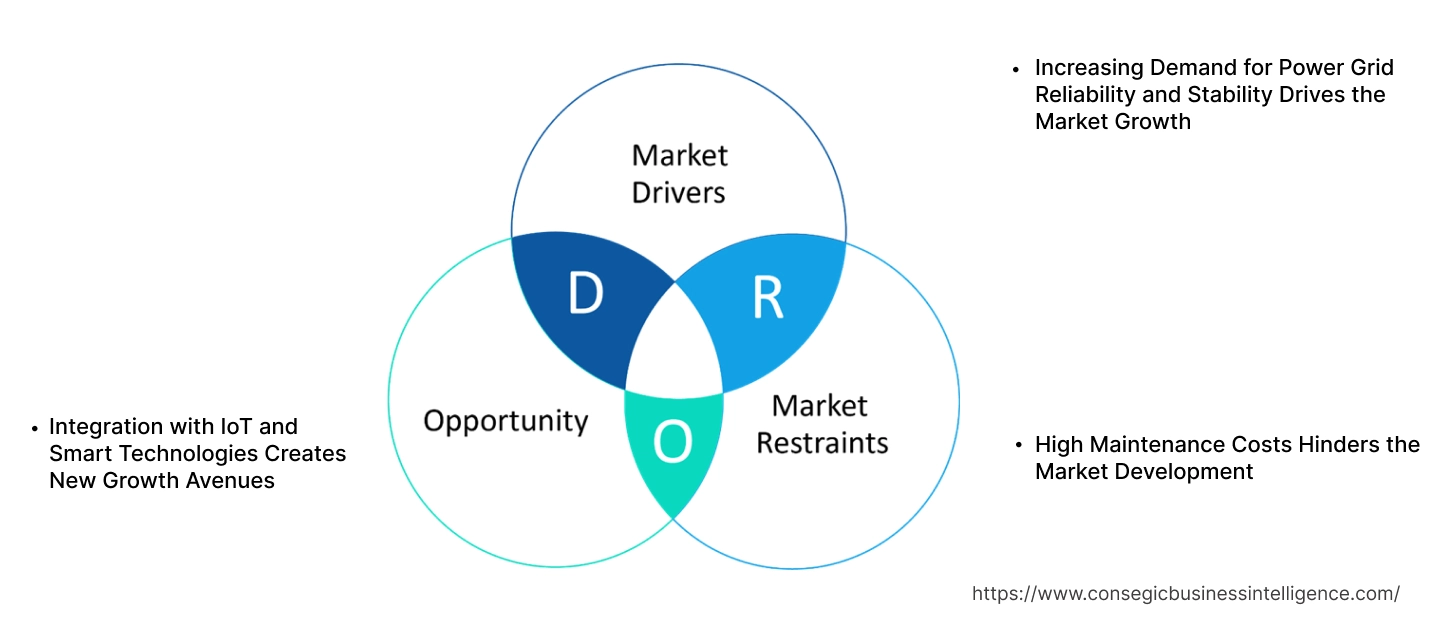
Increasing Demand for Power Grid Reliability and Stability Drives the Market Growth
The increasing need for reliable and stable power supply across industries is driving the demand for advanced fault detection and protection systems in power grids. As industries become more dependent on consistent power, any disruption leads to significant financial losses and operational inefficiencies. These systems play a vital role in monitoring the grid, identifying faults, and responding quickly to prevent system failures. By isolating faulty sections of the grid, they ensure that power continues to flow smoothly to unaffected areas, minimizing downtime. This capability is crucial in preventing widespread outages and maintaining the overall stability of the grid. As the complexity of power networks increases with the integration of renewable energy sources and smart grid technologies, the need for efficient and reliable protection solutions becomes even more critical to ensure uninterrupted power distribution and grid reliability. Thus, the above factors are driving the protective relay market growth.
Key Restraints:
High Maintenance Costs Hinders the Market Development
Protection systems require regular inspections, calibration, and occasional repairs to ensure they operate efficiently and reliably. The need for specialized technicians to perform these tasks adds to the overall expense. Furthermore, as systems age or when new technology is introduced, retrofitting or upgrading existing infrastructure is necessary, further increasing costs. The ongoing maintenance requirements, including software updates and the replacement of worn-out components, make the long-term operational cost quite high. This deters smaller companies or those with budget constraints from adopting or maintaining advanced protection systems, limiting the protective relay market demand, especially in cost-sensitive industries or regions with limited resources.
Future Opportunities :
Integration with IoT and Smart Technologies Creates New Growth Avenues
The integration of fault detection systems with the Internet of Things (IoT) and smart technologies offers significant opportunities for enhancing power grid management. By incorporating IoT devices, real-time data collection allows utilities to monitor grid performance continuously, identify potential faults early, and respond proactively. This integration enables remote monitoring, so grid operators diagnose and address issues without being physically present, improving efficiency and reducing downtime. Automated fault detection systems, combined with smart technologies, optimize the flow of electricity, minimize energy losses, and prevent widespread outages. Additionally, these systems help improve grid resilience by adapting to changing conditions and load demands. As the need for more efficient, flexible, and reliable power systems grows, integrating IoT and smart technologies into fault detection systems presents a valuable solution for optimizing energy distribution and ensuring a stable power supply. This trend is expected to drive protective relay market opportunities as the grid becomes more advanced and interconnected.
Protective Relay Market Segmental Analysis :
By Relay Type:
Based on relay type, the market is segmented into electromechanical relays, microprocessor relays, digital relays, and numerical relays.
The numerical relays segment accounted for the largest revenue of the total protective relay market share in 2024.
- Numerical relays are widely adopted due to their advanced features, such as multi-functionality, self-diagnostics, and remote communication capabilities, making them essential for modern energy systems.
- These relays are highly valued in applications requiring precise fault detection, real-time monitoring, and efficient fault isolation, particularly in large-scale industrial and power generation facilities.
- Continuous advancements in communication protocols, including IEC 61850, have enhanced the integration of numerical relays into smart grids and digital substations.
- As per protective relay market analysis, numerical relays offer superior reliability and operational efficiency, supporting their widespread adoption in utilities and industrial sectors.
The electromechanical relays segment is expected to maintain steady adoption.
- Electromechanical relays are preferred for their robustness and simplicity in applications requiring basic protection functions, particularly in older electrical systems.
- Their cost-effectiveness and reliability in harsh environments make them a preferred choice in industries like oil & gas and heavy manufacturing.
- Despite being overshadowed by digital and numerical relays, electromechanical relays remain relevant for specific applications where advanced features are not required.
- The durability and long operational life of these relays ensure their continued use in legacy systems across developing regions, contributing to the protective relay market expansion.
By Voltage Range:
Based on voltage range, the market is segmented into low voltage (0-1kV), medium voltage (1-35kV), and high voltage (above 35kV).
The medium voltage (1-35kV) segment accounted for the largest revenue of the total protective relay market share in 2024.
- Medium voltage protective relays are critical for safeguarding transformers, motors, and other equipment in industrial and utility applications.
- Their adoption is supported by the widespread use of medium voltage systems in commercial and industrial facilities requiring stable and efficient power distribution.
- Increasing trends toward the modernization of power infrastructure, including the deployment of smart grids, drive the integration of medium voltage relays.
- As per the protective relay market trends, the versatility of medium voltage relays in handling both feeder and transformer protection enhances their significance in diverse end-use industries.
The high voltage (above 35kV) segment is anticipated to grow steadily during the forecast period.
- High voltage protective relays play a vital role in safeguarding transmission systems and large-scale power generation facilities, where operational reliability is critical.
- The expansion of renewable energy projects, including wind and solar farms, has increased the need for high voltage relay systems to ensure grid stability and fault management.
- Advancements in high voltage relay technology, such as real-time fault analysis and adaptive protection features, support their adoption in modern energy networks.
- Increasing investments in high voltage transmission infrastructure, particularly in developing regions, further bolster the protective relay market demand.
By Application:
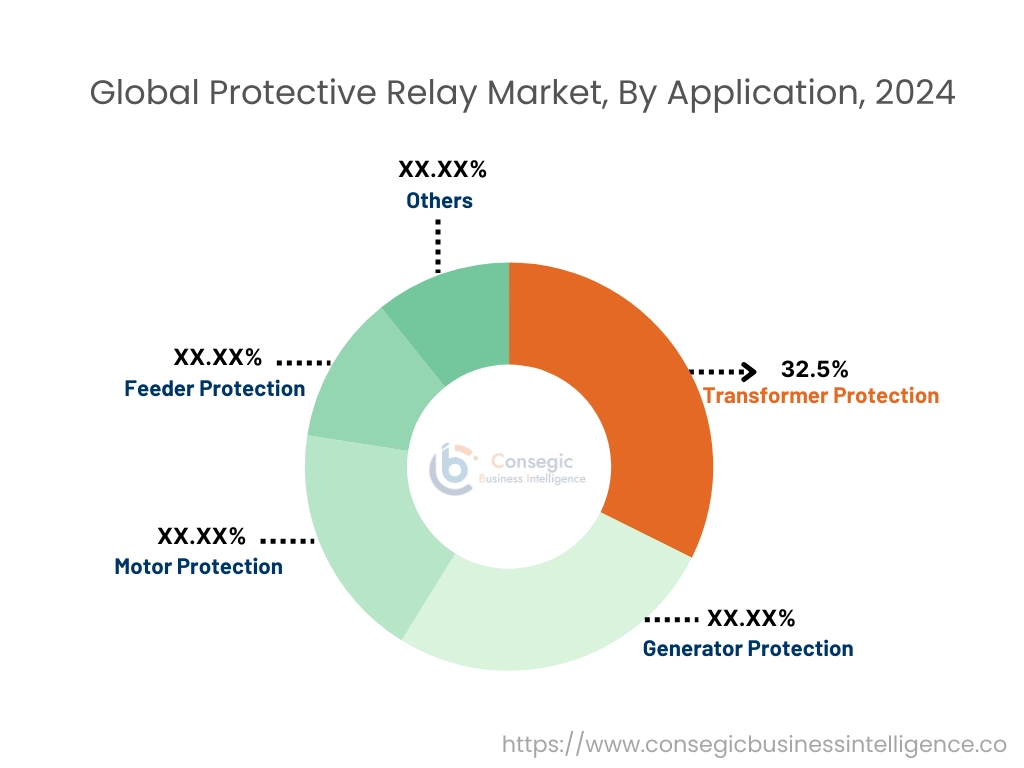
Based on application, the market is segmented into generator protection, transformer protection, motor protection, feeder protection, and others.
The transformer protection segment accounted for the largest revenue of 32.5% share in 2024.
- Protective relays are essential for transformer protection to prevent damages caused by overloading, short circuits, and insulation failures.
- The increasing deployment of transformers in renewable energy systems, such as solar and wind farms, has driven the requirement for advanced relay systems with enhanced fault detection capabilities.
- Advanced transformer protection relays are integrated with digital technologies, enabling real-time monitoring and predictive maintenance to improve operational efficiency.
- The rising trend of deploying digital substations and the adoption of smart transformers support the growth of transformer protection applications, driving the protective relay market growth.
The motor protection segment is projected to grow steadily during the forecast period.
- Motor protection relays are widely used in industrial manufacturing to safeguard motors from faults such as phase imbalances, overloading, and overheating.
- Industries such as oil & gas, mining, and water treatment heavily rely on motor protection relays to ensure the smooth operation of critical equipment.
- Advancements in motor relay technology, including IoT-enabled monitoring and diagnostic features, enhance their application in predictive maintenance systems.
- As per protective relay market trends, the growth in focus on energy efficiency and asset reliability in industrial operations drives the demand for motor protection relays.
By End User Industry:
Based on end-user industry, the market is segmented into energy & power, oil & gas, industrial manufacturing, and others.
The energy & power segment accounted for the largest revenue share in 2024.
- Protective relays are extensively used in the energy & power sector for safeguarding power generation, transmission, and distribution systems.
- The ongoing modernization of energy infrastructure, including the deployment of smart grids and digital substations, drives the adoption of advanced relay systems.
- The integration of renewable energy sources, such as solar and wind, into existing power grids has increased the need for reliable relay systems to manage faults and ensure grid stability.
- As per protective relay market analysis, the energy & power sector benefits from regulatory mandates focused on improving energy efficiency and reliability.
The oil & gas segment is anticipated to grow steadily during the forecast period.
- The oil & gas industry relies on protective relays to ensure the safety and reliability of critical equipment, such as pumps, compressors, and generators.
- Harsh operating environments and the need to prevent downtime drive the adoption of advanced relay systems with real-time monitoring and fault isolation capabilities.
- Increasing exploration and production activities, particularly in offshore locations, further support the need for robust relay systems.
- Thus, the focus on operational safety and the adoption of digital technologies in the oil & gas sector fuels the protective relay market expansion.
Regional Analysis:
The regions covered are North America, Europe, Asia Pacific, the Middle East and Africa, and Latin America.
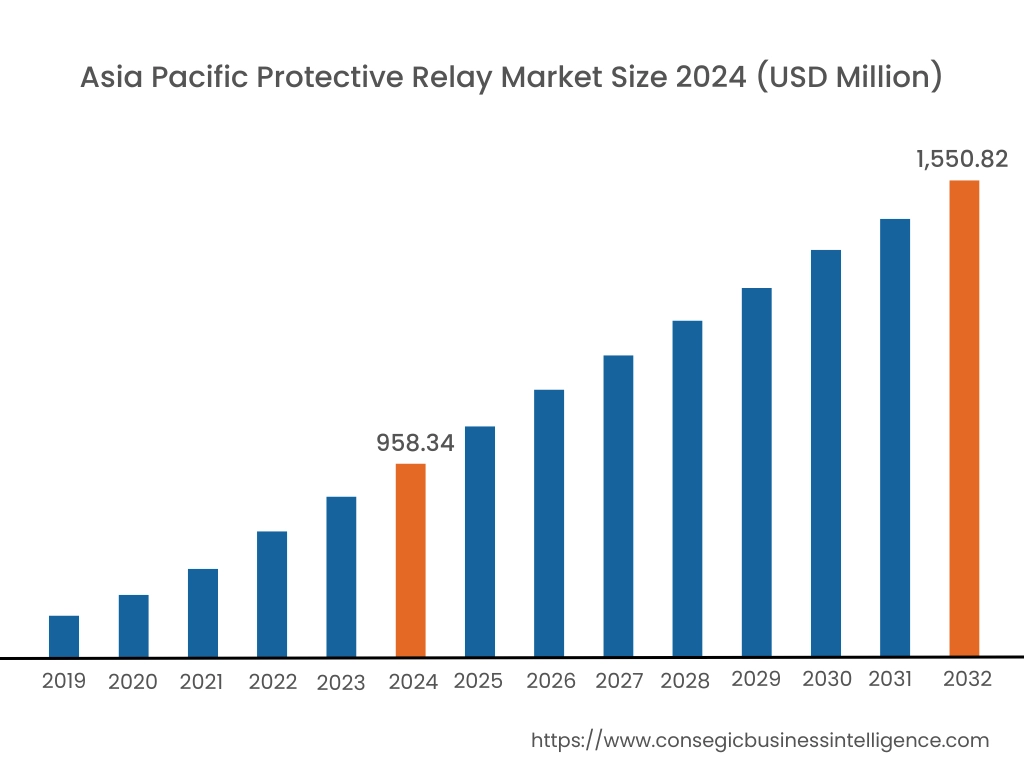
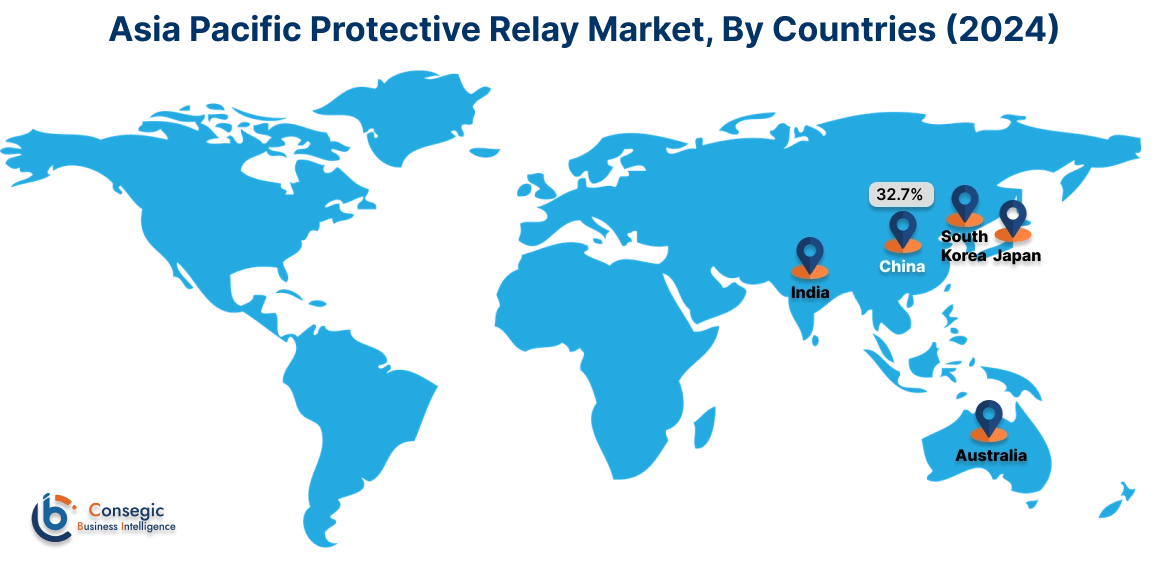
Asia Pacific region was valued at USD 958.34 Million in 2024. Moreover, it is projected to grow by USD 999.28 Million in 2025 and reach over USD 1,550.82 Million by 2032. Out of this, China accounted for the maximum revenue share of 32.7%. The Asia-Pacific region dominates the protective relay market, attributed to rapid industrialization and urbanization leading to increased energy consumption. A prominent trend is the expansion of transmission and distribution networks to accommodate the rising electricity demand. Analysis indicates that government initiatives promoting infrastructure development and investments in power generation are contributing to protective relay market opportunities in this region.
North America is estimated to reach over USD 1,650.64 Million by 2032 from a value of USD 1,079.39 Million in 2024 and is projected to grow by USD 1,120.18 Million in 2025. This region holds a prominent position in the protective relay sector, driven by substantial investments in grid modernization to enhance power infrastructure reliability, efficiency, and security. A notable trend is the deployment of advanced protective relay technologies to monitor and control power flow, detect faults, and improve grid resilience. Analysis indicates that the emphasis on maintaining a resilient and reliable power supply is a key factor influencing market dynamics in North America.
European countries are pivotal in the protective relay market, focusing on integrating renewable energy sources into the power grid. A significant trend is the development of smart grid technologies that require advanced relays to ensure grid stability and reliability. Analysis suggests that the focus on reducing carbon emissions and enhancing energy efficiency is driving the adoption of these relays in this region.
In the Middle East and Africa, the protective relay market is influenced by the adoption of advanced technologies to support infrastructure development and industrial diversification. The focus is on utilizing relays in energy-efficient solutions and smart building applications. Analysis suggests that collaborations with international technology providers are facilitating the transfer of knowledge and expertise, aiding in the establishment of local manufacturing capabilities.
Latin American countries are increasingly recognizing the importance of protective relays in enhancing the reliability and safety of power systems. A notable trend is the modernization of existing power infrastructure to reduce transmission losses and improve efficiency. Analysis indicates that economic development and the pursuit of sustainable energy solutions are key factors influencing the market growth in this region.
Top Key Players and Market Share Insights:
The Protective Relay market is highly competitive with major players providing products and services to the national and international markets. Key players are adopting several strategies in research and development (R&D), product innovation, and end-user launches to hold a strong position in the global Protective Relay market. Key players in the Protective Relay industry include -
- ABB Ltd. (Switzerland)
- Siemens AG (Germany)
- Littelfuse, Inc. (USA)
- Toshiba Corporation (Japan)
- Rockwell Automation, Inc. (USA)
- General Electric Company (USA)
- Schneider Electric SE (France)
- Eaton Corporation plc (Ireland)
- Mitsubishi Electric Corporation (Japan)
- Schweitzer Engineering Laboratories, Inc. (USA)
Recent Industry Developments :
Product Launches:
- In January 2025, AutomationDirect launched Dold VARIMETER series voltage and phase monitoring relays to protect electrical equipment from undervoltage, overvoltage, phase loss, and imbalance. These relays offer measuring ranges up to 250 VDC or 300 VAC, with easy single-turn switch configuration. Designed for single- and three-phase systems up to 525 VAC, select models provide advanced phase loss protection. Featuring a compact design, UL listing, CE marking, and RoHS compliance, these relays enhance system reliability and efficiency.
- In August 2024, Hitachi Energy launched the Relion REF650, a next-generation protection and control relay for medium-voltage power distribution. Designed for distribution automation, REF650 offers modular flexibility, enhanced security, and an intuitive touchscreen interface. It is IEC 61850 Ed 2.1 certified, ensuring interoperability across power systems. With a compact, scalable design, simplified engineering, and modular hardware, REF650 improves grid reliability while reducing operational costs.
Protective Relay Market Report Insights :
| Report Attributes | Report Details |
| Study Timeline | 2019-2032 |
| Market Size in 2032 | USD 5,093.00 Million |
| CAGR (2025-2032) | 5.8% |
| By Relay Type |
|
| By Voltage Range |
|
| By Application |
|
| By End User Industry |
|
| By Region |
|
| Key Players |
|
| North America | U.S. Canada Mexico |
| Europe | U.K. Germany France Spain Italy Russia Benelux Rest of Europe |
| APAC | China South Korea Japan India Australia ASEAN Rest of Asia-Pacific |
| Middle East and Africa | GCC Turkey South Africa Rest of MEA |
| LATAM | Brazil Argentina Chile Rest of LATAM |
| Report Coverage |
|
Key Questions Answered in the Report
What is the size of the Protective Relay Market? −
The Protective Relay Market size is estimated to reach over USD 5,093.00 Million by 2032 from a value of USD 3,254.03 Million in 2024 and is projected to grow by USD 3,383.48 Million in 2025, growing at a CAGR of 5.8% from 2025 to 2032.
What are the key segments in the Protective Relay Market? +
The market is segmented by relay type (electromechanical relays, microprocessor relays, digital relays, numerical relays), voltage range (low voltage, medium voltage, high voltage), application (generator protection, transformer protection, motor protection, feeder protection), and end-user industry (energy & power, oil & gas, industrial manufacturing).
Which segment is expected to grow the fastest in the Protective Relay Market? +
The transformer protection segment is expected to grow at the fastest CAGR during the forecast period, driven by the increasing deployment of transformers in renewable energy systems and the growing demand for advanced fault detection capabilities.
Who are the major players in the Protective Relay Market? +
Key players in the Protective Relay Market include ABB Ltd. (Switzerland), Siemens AG (Germany), General Electric Company (USA), Schneider Electric SE (France), Eaton Corporation plc (Ireland), Mitsubishi Electric Corporation (Japan), Schweitzer Engineering Laboratories, Inc. (USA), Littelfuse, Inc. (USA), Toshiba Corporation (Japan), Rockwell Automation, Inc. (USA).
Overview
Reputation & Certifications


Our Services
- Market Intelligence & Forecasting
- Custom Research Solutions
- Market Entry Strategy
- Competitive Intelligence
- Customer Insights
- Industry Innovation Analysis
- Investment Advisory