Jump to Content
RFID Market - Size, Share, Industry Trends, and Forecasts (2025-2032)
RFID Market Size:
RFID Market Size is estimated to reach over USD 35.93 Billion by 2032 from a value of USD 16.10 Billion in 2024 and is projected to grow by USD 17.52 Billion in 2025, growing at a CAGR of 11.7% from 2025 to 2032.
RFID Market Scope & Overview:
Radio frequency identification is a technology that uses radio waves to detect objects. The system consists of a tiny radio transponder called tag, a transmitter, and a radio receiver. RFID enables businesses to automatically identify and monitor their assets, products, or inventory in real-time, thus offering significant improvement over traditional barcode systems. This technology has widespread adoption across diverse sectors, from retail and healthcare to logistics and manufacturing, due to its ability to enhance operational efficiency, reduce manual errors, and streamline supply chain processes.
How is AI Transforming the RFID Market?
AI algorithms improves overall data reliability by cross-verify and correcting inconsistent data generated by RFID systems,. Also, AI analyzes historical RFID data to forecast demand, predict potential supply chain disruptions or asset failures, and identify consumption patterns. Further, AI processes vast amounts of RFID data rapidly, enabling swift, informed, real-time decisions in dynamic environments like manufacturing and healthcare. Furthermore, AI-powered RFID systems can control autonomous robots for tasks such as picking and dispatching products in warehouses, enhancing efficiency and reducing human error. Moreover, AI leverages RFID data for personalized marketing, improving customer satisfaction, and optimizing inventory based on sales patterns and regional data. Hence, the AI integration into RFID is driving adoption in retail, healthcare and logistics among others.

RFID Market Dynamics - (DRO) :
Key Drivers:
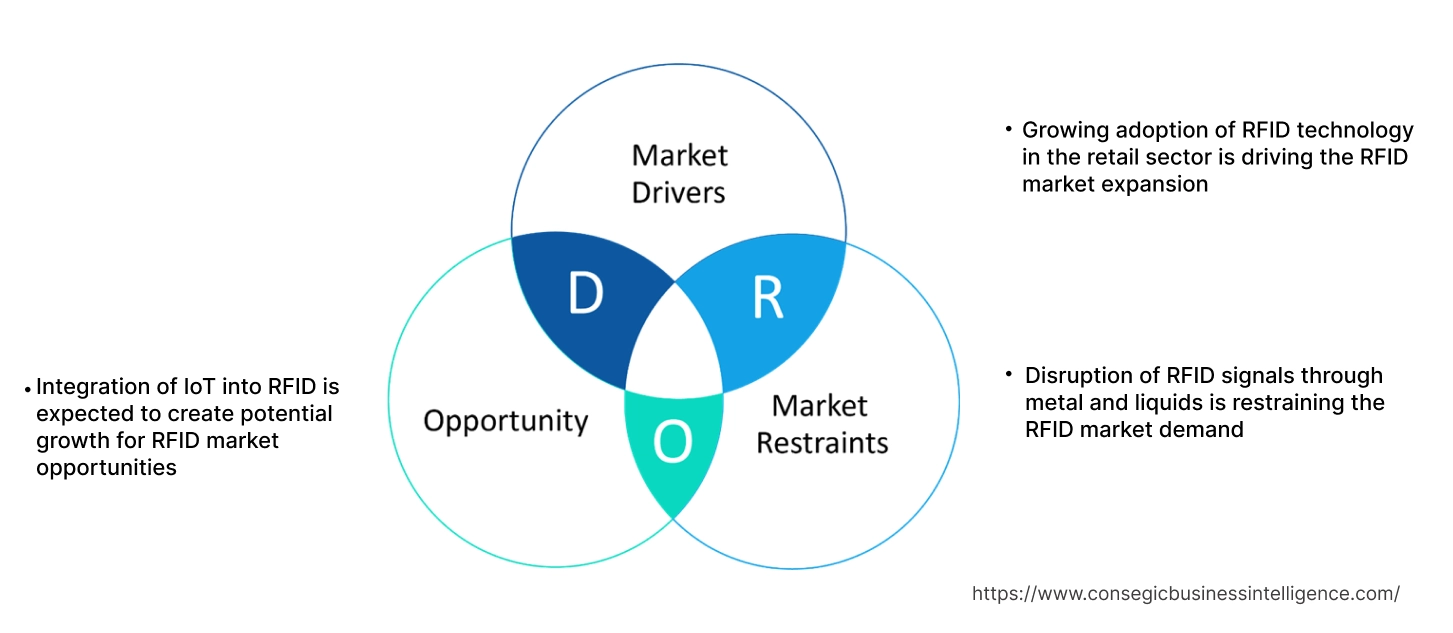
Growing adoption of RFID technology in the retail sector is driving the RFID market expansion
Retail stores are increasingly using radio frequency identification technology to improve and manage their products. By attaching tags and readers, retailers keep accurate track of the inventory, leading to better sales. Furthermore, RFID provides instant data that allows stores to offer personalized services and faster checkouts. As online shopping and the blending of online and in-store experiences become more common, radio frequency identification technology is becoming essential for retailers to effectively manage their inventory and supply chains.
- For instance, in July 2023, Beotang introduced a range of tags enabled with radio frequency identification technology using Impinj M800 series RAIN tag chips. These chips are designed with specialized antennas to retail applications.
Thus, on the above RFID market analysis, the adoption of radio frequency identification technology in retail applications is driving the RFID market size.
Key Restraints:
Disruption of RFID signals through metal and liquids is restraining the RFID market demand
Environmental factors such as metal surfaces and liquids block or distort signals causes interference that reduces the range of RFID systems, leading to scanning failures. Further, in large industrial units, radio frequency identification technology is required to operate in high temperature environments, such as manufacturing facilities, automotive units, and foundries. Traditional tags and readers are not able to withstand the extreme heat, and thermal fluctuations present in these environments, leading to reduced performance and potential failure.
Consequently, the aforementioned factors are hampering the RFID market size.
Future Opportunities :
Integration of IoT into RFID is expected to create potential growth for RFID market opportunities
The integration of RFID with the Internet of Things (IoT) presents a significant opportunity for market progression. IoT-enabled systems provide enhanced real- data analytics and time tracking, while improving decision-making and operational efficiency across industries. Additionally, the increasing trend of smart cities and automated supply chains, relies heavily on radio frequency identification technologies and IoT, is creating opportunities for market growth. As these technologies are continuously evolving, their combined application is expected to drive significant advancements and adoption.
- For instance, in February 2022, Identiv expanded its portfolio of near field communication-enabled detection tags for advanced IoT security. These tags have unique capabilities for advancing tamper detection, anti-counterfeiting, and provide battery less condition sensing features.
Thus, based on the above analysis, the growing integration of IoT-enabled RFID tags in smart cities and automated supply chains is expected to create potential opportunities.
RFID Market Segmental Analysis :
By Product Type:
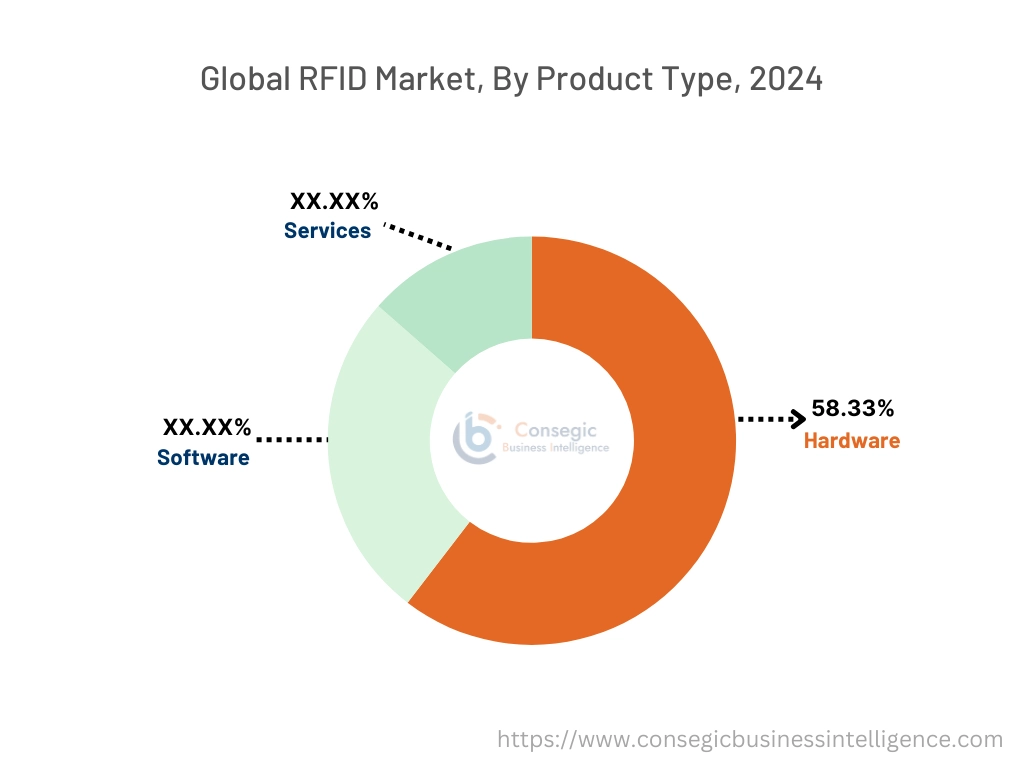
Based on product type, the RFID market is segmented into hardware, software, and services.
Trends in Product Type:
- The tags are used to store and transmit data wirelessly through radio waves, enabling them to read and identified remotely by readers.
- The readers are devices that communicate with tags to capture data and transmit it to backend systems for processing. They are available in handheld, fixed, and portal configurations, tailored to different operational needs including mobile asset tracking and access control.
The hardware segment accounted for the largest revenue share of 58.33% in the year 2024.
- RFID tags provide retailers with valuable insights into consumer behaviour and purchasing patterns. By tracking individual items throughout the supply chain and within stores, retailers analyse data to optimize product placements, refine marketing strategies, and personalize customer interactions.
- The booming e-commerce sector relies on tags to maintain accurate inventory across physical and digital channels, supporting omnichannel strategies and delivering seamless shopping experiences.
- In retail, radio frequency identification (RFID) automates stock replenishment, eliminating manual checks and streamlining the process, while reducing labour costs.
- For instance, in November 2023, Metalcraft launched the Universal Eco Mini tag, to track items on metal surfaces in all retail stores. The tag has a detection range of up to 25 feet on metal surface.
- Therefore, the above-mentioned factors are driving the RFID market growth.
The services segment is anticipated to register the fastest CAGR during the forecast period.
- Businesses are increasingly utilizing real-time services to track their assets and products, which empower efficient asset tracking, quality control, and production monitoring.
- Maintenance services ensure proper tag and reader function through damage checks and calibration, reducing downtime, optimizing resources, and extending asset lifespan.
- Thus, above mentioned factors are expected to drive the RFID market trends during the forecast period.
By Frequency:
Based on frequency, the RFID market is segmented into low Frequency (30kHz - 300kHz), high frequency (3MHz - 30MHz), and ultra-High Frequency (300MHz - 3GHz).
Trends in Frequency:
- The growing adoption of ultra-high frequency tags due to their long reading range and fast data transmission speed, is ideal for large-scale inventory tracking and supply chain management across various industries.
- The increasing adoption of high-frequency and ultra-high frequency solutions in payment and access control, due to the rise of contactless technology, is driving the market trend.
The high frequency (3MHz - 30MHz) segment accounted for the largest revenue share in the year 2024.
- High frequency solutions operate at a frequency of 3MHz to 30 MHz are used in contactless payment systems, access control, and ticketing applications.
- In healthcare, high frequency smart labels are utilized for tracking medical equipment, patient monitoring, and pharmaceutical inventory management. Their relatively low interference with liquids and metals makes them suitable for applications.
- Therefore, the above-mentioned factors are driving the RFID market growth.
The Ultra-High Frequency (300MHz - 3GHz) segment is anticipated to register the fastest CAGR during the forecast period.
- UHF systems operate at a frequency range between 300 MHz and 3 GHz. These systems offer longer read ranges and faster data transfer rates, suitable for applications requiring high-speed and long-distance reading.
- The UHF systems are commonly used in retail inventory management, logistics and supply chain tracking, as well as in automotive and manufacturing industries for asset tracking and process automation.
- Thus, above mentioned factors are expected to drive the RFID market trends.
By End-User:
Based on end user, the RFID market is segmented into agriculture & forestry, healthcare, manufacturing, retail, transportation & logistics, and others.
Trends in End User:
- RFID technology in BFSI sector is a fundamental option for biometric authentication, identity theft protection, and identity verification. These solutions help customers in protecting their money and investments, and allow financial institutions to protect their inventory and assets.
- Governments are increasingly utilizing radio frequency identification technology to modernize their asset-tracking processes. It offers an advanced solution for tracking assets securely and efficiently.
The retail segment accounted for the largest revenue share in the year 2024 and is expected to register the highest CAGR during the forecast period.
- RFID in retail sector involves the placement of tags. These tags send out signals that are picked by readers, which are then software analyses the data, providing real-time information on sales, stock levels, and overall inventory.
- The smart labels play a crucial role in retail inventory management by enabling real-time tracking and monitoring of products from the warehouse to the point of sale. Retailers utilize this technology to improve stock visibility, reduce out-of-stock situations, and enhance the shopping experience for customers.
- For instance, in January 2024, Zebra Technologies launched FXR90 ultra-rugged reader. The device is designed to improve visibility in high-volume and rugged environment, while supporting several applications in retail and logistics.
- In conclusion, these factors in the retail sector are responsible for driving the global market trends.
Regional Analysis:
The regions covered are North America, Europe, Asia Pacific, the Middle East and Africa, and Latin America.
The global market has been classified by region into North America, Europe, Asia-Pacific, MEA, and Latin America.
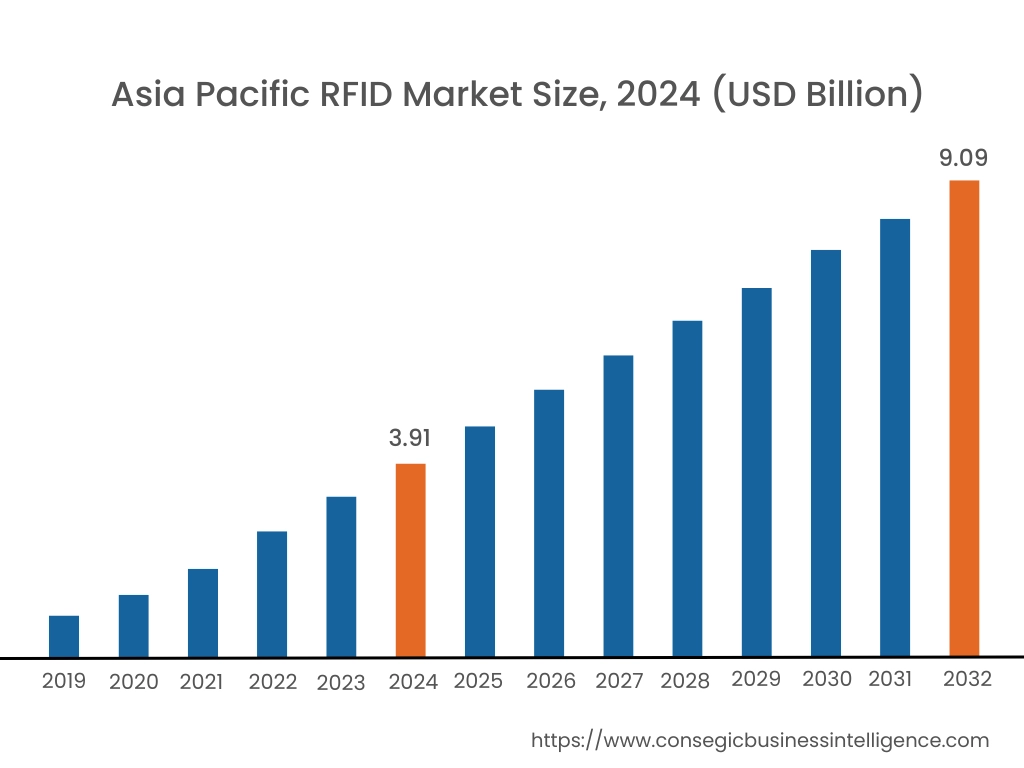
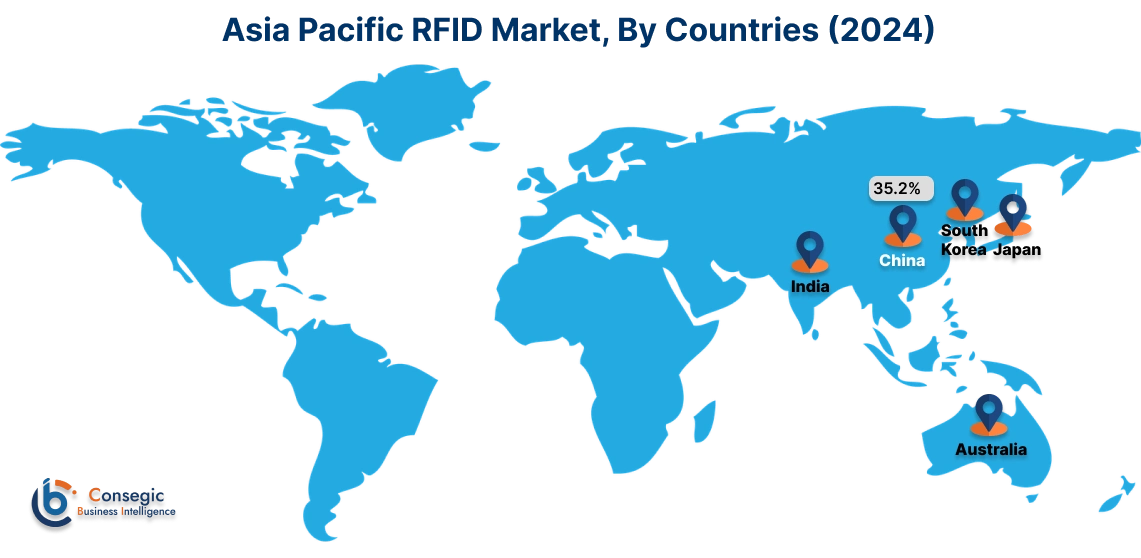
Asia Pacific RFID market expansion is estimated to reach over USD 9.09 billion by 2032 from a value of USD 3.91 billion in 2024 and is projected to grow by USD 4.27 billion in 2025. Out of this, the China market accounted for the maximum revenue split of 35.2%. Countries such as China, Japan, and South Korea are the major markets, driven by robust manufacturing activities, increasing investments in smart cities, and advancements in retail automation and logistics management. Thus, the growing adoption of RFID in retail sector is driving the RFID market share during the forecast period.
- For instance, in August 2024, Bar Code India (BCI), launched Dristi, a IoT-based RFID reader, for retail sector. The reader is built to enable retail organizations to access and leverage real-time data, while providing elevated standards of supply chain management.
North America market is estimated to reach over USD 12.99 billion by 2032 from a value of USD 5.86 billion in 2024 and is projected to grow by USD 6.38 billion in 2025. The region's advanced infrastructure, increasing adoption of IoT technologies, and strong presence of key industry players contribute to the market's growth. North American industries, particularly retail, logistics, and healthcare, are early adopters of this technology, leveraging its capabilities for inventory management, asset tracking, and supply chain optimization. Additionally, the region's focus on technological innovation and digital transformation further propels the demand for smart labels, driving the market growth. These factors would further contribute to its leading position in the RFID market share.
- For instance, in January 2024, HID Global announced the partnership with Olea Kiosk, to enhance the user check-in experience by utilizing RFID technology in access control applications.
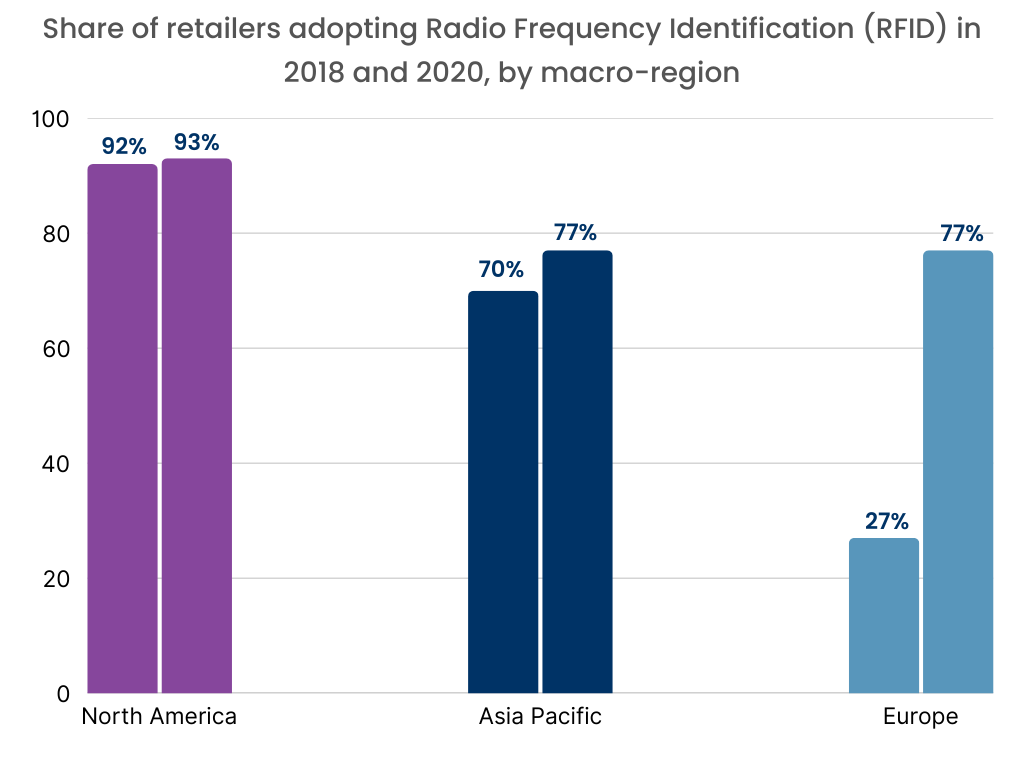
According to the RFID industry, the European market has experienced significant development. European industries are increasingly adopting smart labels to comply with regulatory requirements, improve operational efficiency, and enhance customer satisfaction. Additionally, Latin America region presents RFID market opportunities for local vendors focusing on enhancing operational efficiency and improving customer service through advanced tracking and monitoring solutions. Further, countries in MEA region are adopting radio frequency identification technology, which is driven by robust manufacturing activities, increasing investments in smart cities, and advancements in retail automation and logistics management.
Top Key Players and Market Share Insights:
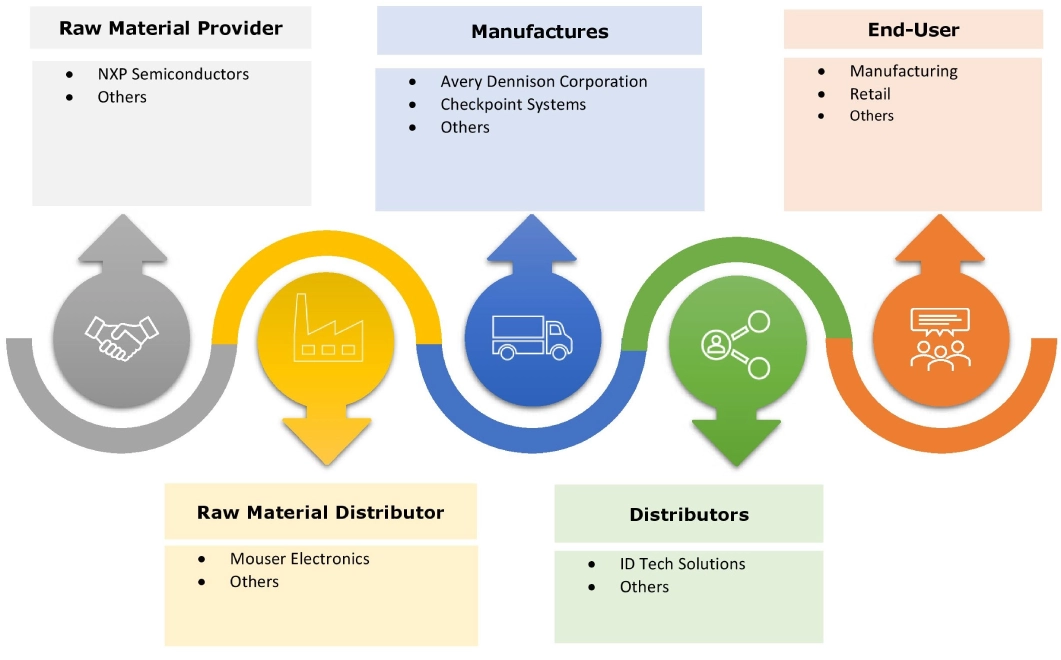
The global RFID market is highly competitive with major players providing radio frequency identification solutions to the national and international markets. Key players are adopting several strategies in research and development (R&D), product innovation, and end-user launches to hold a strong position in the market. Key players in the RFID industry include-
- Alien Technology (U.S.)
- Atmel Corp (U.S.)
- Avery Dennison Corporation (U.S.)
- Checkpoint Systems (U.S.)
- Confidex Ltd. (Finland)
- GAO RFID (Canada)
- HID Global Corporation (U.S.)
- Impinj Inc. (U.S.)
- Invengo Information Technology Co., Ltd. (China)
- Keonn Technologies (Spain)
- Laird (U.S.)
- MoreRfid (China)
- MTI Wireless Edge (Israel)
- Omni- ID Ltd. (U.S.)
- RF Code (U.S.)
- Vizinex RFID (U.S.)
- Zebra Technologies Corp. (U.S.)
Recent Industry Developments :
Collaborations and Partnerships:
- In April 2023, Checkpoint System announced the partnership with Partner Tech Europe, to develop next-generation self-checkout systems. These check out systems are enabled with radio frequency identification technology to improve customer experience and in-store security.
RFID Market Report Insights :
| Report Attributes | Report Details |
| Study Timeline | 2019-2032 |
| Market Size in 2032 | USD 35.93 Billion |
| CAGR (2025-2032) | 11.7% |
| By Product Type |
|
| By Frequency |
|
| By End-User |
|
| By Region |
|
| Key Players |
|
| North America | U.S. Canada Mexico |
| Europe | U.K. Germany France Spain Italy Russia Benelux Rest of Europe |
| APAC | China South Korea Japan India Australia ASEAN Rest of Asia-Pacific |
| Middle East and Africa | GCC Turkey South Africa Rest of MEA |
| LATAM | Brazil Argentina Chile Rest of LATAM |
| Report Coverage |
|
Key Questions Answered in the Report
How big is the RFID market? −
RFID market size is estimated to reach over USD 35.93 Billion by 2032 from a value of USD 16.10 Billion in 2024 and is projected to grow by USD 17.52 Billion in 2025, growing at a CAGR of 11.7% from 2025 to 2032.
Which is the fastest-growing region in the RFID market? +
Asia-Pacific is the region experiencing the most rapid growth in the market. The region's expanding retail sector, expanding e-commerce market, and growing manufacturing activities drive the demand for RFID technology in various applications.
What specific segmentation details are covered in the RFID report? +
The RFID report includes specific segmentation details for product type, frequency, end user, and region.
Who are the major players in the RFID market? +
The key participants in the market are Alien Technology (U.S.), Atmel Corp (U.S.), Avery Dennison Corporation (U.S.), Checkpoint Systems (U.S.), Confidex Ltd. (Finland), GAO RFID (Canada), HID Global Corporation (U.S.), Impinj Inc. (U.S.), Invengo Information Technology Co., Ltd. (China), Keonn Technologies (Spain), Laird (U.S.), MoreRfid (China), MTI Wireless Edge (Israel), Omni- ID Ltd. (U.S.), RF Code (U.S.), Vizinex RFID (U.S.), Zebra Technologies Corp. (U.S.), and others.
Overview
Reputation & Certifications


Our Services
- Market Intelligence & Forecasting
- Custom Research Solutions
- Market Entry Strategy
- Competitive Intelligence
- Customer Insights
- Industry Innovation Analysis
- Investment Advisory