Jump to Content
Rich Communication Services Market - Size, Share, Industry Trends, and Forecasts (2025-2035)
Rich Communication Services Market:
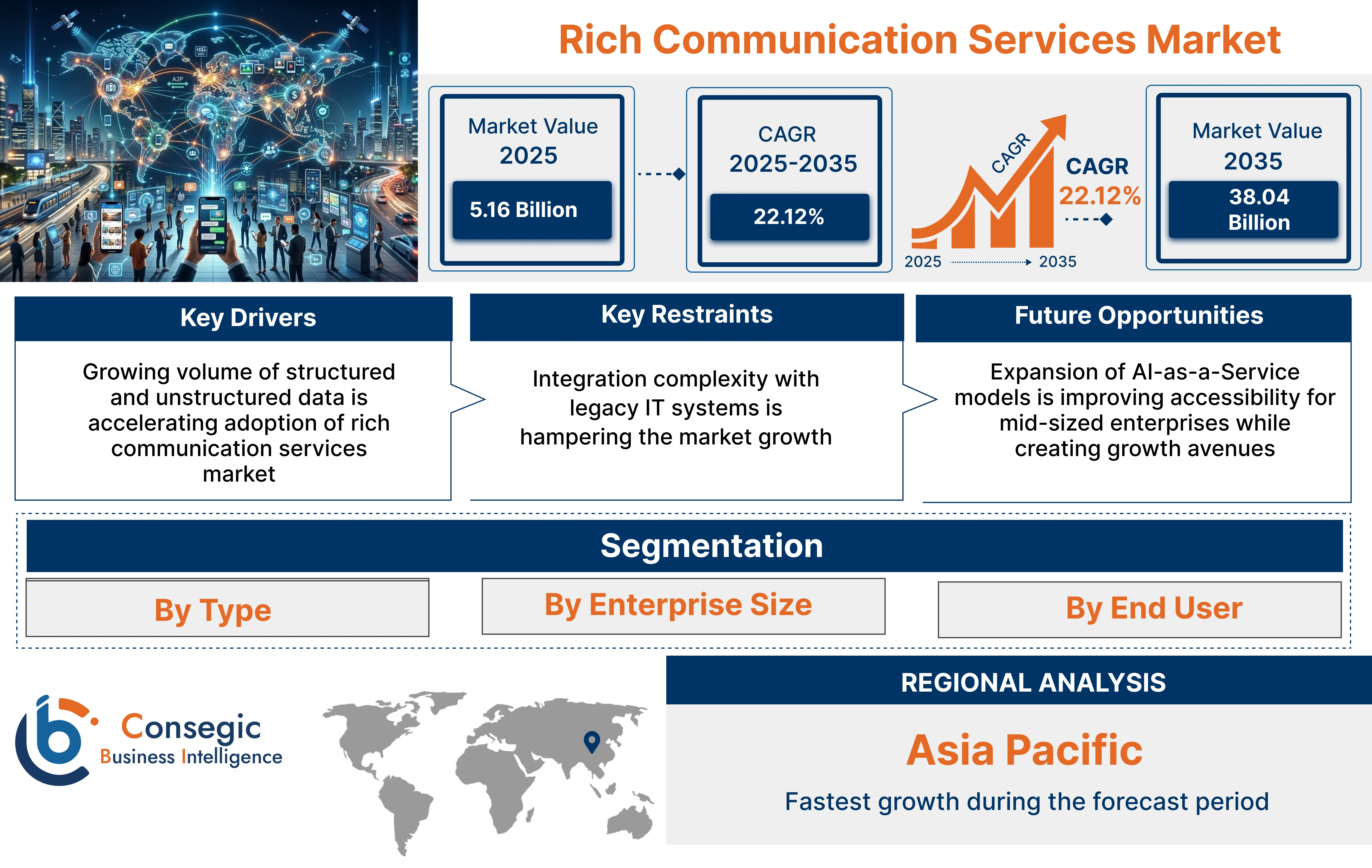
Rich Communication Services Market size is estimated to reach over USD 38.04 Billion by 2035 from a value of USD 4.22 Billion in 2024 and is projected to grow by USD 5.16 Billion in 2025, growing at a CAGR of 22.12% from 2025 to 2035
Rich Communication Services Market Scope & Overview:
Rich communication services can be described as an upgraded mobile messaging protocol that enhances traditional SMS with media-rich and interactive features. The rich communication services industry involves messaging platforms, chatbot integration, application-to-person systems, carrier infrastructure, and cloud communication tools. The objective is to enable secure, branded, and interactive communication within native mobile messaging apps.
The rich communication services sector is expanding due to rising demand for direct mobile engagement and improved customer response rates. Enterprises are integrating RCS into marketing and customer service operations to improve campaign efficiency and user interaction. Telecom operators and cloud communication providers are expanding network support to strengthen enterprise adoption across global markets.
Rich Communication Services Market Size & Forecast
- 2024 Market Size : USD 4.22 Billion
- 2025 Market Size : USD 5.16 Billion
- 2035 Evaluate Market Size : USD 38.04 Billion
- CAGR (2025-2035) : 22.12%
- Largest growing Region : North America
- Fastest growing Region : Asia Pacific
How is the Rich Communication Services Market Affected by AI?
AI can be described as the use of advanced algorithms and computational models to simulate human intelligence in machines. The artificial intelligence industry consists of machine learning platforms, natural language processing systems, computer vision tools, artificial intelligence chips, data training platforms, and cloud-based artificial intelligence deployment platforms.
The artificial intelligence sector has been growing due to the increased attention given by enterprises to operational efficiency and decision-making based on data. Organizations, such as those operating in the healthcare, financial, manufacturing, and retail sectors, are adopting artificial intelligence systems for increased productivity and minimizing manual intervention. Technology companies are investing in artificial intelligence infrastructure and industry-specific models for increased commercialization.
Rich Communication Services Market Dynamics - (DRO):
Key Drivers:
Growing volume of structured and unstructured data is accelerating adoption of rich communication services market
Enterprises are creating large amounts of data from digital transactions, connected devices, enterprise software, and online platforms. Conventional analytics systems are not efficient in handling large amounts of high-velocity data in real-time. Machine learning models assist enterprises in recognizing patterns and making predictions and decisions regarding complex data sets. Enterprises are implementing AI frameworks to derive operational insights and improve the accuracy of forecasts.
- As per Ericsson, 5G networks will transport 43% of mobile data by end-2025 (up from 34% in 2024), rising to 83% by 2031, as global mobile data traffic excluding FWA grows 2.2x to 310 EB/month.
Hence, the increasing amounts of data, both structured and unstructured, are encouraging the adoption of machine learning models across industries.
Key Restraints:
Integration complexity with legacy IT systems is hampering the market growth
There are many organizations that are running on legacy systems, which are not compatible with the latest AI systems. The complexity of integrating the legacy systems is high. The data is also not properly connected. The legacy systems require the migration of the historical data, which is time-consuming. The customization of the legacy systems is also time-consuming.
Therefore, the complexity of integrating the legacy systems is the main cause of the delay in the implementation of the latest AI systems in the established organizations.
Future Opportunities:
Expansion of AI-as-a-Service models is improving accessibility for mid-sized enterprises while creating growth avenues
Cloud-based AI platforms are offering subscription-based access to machine learning tools and models. Enterprises are reducing investment in infrastructure through scalable deployment models. AI-as-a-Service providers are offering industry-specific solutions to ease integration and speed up deployment. Mid-sized enterprises are increasing adoption through flexible pricing models.
- In March 2026, Google announced a partnership with Airtel to deliver AI-powered anti-spam solutions to RCS messaging in India, including sender ID checks, DND checks, spam blocking, malicious domain filtering, and throttling of suspicious senders.
Thus, the expansion of AI-as-a-Service models is improving accessibility and creating new growth avenues in the artificial intelligence market.
Rich Communication Services Market Segmental Analysis:
By Type:
Trends in the Type:
- Rising enterprise focus on direct mobile engagement is increasing A2P traffic volume.
- Growing adoption of conversational messaging is supporting two-way communication models.
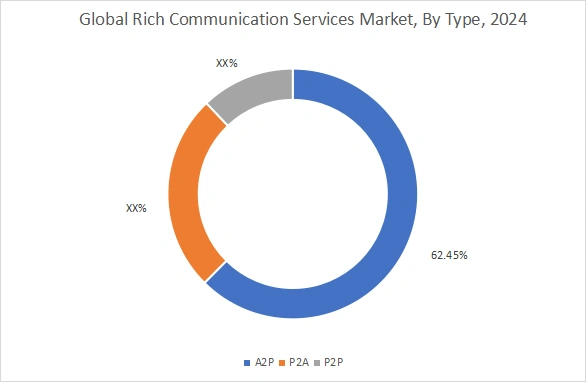
The A2P was responsible for the highest revenue share of 62.45% in 2024.
- A2P includes promotional campaigns, transactional alerts, service notifications, and authentication messages.
- Enterprises are using branded and verified messaging to increase trust and response rates with customers.
- Furthermore, the inclusion of rich media features such as carousels and quick reply buttons is enhancing campaign effectiveness.
- Additionally, demand for secure customer communication in banking and retail is increasing A2P adoption.
- Therefore, expanding enterprise messaging use cases are expected to support the A2P segment during the forecast period.
It is anticipated that the P2A will exhibit the highest compound annual growth rate (CAGR) during the forecast period.
- P2A enables customers to interact directly with businesses through native messaging interfaces.
- Enterprises are integrating chatbots and automated response systems to manage high query volumes.
- Further, rising demand for real-time service support is encouraging conversational workflows.
- Furthermore, integration with CRM and payment gateways is improving transaction efficiency.
- Therefore, increasing preference for interactive business communication is expected to drive the P2A segment growth.
By Enterprise Size:
On the basis of enterprise size, the rich communication services market is segmented into SMEs and large enterprises.
Trends in the Enterprise Size:
- Large enterprises are prioritizing omnichannel customer engagement strategies.
- SMEs are using cloud-based messaging platforms to lower infrastructure costs.
The large enterprises was responsible for the highest revenue share in 2024.
- Large enterprises have large customer bases and thus require effective communication channels.
- Integration with marketing automation and analytics platforms is enhancing campaign optimization.
- Furthermore, an increase in IT budgets is allowing enterprises to use advanced RCS features.
- In addition, an emphasis on customer retention strategies is boosting enterprise messaging.
- Therefore, strong digital infrastructure and established customer bases are supporting the Large Enterprises segment.
It is anticipated that the SMEs will exhibit the highest compound annual growth rate (CAGR) during the forecast period.
- SMEs are shifting from traditional SMS to interactive messaging channels.
- Cloud-based RCS platforms reduce upfront deployment costs.
- Further, simplified subscription pricing models improve accessibility.
- Additionally, rising e-commerce participation among SMEs is increasing digital communication demand.
- Therefore, affordable and scalable messaging solutions are expected to accelerate SME adoption.
By End User:
On the basis of end user, the rich communication services market is divided into retail, media & entertainment, BFSI, healthcare, travel & tourism, and others.
On the basis of end user, the rich communication services market is divided into retail, media & entertainment, BFSI, healthcare, travel & tourism, and others.
Trends in the End User:
- Retail and BFSI sectors are increasing investment in secure and personalized messaging.
- Travel and media companies are adopting interactive notifications to improve customer engagement.
Retail accounted for the largest revenue share in the year 2024.
- Retailers use RCS for promotional campaigns, order updates, and loyalty program communication.
- Rich media content improves click-through and conversion rates.
- Moreover, integration with mobile payment options enhances transaction convenience.
- Additionally, personalized product recommendations support repeat purchases.
- Therefore, expanding mobile commerce activity is strengthening the Retail segment.
BFSI is anticipated to register the fastest CAGR during the forecast period.
- Financial institutions use RCS for secure transaction alerts and customer verification.
- Two-way messaging improves service query resolution timelines.
- Moreover, increasing digital banking adoption is raising mobile interaction volumes.
- Furthermore, regulatory focus on secure communication channels is encouraging RCS integration.
- Therefore, growing demand for trusted and verified messaging is expected to support BFSI segment growth.
Regional Analysis:
North America, Europe, Asia Pacific, the Middle East and Africa, and Latin America are the regions of coverage.
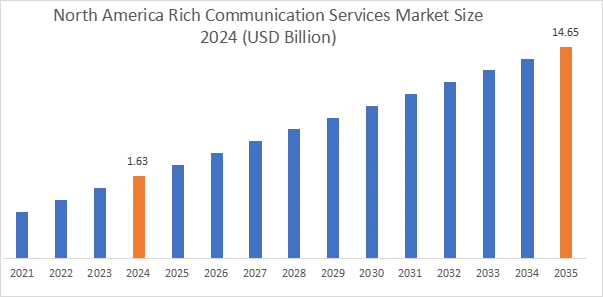
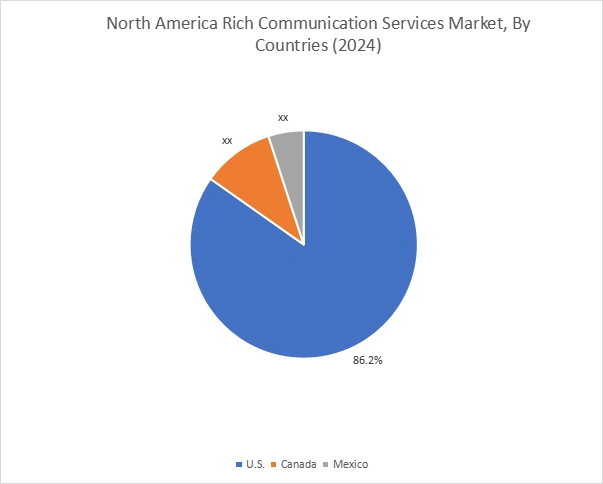
In 2024, North America accounted for the highest market share at 38.51% and was valued at USD 1.63 Billion, and is expected to reach USD 14.65 Billion by 2035. In North America, the U.S. accounted for the highest market share of 86.2% during the base year of 2024. This is attributed to the early adoption of new-age messaging standards, the high footprint of cloud communication players, and the high spend on digital customer engagement for enterprises. Large enterprises, especially in the retail, BFSI, and telecom industries, are adopting RCS as part of the marketing and communication stack. There has also been an increased level of cooperation between players in the Canadian market for the expansion of the interoperable messaging network.
- For example, in October 2025, Airship announced RCS messaging in October 2025, allowing brands to send verified, interactive messages with rich media via existing SMS workflows with automatic fallback to SMS/MMS for reliable delivery.
Asia Pacific is expected to witness the fastest growth during the forecast period. China is expanding enterprise messaging platforms integrated with mobile ecosystems. India is increasing digital payment adoption and mobile commerce penetration, which is strengthening demand for secure and interactive business messaging. Japan and South Korea are upgrading telecom infrastructure to support advanced messaging protocols. Rising smartphone penetration and expanding e-commerce activity are supporting regional adoption.
- For instance, as per IBEF reported that digital payments in India jumped 37% in volume to 206 billion transactions and 30% in value to USD 3.38 trillion from FY24 to FY25. Hence, rising digital payment volumes indicate accelerating demand for secure mobile communication platforms in India.
Europe rich communication services market growth is supported by regulatory focus on secure digital communication and strong enterprise messaging demand in the UK, Germany, and France. Telecom operators are collaborating with technology providers to expand verified business messaging frameworks.
Latin America market growth is supported by rising mobile internet usage in Brazil and Mexico. Enterprises are shifting from traditional SMS campaigns to interactive messaging formats to improve engagement rates.
Middle East & Africa market growth is supported by digital transformation programs in the UAE, Saudi Arabia, and South Africa. Telecom operators are investing in next-generation messaging infrastructure for supporting communication services for enterprises.
Top Key Players & Market Share Insights:
The rich communication services market is a moderately consolidated market, with telecom operators, cloud communication service providers, messaging platform developers, and enterprise solution providers competing with each other for market share. Companies are forming partnerships with mobile operators and technology integrators while investing in secure messaging platforms, chatbots, and analytics solutions. The development of interoperable networks and the integration with customer relationship management and marketing automation solutions have strengthened the competitive positions in regional markets. Key participants in the market for rich communication services include:
- Google LLC – US
- Twilio Inc. – US
- Sinch AB – Sweden
- Infobip Ltd. – UK
- Vonage Holdings Corp. – US
- Cisco Systems Inc. – US
- Orange S.A. – France
- Vodafone Group Plc – UK
- Deutsche Telekom AG – Germany
- Telefonica S.A. – Spain
Recent Industry Developments:
Product Launches
- In February 2026, TrueDialog launched a no-code Visual RCS Composer that lets enterprise marketers design, test, and send rich, app-like messaging campaigns with media, buttons, and suggested replies inside its platform, with automatic SMS fallback for unsupported devices.
- In August 2025, Twilio made Rich Communication Services (RCS) generally available worldwide, letting brands send branded, verified, interactive messages with rich media through the same APIs they use for SMS, plus automatic SMS fallback.
Rich Communication Services Market Report Insights:
| Report Attributes | Report Details |
|---|---|
| Study Timeline | 2019-2035 |
| Market Size in 2035 (USD Billion) | USD 38.04 Billion |
| CAGR (2025-2035) | 22.12% |
| By Type |
|
| By Enterprise Size |
|
| By End User |
|
| By Region |
|
| Key Players |
|
| Report Coverage |
|
Key Questions Answered in the Report
How big is the rich communication services market? −
The rich communication services market size is estimated to reach over USD 38.04 Billion by 2035 from a value of USD 4.22 Billion in 2024 and is projected to grow by USD 5.16 Billion in 2025, growing at a CAGR of 22.12% from 2025 to 2035.
Which segmentation details are covered in the rich communication services report? +
The rich communication services report includes specific segmentation details for type, enterprise size, end user, and regions.
Which is the fastest segment anticipated to impact the market growth? +
P2A is the fastest growing segment, driven by rising demand for interactive and two-way enterprise messaging.
Who are the major players in the rich communication services market? +
The key participants in the rich communication services market are Google LLC (US), Twilio Inc. (US), Sinch AB (Sweden), Infobip Ltd. (UK), Vonage Holdings Corp. (US), Cisco Systems Inc. (US), Orange S.A. (France), Vodafone Group Plc (UK), Deutsche Telekom AG (Germany), Telefonica S.A. (Spain), and others.
What are the key trends in the rich communication services market? +
The market is shaped by growing adoption of branded messaging, chatbot integration, and expanding telecom operator support for verified business communication.
Overview
Reputation & Certifications


Our Services
- Market Intelligence & Forecasting
- Custom Research Solutions
- Market Entry Strategy
- Competitive Intelligence
- Customer Insights
- Industry Innovation Analysis
- Investment Advisory