Jump to Content
Sales Performance Management Market - Size, Share, Industry Trends, and Forecasts (2025-2035)
Sales Performance Management Market:
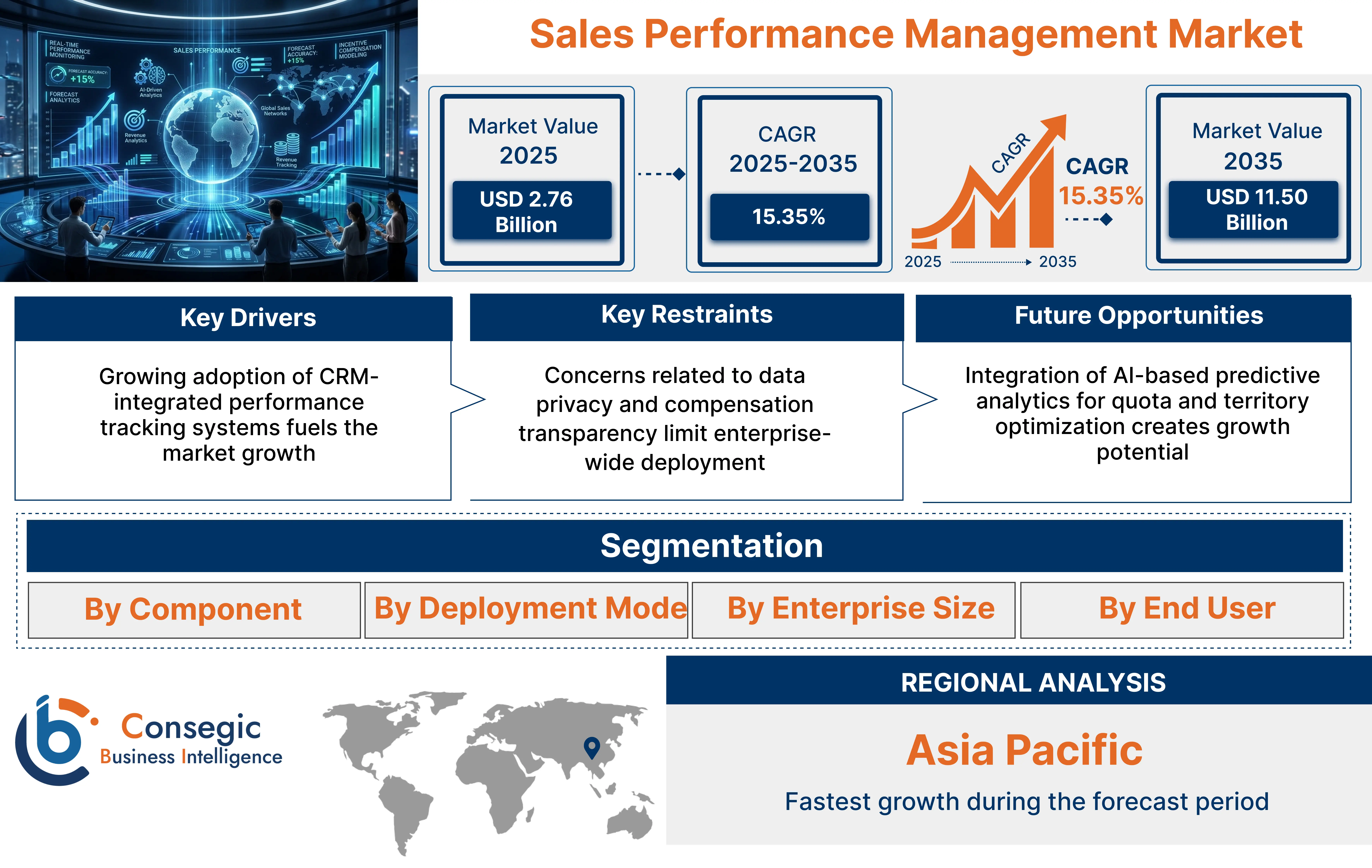
Sales Performance Management Market size is estimated to reach over USD 11.50 Billion by 2035 from a value of USD 2.39 Billion in 2024 and is projected to grow by USD 2.76 Billion in 2025, growing at a CAGR of 15.35% from 2025 to 2035
Sales Performance Management Market Scope & Overview:
Sales performance management refers to the use of structured software platforms to plan, monitor, and improve sales team outcomes. The industry consists of incentive compensation management systems, territory and quota planning systems, sales forecasting systems, and performance analytics systems. The objective is to align sales incentives with revenue targets and improve visibility across distributed sales teams.
The sales performance management industry is expanding due to growing pressure on enterprises to improve sales productivity and margin discipline. Organizations are replacing manual compensation tracking with automated and audit-ready systems. The subscription economy and the complexity of commissions are driving the need for real-time sales performance tracking. Cloud deployment and CRM integration are further supporting adoption across large enterprises and mid-sized firms.
Sales Performance Management Market Size & Forecast
- 2024 Market Size : USD 2.39 Billion
- 2025 Market Size : USD 2.76 Billion
- 2035 Evaluate Market Size : USD 11.50 Billion
- CAGR (2025-2035) : 15.35%
- Largest growing region: North America
- Fastest growing region: Asia Pacific
How is the Sales Performance Management Market Affected by AI?
AI improves sales performance management workflows by processing large volumes of sales transactions, incentive rules, and quota structures with high accuracy. Machine learning models identify commission calculation errors, unusual payout patterns, and forecast deviations across complex sales hierarchies.
AI systems are also used for predictive quota setting, territory optimization, and performance trend analysis within integrated CRM environments. Predictive engines evaluate the quality of the sales pipeline, productivity of sales reps, and compensation exposure before the close of the financial report, enabling the management to maintain revenue and compensation control for dispersed sales forces.
Sales Performance Management Market Dynamics - (DRO):
Key Drivers:
Growing adoption of CRM-integrated performance tracking systems fuels the market growth
Enterprises are increasingly integrating sales data into the CRM space for better pipeline and revenue visibility. Compensation plans, quota assignments, and territory structures require direct alignment with real-time sales activity. Manual data transfers between systems create reporting delays and payout inaccuracies. Integrated sales performance management platforms allow automated commission calculations and unified performance dashboards within existing CRM ecosystems.
- For example, in August 2025, Everstage announced Agent Core, an AI layer that integrates sales performance management with automation for incentive compensation, planning, and more, in August 2025. Some agents include Databook (preps sales data for Salesforce), Commission (provides payouts), Onboarding (allocates plans), and Admin (routes queries), enabling teams to be more proactive.
Therefore, the rising use of sales performance tracking systems integrated with the CRM space is creating a surge for sophisticated sales performance management solutions.
Key Restraints:
Concerns related to data privacy and compensation transparency limit enterprise-wide deployment
The sales performance platforms deal with sensitive employee compensation information and individual employee performance metrics. Organizations need to adhere to internal governance guidelines and regional data protection regulations. Concerns over access control, data misuse, and visibility of payout structures create hesitation during implementation. Complex approval hierarchies and audit requirements increase deployment timelines.
Thus, concerns related to data privacy and compensation transparency are restricting faster adoption of sales performance management systems.
Future Opportunities:
Integration of AI-based predictive analytics for quota and territory optimization creates growth potential
Sales organizations face the need for precise quota management and equitable territory allocation for increased productivity. AI-driven systems evaluate historical revenue trends, market potential, and sales representative performance trends, providing data-driven quota suggestions. Predictive analytics assist with scenario planning and the early detection of potential performance gaps. Organizations are looking to incorporate AI for improved accuracy and minimizing compensation risk exposure.
- In December 2025, Anaplan introduced role-based AI agents like CoModeler, Finance Analyst, Supply Chain Analyst, Sales Analyst, and Workforce Analyst, which help organizations speed up their scenario planning process through data analysis, report generation, and executing decisions.
Thus, integration of AI-based predictive analytics for quota and territory optimization is creating new growth opportunities in the sales performance management market.
Sales Performance Management Market Segmental Analysis:
By Component:
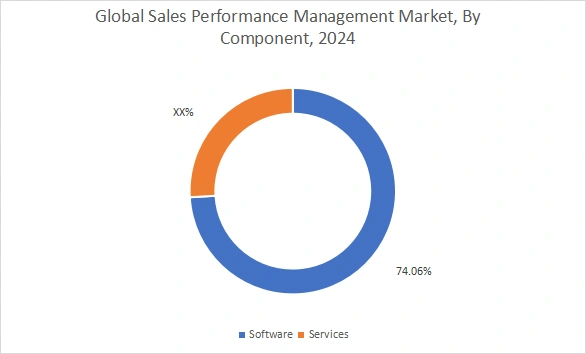
On the basis of component, the sales performance management market is segmented into software and services.
Trends in the Component:
- The rise of automation in incentive compensation processes is fueling the demand for software solutions.
- The need for integrating systems is supporting the demand for consulting and management services.
The software was responsible for the highest revenue share of 74.06% in 2024.
- Software includes incentive compensation management, quota planning, territory management, and analytics dashboards.
- Enterprises are replacing the use of spreadsheets for tracking with centralized systems.
- In addition, the integration of CRM and ERP systems is supporting the adoption of software solutions.
- Further, the use of AI-based forecasting and tracking solutions is expanding the use cases.
- Therefore, increasing reliance on automated compensation governance is expected to boost the software segment during the forecast period.
It is anticipated that the services will exhibit the highest compound annual growth rate (CAGR) during the forecast period.
- Services include implementation, system integration, consulting, customization, and support.
- Organizations require technical expertise to align compensation structures with platform logic.
- In addition, mid-sized enterprises are relying on external consultants for deployment and training.
- Further, ongoing plan revisions and compliance checks are increasing managed service demand.
- Therefore, rising need for technical advisory and post-deployment support is expected to drive the services segment.
By Deployment Mode:
On the basis of deployment mode, the sales performance management market is segmented into on-premises and cloud.
Trends in the Deployment Mode:
- Rising preference for remote accessibility is increasing cloud adoption.
- Data control requirements are sustaining demand for on-premises models.
The cloud was responsible for the highest revenue share in 2024.
- Cloud platforms offer scalable infrastructure and faster implementation cycles.
- Enterprises prefer subscription-based pricing that follows the expansion model for the sales team.
- Furthermore, real-time data synchronization between regions can be achieved for cloud deployments.
- Further, integration with SaaS-based CRM systems strengthens adoption.
- Therefore, growing demand for scalable and flexible infrastructure is expected to boost the cloud segment during the forecast period.
It is anticipated that the on-premise will exhibit the highest compound annual growth rate (CAGR) during the forecast period.
- Large enterprises require direct control over compensation data.
- Moreover, internal IT governance structures also prefer the in-house hosting model.
- Furthermore, the data residency requirements are also more stringent for regulated industries.
- Further, the flexibility for customization also ensures the product remains relevant.
- Therefore, data control priorities are expected to support the on-premises segment.
By Enterprise Size:
On the basis of enterprise size, the sales performance management market is segmented into large enterprises and SMEs.
Trends in the Enterprise Size:
- Expansion of global sales teams is increasing adoption among large enterprises.
- Additionally, growing digitalization among SMEs is opening new demand avenues.
The large enterprises was responsible for the highest revenue share in 2024.
- Complex commission structures need to be supported by automated management systems.
- Moreover, multiple countries' operations need to be supported by standardized systems of governance.
- Also, increased sales staff means there is a growing need for performance tracking systems.
- Furthermore, budget capacity is needed for enterprise-wide solutions.
- Therefore, structured sales governance requirements are expected to drive the large enterprise segment.
It is anticipated that the SMEs will exhibit the highest compound annual growth rate (CAGR) during the forecast period.
- Cloud-based solutions reduce upfront investment barriers.
- In addition, SMEs are structuring incentive plans to increase sales accountability.
- Further, subscription-based pricing is consistent with budget constraints.
- In addition, vendor-based implementation assistance is helpful.
- Therefore, increasing digital adoption among SMEs is expected to boost this segment.
By End User:
On the basis of end user, the sales performance management market is divided into BFSI, automotive, IT & telecom, healthcare, retail, manufacturing, government & education, and others.
Trends in the End User:
- Industries with complex sales hierarchies are increasing adoption of automated compensation tools.
- Moreover, growth in subscription and channel-based selling models is expanding use cases.
BFSI accounted for the largest revenue share in the year 2024.
- Financial institutions operate large distributed sales networks.
- Also, the need for strict compliance is creating the need for transparent compensation tracking.
- Moreover, managing multiple products necessitates structured incentive alignment.
- Further, performance-based payment structures require reporting systems.
- Therefore, governance and compliance requirements are expected to support the BFSI segment.
IT & telecom is anticipated to register the fastest CAGR during the forecast period.
- Subscription revenue models require recurring commission tracking.
- Additionally, rapid sales cycle adjustments demand flexible quota planning tools.
- Moreover, channel partner ecosystems increase incentive calculation complexity.
- Further, expansion of enterprise SaaS sales teams strengthens adoption.
- Therefore, evolving revenue models in IT & telecom are expected to drive segment growth.
Regional Analysis:
North America, Europe, Asia Pacific, the Middle East and Africa, and Latin America are the regions of coverage.
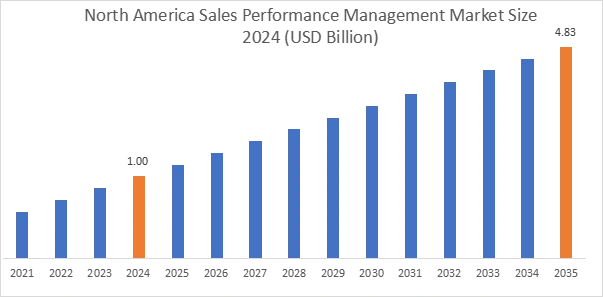
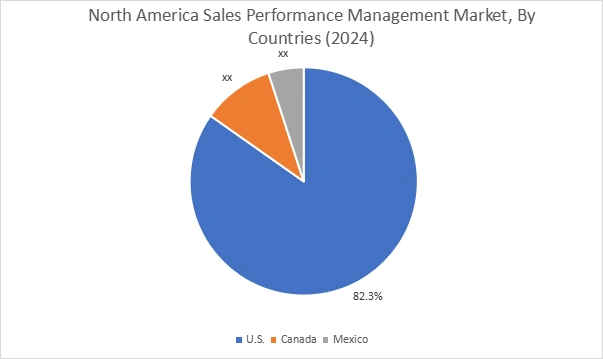
In 2024, North America accounted for the highest market share at 42% and was valued at USD 1.00 Billion, and is expected to reach USD 4.83 Billion by 2035. In North America, the U.S. accounted for the highest market share of 82.3% during the base year of 2024. Market growth is supported by the presence of large technology vendors, mature CRM adoption, and complex commission structures across BFSI and IT sectors. Enterprises are focusing on the automation of incentive governance and sales analytics. The use of sales analytics is also seen in the financial services and telecom industries in Canada, which are focused on compensation transparency.
- For example, in August 2025, Xactly introduced AI agents on its Intelligent Revenue Platform. The agents use natural language prompts, sketches, or even drag-and-drop functionality to build apps quickly. The agents use 20 years of pay data for GTM optimization.
Asia Pacific is expected to experience the fastest growth rate during the forecast period. China is expanding its enterprise digitization programs in the manufacturing and technology sectors. This is driving the demand for structured sales tracking systems. India is scaling exports of SaaS and IT services. This is driving the adoption of cloud-based compensation management systems. Australia, Japan, and Southeast Asian nations are formalizing their incentive structures as their enterprise sales teams are expanding. The adoption of CRM is driving the deployment of integrated sales performance management tools.
- In June 2024, NASSCOM has stated that the factories in India are going digital quickly, with digital technology now being over 40% of the manufacturing costs by 2025, while in 2021 it was only 20%. The automation market is expected to grow by 14.26% annually and reach USD 29.43 billion by 2029. This is going to improve sales performance solutions like Varicent, CaptivateIQ, and Anaplan's AI.
The growth of the Europe sales performance management market is driven by the need for compliance-driven compensation governance in the UK, Germany, and France. Enterprises are standardizing commission systems that comply with regulatory reporting needs.
The growth of the Latin America sales performance management sales performance management market is fueled by the growth of the organized retail and financial services industries in Brazil and Mexico. Enterprises are increasingly using cloud-based solutions to improve commission visibility and minimize errors associated with manual payouts.
The growth of the Middle East & Africa sales performance management sales performance management market is fueled by enterprise modernization initiatives in the UAE and Saudi Arabia. South Africa is experiencing gradual adoption within the telecom and financial services industries.
Top Key Players & Market Share Insights:
The sales performance management market is found to have moderate consolidation, with vendors like enterprise software providers, CRM vendors, and incentive compensation platform developers competing with each other. Firms are enhancing their ability to integrate with CRM and ERP systems, as well as expanding their offerings in the area of AI-based analytics and cloud deployment. Key participants in the market for sales performance management include:
- SAP SE – Germany
- Oracle Corporation – US
- Anaplan, Inc. – US
- Xactly Corporation – US
- Varicent Software Inc. – Canada
- Performio – US
- CaptivateIQ, Inc. – US
- Everstage – US
- Spiff, Inc. – US
- Iconixx Corporation – US
Recent Industry Developments:
Product Launches
- In December 2025, Varicent unveiled its AI-native architecture at the Unlock Innovation Forum, enhancing sales planning, incentives, data prep, and inquiries through system-wide AI integration rather than isolated tools.
- In November 2025, CaptivateIQ launched an AI-powered Payee Experience offering real-time plan clarity, payout explanations, ML forecasts, and personalized coaching to boost employee earnings trust and revenue productivity.
Sales Performance Management Market Report Insights:
| Report Attributes | Report Details |
|---|---|
| Study Timeline | 2019-2035 |
| Market Size in 2035 (USD Billion) | USD 11.50 Billion |
| CAGR (2025-2035) | 15.35% |
| By Component |
|
| By Deployment Mode |
|
| By Enterprise Size |
|
| By End User |
|
| By Region |
|
| Key Players |
|
| Report Coverage |
|
Key Questions Answered in the Report
How big is the sales performance management market? −
The sales performance management market size is estimated to reach over USD 11.50 Billion by 2035 from a value of USD 2.39 Billion in 2024 and is projected to grow by USD 2.76 Billion in 2025, growing at a CAGR of 15.35% from 2025 to 2035.
Which segmentation details are covered in the sales performance management report? +
The sales performance management report includes specific segmentation details for component, deployment mode, enterprise size, end user, and regions.
Which is the fastest segment anticipated to impact the market growth? +
Molecular diagnostics is the fastest growing segment, driven by rising demand for rapid infectious disease detection.
Who are the major players in the sales performance management market? +
The key participants in the sales performance management market are SAP SE (Germany), Oracle Corporation (US), Anaplan, Inc. (US), Xactly Corporation (US), Varicent Software Inc. (Canada), Performio (US), CaptivateIQ, Inc. (US), Everstage (US), Spiff, Inc. (US), Iconixx Corporation (US), and others.
What are the key trends in the sales performance management market? +
The point of care diagnostics market is shaped by increasing adoption of home based testing kits and integration of digital connectivity with health records.
Overview
Reputation & Certifications


Our Services
- Market Intelligence & Forecasting
- Custom Research Solutions
- Market Entry Strategy
- Competitive Intelligence
- Customer Insights
- Industry Innovation Analysis
- Investment Advisory