Jump to Content
Scrambled Egg Mix Market - Size, Share, Industry Trends, and Forecasts (2025-2032)
Scrambled Egg Mix Market Size:
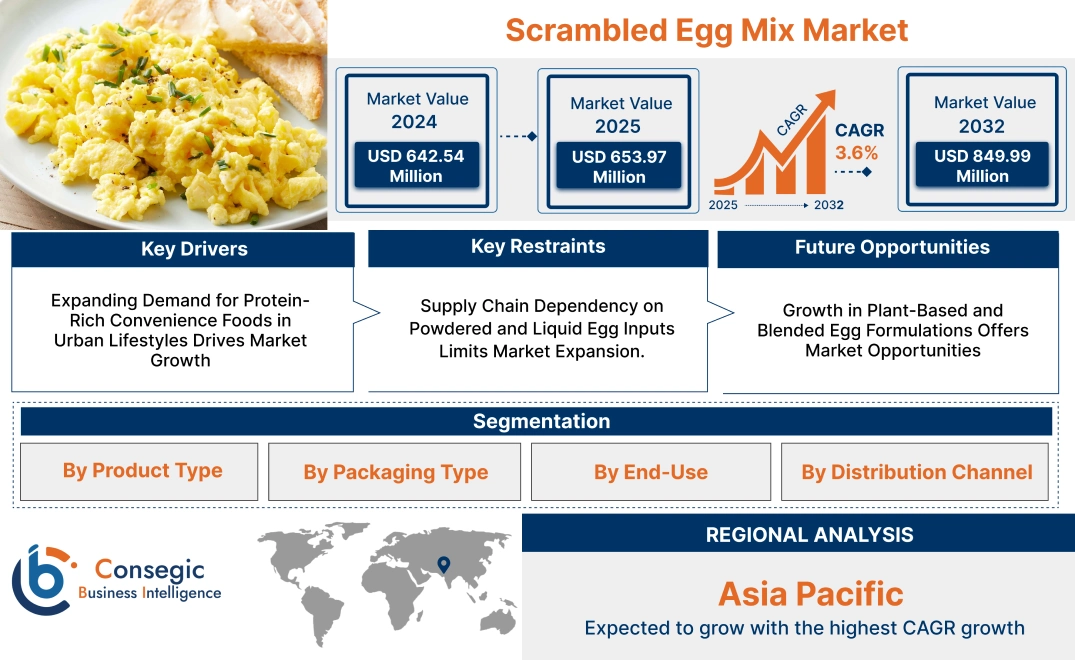
Scrambled Egg Mix Market size is estimated to reach over USD 849.99 Million by 2032 from a value of USD 642.54 Million in 2024 and is projected to grow by USD 653.97 Million in 2025, growing at a CAGR of 3.6% from 2025 to 2032.
Scrambled Egg Mix Market Scope & Overview:
Scrambled egg mix is a pre-formulated product made from processed egg components, designed to deliver consistent texture, flavor, and convenience in culinary applications. It is typically composed of pasteurized whole eggs, stabilizers, and seasonings, available in liquid, powdered, or frozen formats. This mix simplifies preparation while maintaining the nutritional value of fresh eggs.
Key features include extended shelf life, ease of storage, and reduced preparation time. The standardized composition ensures uniform quality and minimizes waste in foodservice operations. Its ready-to-use format supports high-volume cooking and streamlines production in commercial kitchens, catering, and institutional settings.
Restaurants, hotels, and meal service providers incorporate it into breakfast menus and prepared foods for operational efficiency. The versatility of the product allows adaptation across different cuisines, while packaging innovations further enhance portability and hygiene in handling and distribution. The mix supports consistent output without compromising on taste or nutritional standards.
Scrambled Egg Mix Market Dynamics - (DRO):
Key Drivers:
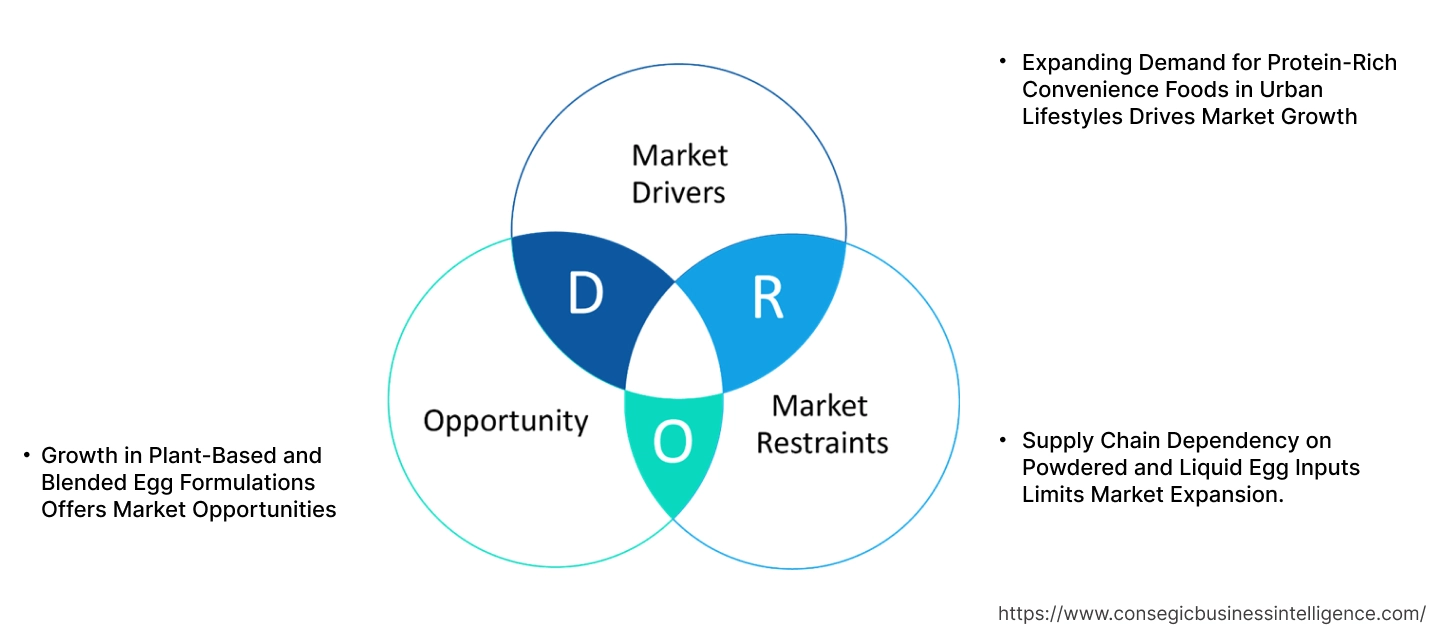
Expanding Demand for Protein-Rich Convenience Foods in Urban Lifestyles Drives Market Growth
Protein-rich products are particularly gaining traction among working professionals, fitness-oriented consumers, and institutional meal providers as a result of rapid urbanization and time-constrained routines. Scrambled egg mix offers a quick-prep, shelf-stable solution with high-quality protein content, making it ideal for consumers seeking balanced meals without elaborate cooking. Its ease of use, long shelf life, and compatibility with various cuisines have made it a staple in foodservice settings, including office cafeterias, hospital kitchens, and educational institutions. Additionally, the product's integration into high-protein breakfast menus at quick-service restaurants has further enhanced its visibility and consumer adoption. With protein consumption now widely associated with satiety, muscle recovery, and metabolic support, its use is expected to rise in both retail and institutional segments. This growing preference for practical, protein-forward solutions is a key driver of the scrambled egg mix market expansion.
Key Restraints:
Supply Chain Dependency on Powdered and Liquid Egg Inputs Limits Market Expansion.
The production of scrambled egg mix is heavily dependent on the continuous availability of powdered and liquid egg inputs. These upstream ingredients are sensitive to fluctuations in raw egg pricing, which are influenced by feed costs, disease outbreaks like avian influenza, and broader disruptions in the poultry supply chain. Demand volatility in the fresh egg market directly affects the stability of processed egg inputs, creating unpredictability in procurement and pricing for finished product manufacturers. Additionally, variations in input quality and sourcing constraints during periods of supply disruption compromise formulation consistency and delivery timelines. Smaller manufacturers, in particular, face difficulties in securing long-term contracts with suppliers due to limited buying power. These dependencies increase cost pressure and supply-side risk, limiting product scalability across new geographies. As a result, input-related volatility remains a key barrier to scrambled egg mix market growth.
Future Opportunities:
Growth in Plant-Based and Blended Egg Formulations Offers Market Opportunities
The rising adoption of flexitarian and plant-forward diets is fostering demand for alternative protein formats, including plant-based and hybrid egg formulations. Consumers seeking ethical, sustainable, or allergen-free options are increasingly drawn to scrambled egg mix variants incorporating chickpea, mung bean, or soy protein. These alternatives mimic the texture and cooking performance of traditional egg-based mixes while aligning with evolving dietary values. In addition, blended formulations that combine real eggs with plant-based ingredients offer improved nutritional profiles and a reduced environmental footprint, making them appealing to institutional buyers and foodservice operators. As the plant-based category matures, manufacturers are investing in flavor-masking technologies and improved emulsifiers to enhance product appeal. The convergence of sustainability goals and consumer health priorities is expected to drive steady growth in this segment.
- For instance, in June 2024, JUST Egg introduced an improved version of its plant-based egg formula called JUST Egg v5. This launch streamlines its manufacturing process as well as elevates the taste and functionality of the product. It ultimately aims to provide vegan and non-vegan customers with more versatility.
These trends are shaping a new product landscape and unlocking scrambled egg mix market opportunities in both retail and commercial channels.
Scrambled Egg Mix Market Segmental Analysis :
By Product Type:
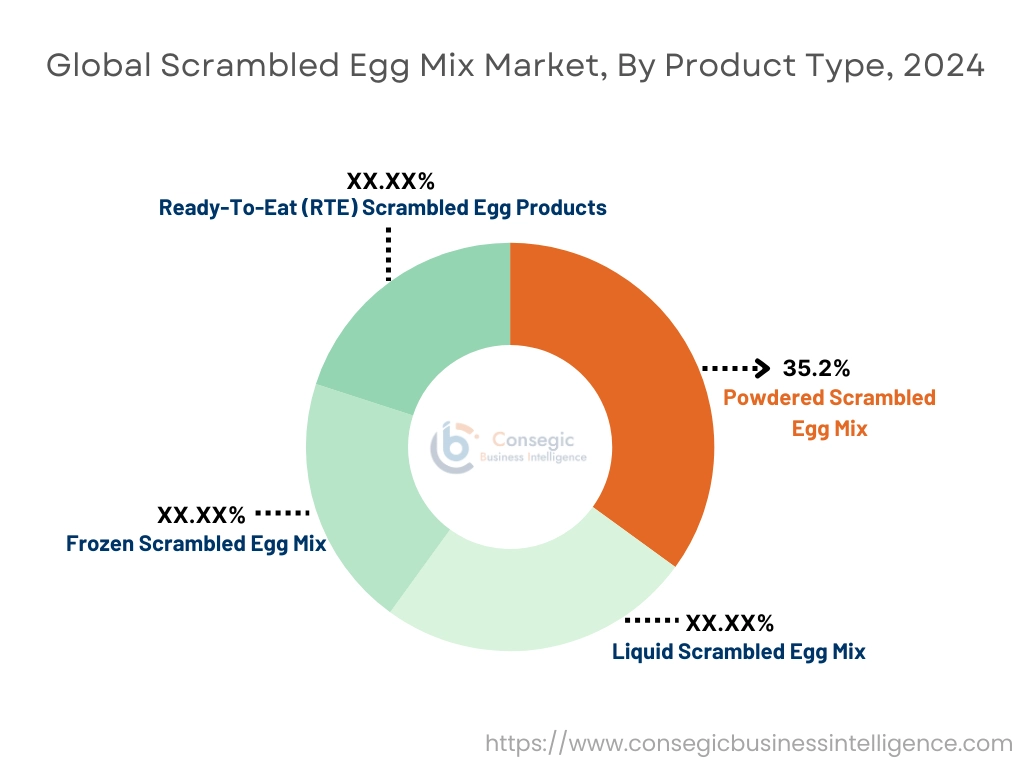
Based on product type, the market is segmented into powdered scrambled egg mix, liquid scrambled egg mix, frozen scrambled egg mix, and ready-to-eat (RTE) scrambled egg products.
The powdered segment held the largest scrambled egg mix market share of 35.2% in 2024.
- Powdered mixes offer long shelf life and convenient storage, making them a preferred choice for both retail and commercial buyers.
- The need for shelf-stable, rehydratable protein options is strong across bakery, institutional, and packaged food sectors.
- Scrambled egg mix market analysis reveals high utility in bulk meal preparation and meal kit production.
- As per segmental trends, the development of fortified and flavored powdered variants for diverse consumer preferences has increased.
The ready-to-eat (RTE) scrambled egg products segment is expected to witness the fastest CAGR.
- RTE options appeal to health-conscious consumers seeking convenient, protein-rich breakfast solutions.
- The need for microwaveable and portable egg formats is rising in urban and on-the-go segments.
- Market trends show increasing placement of RTE scrambled eggs in refrigerated and prepared foods sections.
- Thus, innovation in taste profiles and clean-label claims is accelerating growth in this subsegment and contributing to the scrambled egg mix market growth.
By Packaging Type:
Based on packaging type, the scrambled egg mix market is segmented into pouches, cartons, bottles, cans, tetrapacks, and bulk industrial packaging.
The cartons segment held the largest market share in 2024.
- Cartons are commonly used for liquid and frozen mixes due to their resealability and storage convenience.
- The need for sustainable, lightweight packaging is high in both household and foodservice applications.
- Market analysis highlights cartons as cost-efficient, recyclable, and suitable for extended shelf life formats.
- For instance, in October 2020, Ovostar Union launched liquid egg products in a new gable-top carton packaging. Liquid egg white, liquid whole egg and liquid mix for scrambled eggs are available in 1kg cartons for convenience.
- As per scrambled egg mix market trends, there is a strong preference for carton formats in institutional and commercial kitchens.
The bulk industrial packaging is projected to experience the fastest CAGR.
- Industrial users such as bakeries and meal manufacturers require high-volume packaging with robust food safety standards.
- The need for efficient, contamination-resistant packaging is growing with increasing scale in food processing.
- Segmental trends indicate rising adoption of aseptic and bulk bag-in-box solutions.
- Therefore, as food manufacturing scales globally, this segment supports scrambled egg mix market expansion through the B2B channel.
By End Use:
Based on end-use, the market is segmented into household sector, food and beverage, institutional use (schools, hospitals, military), and industrial (bakery and prepared meal manufacturing).
The food and beverage segment held the dominant scrambled egg mix market share in 2024.
- Restaurants, cafés, and hotels heavily rely on egg mixes for consistent, fast service.
- The need for versatile and portion-controlled scrambled egg solutions is strong in quick-service and buffet models.
- Scrambled egg mix market analysis identifies foodservice chains as key volume buyers of liquid and frozen mixes.
- As per segmental trends, its increased usage in customized breakfast menus and hot food counters is driving market growth.
The household sector segment is anticipated to witness the fastest CAGR.
- Consumers are increasingly preparing high-protein meals at home, favoring easy-to-use scrambled egg formats.
- The need for nutritional convenience foods is rising in households with limited cooking time.
- Market trends show higher retail sales of single-serve and flavored egg mixes through grocery and e-commerce channels.
- Therefore, greater focus on breakfast consumption and protein-rich diets is driving the scrambled egg mix market demand in this category.
By Distribution Channel:
Based on distribution channel, the scrambled egg mix market is segmented into supermarkets & hypermarkets, convenience stores, online retail, specialty food stores, and foodservice distributors.
The supermarkets & hypermarkets segment led the market in 2024.
- These retail formats offer the widest range of scrambled egg products, serving both every day and premium buyers.
- The need for accessible, refrigerated egg options is highest in large-format grocery outlets.
- Segmental analysis shows strong shelf presence and brand differentiation in this channel.
- As per the scrambled egg mix market trends, the increased shelf space for clean-label and plant-based alternatives is expanding this segment.
The online retail segment is expected to register the fastest CAGR.
- E-commerce platforms are reshaping how consumers access refrigerated, powdered, and specialty scrambled egg products.
- The need for home delivery of meal kits and shelf-stable egg products is driving digital channel expansion.
- Segmental trends highlight rising consumer engagement through social media, recipe platforms, and nutrition influencers.
- Thus, with a broader assortment and targeted promotions, this channel plays a vital role in the market growth.
Regional Analysis:
The regions covered are North America, Europe, Asia Pacific, the Middle East and Africa, and Latin America.
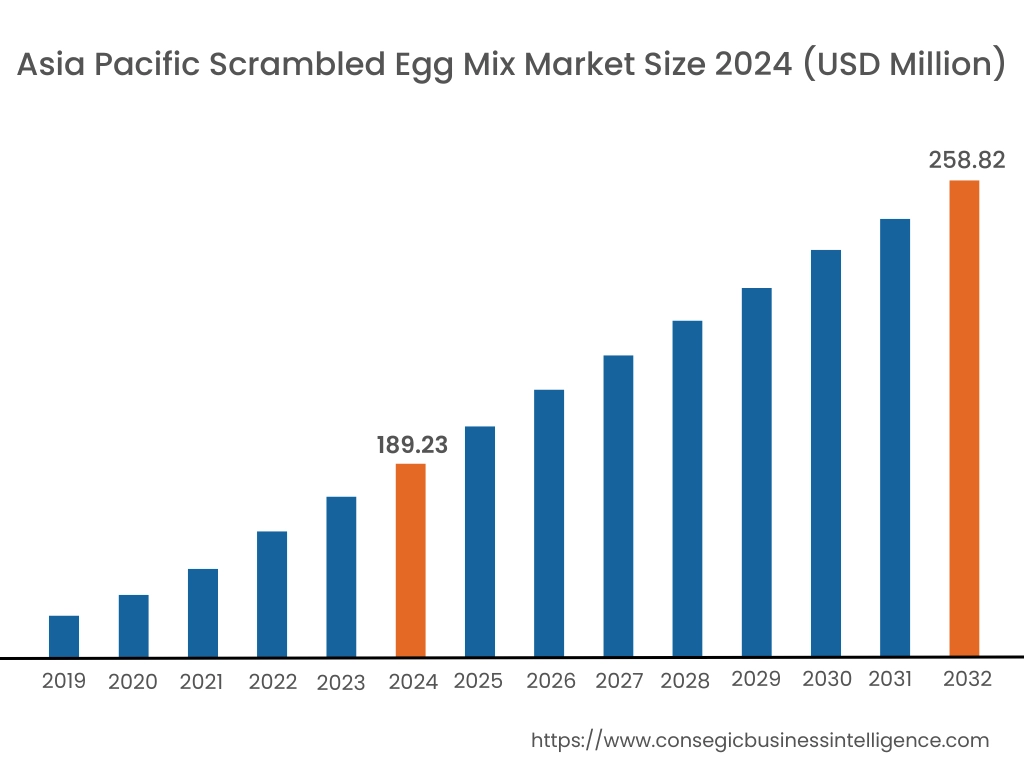
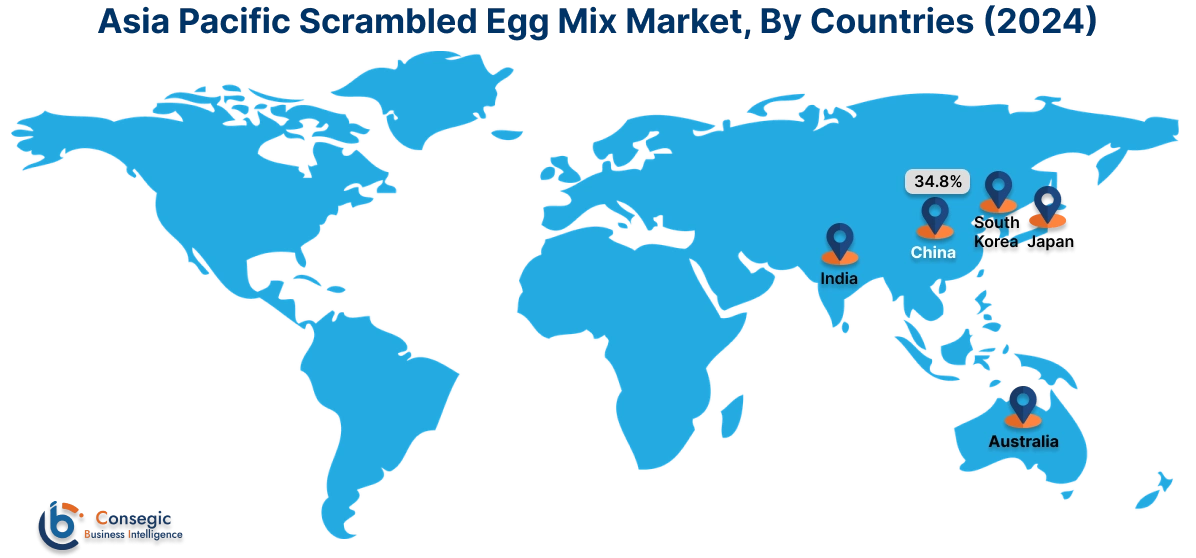
Asia Pacific region was valued at USD 189.23 Million in 2024. Moreover, it is projected to grow by USD 193.14 Million in 2025 and reach over USD 258.82 Million by 2032. Out of this, China accounted for the maximum revenue share of 34.8%. Asia-Pacific is emerging as the fastest-growing region in the scrambled egg mix industry, fueled by rapid urbanization, changing lifestyles, and rising awareness of protein-rich diets. Countries like China, Japan, Australia, and India are witnessing a growing middle-class population and increasing consumption of Western-style breakfast products. Convenience is a major driver, particularly in urban centers, where its ask is increasing in quick-service restaurants, corporate cafeterias, and modern retail chains. Analysis of regional dynamics indicates that the expansion of frozen food infrastructure and the proliferation of dual-income households are accelerating product uptake. Manufacturers are responding by launching locally adapted flavors and packaging formats tailored to diverse consumer segments.
North America is estimated to reach over USD 275.48 Million by 2032 from a value of USD 213.14 Million in 2024 and is projected to grow by USD 216.51 Million in 2025. North America maintains a dominant position in the scrambled egg mix market, primarily due to strong consumer preference for protein-rich breakfast options and a mature market for ready-to-eat and convenience foods. The United States and Canada exhibit a well-established culture of processed and shelf-stable breakfast items, which supports consistent demand across retail and foodservice channels. High adoption of meal kits, on-the-go breakfast products, and institutional foodservice—such as in schools, hospitals, and military bases—continues to reinforce the market. Ongoing innovation in product texture, flavor, and clean-label formulations further bolsters regional growth. Analysis of consumer behavior shows a growing shift toward high-protein, low-preparation products, which sustains a strong trajectory in the coming years.
Europe represents a steadily developing market, where health-conscious dietary patterns and regulatory standards influence product formulation and consumption. Countries such as the United Kingdom, Germany, and the Netherlands have seen increased acceptance of powdered and liquid egg mixes, particularly among commercial kitchens, airlines, and institutional food providers. Market analysis suggests that rising need for vegetarian-friendly protein alternatives and reduced kitchen labor contribute to broader adoption. However, traditional culinary preferences in parts of the region may slow penetration in retail segments. Despite this, the growing foodservice sector and focus on waste reduction create a viable scrambled egg mix market opportunity.
In Latin America, the market is in the developmental stage, with growing traction in commercial and hospitality sectors. Countries such as Brazil, Mexico, and Argentina are experiencing increased requirement from hotels, airlines, and institutional caterers seeking consistent, easy-to-prepare egg products. Analysis reveals that the scrambled egg mix market demand is supported by a need for efficient food preparation in large-scale settings and efforts to minimize foodborne illness risks from shell eggs. While household-level usage is limited, exposure through tourism and global brands is expected to gradually elevate consumer interest.
The Middle East and Africa represent a nascent but promising region for scrambled egg mix, with opportunities arising from the hospitality, education, and healthcare sectors. Gulf nations such as the UAE and Saudi Arabia are investing heavily in tourism and catering services, which contributes to demand for safe, quick-preparation breakfast ingredients. In sub-Saharan Africa, urbanization and institutional feeding programs are introducing shelf-stable egg products to broader audiences. Although current awareness remains relatively low, market analysis suggests that long-term growth will be supported by improvements in cold-chain logistics and regional efforts to adopt nutrient-dense, time-saving meal components.
Top Key Players & Market Share Insights:
The scrambled egg mix market is highly competitive with major players providing products and services to the national and international markets. Key players are adopting several strategies in research and development (R&D), product innovation, and end-user launches to hold a strong position in the global scrambled egg mix market. Key players in the scrambled egg mix industry include -
- Ovostar Europe (Latvia)
- Promin (UK)
- GCF Corporation (USA)
- Lodewijckx NV/SA (Belgium)
- National Food Group (USA)
- Bumble Hole Foods (UK)
- Zeagold Quality Eggs (New Zealand)
- Nestlé S.A. (Switzerland)
- Augason Farms (USA)
- Backpacker's Pantry (USA)
Recent Industry Developments :
Partnerships:
- In June 2024, Grupo Empresarial Palacios Alimentación, the world’s largest producer of Spanish omelets and string chorizo, announced a commercial partnership with US biotech firm The Every Company for use in its flagship Spanish omelets across outlets.
- In December 2022, Michael Foods announced a partnership with Do Good Foods with the launch of Do Good Eggs to upcycle surplus grocery food into nutrient-dense animal feed.
Scrambled Egg Mix Market Report Insights:
| Report Attributes | Report Details |
| Study Timeline | 2019-2032 |
| Market Size in 2032 | USD 849.99 Million |
| CAGR (2025-2032) | 3.6% |
| By Product Type |
|
| By Packaging Type |
|
| By End-Use |
|
| By Distribution Channel |
|
| By Region |
|
| Key Players |
|
| North America | U.S. Canada Mexico |
| Europe | U.K. Germany France Spain Italy Russia Benelux Rest of Europe |
| APAC | China South Korea Japan India Australia ASEAN Rest of Asia-Pacific |
| Middle East and Africa | GCC Turkey South Africa Rest of MEA |
| LATAM | Brazil Argentina Chile Rest of LATAM |
| Report Coverage |
|
Key Questions Answered in the Report
How big is the Scrambled Egg Mix Market? −
Scrambled Egg Mix Market size is estimated to reach over USD 849.99 Million by 2032 from a value of USD 642.54 Million in 2024 and is projected to grow by USD 653.97 Million in 2025, growing at a CAGR of 3.6% from 2025 to 2032.
What specific segmentation details are covered in the Scrambled Egg Mix Market report? +
The Scrambled Egg Mix market report includes specific segmentation details for product type, packaging type, end-use and distribution channel.
Which is the fastest-growing region in the Scrambled Egg Mix Market? +
Asia Pacific is the fastest-growing region in the Scrambled Egg Mix market. These trends are encouraged by rapid urbanization, changing lifestyles, and rising awareness of protein-rich diets.
Who are the major players in the Scrambled Egg Mix Market? +
The key participants in the Scrambled Egg Mix market are Ovostar Europe (Latvia), Promin (UK) , Bumble Hole Foods (UK) , Zeagold Quality Eggs (New Zealand), Nestlé S.A. (Switzerland), Augason Farms (USA), Backpacker's Pantry (USA), GCF Corporation (USA), Lodewijckx NV/SA (Belgium) and National Food Group (USA).
Overview
Reputation & Certifications


Our Services
- Market Intelligence & Forecasting
- Custom Research Solutions
- Market Entry Strategy
- Competitive Intelligence
- Customer Insights
- Industry Innovation Analysis
- Investment Advisory