Jump to Content
Sealant Web Film Market - Size, Share, Industry Trends, and Forecasts (2025-2032)
Sealant Web Film Market Size:
Sealant Web Film Market size is estimated to reach over USD 5.08 Billion by 2032 from a value of USD 3.60 Billion in 2024 and is projected to grow by USD 3.69 Billion in 2025, growing at a CAGR of 4.4% from 2025 to 2032.
Sealant Web Film Market Scope & Overview:
Sealant web film is a specialized thermoplastic material used in flexible packaging to enhance sealing performance, product protection, and shelf stability. It forms a secure barrier against moisture, oxygen, and contaminants, preserving the integrity of packaged goods. The film is compatible with various substrates, ensuring adaptability across different packaging formats.
Key features include high tensile strength, thermal stability, and excellent adhesion properties. Its uniform sealing capability enhances product safety, while its lightweight composition improves handling and efficiency in packaging operations. The material's compatibility with automated processing systems further optimizes production efficiency.
Food packaging, medical supplies, and consumer goods manufacturers rely on the product for its protective and functional qualities. Advancements in polymer technology continue to refine its properties, ensuring improved durability, extended product lifespan, and enhanced packaging performance across diverse industries.

Sealant Web Film Market Dynamics - (DRO):
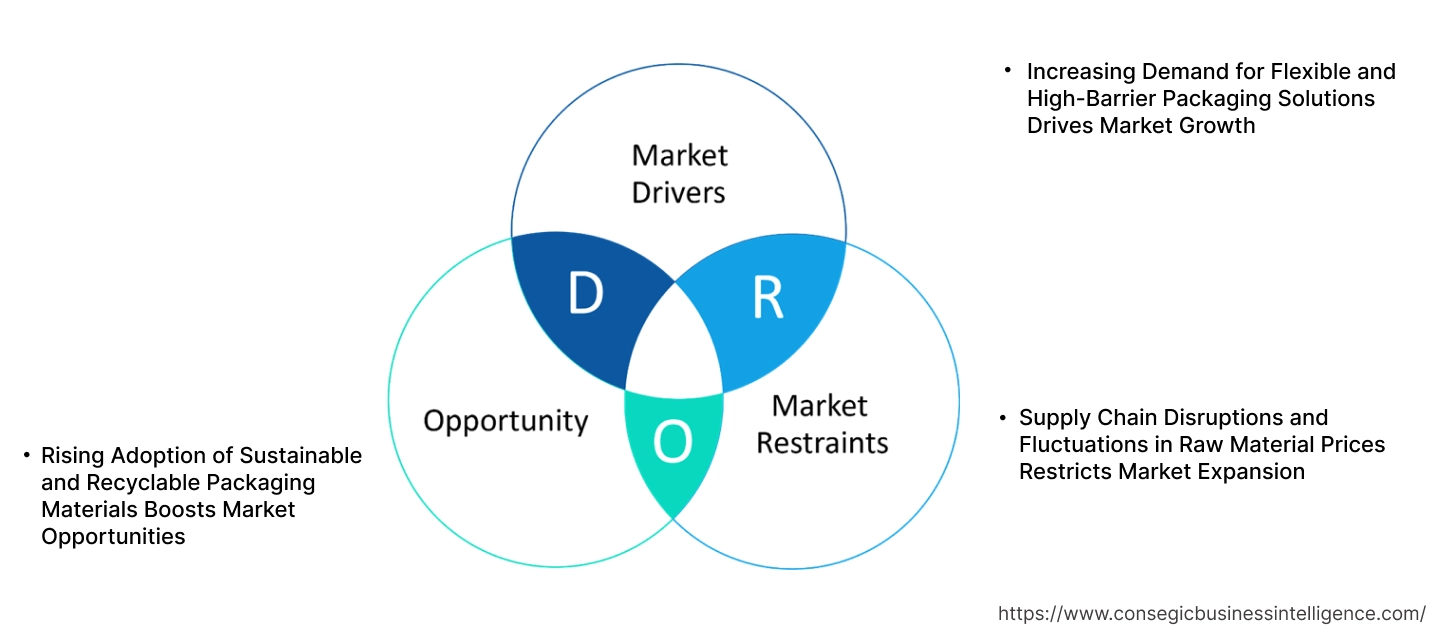
Key Drivers:
Increasing Demand for Flexible and High-Barrier Packaging Solutions Drives Market Growth
Sealant web films offer superior moisture resistance, extended shelf life, and enhanced product protection, making them ideal for vacuum-sealed and modified atmosphere packaging (MAP). The shift toward lightweight and durable materials in flexible packaging accelerates their adoption, as brands seek cost-effective and sustainable alternatives to traditional rigid packaging. Additionally, the growth of e-commerce and direct-to-consumer retailing is increasing the need for secure, tamper-proof, and leak-resistant packaging solutions, in order to ensure product integrity during transit. As consumer preferences shift toward convenient and resealable packaging formats, manufacturers are investing in multi-layered, high-barrier film innovations to meet evolving market needs. These factors are expected to contribute significantly to sealant web film market expansion, reinforcing their role in the future of flexible packaging.
Key Restraints:
Supply Chain Disruptions and Fluctuations in Raw Material Prices Restricts Market Expansion
Sealant web films rely on polyethylene, polypropylene, and other petrochemical-based resins, which are subject to market volatility, geopolitical tensions, and crude oil price fluctuations. Supply chain disruptions, including logistics bottlenecks, transportation delays, and shortages of essential raw materials, increase production costs and lead times, limiting the scalability of manufacturing operations. Additionally, regulatory restrictions on single-use plastics and non-recyclable materials are pressuring manufacturers to invest in alternative raw materials and sustainable production processes, further driving up costs. Companies in the packaging field are focusing on strategic sourcing, localized production, and advanced material research to mitigate these challenges. Addressing these supply chain issues will be essential for sustaining sealant web film market growth, ensuring stability and long-term industry competitiveness.
Future Opportunities:
Rising Adoption of Sustainable and Recyclable Packaging Materials Boosts Market Opportunities
As governments and industries emphasize plastic waste reduction, circular economy initiatives, and eco-friendly alternatives, companies are investing in bio-based and fully recyclable flexible films. The growth of consumer awareness regarding environmental impact is pushing brands to adopt mono-material films, biodegradable coatings, and compostable packaging solutions without compromising seal integrity and product protection. Additionally, regulatory mandates promoting recyclability and material recovery programs are accelerating the shift toward low-carbon, sustainable packaging innovations. Companies investing in water-based adhesives, solvent-free lamination, and energy-efficient production techniques are gaining a competitive edge in the evolving market landscape. As industries transition toward environmentally responsible packaging, these advancements will drive sealant web film market opportunities, positioning sustainability as a key driver of future growth.
Sealant Web Film Market Segmental Analysis :
By Material Type:
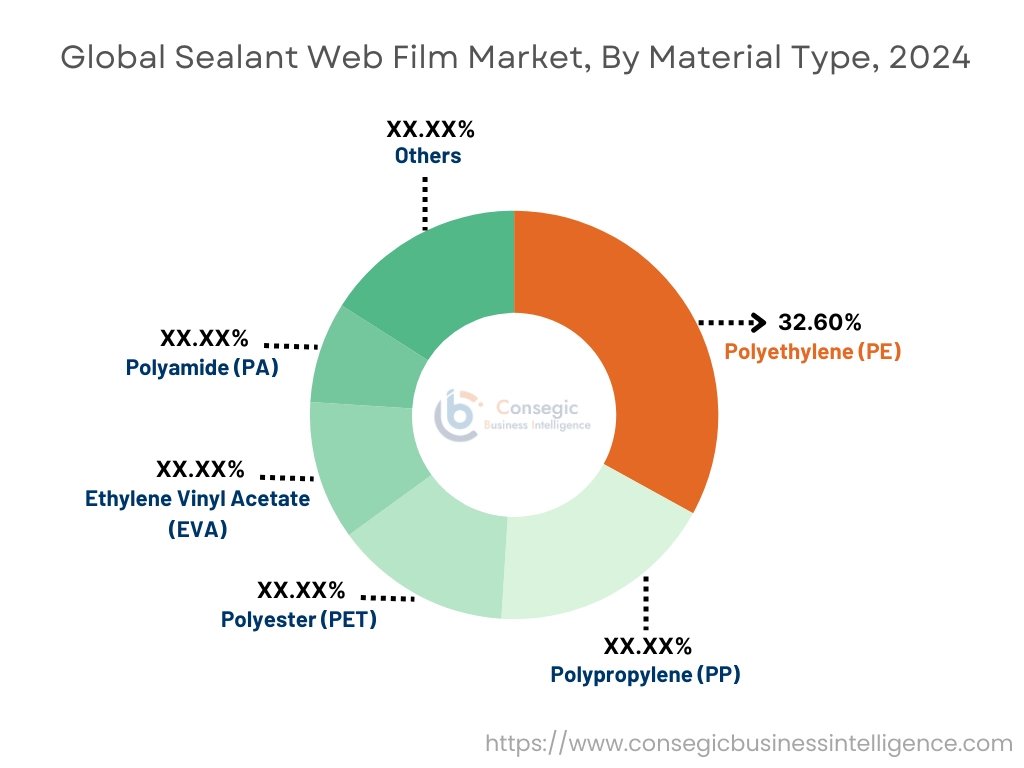
Based on material type, the market is segmented into polyethylene (PE), polypropylene (PP), polyester (PET), ethylene vinyl acetate (EVA), polyamide (PA), and others.
The polyethylene (PE) segment held the largest sealant web film market share of 32.60% in 2024.
- Polyethylene-based films are widely used in flexible packaging due to their excellent heat-sealing properties, flexibility, and cost-effectiveness.
- The need for such films is increasing in food, beverage, and pharmaceutical applications where strong barrier properties are essential.
- Sealant web film market analysis highlights that advancements in multilayer PE films are improving their strength and puncture resistance, making them a preferred choice.
- For instance, in March 2025, Nobelus launched a new line of flexible packaging structures, EcoElement™ PE Thermal Sealants. This polyethylene sealant allows thermal converters to downgauge their packaging structures and access high-quality sealants without purchasing large order quantities.
- As per market trends, manufacturers are focusing on recyclable PE films, catering to the rising preference for sustainable packaging solutions.
The polyester (PET) segment is expected to experience the fastest CAGR during the forecast period.
- PET-based films provide superior thermal stability, clarity, and high mechanical strength, making them ideal for high-performance packaging.
- The demand for such films is growing, particularly in high-barrier packaging applications for pharmaceuticals, personal care, and industrial goods.
- Segmental trends indicate increasing adoption of bio-based and recycled PET films, aligning with sustainability initiatives.
- For instance, in November 2024, Amcor collaborated with Kolon Industries Inc. to co-develop and commercialize more sustainable polyester materials for application in Amcor's flexible packaging business. This agreement will focus on the development of chemically recycled PET (crPET) and polyethylene furanoate (PEF) materials. Ultimately, this partnership aims to provide their customers with more sustainable solutions.
- Thus, with the growing focus on high-performance packaging solutions, this segment is contributing to sealant web film market growth.
By Thickness:
By thickness, the market is segmented into up to 20 microns, 20-50 microns, 50-100 microns, and above 100 microns.
The 20-50 microns segment held the largest share in 2024.
- This thickness range is widely used in flexible packaging solutions across food, pharmaceuticals, and personal care industries.
- The need for medium-thickness films is increasing as brands seek cost-effective yet durable packaging options.
- Market analysis highlights that the 20-50 micron segment provides an optimal balance between strength, flexibility, and cost-efficiency.
- As per sealant web film market trends, brands are optimizing film thickness to enhance sustainability and reduce material waste.
The above 100 microns segment is expected to have the fastest CAGR during the forecast period.
- Thicker films are gaining traction in industrial and heavy-duty applications, where superior puncture resistance is required.
- The need for high-thickness films is increasing in pharmaceutical, industrial, and protective packaging applications.
- Market trends indicate that innovations in multilayer thick films are improving durability and performance.
- Therefore, with increasing requirements for high-barrier protective packaging, this segment is contributing to sealant web film market demand.
By Technology:
Based on technology, the market is categorized into extrusion, coating, and lamination.
The extrusion segment held the largest sealant web film market share in 2024.
- Extrusion technology dominates the market due to its cost efficiency and ability to produce films with uniform thickness and enhanced mechanical properties.
- The need for extrusion-based films is increasing in food packaging and industrial applications where strength and flexibility are essential.
- Segmental analysis highlights that advancements in multilayer extrusion are improving the functionality of these films.
- As per sealant web film market trends, co-extruded films with barrier layers are gaining popularity, ensuring superior product protection.
The lamination segment is expected to experience the fastest CAGR during the forecast period.
- Lamination technology is widely used for producing high-performance multi-layered films, offering enhanced barrier protection and durability.
- The need for laminated sealant web films is increasing in pharmaceutical and medical device packaging, where extended shelf life is crucial.
- Market trends indicate that water-based and solvent-free lamination techniques are becoming industry standards, ensuring sustainability.
- With growing demand for premium protective packaging, this segment is driving sealant web film market expansion.
By End-Use Industry:
By end-use industry, the market is segmented into food & beverage, pharmaceuticals & healthcare, personal care & cosmetics, industrial & manufacturing, retail & consumer goods, and others.
The food & beverage segment held the largest share in 2024.
- Sealant web films play a critical role in food packaging, ensuring product freshness, extended shelf life, and protection from external contaminants.
- The demand for high-barrier packaging films is increasing as brands focus on sustainable, lightweight packaging.
- Sealant web film market analysis suggests that manufacturers are investing in recyclable food packaging solutions to meet regulatory and consumer expectations.
- For instance, Berry Global offers numerous different types of seal films for the F&B sector. These range from general all-purpose films to moisture and oxygen sealant films.
- As per segmental trends, the growing use of antimicrobial and moisture-resistant sealant films, ensures enhanced food safety.
The pharmaceuticals & healthcare segment is anticipated to experience the fastest CAGR during the forecast period.
- Pharmaceutical packaging requires high-performance films with superior barrier properties, ensuring product stability and compliance with stringent regulations.
- The need for medical-grade sealant films is rising, particularly for unit-dose packaging, blister packs, and sterile medical packaging.
- Market trends suggest that innovations in anti-counterfeit packaging technologies are shaping pharmaceutical packaging.
- Thus, with increasing healthcare investments and the need for safe pharmaceutical packaging, this segment is driving sealant web film market demand.
Regional Analysis:
The regions covered are North America, Europe, Asia Pacific, the Middle East and Africa, and Latin America.
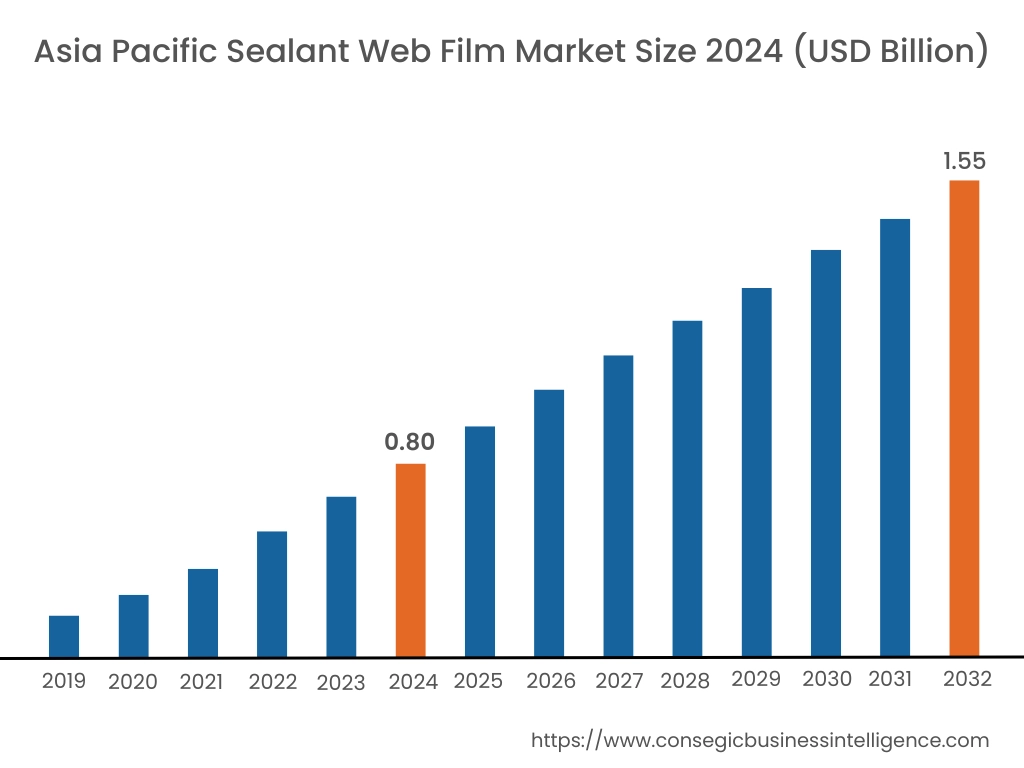
Asia Pacific region was valued at USD 0.80 Billion in 2024. Moreover, it is projected to grow by USD 0.85 Billion in 2025 and reach over USD 1.55 Billion by 2032. Out of this, China accounted for the maximum revenue share of 36.3%. This region holds a significant share of the sealant web film market, driven by rapid industrialization and a burgeoning packaging sector. Countries like China, India, and Japan are at the forefront, with the food and beverage sector being a major consumer of sealant web films. The increasing need for flexible packaging solutions, coupled with a shift towards sustainable materials, presents a substantial sealant web film market opportunity in this region. The presence of numerous small and unorganized packaging manufacturers further contributes to market expansion.

North America is estimated to reach over USD 1.65 Billion by 2032 from a value of USD 1.16 Billion in 2024 and is projected to grow by USD 1.19 Billion in 2025. The North American market is characterized by a strong emphasis on technological innovation and sustainability. The region's advanced manufacturing capabilities and stringent environmental regulations have led to the adoption of eco-friendly films. The food and pharmaceutical sectors are prominent end-users, driving the need for high-quality packaging materials. The market's expansion is also supported by the increasing volume of pharmaceutical and medical products amid post-pandemic recovery.
Europe showcases a mature sealant web film market, with a strong focus on sustainable packaging solutions. The region's commitment to reducing plastic waste has spurred the development and adoption of biodegradable and recyclable sealant web films. The food and beverage sector remains a key driver, with consumers increasingly favoring products with environmentally friendly packaging. The market's rise is further propelled by technological advancements and the implementation of stringent regulatory policies promoting sustainability.
In Latin America, the sealant web film industry is experiencing steady growth, fueled by the expanding food processing and retail sectors. Countries like Brazil and Mexico are witnessing increased demand for flexible packaging solutions to cater to changing consumer lifestyles. However, challenges such as economic volatility and limited access to advanced technologies may hinder rapid market expansion. Nonetheless, the region's growing middle-class population and urbanization trends offer promising opportunities for market players.
The sealant web film market in the Middle East and Africa is in its nascent stage, with growth prospects linked to the development of the food and beverage industry and improving retail infrastructure. The rising adoption of packaged food products, driven by urbanization and changing consumer habits, is expected to boost the demand for sealant web films. However, factors such as political instability and economic challenges may pose constraints to market growth. Despite these hurdles, the region presents untapped potential for market entrants focusing on affordable and adaptable packaging solutions.
Top Key Players & Market Share Insights:
The sealant web film market is highly competitive with major players providing products and services to the national and international markets. Key players are adopting several strategies in research and development (R&D), product innovation, and end-user launches to hold a strong position in the global sealant web film market. Key players in the sealant web film industry include -
- Avery Dennison Corporation (USA)
- Berry Global Inc. (USA)
- DuPont de Nemours, Inc. (USA)
- Amcor Group GmbH (Switzerland)
- Mondi PLC (UK)
- Toray Industries, Inc. (Japan)
- Polyfilm Group (India)
- DIC Corporation (Japan)
- Plastic Suppliers, Inc. (USA)
- Jindal Poly Films Ltd. (India)
Recent Industry Developments :
Product Launches:
- In August 2021, Berry Global unveiled the first comprehensive, commercial-scale clean room for nine-layer blown film manufacturing of pharmaceutical packaging, microchip packaging, sterile intravenous solution bags and medical equipment manufacturing in the US.
Sealant Web Film Market Report Insights:
| Report Attributes | Report Details |
| Study Timeline | 2019-2032 |
| Market Size in 2032 | USD 5.08 Billion |
| CAGR (2025-2032) | 4.4% |
| By Material Type |
|
| By Thickness |
|
| By Technology |
|
| By End-Use Industry |
|
| By Region |
|
| Key Players |
|
| North America | U.S. Canada Mexico |
| Europe | U.K. Germany France Spain Italy Russia Benelux Rest of Europe |
| APAC | China South Korea Japan India Australia ASEAN Rest of Asia-Pacific |
| Middle East and Africa | GCC Turkey South Africa Rest of MEA |
| LATAM | Brazil Argentina Chile Rest of LATAM |
| Report Coverage |
|
Key Questions Answered in the Report
How big is the Sealant Web Film Market? −
Sealant Web Film Market size is estimated to reach over USD 5.08 Billion by 2032 from a value of USD 3.60 Billion in 2024 and is projected to grow by USD 3.69 Billion in 2025, growing at a CAGR of 4.4% from 2025 to 2032.
What specific segmentation details are covered in the Sealant Web Film Market report? +
The Sealant Web Film market report includes specific segmentation details for material type, thickness, technology and end-use industry.
What are the end-use industries in the Sealant Web Film Market? +
The end-use industries in the Sealant Web Film market are food & beverage, pharmaceuticals & healthcare, personal care & cosmetics, industrial & manufacturing, retail & consumer goods, and others.
Who are the major players in the Sealant Web Film Market? +
The key participants in the Sealant Web Film market are Avery Dennison Corporation (USA), Berry Global Inc. (USA), Toray Industries, Inc. (Japan), Polyfilm Group (India), DIC Corporation (Japan), Plastic Suppliers, Inc. (USA), Jindal Poly Films Ltd. (India), DuPont de Nemours, Inc. (USA), Amcor Group GmbH (Switzerland) and Mondi PLC (UK).
Overview
Reputation & Certifications


Our Services
- Market Intelligence & Forecasting
- Custom Research Solutions
- Market Entry Strategy
- Competitive Intelligence
- Customer Insights
- Industry Innovation Analysis
- Investment Advisory