Jump to Content
Secure Access Service Edge Market - Size, Industry Share, Growth Trends and Forecasts (2025 - 2035)
Secure Access Service Edge Market:
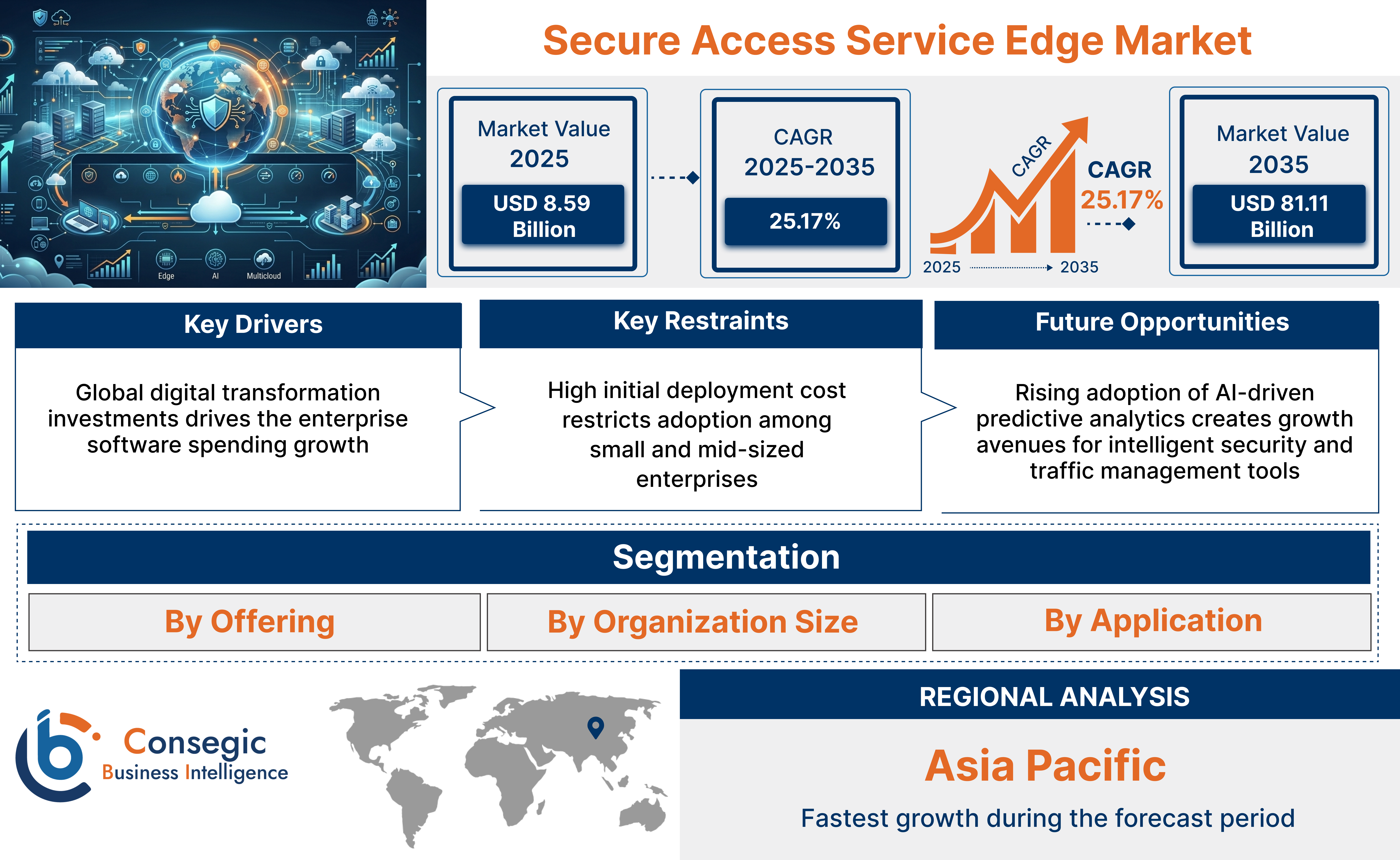
Secure Access Service Edge Market size is estimated to reach over USD 81.11 Billion by 2035 from a value of USD 6.86 Billion in 2024 and is projected to grow by USD 8.59 Billion in 2025, growing at a CAGR of 25.17% from 2025 to 2035
Secure Access Service Edge Market Scope & Overview:
Secure access service edge can be described as a cloud-delivered framework that integrates networking and security into a unified architecture. The secure access service edge industry involves software-defined wide area networking, secure web gateways, cloud access security brokers, zero trust network access, and firewall as a service delivered through centralized cloud platforms. The aim is to offer secure and consistent connectivity for distributed users, branch offices, and cloud applications.
The market for secure access service edge solutions is growing due to an increase in the adoption of new work models and the increasing adoption of public and private cloud platforms for enterprise applications. Enterprises are consolidating standalone security and networking tools into integrated cloud-based platforms to improve visibility and reduce operational complexity. The increasing cyber risks and the need for consistent policies are driving the adoption of secure access service edge solutions by large enterprises and mid-sized companies.
Market Size & Forecast
- 2024 Market Size : USD 6.86 Billion
- 2025 Market Size : USD 8.59 Billion
- 2035 Evaluate Market Size : USD 81.11 Billion
- CAGR (2025-2035) : 25.17%
- Largest growing region : North America
- Fastest growing region : Asia Pacific
How is the Secure Access Service Edge Market Affected by AI?
AI strengthens secure access service edge frameworks through automated traffic analysis, anomaly detection, and policy enforcement across distributed networks. Machine learning models assess user behavior, device conditions, and application access to detect potential threats and unauthorized accesses.
In addition, artificial intelligence-based engines can facilitate the adjustment of policies, inspection of encrypted traffic, and risk-based authentication in cloud and branch environments. Predictive analytics can identify congestion, security incidents, and configuration issues in a network before service disruptions, thereby enabling businesses to maintain performance, compliance, and threat resilience in hybrid environments.
Secure Access Service Edge Market Dynamics - (DRO):
Key Drivers:
Global digital transformation investments drives the enterprise software spending growth
Enterprises are modernizing their network and security infrastructure to support cloud migration, remote workforce, and data-centric models. Digital transformation budgets are increasing spending on cloud-delivered networking and integrated security solutions. Secure access service edge solutions are aligned to the objectives of enterprise businesses, including policy centralization and infrastructure management simplification. Organizations are adopting a new approach to replacing traditional perimeter-based infrastructure with a unified cloud-native approach to enhance operational visibility.
- For instance, in May 2024, Accion has announced a USD 152.5 million fund to facilitate financial institutions catering to small businesses in Asia, Latin America, and Africa in terms of digital transformation initiatives. Rising digitization of financial platforms is increasing demand for secure cloud connectivity and zero trust frameworks in the secure access service edge market.
Therefore, increasing global investments in digital transformation are boosting the adoption of secure access service edge solutions in large enterprises.
Key Restraints:
High initial deployment cost restricts adoption among small and mid-sized enterprises
Implementation of secure access service edge solutions involves subscription licensing, network transformation, endpoint transformation, and policy transformation from existing solutions. Integration with existing data center, branch, and cloud environments increases consulting and configuration expenses. Small and mid-sized enterprises face budget constraints and longer return on investment timelines. Internal skill gaps also increase reliance on external service providers.
Therefore, the high initial deployment cost of secure access service edge solutions is restricting their adoption in small and mid-sized businesses.
Future Opportunities:
Rising adoption of AI-driven predictive analytics creates growth avenues for intelligent security and traffic management tools
Enterprises are also employing artificial intelligence for network monitoring and threat detection systems, which can improve the accuracy of the decision-making process. Secure access service edge platforms are embedding AI engines to strengthen automated policy enforcement and traffic optimization. Demand for data-driven security insights is expanding across cloud-first enterprises.
- In September 2025, Palo Alto Networks has announced the availability of Prisma SASE 4.0 with Prisma Browser, which helps detect evasive, encrypted web threats building inside the browser, along with AI-powered data classification and private app security.
Thus, rising adoption of AI-driven predictive analytics is creating growth opportunities for advanced secure access service edge solutions.
Secure Access Service Edge Market Segmental Analysis:
By Offering:
On the basis of offering, the secure access service edge market is segmented into platform and services.
Trends in the Offering:
- Growing migration toward cloud-native security frameworks is increasing demand for unified platforms.
- Rising complexity of distributed network environments is supporting demand for managed and consulting services.
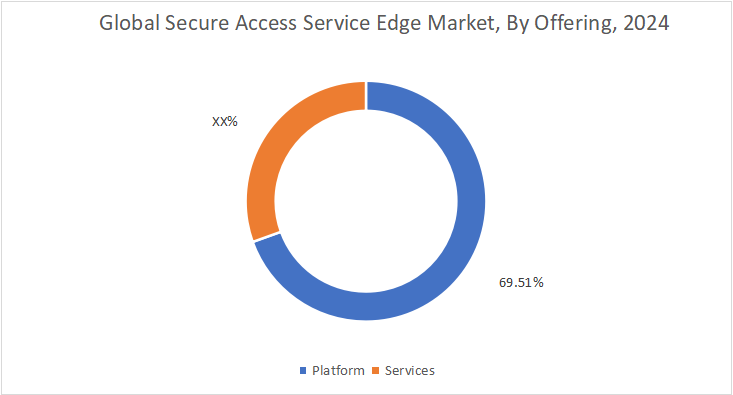
The platform was responsible for the highest revenue share of 69.51% in 2024.
- The features of the platform include SD WAN, secure web gateway, zero trust network access, firewall as a service, and centralized policy management.
- Enterprises are consolidating standalone networking and security tools into integrated cloud-delivered platforms.
- Moreover, the need for centralized visibility across multi-cloud and branch environments is accelerating platform deployment.
- In addition, demand for real-time traffic inspection and consistent policy enforcement is strengthening adoption.
- Therefore, increasing preference for integrated and scalable cloud security frameworks is expected to support the platform segment during the forecast period.
It is anticipated that the services will exhibit the highest compound annual growth rate (CAGR) during the forecast period.
- Services include implementation, system integration, risk assessment, consulting, and managed security operations.
- Organizations require support to migrate from legacy architectures to cloud-based secure access frameworks.
- Furthermore, shortage of in-house cybersecurity expertise is increasing reliance on third-party service providers.
- Moreover, continuous monitoring and policy optimization are expanding long-term service contracts.
- Therefore, growing demand for deployment support and managed security services is expected to boost the services segment during the forecast period.
By Organization Size:
On the basis of organization size, the secure access service edge market is segmented into SMEs and large enterprise.
Trends in the Organization Size:
- Large enterprises are standardizing global security policies.
- SMEs are adopting cloud-first infrastructure models.
The large enterprise was responsible for the highest revenue share in 2024.
- Large enterprises operate multi-branch and multi-cloud environments.
- It requires centralized access control across regions.
- Moreover, higher IT budgets support faster platform deployment.
- In addition, regulatory compliance frameworks require structured security systems.
- Therefore, complex network environments are supporting the large enterprise segment.
It is anticipated that the SMEs will exhibit the highest compound annual growth rate (CAGR) during the forecast period.
- SMEs are shifting toward SaaS and remote access models.
- Cloud-delivered security reduces infrastructure burden.
- Furthermore, rising cyber incidents are driving preventive investments.
- Moreover, managed service providers are offering simplified packages.
- Therefore, increasing digital adoption among SMEs is accelerating segment growth.
By Application:
On the basis of application, the secure access service edge market is divided into IT & telecom, BFSI, manufacturing, retail & e-commerce, healthcare, government, energy & utilities, and others.
Trends in the Application:
- Industry verticals are driving the migration of workloads to cloud platforms.
- Data protection regulations are enhancing the security investments made by the enterprise.
IT & telecom accounted for the largest revenue share in the year 2024.
- IT & telecom firms manage high volumes of distributed network traffic.
- Secure remote connectivity ensures operational continuity across regions.
- Moreover, multi-cloud strategies are increasing secure access requirements.
- In addition, network traffic complexity requires centralized inspection systems.
- Therefore, infrastructure modernization in IT & telecom is sustaining segment dominance.
BFSI is anticipated to register the fastest CAGR during the forecast period.
- Financial institutions process high-value digital transactions daily.
- Encrypted and policy-based connectivity strengthens fraud prevention measures.
- Furthermore, regulatory frameworks mandate advanced access control systems.
- Moreover, expansion of digital banking services increases remote access demand.
- Therefore, digital transformation in BFSI is supporting steady segment expansion.
Regional Analysis:
North America, Europe, Asia Pacific, the Middle East and Africa, and Latin America are the regions of coverage.
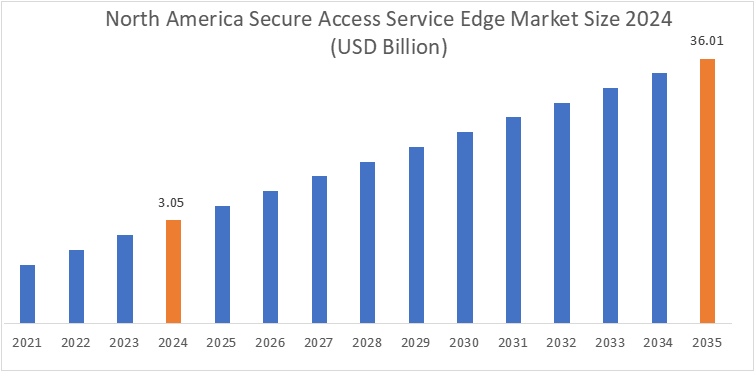
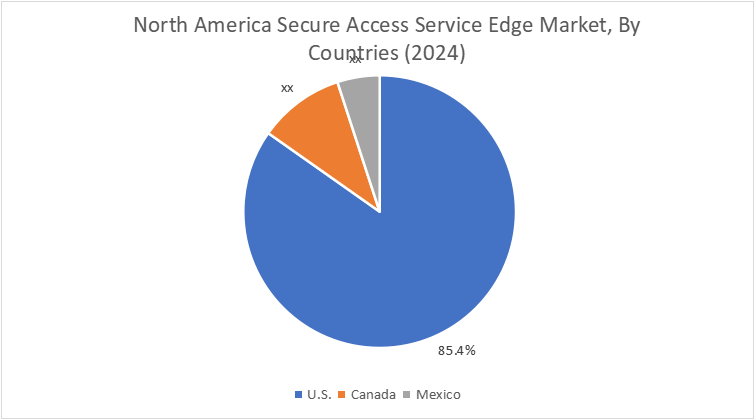
In 2024, North America accounted for the highest market share at 44.4% and was valued at USD 3.05 Billion, and is expected to reach USD 36.01 Billion by 2035. In North America, the U.S. accounted for the highest market share of 85.4% during the base year of 2024. Factors contributing to the growth of the market include early adoption of cloud networking solutions, strong cybersecurity vendors, and high spending by enterprises on digital infrastructure. Large enterprises in the financial services, technology, and healthcare industries are modernizing their traditional network security architectures. Additionally, there is growing investment in cloud-first security architectures in the Canadian market, which supports hybrid workforces.
- For example, in August 2025, AT&T announced its partnership with Cisco to launch its unified solution for SASE, which integrates the strength of AT&T networks with the security and SD-WAN solutions provided by Cisco.
Asia Pacific is expected to grow at the fastest rate during the forecast period. In Asia Pacific, China is expanding enterprise cloud infrastructure in the manufacturing and telecom industries. In Asia Pacific, India is increasing the adoption of cloud-delivered security platforms in the IT services and digital commerce industries. In Asia Pacific, Japan and Korea are strengthening zero trust frameworks to address increasing cyber risk exposure.
- In March 2025, Palo Alto Networks announced the rollout of Prisma Access Browser in Asia Pacific, a SASE native secure browser to improve cybersecurity in a hybrid work environment, including zero trust, data, and malware/phishing protection on managed/unmanaged devices.
Europe market growth is supported by strict data protection regulations across the UK, Germany, and France. Enterprises are upgrading network security frameworks to maintain compliance and standardize secure remote access across cross-border operations.
Latin America is observing steady adoption across Brazil and Mexico due to rising cloud migration among mid-sized enterprises. Organizations are modernizing network infrastructure to secure distributed workforce environments.
Middle East market growth is supported by digital government transformation programs in the UAE and Saudi Arabia. South Africa is strengthening enterprise cybersecurity frameworks to manage increasing cyber threat exposure.
Top Key Players & Market Share Insights:
The secure access service edge market is moderately consolidated, with cloud security vendors, network infrastructure providers, and managed service companies competing for market share. Companies are adding to the capabilities of integrated platforms through strategic acquisitions and partnerships, enhancing zero trust, SD-WAN, and cloud security solutions. Investments in cloud-native infrastructure, AI-based threats, and global data center presence are defining the competitive landscape across various enterprise segments. Key participants in the market for secure access service edge include:
- Palo Alto Networks, Inc. - US
- Cisco Systems, Inc. - US
- Fortinet, Inc. - US
- Zscaler, Inc. - US
- Check Point Software Technologies Ltd. - Israel
- Broadcom Inc. - US
- Netskope, Inc - US
- HPE Aruba Networking - US
- Cloudflare, Inc. - US
- Akamai Technologies, Inc. - US
Recent Industry Developments:
Product Launches
- In February 2026, Cisco added to its AI Defense suite with supply chain governance, runtime protections, and AI-aware SASE to protect agentic AI workflows, as well as IOS XE 26 for post-quantum crypto.
- In January 2026, Kordia launched Secure Edge, a unified SASE solution powered by Fortinet's FortiSASE, merging networking and security to simplify hybrid work, reduce tool sprawl, and provide AI-driven zero-trust access.
Secure Access Service Edge Market Report Insights:
| Report Attributes | Report Details |
|---|---|
| Study Timeline | 2019-2035 |
| Market Size in 2035 (USD Trillion) | USD 81.11 Billion |
| CAGR (2025-2035) | 25.17% |
| By Offering |
|
| By Organization Size |
|
| By Application |
|
| By Region |
|
| Key Players |
|
| Report Coverage |
|
Key Questions Answered in the Report
How big is the secure access service edge market? −
The secure access service edge market size is estimated to reach over USD 81.11 Billion by 2035 from a value of USD 6.86 Billion in 2024 and is projected to grow by USD 8.59 Billion in 2025, growing at a CAGR of 25.17% from 2025 to 2035.
Which segmentation details are covered in the secure access service edge report? +
The secure access service edge report includes specific segmentation details for offering, organization size, application, and regions.
Which is the fastest segment anticipated to impact the market growth? +
Services is the fastest growing segment, driven by rising demand for managed security and deployment support.
Who are the major players in the secure access service edge market? +
The key participants in the secure access service edge market are Palo Alto Networks, Inc. (US), Cisco Systems, Inc. (US), Fortinet, Inc. (US), Zscaler, Inc. (US), Check Point Software Technologies Ltd. (Israel), Broadcom Inc. (US), Netskope, Inc. (US), HPE Aruba Networking (US), Cloudflare, Inc. (US), Akamai Technologies, Inc. (US), and others.
What are the key trends in the secure access service edge market? +
The market is shaped by growing adoption of zero trust frameworks, SD-WAN integration, and cloud-native security platforms.
Overview
Reputation & Certifications


Our Services
- Market Intelligence & Forecasting
- Custom Research Solutions
- Market Entry Strategy
- Competitive Intelligence
- Customer Insights
- Industry Innovation Analysis
- Investment Advisory