Jump to Content
Security Analytics Market - Size, Share, Industry Trends, and Forecasts (2025-2035)
Security Analytics Market:
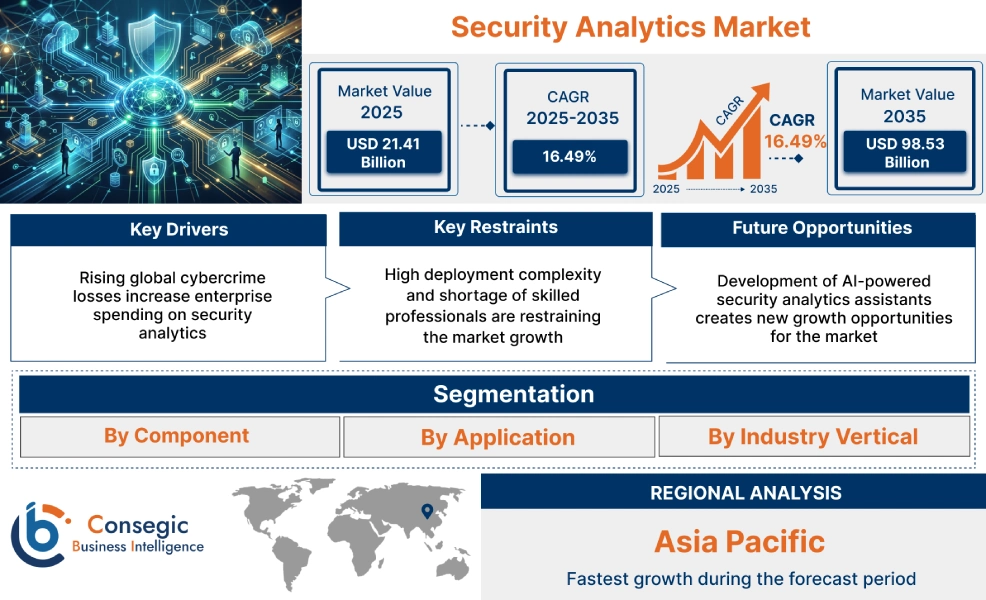
Security Analytics Market size is estimated to reach over USD 98.53 Billion by 2035 from a value of USD 18.38 Billion in 2024 and is projected to grow by USD 21.41 Billion in 2025, growing at a CAGR of 16.49% from 2025 to 2035
Security Analytics Market Scope & Overview:
Security analytics can be described as the use of advanced tools and technology to monitor and analyze security-related data in order to detect, prevent, and respond to cyber threats. This includes solutions such as threat intelligence platforms, security information and event management systems, user behavior analytics, and incident response solutions. These solutions are commonly used in the banking, healthcare, government, retail, and IT sectors to protect critical data and infrastructure.
The market is expanding owing to the rising number of cyberattacks and the rising digital transformation of businesses. The rising regulatory requirements for data protection are also fueling the adoption of solutions. The advancements in artificial intelligence and machine learning are improving the accuracy of threat detection and response, which is also adding to the growth of the market.
How is AI Impacting the Security Analytics Market?
AI uses machine learning to analyze large volumes of network logs, user behavior data, and threat intelligence feeds to detect anomalies and potential cyber threats in real time. In addition, AI helps in the identification of patterns related to advanced persistent threats and zero-day attacks, which improves the accuracy of threat detection. In addition, AI helps in automated incident response, which reduces the time taken to respond to threats. Furthermore, AI helps in continuous learning from dynamic patterns of attacks, which improves predictive threat modeling and overall cybersecurity resilience.
Regional Analysis:
North America, Europe, Asia Pacific, the Middle East and Africa, and Latin America are the regions of coverage.
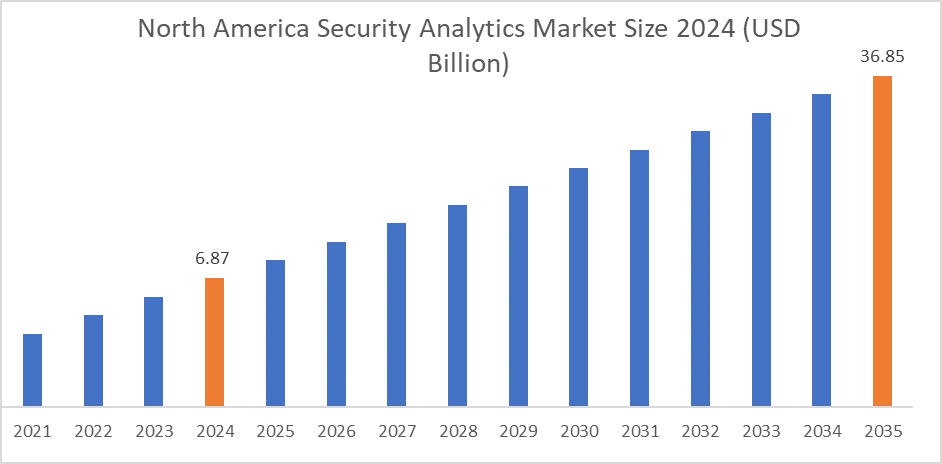
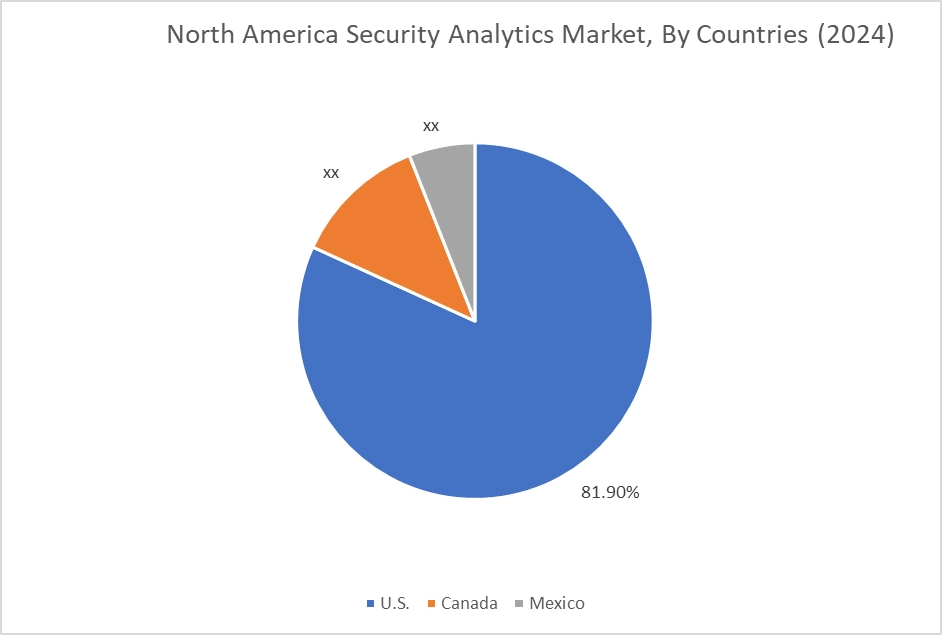
In 2024, North America accounted for the highest market share at 37.40% and was valued at USD 6.87 Billion, and is expected to reach USD 36.85 Billion by 2035. In North America, the U.S. accounted for the highest market share of 81.90% during the base year of 2024. North America security analytics market growth is supported by high cyberattack frequency, cloud-native enterprise environments, and strong cybersecurity spending in the United States and Canada. Federal cybersecurity mandates and zero-trust architecture adoption are increasing deployment of advanced analytics platforms for threat detection and response, thereby driving market growth.
- For instance, in December 2025, the Cybersecurity and Infrastructure Security Agency released the latest cross-sector cybersecurity performance goals (CPG 2.0) to improve the protection of critical infrastructure. The adoption of these guidelines is raising the need for advanced analytics and real-time monitoring tools among enterprises in the US.
In Asia Pacific, the security analytics market is projected to witness the fastest growth over the forecast period. Asia Pacific security analytics market growth is supported by rising cyber incidents, rapid digital infrastructure expansion, and increasing cloud adoption across China, India, Japan, and South Korea. The rise in digital payments, e-commerce, and cloud migration among enterprises is raising the need for threat detection, behavioral analytics, and SIEM solutions, thus fueling the growth of the market.
- For instance, the International Telecommunication Union reported in its 2024 Global Cybersecurity Index that countries in the Asia Pacific region are actively strengthening national cybersecurity frameworks and incident response capabilities. Expansion of regulatory and institutional cybersecurity measures is increasing enterprise adoption of advanced security analytics tools in the region.
Europe security analytics market growth is supported by strict data protection regulations, cross-border digital infrastructure, and increased ransomware incidents across Germany, France, and the UK. Compliance requirements under GDPR and national cybersecurity laws are encouraging enterprises to deploy advanced monitoring, log management, and threat intelligence systems, thereby driving market growth.
Latin America security analytics market growth is supported by rising digital banking adoption, expansion of fintech ecosystems, and growing regulatory oversight in Brazil, Argentina, and Chile. Increasing online transaction volumes are prompting financial institutions to deploy fraud detection and threat intelligence platforms, thereby driving market growth.
Middle East & Africa security analytics market growth is supported by national cybersecurity strategies, expansion of digital government platforms, and increased cyber risk exposure in the UAE, Saudi Arabia, and South Africa. Public sector digitalization and smart city initiatives are increasing deployment of advanced monitoring and threat analytics systems, thereby driving market growth.
Security Analytics Market Segmental Analysis:
By Component:
Based on component, the security analytics market is segmented into solutions and services.
Trends in the Component:
- The increasing frequency of cyberattacks is driving demand for advanced security analytics solutions.
- The increasing complexity of IT infrastructure is driving the demand for professional security services.
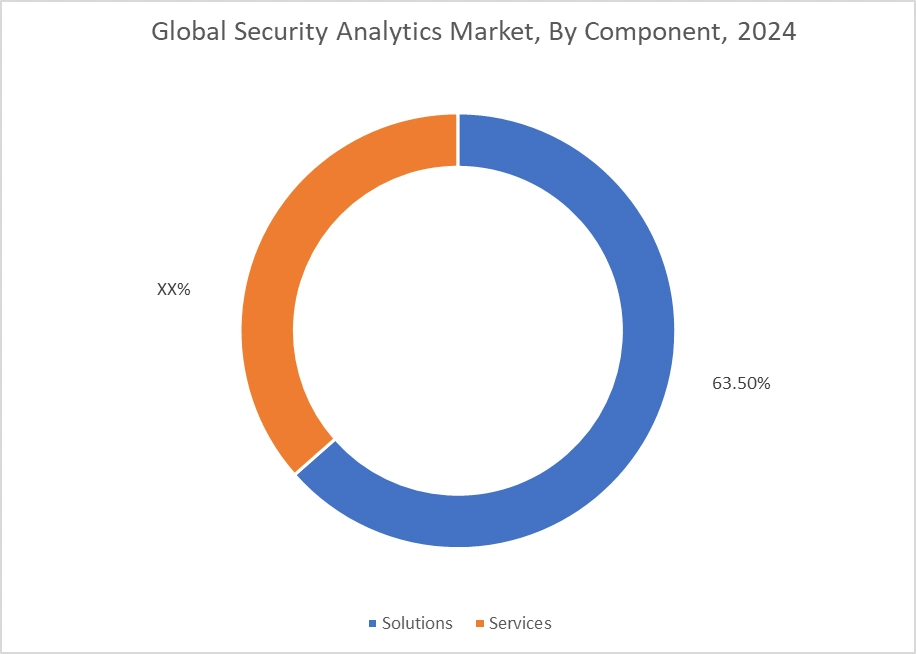
Solutions accounted for the largest revenue share of 63.5% in the year 2024.
- Security analytics solutions comprise SIEM, threat intelligence platforms, and behavior analytics solutions. These solutions enable the detection and response to threats.
- The use of these platforms enables organizations to track network traffic and detect malicious behavior. This enhances security posture.
- Moreover, the integration of AI and machine learning is improving the accuracy of threat detection.
- Additionally, the increasing use of cloud and hybrid infrastructure is driving the demand for scalable security solutions.
- Thus, as per the security analytics market analysis, increasing cyber threats and need for real-time monitoring are driving dominance of solutions.
Services are anticipated to register the fastest CAGR during the forecast period.
- Services include consulting, integration, and managed security services. These services help in effective deployment and monitoring.
- Organizations require expert support to manage complex security systems. This supports segment growth.
- Additionally, the shortage of skilled cybersecurity professionals is increasing reliance on managed services.
- Further, continuous threat monitoring and incident response needs are accelerating adoption.
- Therefore, as per the market analysis, rising demand for expert guidance and managed detection services is expected to boost the services segment during the forecast period.
By Application:
Based on application, the security analytics market is segmented into web security analytics, network security analytics, endpoint security analytics, application security analytics, and others.
Trends in the Application:
- The increasing number of network-based cyberattacks is driving demand for network security analytics.
- The growing adoption of remote work and connected devices is supporting the need for endpoint security analytics.
Network Security Analytics accounted for the largest revenue share in the year 2024.
- Network security analytics helps organizations monitor network traffic in real time. It detects unusual patterns and potential threats.
- These solutions analyze large volumes of data across enterprise networks. This improves threat visibility.
- Additionally, the rise in ransomware and advanced persistent threats is increasing demand for network monitoring tools.
- Further, expansion of cloud and hybrid infrastructures is supporting segment growth.
- Thus, as per the security analytics market analysis, rising network threats and data traffic are driving dominance of network security analytics.
Endpoint Security Analytics is anticipated to register the fastest CAGR during the forecast period.
- Endpoint security analytics focuses on monitoring devices such as laptops, servers, and mobile devices. It detects malicious activity at the device level.
- The increase in remote workforce and BYOD policies is supporting segment growth.
- Additionally, growing cyber risks targeting endpoints are accelerating adoption.
- Further, integration of AI-based threat detection is improving response speed and accuracy.
- Therefore, as per the market analysis, increasing endpoint vulnerabilities and remote work trends are expected to boost the endpoint security analytics segment during the forecast period.
By Industry Vertical:
Based on industry vertical, the security analytics market is segmented into BFSI, healthcare, IT & telecommunications, retail & e-commerce, government, energy & utilities, manufacturing, and others.
Trends in the Industry Vertical:
- The increasing volume of digital financial transactions is driving demand for security analytics in the BFSI sector.
- The growing number of cyberattacks on critical infrastructure is supporting adoption in government and energy sectors.
BFSI accounted for the largest revenue share in the year 2024.
- The BFSI sector handles large volumes of sensitive financial data. It requires continuous monitoring.
- Security analytics helps detect fraud and prevent data breaches. It improves regulatory compliance.
- Additionally, the rise in digital banking and mobile payments is increasing cyber risk exposure.
- Further, strict data protection regulations are driving investment in advanced threat detection platforms.
- Thus, as per the security analytics market analysis, high data sensitivity and fraud risks are driving dominance of the BFSI segment.
Healthcare is anticipated to register the fastest CAGR during the forecast period.
- Healthcare organizations manage patient records and clinical data. These systems are frequent targets of cyberattacks.
- Security analytics helps detect ransomware and unauthorized access. It improves patient data protection.
- Additionally, the growth of telehealth and connected medical devices is increasing endpoint vulnerabilities.
- Further, regulatory compliance requirements are supporting adoption of advanced monitoring solutions.
- Therefore, as per the market analysis, rising cyber threats and digital health expansion are expected to boost the healthcare segment during the forecast period.
Security Analytics Market Dynamics - (DRO):
Key Drivers:
Rising global cybercrime losses increase enterprise spending on security analytics
The market for security analytics is growing due to the increasing economic impact of cybercrime. As cyberattacks are becoming more sophisticated, organizations are turning to advanced analytics solutions to identify potential threats early and reduce their economic risk. Security analytics tools help lower breach impact by improving visibility, automating threat detection, and accelerating response time.
The increasing financial impact of cyber incidents is directly affecting the budget allocated for cybersecurity. Organizations are also concentrating on the implementation of analytics-based security models to protect their vital data.
- For example, in November 2024, the FBI reported that the loss of money because of cybercrime in the United States was USD 12.5 billion in 2023, which is a 22% increase from 2023.
Therefore, the growing economic impact of cybercrime and data breaches is driving the implementation of security analytics solutions.
Key Restraints:
High deployment complexity and shortage of skilled professionals are restraining the market growth
Security analytics tools need to be integrated with the existing IT infrastructure. Implementation can be a complex and time-consuming process. Upgrades in the system may be required before implementation. This can be expensive and time-consuming. There is also a talent gap in the field of cybersecurity. Qualified professionals are needed to handle advanced analytics tools. In-house talent is lacking in small to mid-sized businesses.
Therefore, deployment complexity and limited skilled workforce are restraining the security analytics market expansion.
Future Opportunities:
Development of AI-powered security analytics assistants creates new growth opportunities for the market
The rising volume of cyber threats is increasing the need for faster threat detection and response. Organizations are implementing AI-based security analytics solutions to enhance incident analysis and response times. Security teams are experiencing alert fatigue and attack complexity. However, the current scenario is also creating a demand for automated analytics solutions that can make the process of threat analysis simpler.
- For example, in March 2024, Cloudflare announced the launch of an AI-powered Security Analytics Assistant that claims to help security analysts analyze threats, comprehend logs, and investigate incidents using natural language queries. The tool helps in faster decision-making by making complex security data analysis simpler.
Therefore, the announcement of the launch of AI-powered security analytics assistants is expected to enhance the efficiency of threat detection and the adoption of advanced analytics platforms, thus creating future opportunities in the security analytics market.
Top Key Players & Market Share Insights:
The global security analytics market is quite competitive, with the leading cybersecurity and enterprise technology companies offering innovative threat detection and risk management solutions in the domestic as well as international markets. The key players in the industry are using a number of approaches in research and development, AI-powered analytics innovation, cloud-based security integration, and product launches to keep a strong foothold in the security analytics market. Companies are focusing on real-time threat intelligence, automated risk prioritization, extended detection and response platforms, and centralized security monitoring to address the rising complexity of cyber threats and regulatory compliance requirements. The key players operating in the security analytics market are:
- IBM Corporation (U.S.)
- Cisco Systems, Inc. (U.S.)
- Splunk Inc. (U.S.)
- Palo Alto Networks, Inc. (U.S.)
- Fortinet, Inc. (U.S.)
- Broadcom Inc. (U.S.)
- Check Point Software Technologies Ltd. (Israel)
- Microsoft Corporation (U.S.)
- RSA Security LLC (U.S.)
- Elastic N.V. (Netherlands)
Recent Industry Developments:
- In December 2025, Amazon Web Services announced that AWS Security Hub became generally available with near real-time analytics and automated risk prioritization. The launch enables organizations to centrally manage security findings across AWS accounts and integrated partner solutions, improving visibility and security posture management.
Security Analytics Market Report Insights:
| Report Attributes | Report Details |
|---|---|
| Study Timeline | 2019-2035 |
| Market Size in 2035 (USD Trillion) | USD 98.53 Billion |
| CAGR (2025-2035) | 16.49% |
| By Component |
|
| By Application |
|
| By Industry Vertical |
|
| By Region |
|
| Key Players |
|
| Report Coverage |
|
Key Questions Answered in the Report
How big is the security analytics market? −
The security analytics market size is estimated to reach over USD 98.53 Billion by 2035 from a value of USD 18.38 Billion in 2024 and is projected to grow by USD 21.41 Billion in 2025, growing at a CAGR of 16.49% from 2025 to 2035.
Which segmentation details are covered in the security analytics report? +
The security analytics report includes specific segmentation details for component, application, industry vertical, and regions.
Which is the fastest segment anticipated to impact the market growth? +
In the security analytics market, the healthcare segment is anticipated to be the fastest-growing segment during the growth of telehealth and connected medical devices.
Who are the major players in the security analytics market? +
The key participants in the security analytics market are IBM Corporation (U.S.), Cisco Systems, Inc. (U.S.), Splunk Inc. (U.S.), Palo Alto Networks, Inc. (U.S.), Fortinet, Inc. (U.S.), Broadcom Inc. (U.S.), Check Point Software Technologies Ltd. (Israel), Microsoft Corporation (U.S.), RSA Security LLC (U.S.), Elastic N.V. (Netherlands), and others.
What are the key trends in the security analytics market? +
The security analytics market is being shaped by several key trends including integration of AI and machine learning for advanced threat detection, increasing use of behavior analytics to identify insider threats, growing demand for automated incident response solutions, and rising regulatory requirements for data protection and cybersecurity compliance.
Overview
Reputation & Certifications


Our Services
- Market Intelligence & Forecasting
- Custom Research Solutions
- Market Entry Strategy
- Competitive Intelligence
- Customer Insights
- Industry Innovation Analysis
- Investment Advisory