Jump to Content
Self-Contained Breathing Apparatus Market - Size, Share, Industry Trends, and Forecasts (2025 - 2035)
Self-Contained Breathing Apparatus Market Scope & Overview
The global self-contained breathing apparatus (SCBA) market is a mission critical industry segment of the personal protective equipment, respiratory protection market used as life-saving equipment in oxygen deficient, toxic, or hazardous atmosphere environments during firefighting, industrial emergency response, confined space entry, chemical processing, mining operations and other special needs in the military market. It is estimated that the market is USD 4,280 Million in 2024, USD 4,550 Million in 2025 (base year) with the future prospects of increasing to USD 7,920 Million in 2035. This growth trend demonstrates a compounded every-year growth rate (CAGR) of 5.7% during this forecast period (2026-2035) due to strict safety regulations in the workplace, the rise in frequency of industrial accidents and emergencies, the growth in economic awareness about the health and safety of firefighters, technological development of light weight materials and smart monitoring systems, and the development of industrial infrastructure in emerging economies.
Key Market Insights
- The Self-Contained Breathing Apparatus (SCBA) market is expected to grow from USD 4,550 million in 2025 to USD 7,920 million by 2035, at a CAGR of 5.7% (2026–2035)
- SCBA systems are critical life-saving respiratory protection equipment used in firefighting, industrial emergencies, mining, chemical processing, and military operations
- Market growth is driven by strict workplace safety regulations, rising industrial accidents, and increasing focus on firefighter and worker safety
- Technological advancements such as lightweight materials and smart monitoring systems are further supporting market expansion
- Industrial growth in emerging economies is also contributing to increasing demand for SCBA equipment

The Self-contained breathing apparatus systems are made up of packaged units such as high-pressure compressed air cylinders (high pressure normally 200-300 bar pressure), pressure regulators, face mask units, which contain positive pressure demand valves, harness and backplate systems, heads-up displays, and emergency warning systems that combine to offer respiratory protection covering periods between 30-90 minutes depending on the cylinder capacity, the breathing rates and intensity of operation. As of 2024, the installed base of SCBA units is over 3.85 million units with the annual procurement and replacement demand of about 485,000 units priced at the current market size and serving about 2.8 million firefighters, 1.2 million industrial workers, and specialized in military, aviation, marine, and emergency medical services worldwide.
Distribution Analysis:
The distribution analysis of the market is conducted in the following manner:
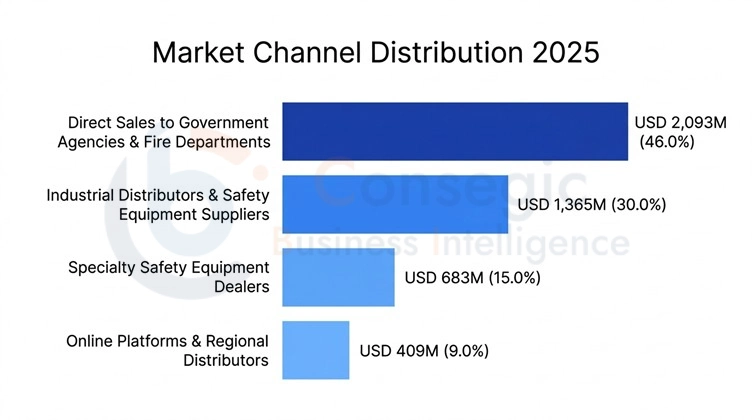
The self-contained breathing apparatus market has the advantage of having four different sales and delivery channels, each accommodating particular customer groups with differentiated value propositions and models of services. The overall market revenue scene indicates that the distribution is highly varied in terms of the type of customer, the way it was procured, and the geographic factor:
Direct Sales to Government Agencies and Fire Departments USD 2,093 Million (46.0% of total market value)
- Industrial Distributors & Safety Equipment Suppliers: USD 1,365 Million (30.0% of market revenue)
- Specialty Safety Equipment Dealers USD 683 Million (15.0% of market share)
- Online Platforms and Regional Distributors USD 409 Million (9.0% of total market value)
By 2024, global investment in SCBA development, smart sensor integration, and advanced materials research hit USD 425 Million with large manufacturers committing about 6.8% of the revenue to the development of lighter weight systems, enhancement in air supply duration, real-time health integration monitoring, thermal protection, and commercialization of communication systems to improve operational coordination. There is a paradigm shift to connected SCBA systems, which include telemetry, location tracking, and physiological monitoring functionality in the industry, and this is being adopted in massive numbers by professional fire services, industrial facilities, and special response teams.
Market Dynamics (DRO) of Self-Contained Breathing Apparatus.
Key Drivers:
Bureaucratic Occupational Safety Rules and Obligations.
The greatest structural contributor is the fact that the occupational safety rules are becoming stricter and require respiratory protection in dangerous worksites in industrial, emergency response, as well as confined space use. In the United States, European Directive 89/686/EEC and other similar national regulations in more than 125 countries set requirements which are mandatory regarding the provision and maintenance of SCBA and the associated training and replacement cycles of SCBA equipment in the firefighting activities, chemical production, petroleum refining, mining and other emergency response activity sectors.
NFPA 1981 and NFPA 1982 standards in North America require extensive testing, certification and replacement of SCBA systems which are normally to be retired after 15 years of usefulness or after being exposed to extreme heat conditions irrespective of apparent functionality. The European EN 137 standards provide similar requirements and provide a sustained replacement demand regardless of unit failures. It is estimated that about 285,000 units of SCBA retire out of developed markets every year, which translates to USD 2,850 Million of the replacement market value during the forecast period.
Increasing Incidents of Industry Accidents and Emergencies.
The constant presence of industrial accidents, chemical releases, confined space events, and structural fires give sustained demand of SCBA equipment and is the cause of ever-improving technology to make the firefighters and industrial worker safer. The statistics of industrial accidents around the globe suggest that about 374,000 people die at the workplace every year, with respiratory risks being some of the major causative factors in chemical, mining, and tunneling accidents.
Large-scale industrial incidents such as refinery explosions, releases of chemicals plants, and mining disasters bring about increased awareness and regulatory attention, usually leading to increased safety equipment requirements and shortened replacement periods. The 2024 industrial incident data revealed that there were 1,850 significant incidents that were releases of hazardous materials in the United States alone which demanded emergency response with SCBA protection to the first responders and the facility employees.
Health and Cancer Prevention Initiatives: Firefighters.
The emerging scientific evidence of firefighter occupational exposures increasing cancer rates and long-term chronic health issues is motivating far-reaching safety measures such as respiratory protection, better decontamination efforts, and longer SCBA usage during an overhaul operation process. Studies that have shown that the firefighters are at 14 and 9 percent more exposed to cancer and have a higher death rate to the cancer than the general population have sparked changes in policies that need firefighters to carry the SCBA during all fire ground operations including investigation and overhaul jobs that were performed without respiratory protection.
Key Restraints:
Huge Acquisition Costs and Financial restrictions.
SCBA systems are considered great capital investments to the fire departments, industrial facilities, and emergency response organizations with full systems of 7 cylinders, face pieces, and accessories typically costing USD 5,500-8,500 per unit in the case of professional-grade firefighting and USD 4,200-6,800 in the case of industrial. Small and rural fire departments with small budgets frequently lack sufficient SCBA stocks and turnover frequencies, and about 38% of American fire services have SCBA units that have surpassed their suggested servicability owing to their financial circumstances.
The financial pressures of municipal budgets, other capital demands and economic ambiguities generate delays in procurements and long replacement periods that smother market development to the lowest safety thresholds. The funding situation in volunteer fire departments with populations of 26,000 or so around the United States is especially acute, as the mean equipment budget of USD 45,000-125,000/year caters to the entire requirements in terms of apparatus, tools, and protective equipment.
Physical User Fatigue and Burden Constraints.
Regardless of ongoing weight loss programs, SCBA systems continue to be physically demanding devices that place a weight burden of 9-14 kilograms to firefighter weight loads with a variable cylinder capacity and design. This extra weight in addition to protective clothing, tools, and equipment incurs great physiological burden especially when performing prolonged operations, on high-rise fire, and under extreme environments. Research shows that SCBA weight is contributing to cardiovascular load, shortened working time, and heightened risk of injury, especially in old-age populations of firefighters.
Future Opportunities:
Connected Safety Systems and Smart SCBA.
The intersection of the SCBA technology with the Internet of Things sensors, wireless communication, and data analytics provides the transformative potential of improving situational awareness and enhancing real-time accountability of the personnel and predictive safety interventions. The introduction of Smart SCBA systems with pressure sensors, location sensors, motion sensors, and physiological sensors allows the incident commanders to observe pressure, location, orientation, and distress indicators of individual firefighters in real-time using integrated command systems.
The smart SCBA market experienced USD 485 Million in 2024 with 18.5% yearly growth with large metropolitan fire departments, industrial plants with advanced safety programmes and military special operations units being the main adoption drivers. The sophisticated systems also include head up displays with remaining air time, thermal imaging integration, buddy breathing alarms, and automatic activation of distress signals in case firefighters motionlessly remain or have rapid air pressure loss.
Longer Period and Less Massive Materials.
New composite materials used in cylinder construction, optimization in pressure vessel design and in optimizing air supply allow the creation of longer-duration SCBA systems with 75-90 minutes of operational life and at the same time maintain or decrease the overall system weight as compared to traditional 45-60 minute setups. Carbon fiber wrapped cylinders with state-of-the-art resin systems result in 30-35 percent weight savings over traditionally cast steel or aluminum cylinders with a higher pressure of up to 300 bar.
Market Segmentation Analysis
By Type:
Open-Circuit SCBA:
SCBA systems based on open circuits continue to dominate the market leadership at USD 3,913 Million or 86.0 of the entire market value in the year 2025 with an estimated USD 6,811 Million of the same in 2035 at 5.7 percent CAGR. This design vents the exhaled air directly to the air instead of recycles it, has simpler operation with lower acquisitions costs, less maintenance needs, and has a record of reliability in firefighting and industrial use.
In firefighting, open-circuit systems are predominant in most situations where fire fighting operation times of 30-60 minutes are adequate to manage most structural fire fighting operations and that the cylinder capacity of 6.8 liters at 300 bar or 9 liters at 200 bar is adequate to supply the necessary amount of air. The segment has the advantages of well-established training standards, extensive service infrastructure and also has an economic edge over closed-circuit systems.
Closed-Circuit SCBA:
Closed-circuit rebreather SCBA systems take USD 637 Million (14.0) of total market value, to use in special applications with long duration of use such as mine rescue, submarine escape, aviation emergency oxygen, and military special operations where the 2-4 hours of operational usage warrants the significantly higher costs and maintenance complexity.
Through Application: End-Use Sector Analysis.
Firefighting
The highest segment will be firefighting applications at USD 2,548 Million in 2025 which will be 56.0% of total market value and USD 4,435 Million in 2035 with a 5.7% CAGR. This includes structural firefighting, wildland firefighting, airport rescue firefighting, marine fighting, and industrial fire brigade that involves the use of respiratory protection in a puff of smoke, in the absence of oxygen and in deadly situations.
The international firefighter population is estimated to be 2.8 million career and volunteer firefighters with the developed markets having a ratio of 1.2-1.8 firefighters to every thousand population. Large metropolitan fire departments maintain SCBA inventories of 1.5-2.0 to one firefighter to be sufficient in the case of maintenance, testing, and concurrent incident responses.
Industrial Applications:
The Industrial application is USD 1, 547 Million (34.0%), which includes chemical manufacturing, petroleum refining, mining activities, pharmaceutical production, confined space entry and emergency response teams within the industrial premises. Industries that work with OSHA IDLH standards have SCBA systems used in emergency escape and rescue cases as well as normal maintenance in dangerous atmosphere.
Other Applications
Military, marine, aviation and special applications are also USD 455 Million (10.0) totaling submarine operations, aircraft emergency oxygen, hazardous material response, and special operations forces need of respiratory protection under a variety of difficult conditions.
By Cylinder Material:
Composite Cylinders:
The market is dominated by composite cylinders (carbon fiber wrapped) at USD 3,185 Million (70.0%), which have a high pressurization of 30-50% weight reduction over steel alternatives with high pressures of up to 300 bar to long operation durations.
Aluminum Cylinders and Steel Cylinders.
The cylinders made of steel and aluminum are combined USD 1,365 Million (30.0) and it is used in cost sensitivity, training use and industrial activities where weight is not a vital factor as compared to the first cost benefits.
Regional Market Analysis
North America
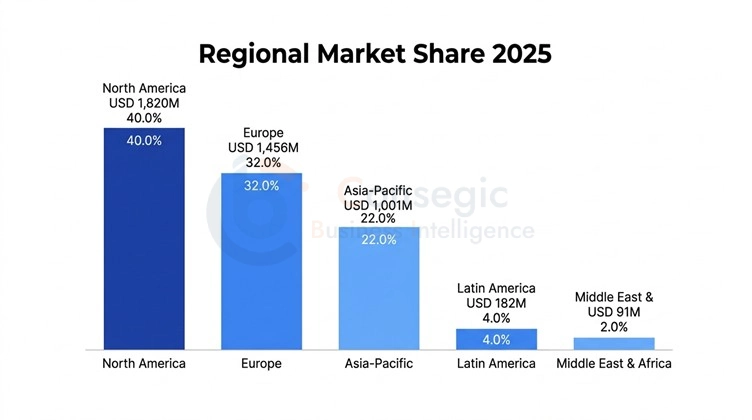
The North American SCBA market will have USD 1,820 Million market value in 2025 which is 40.0 percentage of world market and a projection of USD 3,168 Million market value in 2035 at 5.7 percentage CAGR. The US controls the regional demand with 87.5 percent market value and has around 30, 500 fire departments that constitute the workforce of 1.15 million firefighters and have an estimated 1.85 million SCBA units in the line of duty.
The adoption rates of high-technology SCBA are the highest in the region featuring the integration of thermal imaging and heads-up displays, telemetry systems, and smart capabilities of monitoring. Federal grant programs such as the Assistance to Firefighters Grant (AFG) are the lifeline granting facilities to modernize the equipment in smaller and volunteer departments.
Europe
At USD 1,456 Million, SCBA market in Europe had reached USD 32.0% of total market value globally in 2025 with forecasts of USD 2,534 Million in 2035 with 5.7% CAGR growth. The 62% of regional demand is concentrated in Germany, United Kingdom, France and Italy which have strict EN 137 standards and the extensive occupational safety frameworks that promote the high quality equipment and the frequent replacement cycles.
European fire services have about 485,000 firefighters in career and volunteer services, their SCBA inventories are focused on reliability, and serviceability and up to tough certification standards. The region exhibits a high rate of light weight composite cylinders and ergonomic harness that decrease weight of the body and increases working efficiency.
Asia-Pacific
SCBA market in Asia-Pacific also has a strong market value of USD 1,001 Million in 2025, which is 22.0% of the global market value and a strong growth of USD 1,822 Million in 2035 at a healthy CAGR of 6.2, making it the highest regional growth rate. China is the biggest national market with 48.5% of the regional value, and Japan has 18.5%, India has 14.0 and other Asian nations have 19.0.
In 2025, the SCBA market of china will have USD 486 Million, which will be driven by the huge infrastructure development, industrialization, and modernization of fire services and rescue services. The country has around 225,000 firefighters in professional fire services and there is a modernization program on equipment and an increasing industrial safety needs are bolstering the continued growth in demand.
Other Regions
Latin America has USD 182 Million (4.0%), and Middle East as well as Africa has USD 91 Million (2.0%) with both of them exhibiting growth prospects due to the development of infrastructure, the expansion of industries and a rise in the safety standard.
Market Competitors and Major Market Forces.
United States - MSA Safety Incorporated.
MSA Safety enjoys an impressive market leadership that is expected to generate USD 685 Million in SCBA revenues in 2024, equivalent to 15.1 percentage of market share worldwide. The company has extensive manufacturing, service and distribution networks in North America, Europe and Asia-Pacific with full SCBA product range including the G1 SCBA platform with built-in thermal imaging and advanced telemetry systems via the FireGrid connected safety platform.
Scott Safety (3M) (United States)
As an element of the Personal Safety Division of 3M, Scott Safety enjoys a market share of about 13.8 per cent globally and SCBA is projected to reach USD 625 Million in 2024. The Air-Pak X3 Pro and Air-Pak SCBA platforms of the company cater to the needs of the firefighting and industrial markets by focusing on ergonomic system, less weight, and inbuilt communication systems.
Drägerwerk AG & Co. KGaA (Germany)
Dräger has about 12.5% market share in the world with SCBA revenue pegged at USD 565 Million in 2024 with strong market positioning in European and international markets with robust product portfolios such as PSS 7000 and PSS BG 4 with strong emphasis on reliability, serviceability and compliance with international standards.
Other Major Market Competitors:
- Honeywell International Inc. (United States) - 11.2 market share, industry focus.
- Interspiro AB (Sweden) - 7.5% market share, diving and fire fighting systems.
- Bullard (United States)- 6.2% market share, thermal imaging integration.
- Shigematsu Works Co., Ltd. (Japan) 5.8% market share, Asia-Pacific presence.
Recent Industry Developments
MSA Safety
In early 2025, MSA Safety released its G1 SCBA with LUNAR Connected Technology, which has a built-in mesh network communication to allow firefighters direct communication between themselves regardless of the presence of incident command infrastructure. The system has real-time air monitoring, automatic activation of a distress signal and buddy breathing alert, and it is already in use by major metropolitan fire departments, such as the Houston Fire Department and Miami-Dade Fire Rescue.
Scott Safety (3M)
Scott Safety launched its Air-Pak X3 Ultra with state-of-the-art carbon fiber composite cylinders that had 28 per cent reduction in weight than the past generation systems and retained 60 minutes of operating time. The system has the heads-up display technology of the HUD II that allows the heads-up display to showcase the remaining air time, pressure warnings, and emergency activation indicators in the line of sight of the firefighter.
Dräger
Drager has also proclaimed full integration of its PSS 7000 SCBA system with Drager UCF 9000 universal communication and monitoring system so that incident commanders can simultaneously monitor up to 100 individual firefighters, indicating their location, air supply, distress signals and physiological parameters by use of tablet based command interfaces.
Self-Contained Breathing Apparatus Market Report Insights
| Report Attributes | Report Details |
|---|---|
| Study Timeline | 2022–2035 |
| Base Year | 2025 |
| Forecast Period | 2026–2035 |
| Market Size in 2025 | USD 4,550 Million |
| Market Size in 2035 | USD 7,920 Million |
| CAGR (2026–2035) | 5.7% |
| By Type | Open-Circuit SCBA, Closed-Circuit SCBA (Rebreathers) |
| By Application | Firefighting, Industrial, Mining, Oil & Gas, Chemical Industry, Military & Defense, Others |
| By End-User | Fire Services, Industrial Facilities, Military & Defense, Marine, Aviation, Others |
| By Cylinder Material | Composite (Carbon Fiber), Steel, Aluminum |
| By Pressure Type | High-Pressure (200-300 bar), Medium-Pressure (100-200 bar) |
| By Region | Asia-Pacific, Europe, North America, Latin America, Middle East & Africa |
| Key Players | MSA Safety, Scott Safety (3M), Drägerwerk, Honeywell International, Avon Protection, Interspiro, Bullard, Shigematsu Works |
Key Questions Answered in the Report
How big is the Self-Contained Breathing Apparatus market? −
The market of the global self-contained breathing apparatus shows a high level of stability and demand with its valuesexpected to reach USD 4,550 Million in 2025 and USD 7,920 Million in 2035, which is a long-term growth due to strict safety standards, rising numbers of industrial accidents, health programs of firefighters, technological progress in smart monitoring systems, and growing industrial infrastructure in developed and developing economies.
What is the fastest-growing market in the Self-Contained Breathing Apparatus market? +
The fastest-growing regional markets are Asia-Pacific with a CAGR of 6.2 percent, owing to rapid industrialization, infrastructure development, modernization of fire services, the growth of chemical and petroleum industries, and higher standards of workplace safety and the government investments in emergency responses capacity of China, India, Southeast Asia, and other emerging economies.
What are some of the segmentation specifications that are addressed in the Self-Contained Breathing Apparatus report? +
The report includes detailed segmentation analysis which consists of Type (Open-Circuit SCBA, Closed-Circuit SCBA), Applications (Firefighting, Industrial, Mining, Oil and Gas, Chemical Industry, Military and Defense), End User (Fire Services, industrial facilities, military and defense, marine, aviation), material of the cylinder (composite, steel, aluminum), type of pressures (high-pressure, medium-pressure), and regions with sub segmentation and unit volume analysis.
Who are the key market participants in Self-Contained Breathing Apparatus market? +
MSA Safety Incorporated (15.1% market share), Scott Safety/3M (13.8% market share), Dragerwerk AG and Co. KGaA (12.5% market share), Honeywell International Inc. (11.2% market share), Avon Protection (9.8% market share), Interspiro AB (7.5% market share) and a wide range of regional manufacturers that cater to specialized applications and geographic markets with product differentiation and service offering are the market leaders.
What are the major technology trends that are defining the market into 2035? +
Key trends in technology are smart SCBA systems with built-in telemetry that deliver real time protection of air supply, positioning, and physiological condition of the fire fighter, lightweight composite cylinders that achieve a weight reduction of 28-35% and an increased operational time up to 75-90 minutes, head-up display systems that provide essential information without requiring any diversion of attention, mesh network communications that allow direct firefighter to firefighter communication in GPS-denied conditions, thermal imaging that combines respiratory protection with situational awareness, and predict.
Overview
Reputation & Certifications


Our Services
- Market Intelligence & Forecasting
- Custom Research Solutions
- Market Entry Strategy
- Competitive Intelligence
- Customer Insights
- Industry Innovation Analysis
- Investment Advisory