Jump to Content
Service Virtualization Market - Size, Share, Industry Trends, and Forecasts (2025-2032)
Service Virtualization Market Size:
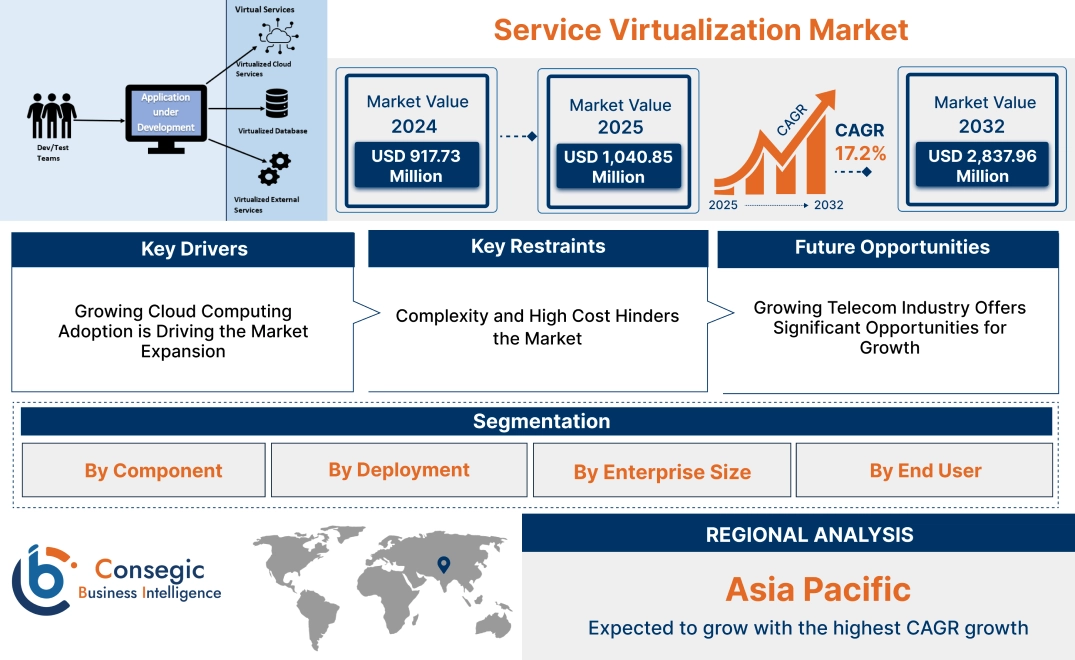
Service Virtualization Market is estimated to reach over USD 2,837.96 Million by 2032 from a value of USD 917.73 Million in 2024 and is projected to grow by USD 1,040.85 Million in 2025, growing at a CAGR of 17.2% from 2025 to 2032.
Service Virtualization Market Scope & Overview:
Service virtualization is a technique used in software testing to simulate the behavior of dependent systems or components that are unavailable, difficult to access, or too expensive to use during the testing process. It involves creating virtual representations of these dependencies and allowing testers to interact with them. The service virtualization market is experiencing significant growth due to the increasing complexity of IT environments and the need for faster software development cycles. Further, trends include the rise of microservices and cloud-based architectures, the push for digital transformation, and the adoption of Agile and DevOps methodologies. Moreover, benefits including improved testing efficiency, reduced costs, and faster time-to-market are significant factors that drive the market. Furthermore, applications including API testing, performance testing, and security testing also contribute in driving the market. Thus virtualization empowers organizations to streamline development and enhance testing in turn driving the market.
Service Virtualization Market Dynamics - (DRO) :
Key Drivers:
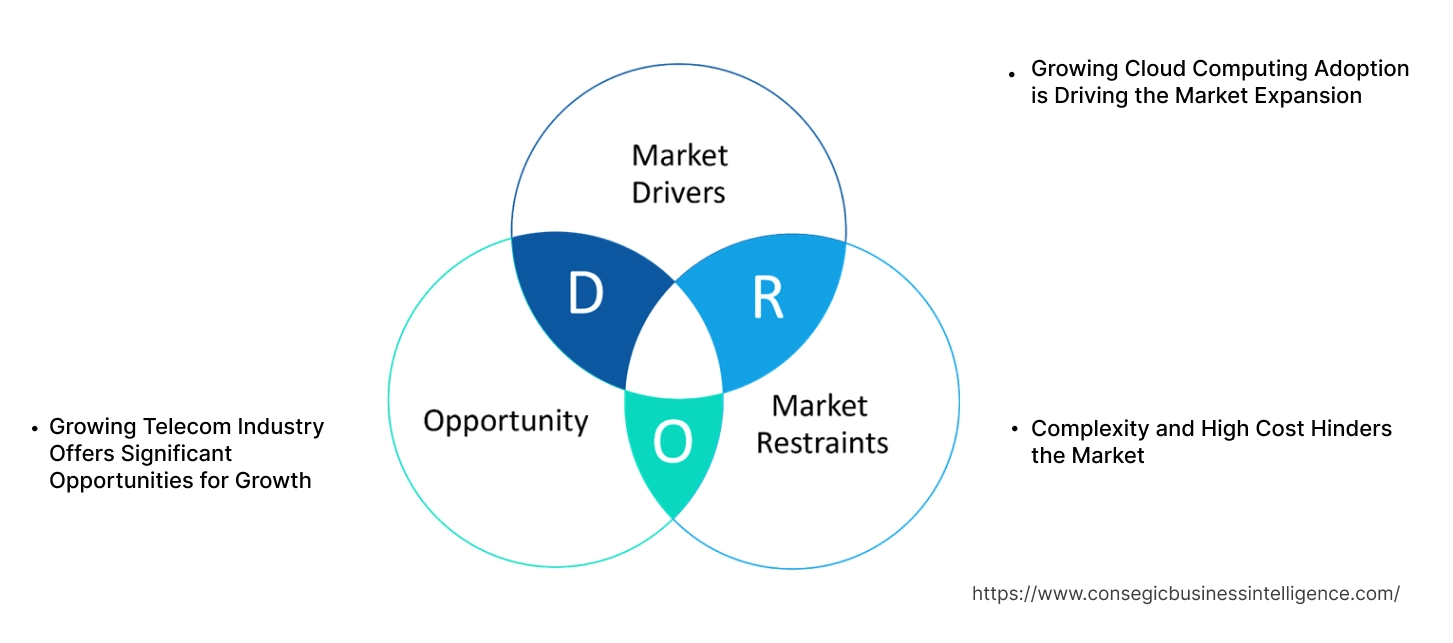
Growing Cloud Computing Adoption is Driving the Market Expansion
The increasing adoption of cloud computing is a significant driver of the service virtualization market. The organizations are migrating their applications and infrastructure to the cloud which results in new challenges in testing and development. The cloud environments are generally complex and dynamic as applications rely on various interconnected services. Virtualization tools enable organizations to simulate cloud-based services, allowing for efficient testing without the need for real infrastructure. This is crucial for ensuring the performance and reliability of cloud applications. Additionally, the tool helps organizations accelerate their cloud migration initiatives by providing a stable and predictable testing environment.
- For instance, according to Eurostat, in 2023, cloud computing adoption in European Union is widely varied by business size. Large enterprises lead with 77.6% using cloud services in 2023. Moreover, medium-sized enterprises saw 59% adoption, while small businesses had 41.7% adoption.
Thus, as cloud computing continues to grow, the demand for virtualization is expected to increase, making it an essential tool for organizations looking to leverage the benefits of the cloud.
Key Restraints:
Complexity and High Cost Hinders the Market
The service virtualization market is growing however its adoption faces certain hurdles such as complexity and high cost. Implementing virtualization can be complex and require specialized expertise to properly model and simulate intricate system interactions. The complexity leads to extended setup times and difficulties in maintaining the virtualized environment. Further, the initial investment in virtualization tools and the necessary training for personnel can be substantial. This high cost can be a barrier, particularly for smaller organizations or those with limited IT budgets. The perceived complexity and the upfront financial commitment can deter potential adopters, slowing market growth despite the long-term benefits of the tool. Moreover, overcoming these challenges through simplified solutions and more accessible pricing models will be crucial for broader market penetration.
Future Opportunities :
Growing Telecom Industry Offers Significant Opportunities for Growth
The rapidly evolving telecom industry presents significant growth opportunities for the service virtualization market. Telecom companies rely on complex, interconnected systems, making testing and development challenging. Virtualization addresses these challenges by simulating network elements, protocols, and third-party services, enabling efficient testing of new telecom applications and services. 2 This is crucial for ensuring network reliability, performance, and the rapid deployment of innovative offerings like 5G and IoT solutions. As telecom providers strive to enhance customer experience and introduce new technologies, virtualization becomes essential for streamlining testing processes, reducing time-to-market, and optimizing infrastructure utilization. The increasing demand for seamless connectivity and the constant evolution of telecom technologies are driving the service virtualization market.
Service Virtualization Market Segmental Analysis :
By Component:
Based on the component, the market is segmented into software and service.
Trends in the Component:
- Seamless integration of service virtualization into DevOps and Continuous Integration/Continuous Delivery pipelines is driving the market.
- Increasing trend of incorporating artificial intelligence and machine learning to automate the creation and maintenance of virtual services.
Software accounted for the largest revenue share in the year 2024.
- Increasing focus on improving performance and scalability to handle complex application architectures and high transaction volumes.
- Further, solutions designed specifically for cloud environments, leveraging cloud-native technologies like containers and microservices. This allows for greater scalability, flexibility, and portability which in turn drives the service virtualization market.
- For instance, Parasoft offers virtualization tool “Parasoft Virtualize” which allows testing of entire applications by creating virtual equivalents of unavailable or limited real data and services. It enables realistic simulations, comprehensive service testing, and safe data verification through masking.
- Thus, as per analysis, increasing focus on improving performance and scalability is driving the market.
Service is anticipated to register the fastest CAGR during the forecast period.
- Organizations are increasingly outsourcing the management of their virtualization infrastructure to specialized providers which in turn drives the service virtualization market.
- Further, rise of specialized virtualization tools for specific industries such as finance, healthcare and others are expected to drive the market expansion.
- Furthermore, virtualization tools help organizations identify and resolve performance issues before they impact end-users, leading to improved customer experiences.
- Therefore, as per analysis, demand for managed service and rise of specialized service is anticipated to boost the growth of the service virtualization market during the forecast period.
By Deployment:
Based on the deployment, the market is bifurcated into On-Premise and Cloud.
Trends in the Deployment:
- Organizations are choosing on-premise deployments to prioritize data security and control.
- Cloud deployments facilitate collaboration among distributed teams by providing easy access to virtual services from anywhere.
Cloud Deployment accounted for the largest revenue share in the year 2024 and is anticipated to register the fastest CAGR during the forecast period.
- Cloud deployments offer unparalleled scalability and flexibility which in turn drives the market
- Further, cloud-based virtualization software often follows pay-as-you-go models, making it cost-effective, especially for fluctuating workloads.
- Cloud deployments enable faster provisioning and deployment of virtual services which in turn accelerates the development and testing cycles.
- Thus, according to analysis, faster deployment, cost-effectiveness, and scalability & flexibility are driving the market.
By Enterprise Size:
Based on the enterprise size, the market is bifurcated into Small & Medium Enterprise and Large Enterprise.
Trends in the Enterprise Size:
- Increasing demand virtualization solutions that offer a good balance of features and affordability.
- Increasing focus on enabling faster testing and development cycles, allowing small enterprises to bring products and services to market more rapidly.
Large Enterprise accounted for the largest revenue share in the year 2024 and is anticipated to register the fastest CAGR during the forecast period.
- Increasing adoption of the virtualization tools in large enterprises to handle complex architectures and high transaction volumes is driving the service virtualization market.
- Further, large enterprises often have intricate IT systems with numerous interconnected applications. They need solutions that can handle this complexity, accurately simulate various dependencies, and ensure comprehensive testing.
- Furthermore, there is a growing need for solutions that adhere to strict security standards and help them comply with industry regulations.
- Thus, as per analysis, complex IT landscapes, scalability & performance, and security & compliance are factors that are driving the service virtualization market.
By End-User:
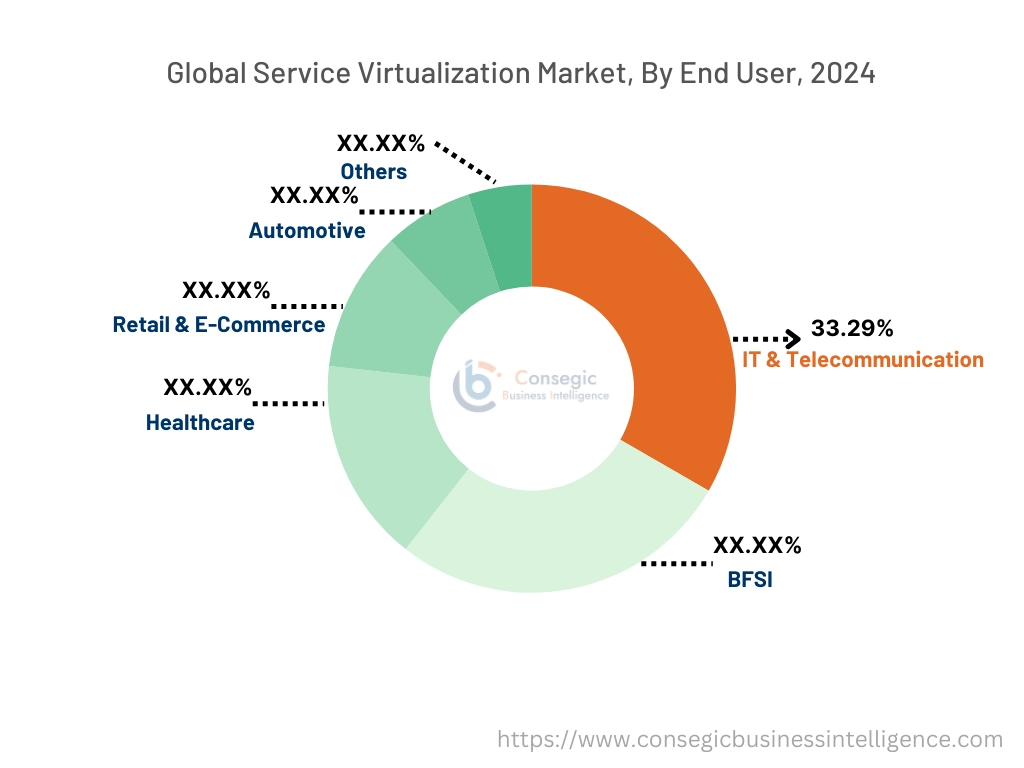
Based on the end user, the market is segmented into IT & telecommunication, BFSI, healthcare, retail & e-commerce, automotive, and others.
Trends in the End User:
- Virtualization tools are crucial for testing connected car features, including telematics, infotainment, and autonomous driving systems.
- Virtualization tool also facilitates interoperability testing in healthcare sector by simulating different healthcare systems and data formats.
IT & Telecommunication accounted for the largest revenue share of 33.29% in the year 2024.
- Service virtualization is crucial for testing and optimizing complex network infrastructures, including 5G and IoT deployments.
- Further, Service virtualization enables parallel development and testing, accelerating time-to-market for new services fueling the need for service virtualization market
- Furthermore, virtualizing services reduces the need for expensive physical test environments, leading to significant cost savings for IT and telecom companies.
- Thus, network virtualization, cost optimization, and agile development & testing are driving the service virtualization market in It & telecommunication sector.
Retail & E-commerce is anticipated to register the fastest CAGR during the forecast period.
- In e-commerce sector the virtualization tool enables load testing to ensure systems can handle peak traffic surges during sales events.
- Further, virtualization tools can be used to simulate different customer profiles and test personalized recommendations and offers.
- Thus, based on analysis, aforementioned factors are expected to drive the service virtualization market during the forecast period.
Regional Analysis:
The regions covered are North America, Europe, Asia Pacific, the Middle East and Africa, and Latin America.
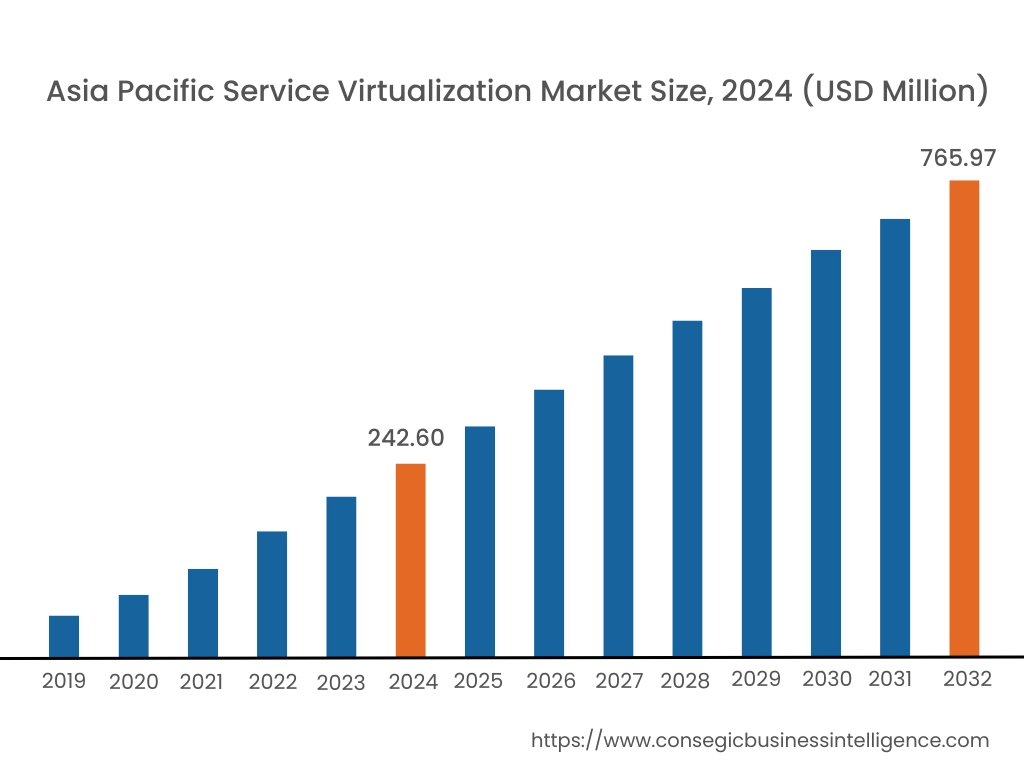
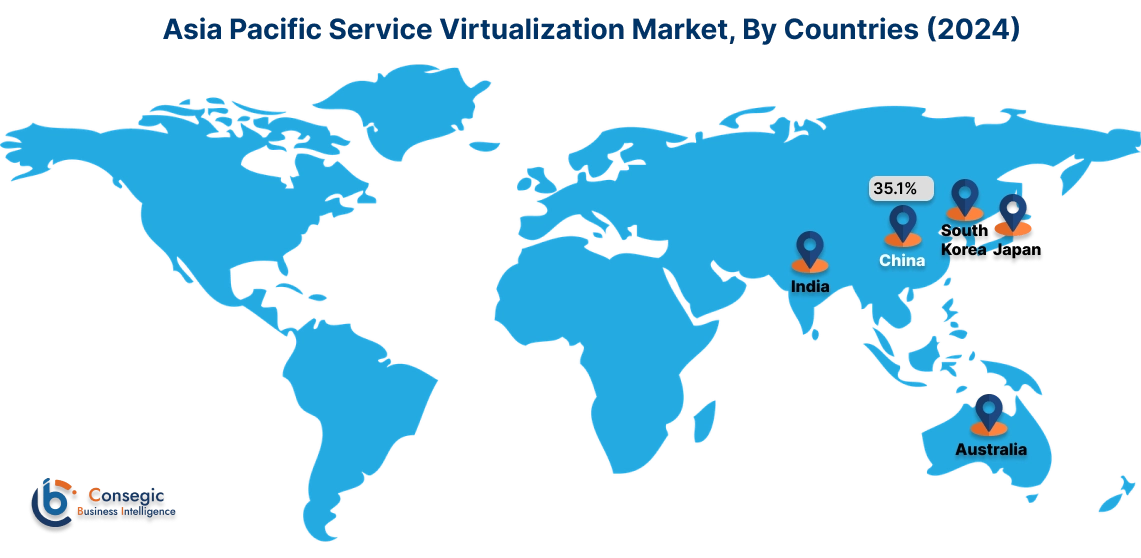
Asia Pacific region was valued at USD 242.60 Million in 2024. Moreover, it is projected to grow by USD 275.63 Million in 2025 and reach over USD 765.97 Million by 2032. Out of this, China accounted for the maximum revenue share of 35.1%. The service virtualization market growth is mainly driven by rapid digital transformation and increasing adoption of Agile/DevOps practices, coupled with the rising need for faster time-to-market and enhanced software quality in a rapidly expanding cloud and IoT landscape.
- For instance, in August 2023, OpenText a major global player released product update for service Virtualization 2023 R1. This release enhances API and Virtual Service simulations with new features and benefits across user experience, design and modeling, protocol updates, integrations, and security.
North America is estimated to reach over USD 936.53 Million by 2032 from a value of USD 305.09 Million in 2024 and is projected to grow by USD 345.81 Million in 2025. The North American region's advanced technological infrastructure, high adoption of cloud and microservices architectures, and strong emphasis on agile development offer lucrative prospects for the market. Additionally, the growth of hybrid work culture is driving the service virtualization market.
- For instance, in October 2023 Parasoft highlights the success of its service virtualization solution during QA Financial event in New York. According to company financial institutions using Parasoft's solution have seen a 40% decrease in CI/CD pipeline execution time and a 74% reduction in critical defects, achieving 99.97% system availability.
The regional trends analysis depicts that the stringent data privacy regulations, increasing adoption of cloud-native technologies, and DevOps practices in Europe is driving the service virtualization market. Additionally, the primary factors driving the market in the Middle East and African region are increasing investments in digital transformation initiatives and growing focus on agile development. Further, increasing adoption of cloud computing and digital transformation initiatives are paving the way for the progress of market trend in Latin America region.
Top Key Players and Market Share Insights:
The global service virtualization market is highly competitive with major players providing solutions to the national and international markets. Key players are adopting several strategies in research and development (R&D), product innovation, and end-user launches to hold a strong position in the Service Virtualization industry. Key players in the service virtualization market include-
- Open Text Corporation (Canada)
- Broadcom (US)
- Parasoft (US)
- IBM Corporation (US)
- SmartBear Software (US)
- Perforce Software, Inc. (US)
- Tricentis (Austria)
- Cavisson Systems Inc. (US)
- Qualitest Group (Israel)
- Capgemini (France)
Recent Industry Developments :
Partnerships & Collaborations:
- In November 2023, Broadcom has completed the acquisition of virtualization business of VMware. Broadcom will focus on enabling enterprise customers to create and modernize private and hybrid cloud environments, investing in VMware Cloud Foundation.
- In January 2025, Broadcom announced updates to VMware Cloud Foundation (VCF), its private cloud platform, and VMware vSphere Foundation. VCF enhancements focus on faster infrastructure modernization, improved developer productivity, and better security.
Service Virtualization Market Report Insights :
| Report Attributes | Report Details |
| Study Timeline | 2018-2032 |
| Market Size in 2032 | USD 2,837.96 Million |
| CAGR (2025-2032) | 17.2% |
| By Component |
|
| By Deployment |
|
| By Enterprise Size |
|
| By End-User |
|
| By Region |
|
| Key Players |
|
| North America | U.S. Canada Mexico |
| Europe | U.K. Germany France Spain Italy Russia Benelux Rest of Europe |
| APAC | China South Korea Japan India Australia ASEAN Rest of Asia-Pacific |
| Middle East and Africa | GCC Turkey South Africa Rest of MEA |
| LATAM | Brazil Argentina Chile Rest of LATAM |
| Report Coverage |
|
Key Questions Answered in the Report
How big is the service virtualization market? −
The service virtualization market is estimated to reach over USD 2,837.96 Million by 2032 from a value of USD 917.73 Million in 2024 and is projected to grow by USD 1,040.85 Million in 2025, growing at a CAGR of 17.2% from 2025 to 2032.
What specific segmentation details are covered in the Service Virtualization report? +
The service virtualization report includes specific segmentation details for component, deployment, enterprise size, end user, and regions.
Which is the fastest segment anticipated to impact the market growth? +
In the service virtualization market, cloud deployment is the fastest-growing segment during the forecast period due to its scalability, flexibility, and cost-effectiveness, enabling organizations to easily adapt to changing demands and leverage pay-per-use models.
Who are the major players in the Service Virtualization market? +
The key participants in the service virtualization market are Open Text Corporation (Canada), Broadcom (US), Parasoft (US), IBM Corporation (US), SmartBear Software (US), Perforce Software, Inc. (US), Tricentis (Austria), Cavisson Systems Inc. (US), Qualitest Group (Israel), Capgemini (France) and others.
What are the key trends in the service virtualization market? +
The service virtualization market is being shaped by several key trends including increasing adoption of cloud-native architectures and microservices, the rise of AI/ML for automated service creation and intelligent test data management, and the growing demand for API-driven virtualization to support modern application development.
Overview
Reputation & Certifications


Our Services
- Market Intelligence & Forecasting
- Custom Research Solutions
- Market Entry Strategy
- Competitive Intelligence
- Customer Insights
- Industry Innovation Analysis
- Investment Advisory