Jump to Content
Smart Commute Market - Size, Share, Industry Trends, and Forecasts (2025 - 2032)
Smart Commute Market Size:
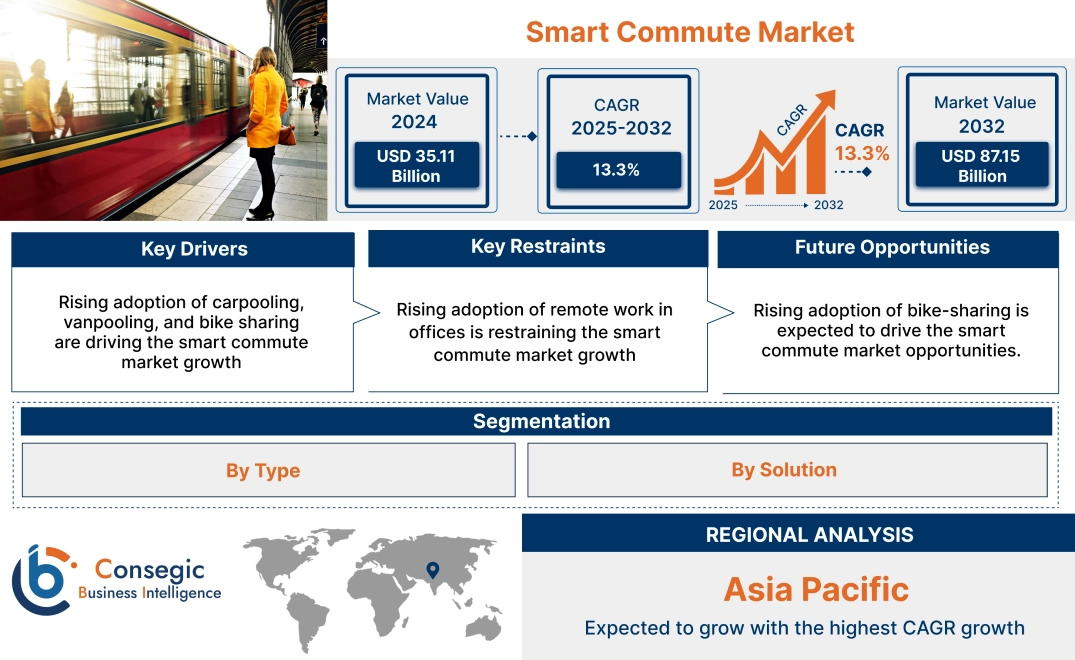
Smart Commute Market size is estimated to reach over USD 87.15 Billion by 2032 from a value of USD 35.11 Billion in 2024 and is projected to grow by USD 38.66 Billion in 2025, growing at a CAGR of 13.3% from 2025 to 2032.
Smart Commute Market Scope & Overview:
Smart commute refers to enhanced traveling from one location to another location via different modes of transport. Smart commute includes different types of strategies such as transit, carpooling, vanpooling, cycling, walking, metro, and others. Further, smart commute helps in optimizing parking space, improving traffic congestion, real-time location services, parking reservations, traffic reduction, and others. Additionally, a smart commute system is a cost-efficient approach for employees while commuting to and from the office to save travel time and improve overall user experience in transportation.
Smart Commute Market Dynamics - (DRO) :
Key Drivers:
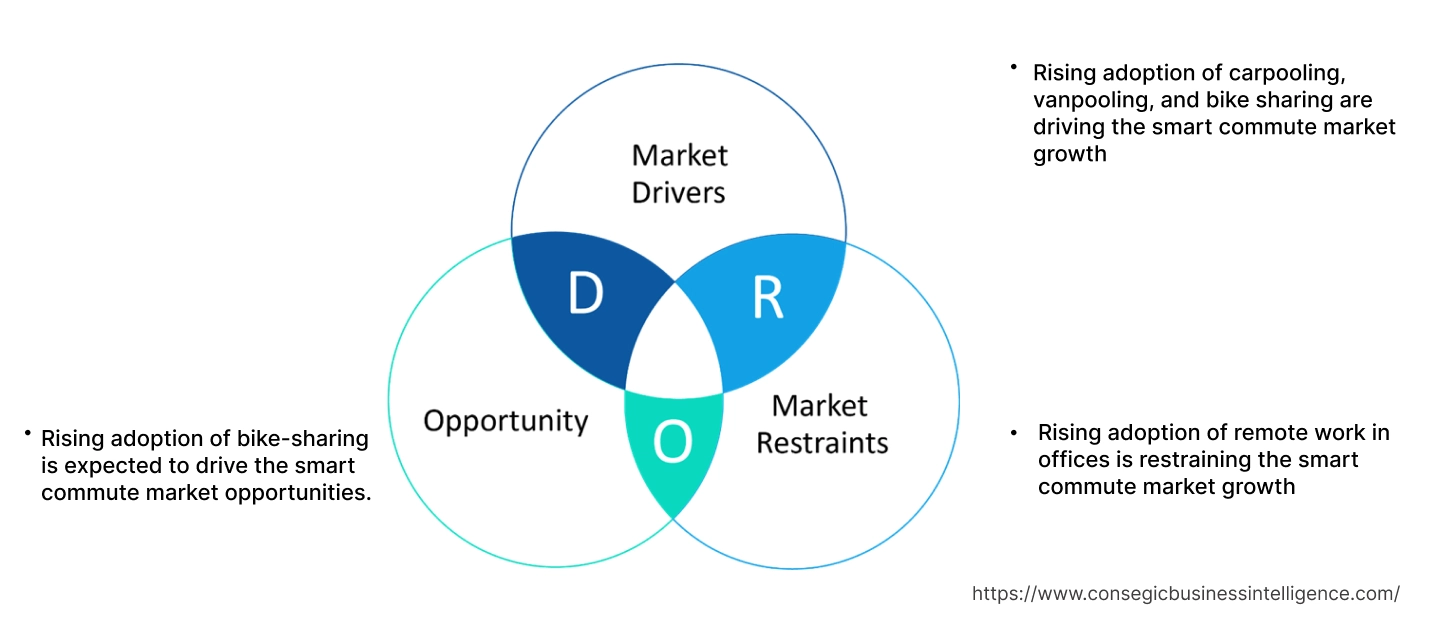
Rising adoption of carpooling, vanpooling, and bike sharing are driving the smart commute market growth
Increasing utilization of carpooling, vanpooling, and bike-sharing options by daily commuters and office workers is trending, which helps reduce transportation expenditures and traffic congestion. Moreover, sharing vehicles for commute is growing and it provides an option to choose a more effective commute path. Additionally, office workers are increasingly utilizing carpooling and bike-sharing apps for daily usage due to improved user experience and low cost.
- For instance, in November 2024, the City of Fort Collinslaunched VanGo, a Vanpooling Incentive Program, with various benefits to commuters and employers, which is further driving the market growth.
Thus, as per the analysis, the rising adoption of enhanced commute services such as carpooling, vanpooling, and bike sharing is driving the smart commute market size.
Key Restraints:
Rising adoption of remote work in offices is restraining the smart commute market growth
Remote work refers to a work environment in which employees are not required to commute to an office for work. Further, in remote jobs employees work with the same team without being present in the same physical space or in the same time zone. Moreover, eliminating daily commutes to the workplace reduces the significant portion of an employee’s day. Additionally, employees can use this time for relaxing or doing more productive work such as learning new skills, shopping, and others. This is further driving the adoption of remote work culture in various companies across different countries for increased productivity, flexibility, improved work-life balance, and cost savings for both employees and employers.
However, a remote work culture does not require employees to commute to offices, which in turn may decrease the demand and need for smart commuting solutions/services for corporate applications, in turn hindering the smart commute market. Therefore, the rising adoption of remote work in the corporate/professional sector is restraining the smart commute market.
Future Opportunities :
Rising adoption of bike-sharing is expected to drive the smart commute market opportunities.
Bike-sharing refers to sharing two-wheelers such as bicycles and e-bikes for an annual, daily, monthly, or trip-based fee. Further, bicycles are provided to commuters for traveling within a city or town by using an application that enables renting of a bicycle for a short period of time. Additionally, using an electrically powered vehicle helps in reducing carbon emissions and air pollution significantly. Moreover, it supports sustainable urban mobility in densely populated countries for improving traffic management.
- For instance, VAIMOO offers bike-sharing services in its product offerings. It provides an alternative to private cars for reducing carbon emissions and improving health.
Thus, as per the smart commute market analysis, the rising utilization of bike-sharing services is driving the global smart commute market opportunities.
Smart Commute Market Segmental Analysis :
By Type:
Based on the type, the market is segmented into transit, carpooling, vanpooling, cycling, metro, and others.
Trends in the Type:
- There is an increasing trend towards the adoption of vanpooling due to low cost, reduced air pollution, reduced stress, reduced demand for parking, and others.
- Increasing trend in utilization of cycles by employers due to improved mental health as well as reduced parking space.
Carpooling accounted for the largest revenue share in the total smart commute market share in 2024.
- Carpooling refers to the sharing of a car by different individuals for commuting, to and from different destinations that lie on the same path.
- Further, carpooling helps in the reduction of traffic, potential financial savings, reduction in traffic congestion, improved parking management, and others.
- Moreover, a single private vehicle is shared among passengers by using different technological platforms for the same destination.
- For instance, in December 2024, BlaBlaCar launched Zen, an app for carpooling for occasional short-distance car trips.
- Thus, as per the analysis, the rising advancements associated with carpooling apps are driving the smart commute market trends.
Metro is anticipated to register a significant CAGR during the forecast period.
- A metro is referred to as mass rapid transit (MRT) or heavy rail, which is responsible for handling high-capacity public transport in urban areas.
- Further, the metro offers various benefits such as faster travel, reduced traffic, lower pollution, comfort, and others.
- Additionally, in large cities a huge number of passengers travel from the metro for work, schools, and others in high frequency.
- For instance, in June 2024, Alstom delivered the first metro train for the Pune Metro Line 3 in India.
- According to the analysis, the rising utilization of the metro for daily commutes is driving the smart commute market expansion.
By Solution:
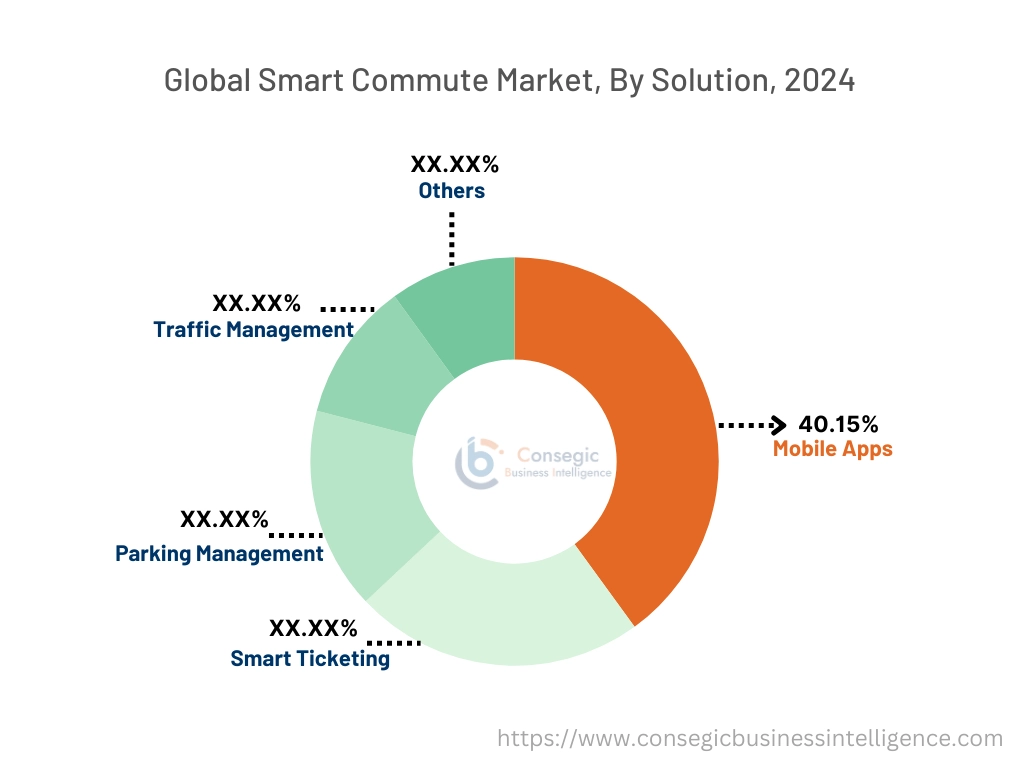
Based on the solution, the market is segmented into mobile apps, smart ticketing, parking management, traffic management, and others.
Trends in the Solution:
- There is an increasing trend toward the adoption of parking management software in shopping malls, office workspaces, and others.
- Utilization of smart ticketing systems is trending for storing a ticket in a smartphone or a smartcard during travel.
Mobile apps accounted for the largest revenue share 40.15% in the total smart commute market share in 2024
- Mobile apps are used by individuals and organizations for carpooling, vanpooling, cycling, walking, and others.
- Further, mobile apps offer various benefits such as improved services to customers, enhanced performance, and navigation apps for improved commutes.
- Moreover, mobile apps are in trend for booking services, real-time location services, local insights, marketing, and others.
- For instance, in November 2024, Bruce Country launched the Smart Commute app, which helps in providing new transit options for employees to easily connect riders and drivers.
- Thus, as per the analysis, the rising advancements associated with mobile apps for commuters are driving the smart commute market size.
Traffic management is anticipated to register a significant CAGR during the forecast period.
- In traffic management systems, various methods are implemented to improve the security, safety, and reliability of the overall road transport system and to preserve the traffic capacity.
- Moreover, traffic management systems offer various benefits such as diminishing congestion, averting accidents, and safeguarding road users.
- Additionally, it helps ensure smooth management of traffic and enhanced operation of traffic lights for responding to unusual traffic and malfunctions in the road traffic system.
- For instance, in March 2023, according to NIC Goa, the Chief Minister of Goa, launched ITMS (Intelligent Traffic Management System) for monitoring traffic regulations.
- Thus, the rising adoption of traffic management systems is driving the smart commute market trends.
Regional Analysis:
The regions covered are North America, Europe, Asia Pacific, the Middle East and Africa, and Latin America.
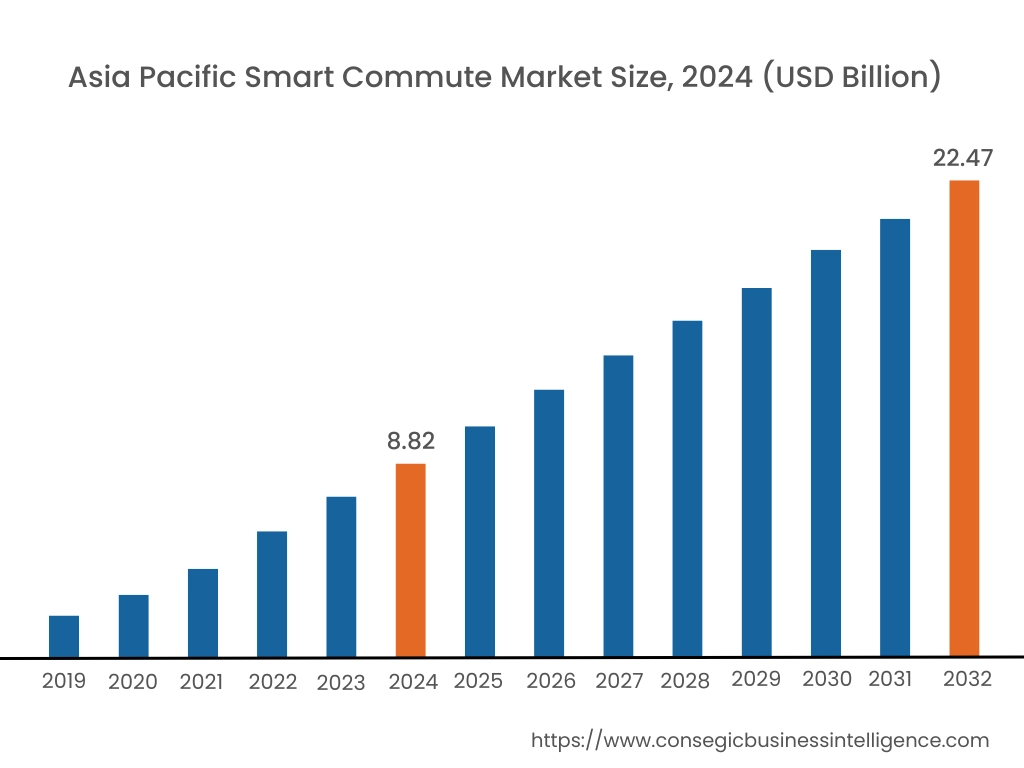
Asia Pacific region was valued at USD 8.82 Billion in 2024. Moreover, it is projected to grow by USD 9.74 Billion in 2025 and reach over USD 22.47 Billion by 2032. Out of this, China accounted for the maximum revenue share of 30.7%. As per the smart commute market analysis, there is increasing adoption of ride-sharing services, particularly in countries such as China, India, and Japan, for providing advanced and efficient traveling solutions to office commuters. The rapid development and growing investments in the infrastructure sector and transportation industry are accelerating the smart commute market expansion.
- For instance, in December 2024, Delhi Metro Rail Corporation Ltd. (DMRC) collaborated with Aurionpro to develop smart transit technology including AFC (Automated Fare Collection) technology, automated card readers, gates, and validators. This is further increasing the adoption of advanced commute systems, which in turn is driving the market.

North America is estimated to reach over USD 31.70 Billion by 2032 from a value of USD 12.76 Billion in 2024 and is projected to grow by USD 14.05 Billion in 2025. In North America, the growth of the smart commute industry is driven by the rising adoption of carpool services by daily workers, office commuters, and others. The rising adoption of advanced commute services for advanced traveling solutions is also driving the market growth. Further, increasing advancements for reducing traffic congestion on roads are massively contributing to growth in smart commute market demand.
- For instance, in July 2024, Spacer Technologies acquired Scoop Technologies commute assets and launched the Scoop Commute carpooling app to expand its mobility services in the United States. This is further driving the market in the North America region.
The regional analysis depicts that the rising investments in the traffic management solutions industry and the increasing adoption of carpooling, vanpooling, and bike sharing are driving the smart commute market demand in Europe. Further, as per the market analysis, the primary factor driving the market growth in the Middle East and African region includes increasing investment in advanced commute solutions in the public and private sectors. The rising demand for mobility-as-a-service and the rising utilization of ride-sharing services are driving the market demand in the Latin America region.
Top Key Players and Market Share Insights:
The smart commute market is highly competitive with major players providing services to the national and international markets. Key players are adopting several strategies in research and development (R&D), product innovation, and end-user launches to hold a strong position in the global smart commute market. Key players in the smart commute industry include -
- Uber Technologies Inc. (US)
- South Florida Commuter Services (US)
- Central Indiana Regional Transportation Authority (CIRTA) (US)
- Oakland Smart Commute (US)
- Quick Ride (India)
- CommuteSMART (US)
- BlaBlaCar (France)
- Turo (US)
- Metrolinx (Canada)
- ZipGo Technologies Pvt. Ltd (India)
Recent Industry Developments:
Product Launches:
- In November 2024, the City of Fort Collins launched VanGo, a Vanpooling Incentive Program, with benefits including a guaranteed ride home, professional fleet maintenance, and others to commuters and freed up parking spaces for visitors to the employers.
- In December 2024, BlaBlaCar launched an app called Zen for occasional carpooling services with benefits such as flexibility and improved adaptability for their travel plans.
Smart Commute Market Report Insights :
| Report Attributes | Report Details |
| Study Timeline | 2019-2032 |
| Market Size in 2032 | USD 87.15 Billion |
| CAGR (2025-2032) | 13.3% |
| By Type |
|
| By Solution |
|
| By Region |
|
| Key Players |
|
| North America | U.S. Canada Mexico |
| Europe | U.K. Germany France Spain Italy Russia Benelux Rest of Europe |
| APAC | China South Korea Japan India Australia ASEAN Rest of Asia-Pacific |
| Middle East and Africa | GCC Turkey South Africa Rest of MEA |
| LATAM | Brazil Argentina Chile Rest of LATAM |
| Report Coverage |
|
Key Questions Answered in the Report
How big is the smart commute market? −
The smart commute market was valued at USD 35.11 Billion in 2024 and is projected to grow to USD 87.15 Billion by 2032.
Which is the fastest-growing region in the smart commute market? +
Asia-Pacific is the region experiencing the most rapid growth in the smart commute market.
What specific segmentation details are covered in the smart commute report? +
The smart commute report includes specific segmentation details for type, solution, and region.
Who are the major players in the smart commute market? +
The key participants in the smart commute market are Uber Technologies Inc. (US), South Florida Commuter Services (US), CommuteSMART (US), BlaBlaCar (France), Turo (US), Metrolinx (Canada), ZipGo Technologies Pvt. Ltd (India), Central Indiana Regional Transportation Authority (CIRTA) (US), Oakland Smart Commute (US), and Quick Ride (India).
Overview
Reputation & Certifications


Our Services
- Market Intelligence & Forecasting
- Custom Research Solutions
- Market Entry Strategy
- Competitive Intelligence
- Customer Insights
- Industry Innovation Analysis
- Investment Advisory