Jump to Content
Smart Crop Monitoring Market - Size, Share, Industry Trends, and Forecasts (2025-2035)
Smart Crop Monitoring Market: Size:
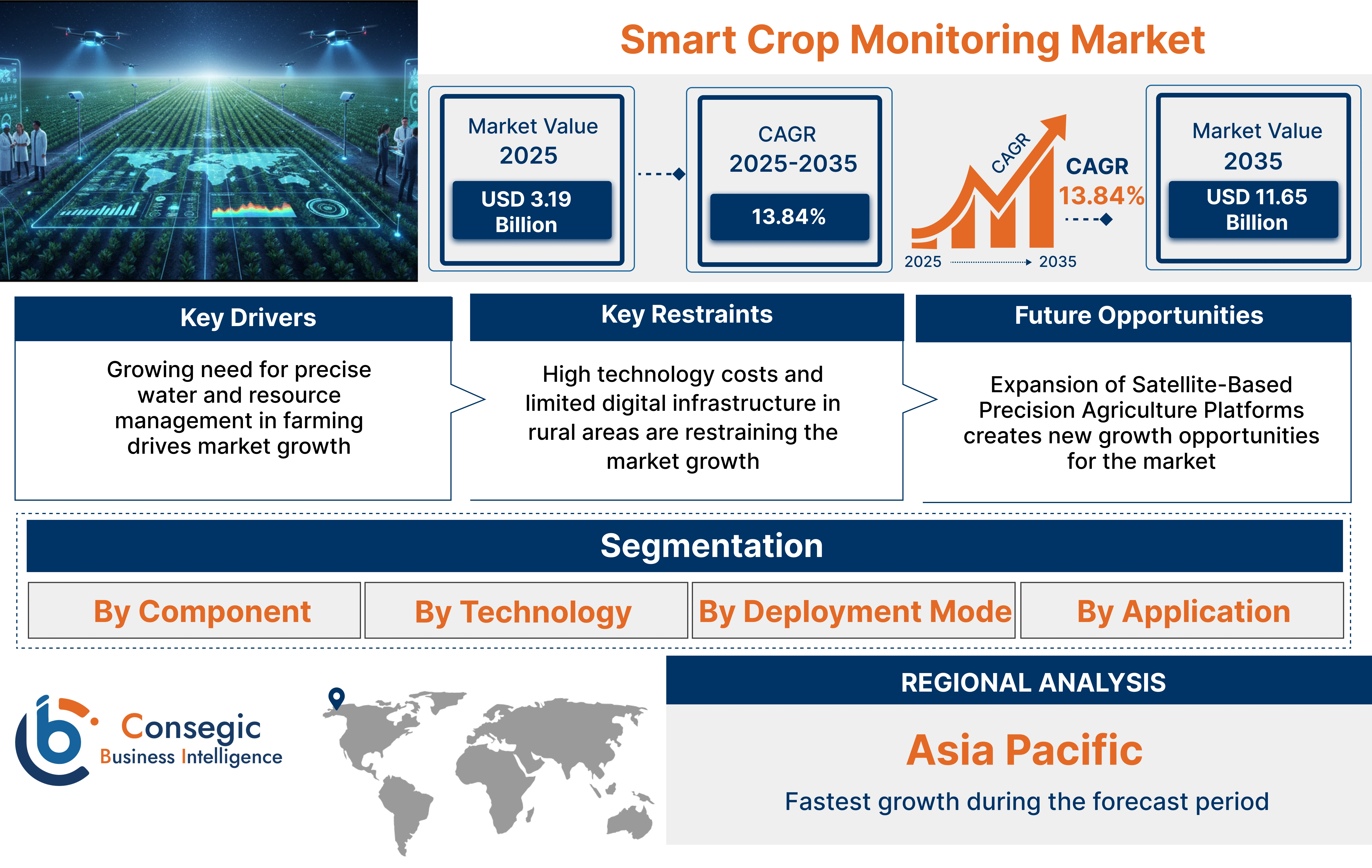
Smart Crop Monitoring Market size is estimated to reach over USD 11.65 Billion by 2035 from a value of USD 2.80 Billion in 2024 and is projected to grow by USD 3.19 Billion in 2025, growing at a CAGR of 13.84% from 2025 to 2035
Smart Crop Monitoring Market Scope & Overview:
Smart crop management can be defined as the application of the latest technologies such as IoT sensor technology, satellite imaging, drone technology, artificial intelligence, and data analytics to monitor crop health, soil, and weather patterns. The technology allows farmers to monitor crop growth, track diseases early, determine nutrient levels, and optimize irrigation and fertilizer application. The technology allows for decision-making to improve the quality and efficiency of agricultural operations.
The factors propelling the smart crop monitoring market are the growing demand for food and the adoption of precision agriculture methods. Governments are promoting digital farming to improve productivity and resource management. Advancements in remote sensing technology and cloud-based analytics platforms are improving the accuracy and availability of monitoring. The increasing concern for water conservation and profitability in agriculture is also boosting the market.
How are Tariffs Impacting the Smart Crop Monitoring Market?
The tariffs imposed on imported agricultural drones, sensors, and electronic components have raised the cost of equipment for manufacturers and consumers in the smart crop monitoring market. In addition, trade barriers on semiconductor chips and imaging technology have impacted the supply chain, leading to longer procurement cycles and price volatility. In addition, tariffs on cross-border agricultural technology products have influenced procurement patterns, with a focus on local sourcing and regional manufacturing partnerships. Furthermore, trade policies are compelling firms to build a diverse supplier base and manufacturing capacity in the market.
Smart Crop Monitoring Market Dynamics - (DRO):
Key Drivers:
Growing need for precise water and resource management in farming drives market growth
The smart crop monitoring market is growing as farmers and agricultural businesses are increasingly adopting advanced technologies to better manage water usage, crop conditions, and environmental factors. Precision crop monitoring systems are useful in the prevention of resource wastage, irrigation schedule optimization, and enhanced crop yield through real-time field data. This is because of climate change and water scarcity, which force agricultural systems to make the most of every drop of water and resource used in the field. Furthermore, the growing adoption of digital farming solutions such as IoT sensors, data analytics, and remote monitoring platforms enables informed decision-making, enabling farmers to detect crop stress early and take corrective measures before crop losses are incurred.
- For example, in February 2024, CropX Technologies recently announced a collaboration with Reinke Irrigation to introduce the Reinke Direct ET sensor, a pivot-mounted sensor that measures actual evapotranspiration to provide farmers with accurate information regarding crop water use.
Therefore, the growing need for precision water management in agriculture is contributing to the growth of the smart crop monitoring market.
Key Restraints:
High technology costs and limited digital infrastructure in rural areas are restraining the market growth
Smart crop monitoring systems rely on the use of advanced technologies such as IoT sensor technology, drones, satellite imaging, and data analytics platforms, which require high capital expenditure. The cost of hardware installation, software licensing, connectivity, and system maintenance makes it even more expensive for farmers.
Moreover, the lack of internet connectivity and digital infrastructure in rural agricultural areas hinders the implementation of real-time crop monitoring systems. Farmers with low technical awareness may also face challenges in operating and interpreting data-driven solutions, reducing adoption rates.
Therefore, high technology costs and infrastructure limitations are restraining the smart crop monitoring market expansion.
Future Opportunities:
Expansion of Satellite-Based Precision Agriculture Platforms creates new growth opportunities for the market
The combination of satellite imaging and digital agronomy platforms is expected to create substantial growth opportunities in the smart crop monitoring market. Farmers and agricultural enterprises are increasingly adopting near-real-time field intelligence solutions for crop health monitoring, pest detection, irrigation scheduling, and yield forecasting. Moreover, the increasing requirement to optimize input costs and counter climate change risks is also contributing to the adoption of AI-driven remote sensing and data analytics solutions in commercial agriculture.
- For instance, in March 2025, Syngenta announced a new partnership with Planet Labs PBC to integrate near-daily high-resolution satellite imagery into Syngenta’s Cropwise platform. This partnership will help improve crop monitoring by allowing farmers to view field variability and stress patterns using satellite imagery.
Hence, the expansion of satellite-enabled crop intelligence platforms and AI-driven agronomic analytics is anticipated to strengthen precision farming adoption, thereby promoting future opportunities for the smart crop monitoring market during the forecast period.
Smart Crop Monitoring Market Segmental Analysis:
By Component:
Based on component, the smart crop monitoring market is segmented into hardware, software, and services.
Trends in the Component:
- The increasing adoption of precision agriculture solutions is also fueling the need for advanced hardware such as sensors, drones, and monitoring systems.
- The increasing demand for real-time data analytics and predictive analysis in agricultural processes is also fueling the adoption of software solutions.
Hardware accounted for the largest revenue share in the year 2024.
- Hardware components include sensors, drones, GPS devices, weather stations, and imaging systems.
- Hardware components allow farmers to monitor soil moisture, temperature, crop, and environmental conditions in real-time.
- In addition, the increasing adoption of IoT-enabled agricultural equipment is also fueling the adoption of hardware components in large-scale farming.
- Furthermore, the need for accurate field-level monitoring to improve crop yield and resource efficiency is driving hardware demand.
- Thus, the growing implementation of precision farming technologies is driving dominance in the hardware segment.
Software is anticipated to register the fastest CAGR during the forecast period.
- The software platforms offer data analytics, crop health analysis, yield estimation, and decision support to farmers.
- The software platforms offer integration of data obtained from sensors and drones to provide actionable insights for optimal farm management.
- In addition, the rising use of cloud-based agricultural management solutions is fueling the growth of software platforms.
- Moreover, the rising demand for agricultural management automation and remote monitoring solutions is accelerating the adoption of software platforms.
- Therefore, the growing focus on data-driven agriculture and predictive analytics is anticipated to boost the software segment during the forecast period.
By Technology:
Based on technology, the smart crop monitoring market is segmented into remote sensing, IoT-based sensors, artificial intelligence & data analytics, and GPS & GNSS systems.
Trends in the Technology:
- The increasing adoption of satellite images and drone analysis of agricultural fields is propelling the adoption of remote sensing solutions.
- The increasing interest in data-driven agriculture and predictive decision-making is accelerating the adoption of artificial intelligence and analytics in agriculture.
IoT-Based Sensors accounted for the largest revenue share in the year 2024.
- IoT sensor-based systems are widely used for soil moisture, temperature, humidity, and nutrient content measurement.
- These systems make it possible to have continuous data acquisition from farmlands, ensuring efficiency in irrigation and fertilizer use.
- Moreover, the increasing need to save water and reduce costs on inputs is also promoting the use of networked sensor systems.
- In addition, the ability to integrate with cloud solutions enables farmers to monitor their crops from a distance and take corrective measures.
- Furthermore, government initiatives promoting smart agriculture and precision farming technologies are supporting segment growth.
- Thus, the need for real-time field monitoring and resource optimization is driving dominance of IoT-based sensors.
Artificial Intelligence & Data Analytics is anticipated to register the fastest CAGR during the forecast period.
- Artificial intelligence and data analytics technologies help in crop health assessment, disease prediction, and yield forecasting.
- These technologies enable the analysis of vast amounts of agricultural data collected from sensors, drones, and satellites, offering valuable insights.
- In addition, the increasing adoption of predictive analytics to mitigate crop damage and improve productivity is also contributing to the growth of the industry.
- Moreover, the improvement in machine learning algorithms is also enhancing the accuracy of crop monitoring and risk prediction.
- Further, the increasing need for automated decision-support systems in large-scale agricultural farming is also fueling the growth of the industry.
- Therefore, the rising focus on predictive farming and precision agriculture is anticipated to boost the artificial intelligence & data analytics segment during the forecast period.
By Deployment Mode:
Based on deployment mode, the smart crop monitoring market is segmented into cloud-based and on-premises.
Trends in the Deployment Mode:
- The increasing adoption of remote farm management solutions is driving the demand for cloud-based deployment models.
- The growing concern regarding data security and localized data control is supporting the continued use of on-premises systems.
Cloud-Based accounted for the largest revenue share in the year 2024.
- Cloud-based solutions allow farmers and agricultural businesses to monitor crop information in real-time from different sites using connected devices.
- Cloud-based solutions provide scalability, flexibility, and reduced infrastructure costs compared to traditional solutions.
- Moreover, the integration of cloud-based solutions with IoT devices, drones, and AI analytics tools improves the efficiency of cloud-based monitoring solutions.
- In addition, the increasing trend of subscription-based agricultural software solutions is fueling the adoption of cloud solutions in small and large agricultural farms.
- Thus, scalability and remote accessibility are driving dominance of cloud-based deployment.
On-Premises is anticipated to register the fastest CAGR during the forecast period.
- Recycled On-premises deployment gives more control over data storage and system customization to large agri-businesses.
- These systems are preferred in areas where the internet connection is limited, and access to cloud services may be restricted.
- Moreover, organizations dealing with sensitive agricultural or proprietary information may choose internal infrastructure for better security.
- In addition, the growing investments in digital infrastructure in agricultural businesses are promoting on-premises deployment.
- Therefore, the need for enhanced data control and infrastructure customization is anticipated to boost the on-premises segment during the forecast period.
By Application:
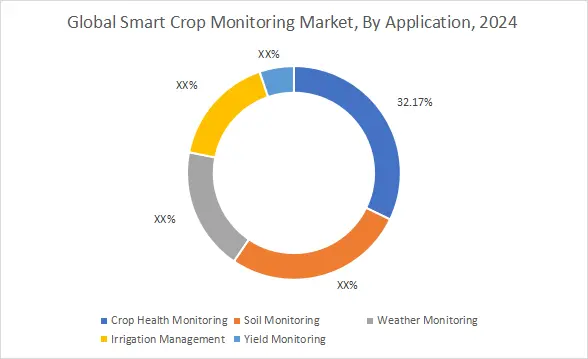
Based on application, the smart crop monitoring market is segmented into crop health monitoring, soil monitoring, weather monitoring, irrigation management, and yield monitoring.
Trends in the Application:
- The growing need to detect crop diseases and nutrient deficiencies at an early stage is driving the demand for crop health monitoring solutions.
- The growing interest in optimizing water consumption and irrigation efficiency is accelerating the demand for smart irrigation management solutions.
The Crop Health Monitoring segment accounted for the largest revenue share of 32.17% in 2024.
- Crop health monitoring solutions employ sensors, drones, and image processing algorithms to identify crop health in real-time.
- These solutions allow farmers to identify pest attacks, nutrient deficiencies, and stress factors before they result in significant damage to crops.
- In addition, the rising adoption of remote sensing and multispectral imaging technology is enhancing the accuracy of crop health analysis.
- Further, the growing need for increased agricultural productivity to fulfill the global food demand is driving the market.
- Furthermore, data-driven decision-making enabled by AI-based crop analysis tools is strengthening adoption across large-scale farms.
- Thus, the need for early disease detection and productivity improvement is driving dominance of crop health monitoring.
Irrigation Management is anticipated to register the fastest CAGR during the forecast period.
- The irrigation management solutions enable the efficient distribution of water based on the soil moisture content and weather predictions.
- The irrigation management solutions also assist in reducing water wastage and maximizing crop production based on efficient irrigation schedules.
- In addition, the increasing awareness about water scarcity and government regulations on water utilization are also driving the adoption of irrigation management solutions.
- Furthermore, the combination of IoT soil sensors with automated irrigation solutions is also improving efficiency.
- In addition, the government initiatives to encourage sustainable water management practices in agriculture are also propelling the growth of the market.
- Therefore, the growing emphasis on water conservation and resource optimization is anticipated to boost the irrigation management segment during the forecast period.
Regional Analysis:
North America, Europe, Asia Pacific, the Middle East and Africa, and Latin America are the regions of coverage.
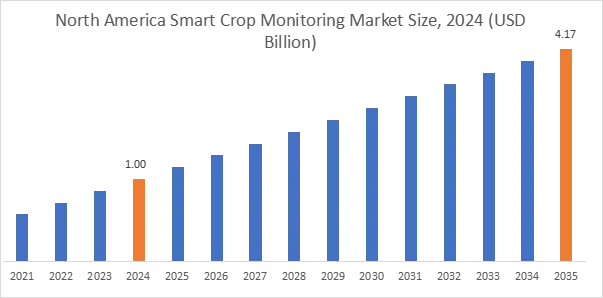
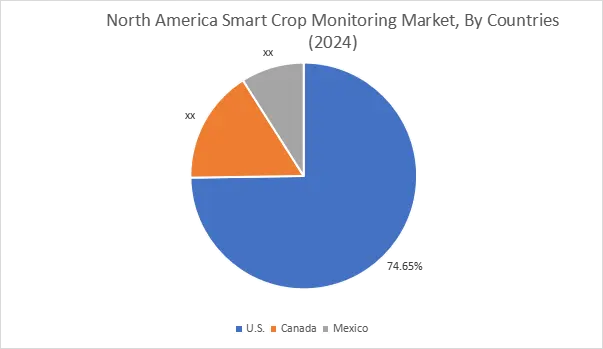
In 2024, North America accounted for the highest market share at 35.80% and was valued at USD 1.00 Billion, and is expected to reach USD 4.17 Billion by 2035. In North America, the U.S. accounted for the highest market share of 74.65% during the base year of 2024. North America smart crop monitoring market is driven by commercial farming practices, high mechanization, and the adoption of precision agriculture solutions in the United States and Canada. The integration of GPS-enabled equipment, real-time crop analytics, and AI-powered yield prediction solutions is enhancing farm productivity and resource management, thereby fueling the growth of the market.
- For example, the U.S. Department of Agriculture has pledged over USD 3.1 billion under its Partnerships for Climate-Smart Commodities program to support projects that include the use of innovative monitoring, data gathering, and verification technologies in farming practices. Such projects include digital farm management solutions, remote sensing solutions, and precision agriculture solutions, thereby increasing the adoption of smart crop monitoring solutions in North America.
In Asia Pacific, the smart crop monitoring market is experiencing the fastest growth with a CAGR of 16.31% over the forecast period. Asia Pacific smart crop monitoring market is fueled by the adoption of precision agriculture, increasing food requirements, and government-supported smart farming projects in China, India, Japan, and Australia. Farmers are incorporating satellite imaging, IoT soil sensors, and drone monitoring systems to improve crop forecasting and water resource management efficiency, thus driving the market.
- For example, in October 2025, SBI Foundation in India collaborated with the University of Agricultural Sciences, Raichur, and ICRISAT to initiate the SMART-CROP project, which is a technology-based project utilizing satellite imaging, remote sensing, and AI analysis to provide real-time crop stress analysis for 8,000 small-scale farmers.
The Europe smart crop monitoring market is fueled by sustainable agriculture regulations, precision agriculture projects supported by government subsidies, and climate change mitigation initiatives in Germany, France, Spain, and the Netherlands. Agricultural operators are deploying remote sensing tools, GIS platforms, and automated irrigation monitoring systems to comply with environmental standards and improve input optimization, thereby driving market growth.
Latin America smart crop monitoring market growth is supported by expanding soybean, corn, and sugarcane cultivation across Brazil and Argentina, along with rising export-oriented agricultural production. Large agribusiness operators are deploying drone mapping, satellite monitoring, and soil health analytics systems to optimize crop performance, thereby driving market growth.
Middle East & Africa smart crop monitoring market is aided by water scarcity management initiatives and agricultural modernization plans by governments in Israel, Saudi Arabia, and South Africa. The adoption of irrigation control systems and crop monitoring solutions is increasing the efficiency and productivity of the crops, thus driving the growth of the market.
Top Key Players & Market Share Insights:
The global smart crop monitoring market is highly competitive, with top agricultural technology firms providing innovative precision farming solutions in the global market. The top firms are using various approaches in research and development, digital platform integration, collaborations, and innovations to keep a strong foothold in the smart crop monitoring market. The key players operating in the smart crop monitoring market include:
- Trimble Inc. (U.S.)
- Deere & Company (U.S.)
- Bayer AG (Germany)
- Corteva Agriscience (U.S.)
- AGCO Corporation (U.S.)
- Topcon Corporation (Japan)
- Hexagon AB (Sweden)
- CNH Industrial N.V. (UK)
- Raven Industries (U.S.)
- Sentera Inc. (U.S.)
Recent Industry Developments:
Product Launches
- In June 2025, In June 2025, Kubota North America Corporation made an announcement about a strategic partnership with Agtonomy to combine autonomous operation software on Kubota’s M5N tractors, which will benefit specialty crop farmers by providing them with autonomous spraying and mowing capabilities to increase field productivity and save costs in precision crop monitoring agriculture.
- In May 2025, Syngenta made an announcement about the integration of Cropwise Operations with Al Dahra’s farm management solutions to provide real-time crop monitoring and rapid agronomic decision-making. The data provided by the software solution helps farm managers take appropriate actions regarding pest infestations, water management, and irrigation and input application.
Smart Crop Monitoring Market Report Insights:
| Report Attributes | Report Details |
|---|---|
| Study Timeline | 2019-2035 |
| Market Size in 2035 (USD Billion) | USD 11.65 Billion |
| CAGR (2025-2035) | 13.84% |
| By Component |
|
| By Technology |
|
| By Deployment Mode |
|
| By Application |
|
| By Region |
|
| Key Players |
|
| Report Coverage |
|
Key Questions Answered in the Report
Overview
Reputation & Certifications


Our Services
- Market Intelligence & Forecasting
- Custom Research Solutions
- Market Entry Strategy
- Competitive Intelligence
- Customer Insights
- Industry Innovation Analysis
- Investment Advisory