Jump to Content
Smart Home Energy Management Device Market - Size, Share, Industry Trends, and Forecasts (2025 - 2032)
Smart Home Energy Management Device Market Size:
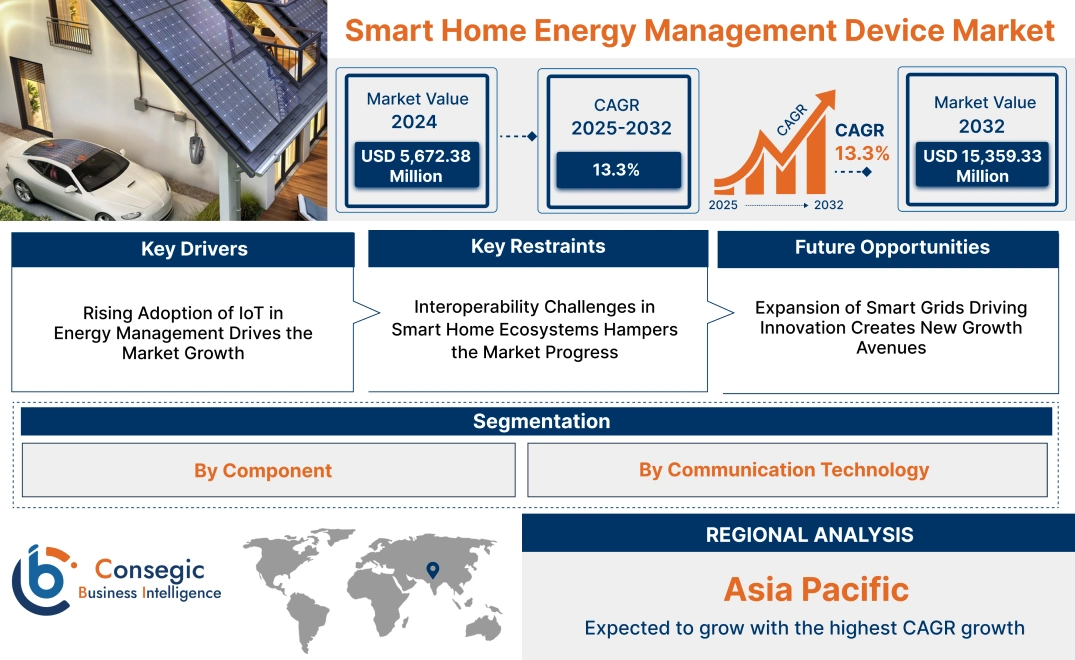
Smart Home Energy Management Device Market size is estimated to reach over USD 15,359.33 Million by 2032 from a value of USD 5,672.38 Million in 2024 and is projected to grow by USD 6,323.46 Million in 2025, growing at a CAGR of 13.3% from 2025 to 2032.
Smart Home Energy Management Device Market Scope & Overview:
A smart home energy management device is an advanced system designed to monitor, control, and optimize energy consumption within residential spaces. These devices enable homeowners to track real-time energy usage, automate energy-saving processes, and manage appliances remotely through connected platforms. They play a significant role in enhancing energy efficiency and reducing utility costs by providing actionable insights and control.
These devices come equipped with features such as energy usage analytics, integration with smart home ecosystems, and compatibility with renewable energy sources. They are designed for seamless operation with IoT-enabled devices, offering centralized control through mobile apps or voice-activated assistants. Additionally, these systems support dynamic energy management, ensuring efficient use of electricity during peak and off-peak hours.
End-users of these devices include residential property owners, smart home solution providers, and energy-conscious consumers seeking to enhance efficiency and sustainability in their homes. These systems are essential for enabling intelligent energy management and supporting modern connected lifestyles.
Smart Home Energy Management Device Market Dynamics - (DRO) :
Key Drivers:
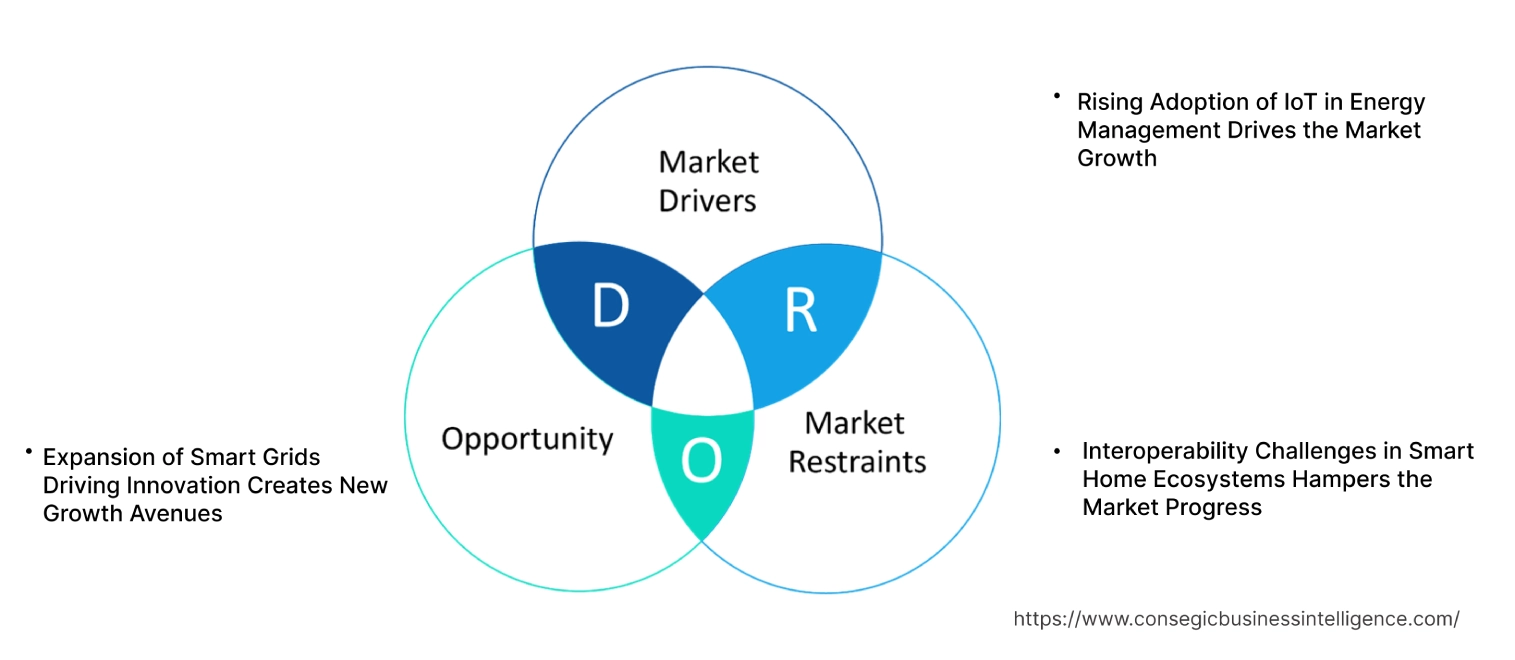
Rising Adoption of IoT in Energy Management Drives the Market Growth
The integration of Internet of Things (IoT) technology into energy management devices is transforming how homeowners optimize energy consumption. IoT-enabled systems offer real-time monitoring, predictive analytics, and remote control capabilities, empowering users to make data-driven decisions about their energy use. These devices detect patterns in consumption, provide actionable insights, and automate processes such as adjusting heating, cooling, or lighting to reduce wastage. In urban areas, where energy costs are high, this technology offers significant cost-saving potential, making it highly appealing to consumers. Moreover, IoT-driven energy management enhances sustainability efforts by promoting efficient resource utilization. The seamless connectivity of IoT devices with other smart home systems further improves convenience and interoperability, driving their adoption. As IoT technology advances, its role in creating smarter, more energy-efficient homes is expected to grow, aligning with global trends in sustainable living and smart city development. Therefore, the aforementioned factors are driving the smart home energy management device market demand.
Key Restraints:
Interoperability Challenges in Smart Home Ecosystems Hampers the Market Progress
The lack of interoperability among smart home devices poses a significant restraint in adopting energy management systems. Many smart home appliances and systems are developed using proprietary protocols, making it difficult to integrate devices from different manufacturers into a unified ecosystem. This fragmentation limits the effectiveness of energy management devices, as optimal control and automation require seamless communication between appliances. For instance, a smart energy management device struggles to control lighting systems, HVAC units, and kitchen appliances simultaneously due to compatibility issues. This creates inefficiencies and reduces user satisfaction, particularly in households with diverse smart home setups. Furthermore, addressing these challenges often requires additional investments in hubs or software solutions, increasing overall costs and complicating installation. The analysis of market trends depicts that until standardized protocols or universal platforms become more prevalent, interoperability issues will continue to hinder the smart home energy management device market growth.
Future Opportunities :
Expansion of Smart Grids Driving Innovation Creates New Growth Avenues
The proliferation of smart grids, enabling two-way communication between energy providers and consumers, is transforming home energy management. These grids facilitate real-time energy data exchange, allowing users to optimize energy consumption based on dynamic pricing and demand-response programs. Smart home energy management devices integrated with smart grids automatically adjust energy usage during peak hours, maximizing cost efficiency and reducing overall consumption. This capability is particularly beneficial in managing renewable energy sources, such as solar panels, by efficiently distributing excess energy back to the grid. Additionally, smart grids enhance system reliability by detecting and addressing power fluctuations or outages in real time. The synergy between smart grids and energy management devices is fostering innovation, offering significant benefits for cost-conscious consumers while contributing to sustainability goals. The analysis of market trends shows that as the smart grid adoption accelerates globally, it presents a promising avenue for expanding smart home energy management device market opportunities.
Smart Home Energy Management Device Market Segmental Analysis :
By Component:
Based on the component, the market is segmented into hardware, software, and services.
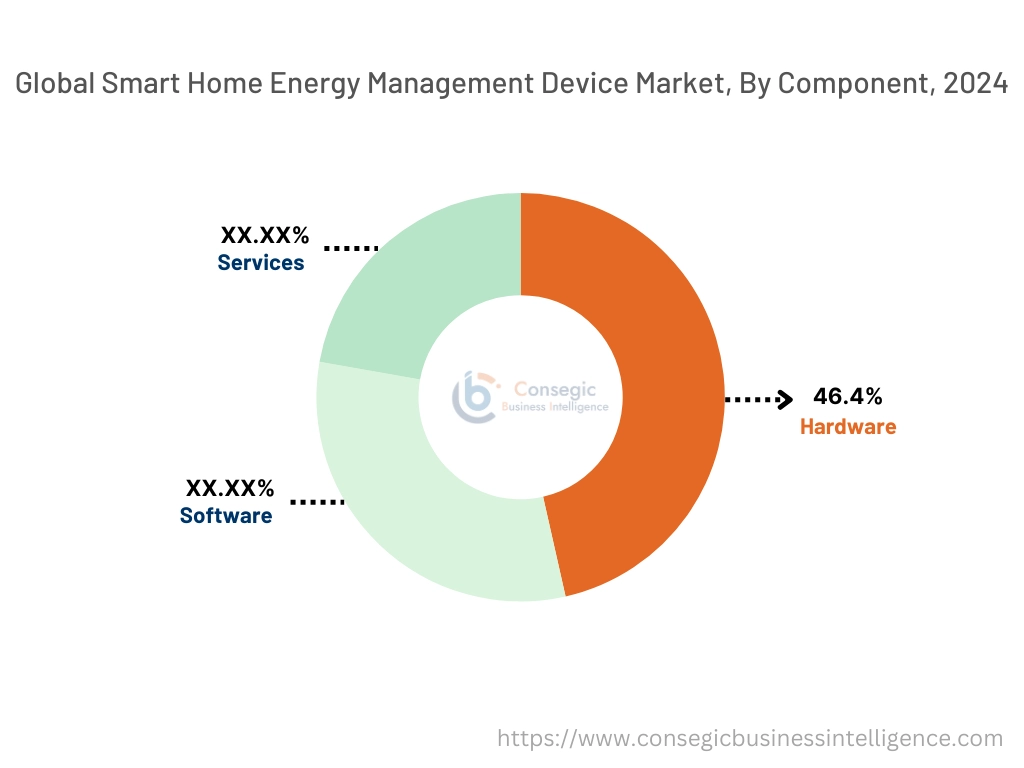
The hardware segment held the largest revenue of 46.4% of the total smart home energy management device market share in 2024.
- Smart meters and energy monitors enable real-time monitoring and control of energy consumption, enhancing energy efficiency.
- The widespread adoption of smart plugs and renewable energy devices, such as solar panels and storage units, drives the segment's dominance.
- Increasing integration of advanced hardware devices with IoT platforms supports seamless energy management in residential settings.
- The reliance on hardware components for accurate data collection and interaction with smart home ecosystems further solidifies the segment's leadership, fueling the smart home energy management device market expansion.
The services segment is projected to grow at the fastest CAGR during the forecast period.
- Consulting and energy audit services assist consumers in optimizing energy consumption and minimizing operational inefficiencies.
- Installation and integration services ensure seamless deployment of hardware and software systems, enhancing user satisfaction.
- Maintenance and support services are vital for the consistent operation of energy management systems, minimizing downtime.
- As per the smart home energy management device market analysis, the rapid adoption of energy optimization and training services is driven by the increasing complexity of smart home technologies.
By Communication Technology:
Based on communication technology, the market is segmented into Wi-Fi, Zigbee, Z-Wave, Bluetooth, and others.
The Wi-Fi segment held the largest revenue of the smart home energy management device market share in 2024.
- Wi-Fi-enabled devices provide reliable connectivity for real-time energy monitoring and remote control of home energy systems.
- The prevalence of Wi-Fi networks in households ensures seamless integration with other smart home devices and ecosystems.
- The adoption of cloud-based platforms powered by Wi-Fi connectivity enhances system scalability and accessibility.
- As per the smart home energy management device market trends, the dominance of this segment is supported by the increasing use of Wi-Fi technology in smart meters and energy management applications.
The Zigbee segment is expected to grow at the fastest CAGR during the forecast period.
- Zigbee technology is widely adopted for its low power consumption and reliable connectivity in home energy management devices.
- Its compatibility with various devices in smart home ecosystems drives its growing adoption across residential applications.
- Zigbee networks enable secure communication for energy data transfer, ensuring privacy and system reliability.
- As the trends in energy-efficient homes evolve, the adoption of Zigbee technology for advanced energy management solutions is accelerating, driving the smart home energy management device market demand.
Regional Analysis:
The regions covered are North America, Europe, Asia Pacific, the Middle East and Africa, and Latin America.
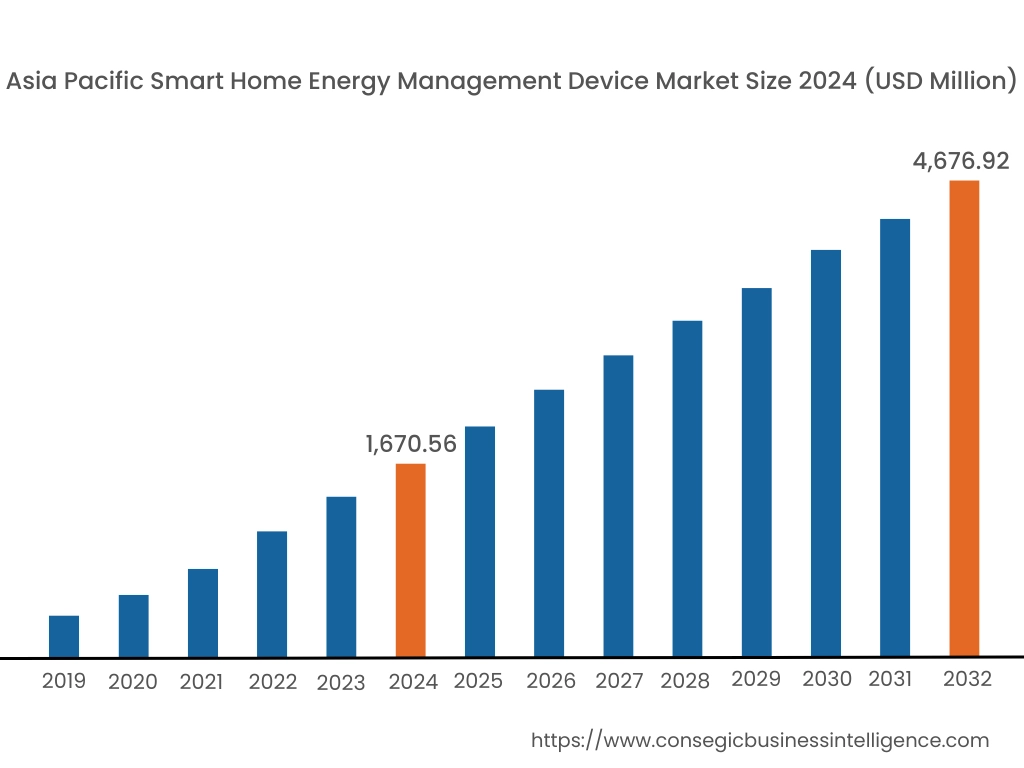
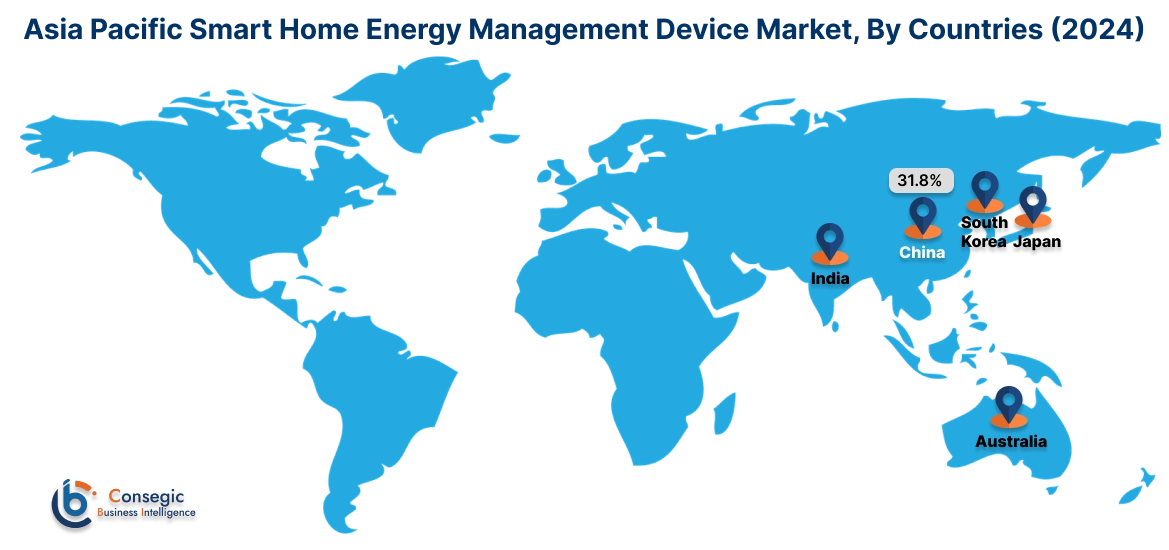
Asia Pacific region was valued at USD 1,670.56 Million in 2024. Moreover, it is projected to grow by USD 1,867.58 Million in 2025 and reach over USD 4,676.92 Million by 2032. Out of this, China accounted for the maximum revenue share of 31.8%. The Asia-Pacific region is experiencing rapid development in the market, driven by industrialization and technological advancements in countries such as China, Japan, and India. The enlargement of the consumer electronics industry and the rising demand for energy-efficient solutions have intensified the need for advanced energy management devices. Government initiatives promoting industrial efficiency further influence smart home energy management device market growth.
North America is estimated to reach over USD 4,977.96 Million by 2032 from a value of USD 1,881.58 Million in 2024 and is projected to grow by USD 2,093.54 Million in 2025. This region holds a substantial share of the market, driven by the increasing adoption of smart home technologies and a heightened focus on energy efficiency. The United States, in particular, has seen a rise in the implementation of smart home energy management devices, with the market projected to grow significantly in the coming years. As per the smart home energy management device market trends, the integration of Internet of Things (IoT) devices and advanced analytics to optimize energy consumption is growing. Analysis indicates that the presence of key market players and continuous technological advancements contribute to the region's smart home energy management device market expansion.
Europe represents a substantial portion of the global market, with countries like Germany, France, and the United Kingdom leading in adoption and innovation. The region's emphasis on sustainability and energy efficiency has propelled the utilization of eco-friendly energy management solutions. The smart home energy management device market analysis indicates growth in trend towards the deployment of integrated energy management systems that combine various smart devices to offer comprehensive solutions across multiple sectors.
The Middle East & Africa region shows a growing interest in advanced energy management solutions, particularly in the construction and industrial sectors. Countries like Saudi Arabia and South Africa are investing in modern technologies to enhance production efficiency. Analysis suggests an increasing trend towards adopting smart home energy management devices to meet international quality standards.
Latin America is an emerging market for smart home energy management devices, with Brazil and Mexico being key contributors. The region's growing focus on industrial modernization and the automotive industry has spurred the adoption of advanced energy management solutions. Government policies aimed at enhancing manufacturing capabilities influence smart home energy management device market opportunities.
Top Key Players and Market Share Insights:
The Smart Home Energy Management Device market is highly competitive with major players providing products and services to the national and international markets. Key players are adopting several strategies in research and development (R&D), product innovation, and end-user launches to hold a strong position in the global Smart Home Energy Management Device market. Key players in the Smart Home Energy Management Device industry include -
- Schneider Electric (France)
- Siemens AG (Germany)
- LG Electronics Inc. (South Korea)
- Samsung Electronics Co., Ltd. (South Korea)
- Panasonic Corporation (Japan)
- Honeywell International Inc. (USA)
- General Electric Company (USA)
- Eaton Corporation (Ireland)
- Johnson Controls International plc (Ireland)
- ABB Ltd. (Switzerland)
Recent Industry Developments :
Partnerships & Collaborations:
- In October 2024, Eaton collaborates with Lunar Energy to integrate AbleEdge smart breakers with Lunar’s solar battery system, streamlining installation and optimizing energy management for homeowners. The solution, compatible with Lunar’s mobile app, offers load management, cost optimization, and enhanced battery life. The partnership supports Eaton’s "Home as a Grid" strategy, advancing sustainable and resilient home energy solutions.
- In January 2024, Samsung announced a collaboration with Tesla, to integrate SmartThings Energy with Tesla's Powerwall, Solar Inverter, Wall Connector, and EVs. Leveraging Tesla’s open APIs, this partnership enhances energy monitoring, storage, and management for homeowners. Features include syncing SmartThings Energy with Tesla’s Powerwall “Storm Watch” for power outage alerts and AI Energy Mode to optimize backup energy. This integration aligns with Samsung’s Net Zero Home initiative, offering seamless, energy-efficient smart home experiences.
Product Launches:
- In June 2024, ABB unveiled the ReliaHome™ Smart Panel, its first residential energy management platform for the U.S. and Canadian markets. Developed in partnership with Lumin, this solution optimizes on- and off-grid energy use through features like circuit scheduling, real-time control, and whole-home energy monitoring. Compatible with batteries, solar inverters, EV chargers, and generators, the panel supports energy savings and decarbonization goals while ensuring cybersecurity and reliable offline functionality. This launch aligns with ABB’s commitment to accelerating the energy transition through innovative home solutions.
- In January 2024, Samsung’s SmartThings platform introduced the SmartThings Energy Flex Connect program in New York and California, empowering users to support the grid during peak demand events. By automating energy conservation with devices like thermostats, lights, and appliances, users can reduce energy consumption and earn Samsung Rewards points. The program utilizes AI Energy Mode and automations for seamless participation, offering advanced control, flexibility, and eco-conscious living while promoting a sustainable energy grid.
Smart Home Energy Management Device Market Report Insights :
| Report Attributes | Report Details |
| Study Timeline | 2019-2032 |
| Market Size in 2032 | USD 15,359.33 Million |
| CAGR (2025-2032) | 13.3% |
| By Component |
|
| By Communication Technology |
|
| By Region |
|
| Key Players |
|
| North America | U.S. Canada Mexico |
| Europe | U.K. Germany France Spain Italy Russia Benelux Rest of Europe |
| APAC | China South Korea Japan India Australia ASEAN Rest of Asia-Pacific |
| Middle East and Africa | GCC Turkey South Africa Rest of MEA |
| LATAM | Brazil Argentina Chile Rest of LATAM |
| Report Coverage |
|
Key Questions Answered in the Report
What is the size of the Smart Home Energy Management Device Market? −
Smart Home Energy Management Device Market size is estimated to reach over USD 15,359.33 Million by 2032 from a value of USD 5,672.38 Million in 2024 and is projected to grow by USD 6,323.46 Million in 2025, growing at a CAGR of 13.3% from 2025 to 2032.
What are the key segments of the Smart Home Energy Management Device Market? +
The market is segmented by component, communication technology, and region. The components include hardware (smart meters, energy monitors, smart plugs), software (energy analytics, home energy management platforms), and services (consulting, energy audits, installation, maintenance). Communication technologies include Wi-Fi, Zigbee, Z-Wave, Bluetooth, and others.
Which communication technology is expected to dominate the Smart Home Energy Management Device Market? +
The Wi-Fi segment held the largest revenue share of the market in 2024, driven by the widespread availability and reliable connectivity of Wi-Fi networks in households. Wi-Fi enables seamless integration with other smart home devices, enhancing the efficiency of energy management.
Who are the key players in the Smart Home Energy Management Device Market? +
Key players in the Smart Home Energy Management Device Market include Schneider Electric (France), Siemens AG (Germany), Honeywell International Inc. (USA), General Electric Company (USA), Eaton Corporation (Ireland), Johnson Controls International plc (Ireland), ABB Ltd. (Switzerland), LG Electronics Inc. (South Korea), Samsung Electronics Co., Ltd. (South Korea), and Panasonic Corporation (Japan).
Overview
Reputation & Certifications


Our Services
- Market Intelligence & Forecasting
- Custom Research Solutions
- Market Entry Strategy
- Competitive Intelligence
- Customer Insights
- Industry Innovation Analysis
- Investment Advisory