Jump to Content
Smart Indoor Lighting Market - Size, Share, Industry Trends, and Forecasts (2025 - 2032)
Smart Indoor Lighting Market Scope & Overview:
Smart indoor lighting refers to advanced lighting systems that integrate automation, wireless connectivity, and energy-efficient technologies to provide enhanced lighting control and customization. These systems are designed to enable remote operation, scheduling, and adaptive lighting adjustments through connected devices such as smartphones, tablets, or voice-activated assistants.
They are widely utilized in residential, commercial, and industrial environments to create efficient and dynamic lighting experiences.These lighting systems include features such as dimming, color tuning, motion sensing, and real-time monitoring, offering versatility and improved user convenience. They are compatible with various smart home ecosystems and building management systems, ensuring seamless integration and centralized control.
Smart indoor lighting solutions are available in different forms, including LED bulbs, luminaires, and lighting panels, catering to diverse interior design and functionality requirements.End-users of smart indoor lighting include homeowners, businesses, and facility managers seeking modern lighting solutions that enhance ambiance, efficiency, and operational flexibility. These systems play a significant role in modernizing interior spaces while offering greater control and energy savings.
Smart Indoor Lighting Market Size:
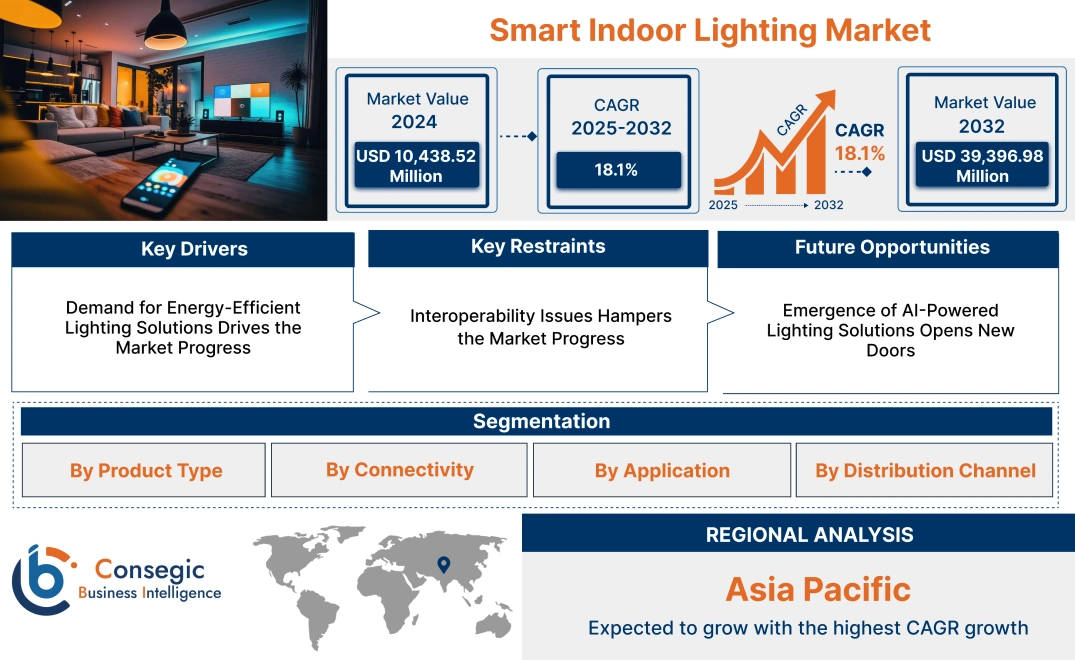
Smart Indoor Lighting Market size is estimated to reach over USD 39,396.98 Million by 2032 from a value of USD 10,438.52 Million in 2024 and is projected to grow by USD 12,137.72 Million in 2025, growing at a CAGR of 18.1% from 2025 to 2032.
Smart Indoor Lighting Market Dynamics - (DRO) :
Key Drivers:
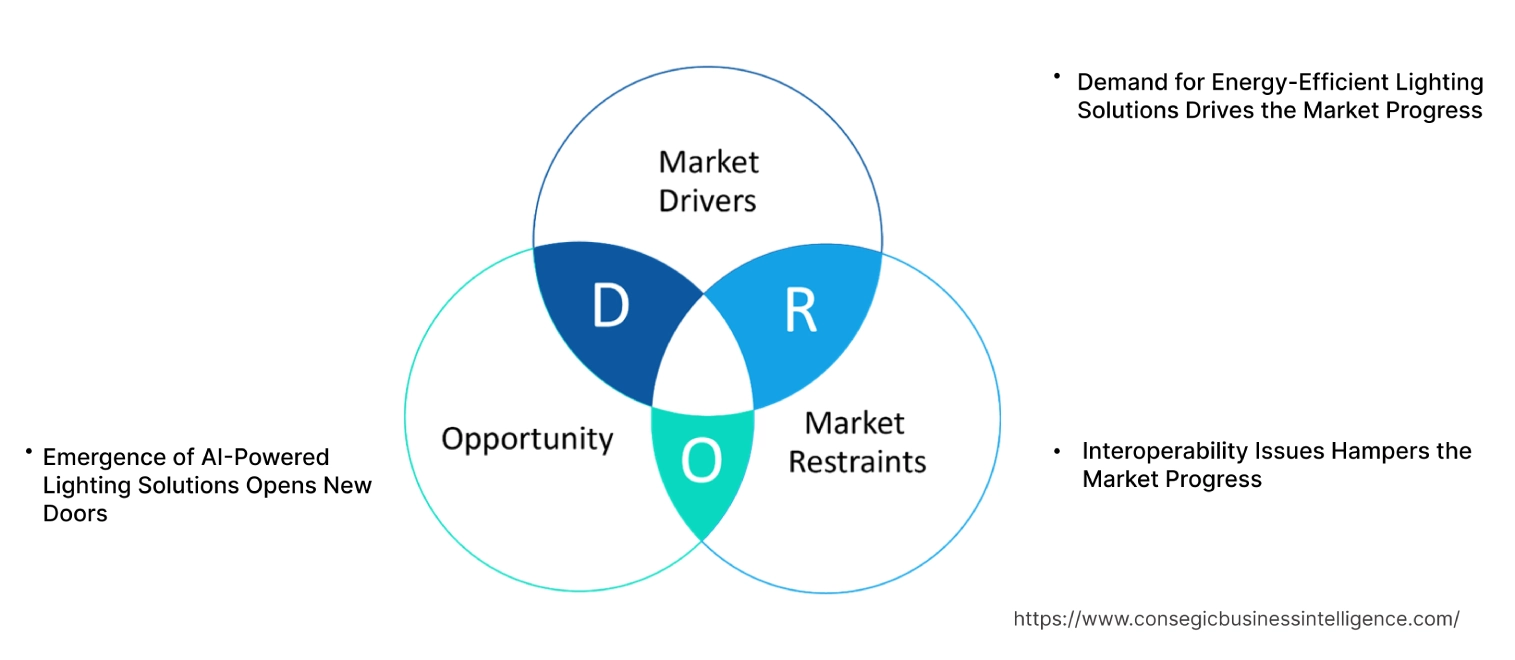
Demand for Energy-Efficient Lighting Solutions Drives the Market Progress
The growing emphasis on energy conservation worldwide is driving the adoption of energy-efficient lighting solutions. LED-based smart lighting systems are at the forefront of this trend, offering significantly lower energy consumption compared to traditional incandescent or fluorescent lighting.
These systems not only reduce electricity bills but also support environmental sustainability by minimizing carbon emissions. Additionally, their longer lifespans reduce the need for frequent replacements, further contributing to cost savings and reducing waste. Smart lighting features, such as automated brightness adjustment and motion sensing, enhance energy efficiency by ensuring lights are only used when needed.
Governments and organizations promoting green initiatives and energy-saving regulations are further accelerating the adoption of these solutions. As sustainability goals gain momentum globally, energy-efficient smart lighting systems are becoming an essential component in residential, commercial, and industrial spaces. This shift aligns with broader trends in eco-friendly infrastructure and technology, fueling the smart indoor lighting market growth.
Key Restraints:
Interoperability Issues Hampers the Market Progress
Interoperability remains a significant constraint in the adoption of smart lighting systems. The absence of standardized communication protocols and compatibility between devices often complicates integration with other smart home components, such as thermostats, security systems, and voice assistants.
These inconsistencies result in limited functionality, such as the inability to control all devices through a single interface or coordinate multiple systems efficiently. For instance, devices operating on different wireless standards like Zigbee, Z-Wave, or Wi-Fi require additional hubs or adapters, increasing setup complexity and cost.
This lack of seamless integration undermines the convenience and user experience that smart lighting systems aim to provide. Furthermore, compatibility issues deter less tech-savvy consumers from adopting these solutions, hindering the smart indoor lighting market demand. Addressing these interoperability restraints is critical to ensuring the widespread and efficient adoption of smart lighting technologies across diverse applications.
Future Opportunities :
Emergence of AI-Powered Lighting Solutions Opens New Doors
The integration of artificial intelligence (AI) in lighting systems is revolutionizing smart indoor lighting by enabling adaptive and predictive functionalities. AI-powered lighting solutions learn user behavior and preferences over time, allowing systems to automatically adjust brightness, color temperature, and schedules for optimal comfort and energy efficiency.
For example, lights dim or brighten based on ambient light levels or activate specific modes during predefined activities like reading or relaxing. These intelligent systems also provide predictive scheduling, turning lights on or off based on historical usage patterns or occupancy detection. Such capabilities enhance convenience in residential settings while improving operational efficiency in commercial spaces.
The ability to seamlessly integrate with other AI-driven devices, such as voice assistants and IoT systems, further expands their appeal. As consumer and business demand for personalized and energy-efficient solutions grows, AI-powered lighting presents significant smart indoor lighting market opportunities.
Top Key Players and Market Share Insights:
The Smart Indoor Lighting market is highly competitive with major players providing products and services to the national and international markets. Key players are adopting several strategies in research and development (R&D), product innovation, and end-user launches to hold a strong position in the global Smart Indoor Lighting market. Key players in the Smart Indoor Lighting industry include -
- Signify Holding (Netherlands)
- Legrand (France)
- Lutron Electronics Co., Inc. (USA)
- LEDVANCE GmbH (Germany)
- Current Lighting (USA)
- Acuity Brands, Inc. (USA)
- ams-OSRAM AG (Austria)
- Honeywell International Inc. (USA)
- Zumtobel Group (Austria)
- Wipro Lighting (India)
Smart Indoor Lighting Market Segmental Analysis :
By Product Type:
Based on product type, the market is segmented into LED lights, fluorescent lights, incandescent lights, high-intensity discharge (HID) lights, and others.
The LED lights segment held the largest revenue of the total smart indoor lighting market share in 2024 and is also expected to register the fastest CAGR during the forecast period.
- LED lights are known for their superior energy efficiency and longer lifespan compared to traditional lighting solutions, making them the preferred choice in smart indoor lighting systems.
- Their compatibility with smart lighting technologies and ability to offer adjustable color temperatures support their wide-scale adoption in both residential and commercial sectors.
- The rising demand for energy-saving lighting systems and the growing adoption of smart home technologies contribute to the rapid extension of this segment.
- Innovations in LED technology, such as tunable lighting and human-centric designs, and government initiatives promoting energy-efficient lighting solutions further boost its growth.
- As per the smart indoor lighting market analysis, increased investments by manufacturers to improve the performance and aesthetics of LED lighting systems also drive this segment’s growth.
By Connectivity:
Based on connectivity, the market is segmented into wired and wireless.
The wired segment held the largest revenue of the total smart indoor lighting market share in 2024.
- Wired connectivity is widely adopted in industrial and commercial applications due to its stability and resistance to interference.
- Technologies like Ethernet and Power Line Communication provide robust and secure data transmission, ensuring reliable lighting control systems.
- Wired systems are often preferred in large-scale projects where integrated cabling is cost-effective and feasible during construction.
- As per the smart indoor lighting market trends, the dominance of this segment is driven by its established infrastructure and compatibility with long-term operations in high-demand environments.
The wireless segment is expected to register the fastest CAGR during the forecast period.
- Wireless systems are increasingly popular in residential and retrofitting applications, offering easy installation and flexibility without extensive cabling.
- The integration of IoT technologies and voice-activated assistants like Alexa and Google Assistant drives the adoption of wireless lighting solutions.
- Emerging technologies such as Zigbee, Wi-Fi, and Z-Wave enhance interoperability with smart home devices, boosting the segment's appeal.
- Thus, rapid advancements in wireless protocols and the rising demand for energy-efficient and portable solutions contribute to the segment's strong growth trajectory, fueling the smart indoor lighting market demand.
By Application:
Based on application, the market is segmented into residential, commercial, and industrial.
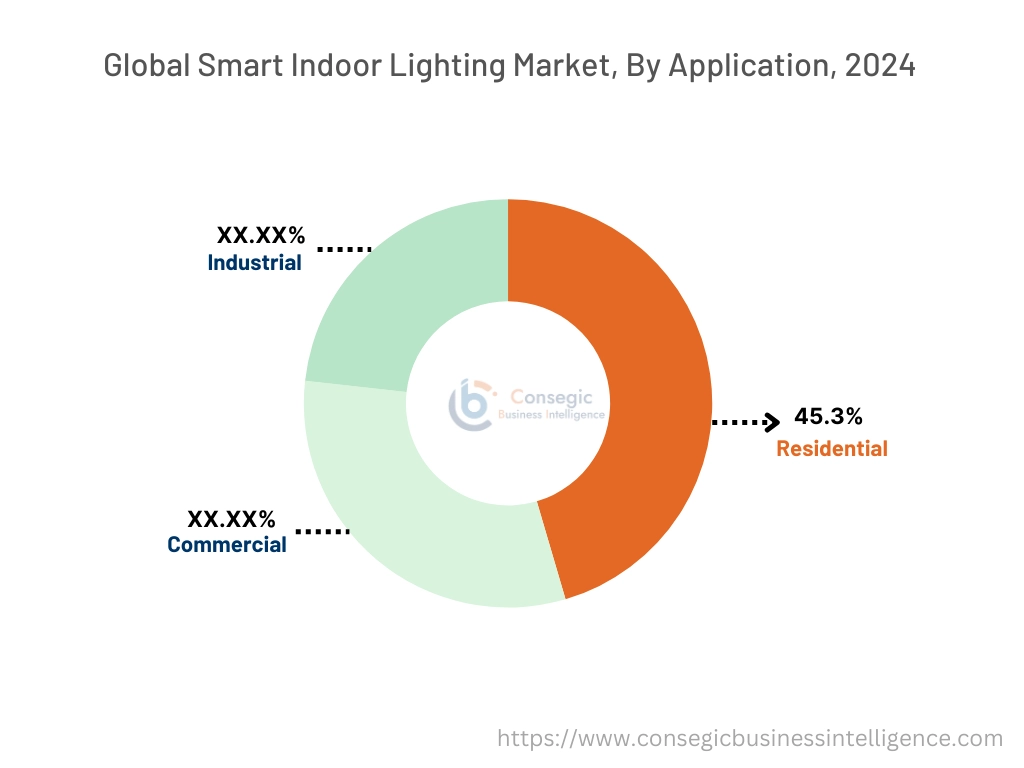
The residential segment held the largest revenue of 45.3% share in 2024 and is expected to register the fastest CAGR during the forecast period.
- Increasing consumer preference for energy-efficient lighting and smart home solutions drives smart indoor lighting market growth in residential spaces.
- Features like customizable lighting, voice control, and integration with smart home ecosystems enhance residential adoption.
- Rising disposable income and awareness of energy conservation further accelerate this segment’s growth.
- Government incentives for sustainable energy solutions contribute to the expansion of the residential segment.
- As per the smart indoor lighting market analysis, the demand for IoT-enabled, app-based, and voice-controlled lighting systems is rising, driven by modern interior design trends and urban households' aesthetic preferences.
By Distribution Channel:
Based on distribution channels, the market is segmented into online retail and offline retail.
The offline retail segment held the largest revenue share in 2024.
- Offline retail channels allow customers to experience and compare products physically, providing better confidence in purchasing high-value smart lighting systems.
- Specialty stores offer personalized recommendations and expert guidance, further enhancing customer satisfaction.
- The dominance of offline retail channels is driven by their strong presence in both developed and emerging markets.
- As per the smart indoor lighting market trends, large-scale retail outlets, such as supermarkets, also play a significant role in promoting and selling smart indoor lighting systems.
The online retail segment is expected to register the fastest CAGR during the forecast period.
- Increasing penetration of e-commerce platforms and the convenience of online shopping drive the rapid progress of this segment.
- Online platforms offer a wider variety of products, competitive pricing, and ease of comparison, appealing to tech-savvy consumers.
- Strategic partnerships between manufacturers and online retailers further propel the progress of this segment.
- Therefore, the growing trend of direct-to-consumer sales by lighting manufacturers through online channels supports the growth of the online retail segment, which further boosts the smart indoor lighting market expansion.
Smart Indoor Lighting Market Report Insights :
| Report Attributes | Report Details |
| Study Timeline | 2019-2032 |
| Market Size in 2032 | USD 39,396.98 Million |
| CAGR (2025-2032) | 18.1% |
| By Product Type |
|
| By Connectivity |
|
| By Application |
|
| By Distribution Channel |
|
| By Region |
|
| Key Players |
|
| North America | U.S. Canada Mexico |
| Europe | U.K. Germany France Spain Italy Russia Benelux Rest of Europe |
| APAC | China South Korea Japan India Australia ASEAN Rest of Asia-Pacific |
| Middle East and Africa | GCC Turkey South Africa Rest of MEA |
| LATAM | Brazil Argentina Chile Rest of LATAM |
| Report Coverage |
|
Regional Analysis:
The regions covered are North America, Europe, Asia Pacific, the Middle East and Africa, and Latin America.
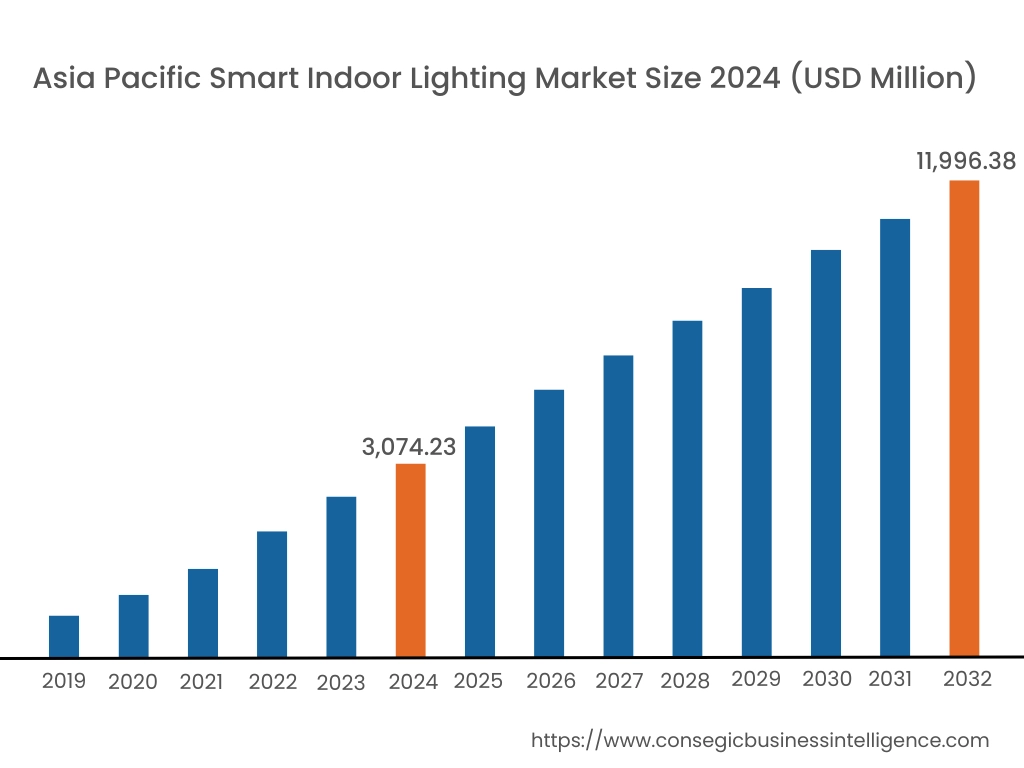
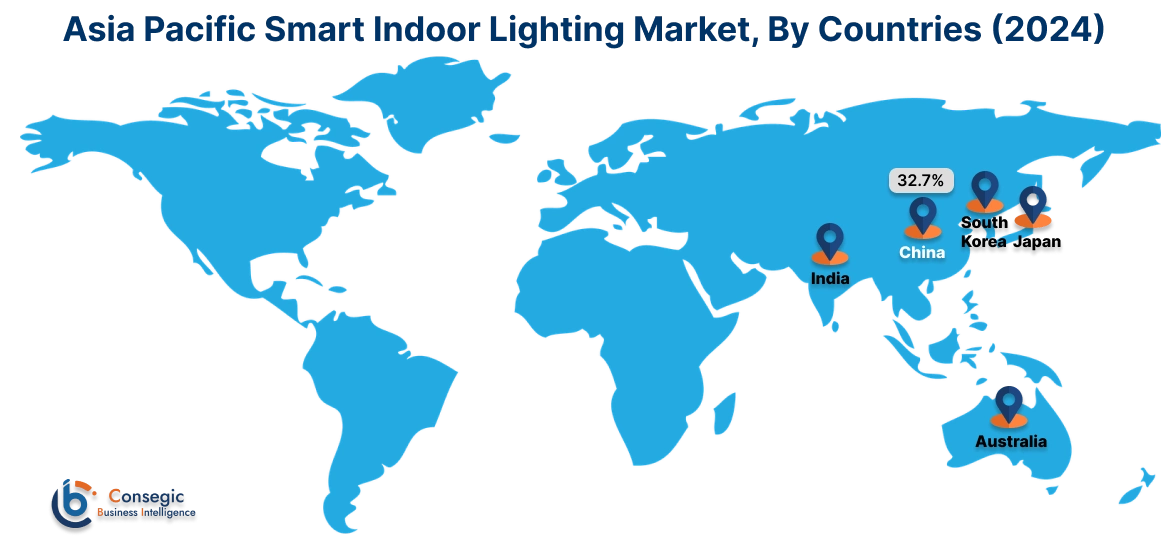
Asia Pacific region was valued at USD 3,074.23 Million in 2024. Moreover, it is projected to grow by USD 3,584.77 Million in 2025 and reach over USD 11,996.38 Million by 2032. Out of this, China accounted for the maximum revenue share of 32.7%. The Asia-Pacific region is experiencing rapid development in the smart indoor lighting market, driven by industrialization and technological advancements in countries such as China, Japan, and India. The enlargement of the consumer electronics industry and the rising need for energy-efficient solutions have intensified the need for advanced lighting technologies. Government initiatives promoting industrial efficiency further influence smart indoor lighting market opportunities.
North America is estimated to reach over USD 12,768.56 Million by 2032 from a value of USD 3,462.54 Million in 2024 and is projected to grow by USD 4,018.49 Million in 2025. This region holds a substantial share of the smart indoor lighting market, driven by the increasing adoption of smart home technologies and a heightened focus on energy efficiency. The United States, in particular, has seen a rise in the implementation of smart indoor lighting systems, with the market projected to grow significantly in the coming years. A notable trend is the integration of Internet of Things (IoT) devices and advanced analytics to optimize energy consumption. Analysis indicates that the presence of key market players and continuous technological advancements contribute to the region's market dominance.
Europe represents a substantial portion of the global smart indoor lighting market, with countries like Germany, France, and the United Kingdom leading in adoption and innovation. The region's emphasis on sustainability and energy efficiency has propelled the utilization of eco-friendly lighting solutions. Analysis indicates a growing trend towards the deployment of smart indoor lighting systems in various applications, offering flexibility across multiple sectors.
The Middle East & Africa region shows a growing interest in advanced lighting solutions, particularly in the construction and industrial sectors. Countries like Saudi Arabia and South Africa are investing in modern technologies to enhance production efficiency. Analysis suggests an increasing trend towards adopting smart indoor lighting systems to meet international quality standards.
Latin America is an emerging market for smart indoor lighting, with Brazil and Mexico being key contributors. The region's growing focus on industrial modernization and the automotive industry has spurred the adoption of advanced lighting solutions. As per the market analysis, government policies aimed at enhancing manufacturing capabilities influence market trends.
Recent Industry Developments :
Partnerships & Collaborations:
- In July 2024, GE Lighting partnered with Samsung’s SmartThings to expand smart lighting options with Matter-compatible Cync® reveal® HD+ Full Color Undercabinet Fixtures. These edge-lit, full-color smart lights offer millions of color options, sleek design, and flexible installation. With SmartThings integration, users can customize lighting schedules, control remotely, and create scenes for cooking or entertaining. This collaboration aims to deliver seamless, user-friendly connected home experiences that enhance functionality and aesthetics.
Business Expansion:
- In September 2024, Signify introduces WiZ Smart Lighting to Indonesia, offering 16 million colors and white-to-full-color options for a vibrant, connected home experience. Targeting young, tech-savvy users, WiZ features a simple plug-and-play setup and advanced controls, including Music Sync, Automation, and presets. WiZ integrates seamlessly into routines, enhancing activities like gaming, content creation, and family moments. With flexible options like RGB light strips, downlights, and smart bulbs, WiZ elevates home aesthetics and functionality.
Product Launches:
- In December 2023, Connect SmartHome launched its AmbiColour decorative smart lighting range, offering cost-effective, creative lighting solutions for bedrooms, gaming rooms, studies, and lounges. Designed for personalization, the AmbiColour range allows users to transform their spaces with dynamic lighting effects without overspending, blending style and functionality for any room.
Key Questions Answered in the Report
What is the size of the Smart Indoor Lighting Market? −
The Smart Indoor Lighting Market size is estimated to reach over USD 39,396.98 Million by 2032 from a value of USD 10,438.52 Million in 2024 and is projected to grow by USD 12,137.72 Million in 2025, growing at a CAGR of 18.1% from 2025 to 2032.
What are the key drivers of the Smart Indoor Lighting Market? +
Key drivers include the growing demand for energy-efficient lighting solutions, particularly LED-based smart lighting systems, which help reduce electricity consumption and support environmental sustainability. Government initiatives and the adoption of energy-saving technologies also drive market growth.
What are the key segments of the Smart Indoor Lighting Market? +
The market is segmented by product type (LED lights, fluorescent lights, incandescent lights, HID lights, and others), connectivity (wired and wireless), application (residential, commercial, industrial), distribution channel (online and offline retail), and region.
Who are the leading players in the Smart Indoor Lighting Market? +
Leading players include Signify Holding (Netherlands), Legrand (France), Acuity Brands, Inc. (USA), ams-OSRAM AG (Austria), Honeywell International Inc. (USA), Zumtobel Group (Austria), Wipro Lighting (India), Lutron Electronics Co., Inc. (USA), LEDVANCE GmbH (Germany), and Current Lighting (USA).
Overview
Reputation & Certifications


Our Services
- Market Intelligence & Forecasting
- Custom Research Solutions
- Market Entry Strategy
- Competitive Intelligence
- Customer Insights
- Industry Innovation Analysis
- Investment Advisory