Jump to Content
Smart Label Market - Size, Share, Industry Trends, and Forecasts (2025-2032)
Smart Label Market Size:
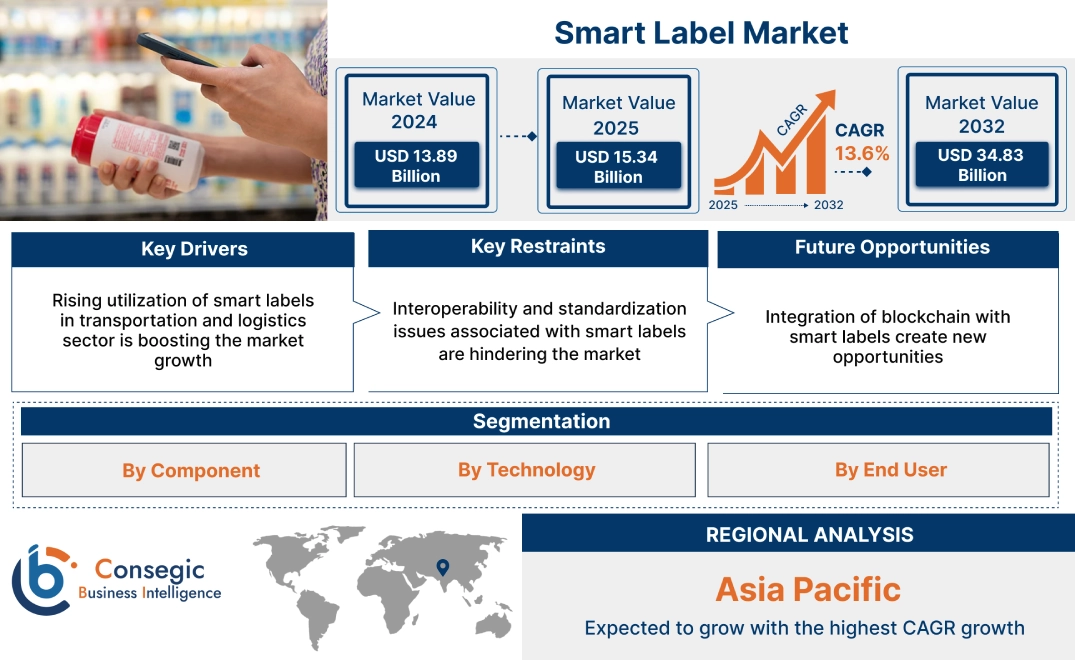
Smart Label Market size is estimated to reach over USD 34.83 Billion by 2032 from a value of USD 13.89 Billion in 2024 and is projected to grow by USD 15.34 Billion in 2025, growing at a CAGR of 13.6% from 2025 to 2032.
Smart Label Market Scope & Overview:
Smart labels integrate advanced technologies to provide real-time information and tracking of the products. It enables enhanced supply chain management and customer experience. These labels store data, interact with the consumer devices, and allow real-time tracking of data and information. These labels improve accuracy and efficiency, reduce paperwork, streamline communication, and enhance security, leading to increased customer engagement and improved supply chain management. These labels are used across industries including healthcare, retail, transportation, logistics, and manufacturing, among others.
Smart Label Market Dynamics - (DRO) :
Key Drivers:
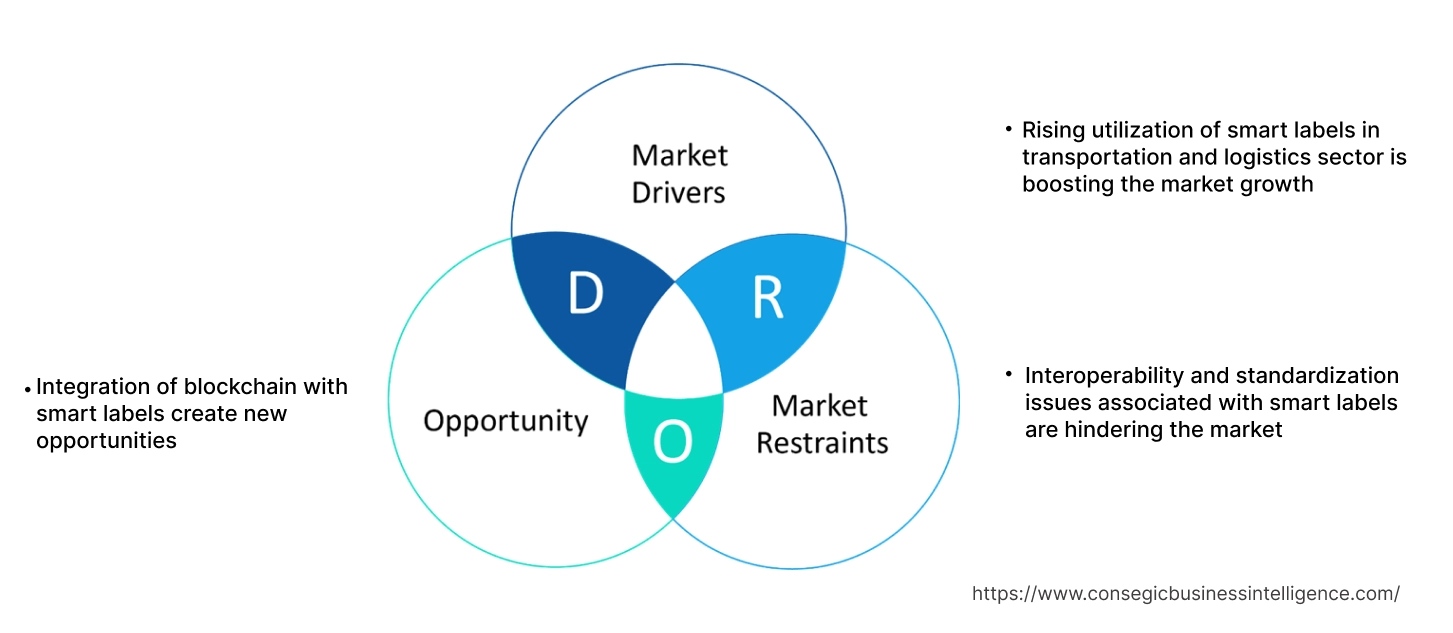
Rising utilization of smart labels in transportation and logistics sector is boosting the market growth
Smart labels enable real-time tracking of packages, pallets, or containers throughout the supply chain. These labels provide detailed information about location, condition, and movement of the products, leading to enhanced visibility and efficiency in logistics operations.Moreover, smart labels store additional data including manufacturing date, temperature conditions, tamper detection information, and expiry date. This enables better inventory management and quality control, thereby, enhancing the operational efficiency in transportation and logistics sector.
- For instance, in January 2025, Giesecke+Devrient (G+D) launched the G+D Smart Label, which is designed for application in transportation and logistics sector. The label includes an open-close sensor for tamper protection and automated proof of delivery. It also includes a temperature monitor to ensure the quality and integrity of goods.
Thus, the aforementioned factors are boosting the utilization of labels in logistics and transportation sectors, in turn, driving the smart label market growth.
Key Restraints:
Interoperability and standardization issues associated with smart labels are hindering the market
Lack of standardized protocols leads to interoperability issues as various products from several manufacturers follow different protocols. The diverse types of smart labels lead to compatibility issues between different devices and systems. Moreover, numerous levels of supply chain require multiple devices for tracking and communication, which leads to complexity in the integration and compatibility of devices.
Thus, the market analysis shows that the aforementioned factors are restraining the smart label market demand.
Future Opportunities :
Integration of blockchain with smart labels create new opportunities
The blockchain technology provides security, salability, transparency, and tamper proof record. A smart label attached to the product is scanned and the information is stored into the blockchain. Consumers scan the label to get all the information of the product, which enables improved efficiency and transparency. Moreover, manufacturers and distributors can verify the authenticity of the product, and also trace the product throughout the supply chain in real-time.
- For instance, in May 2024, Pairpoint and Sensos collaborated to work on blockchain IoT platform integrated with smart IoT label. Unilog, a US-based logistics operator, is testing the solution in the US and European sites.
Thus, the ongoing advancements in blockchain and its integration with these labels are projected to drive smart label market opportunities during the forecast period.
Smart Label Market Segmental Analysis :
By Component:
Based on the component, the market is segmented into batteries, memories, microprocessors, transceivers, and others.
Trends in the Component:
- Rising demand and adoption of transceivers in smart labels to allow automatic identification in inventory management is boosting the market growth.
- Increasing trend in adoption of microprocessors in smart labels to process and store data is driving the smart label market growth.
The batteries segment accounted for the largest revenue share in the smart label market share in 2024.
- The batteries in smart labels primarily include printed batteries such as lithium-ion coin cells or thin film batteries. These batteries power the electrical components in a label that enables features such as tracking, processing, and storing of information.
- For instance, in February 2024, Reelables introduced roll-to-roll printed smart label. It allows a zinc coated battery to be inserted alongside the wireless tracking circuit on a thin plastic film.
- Therefore, the segmental analysis depicts that the features and functions provided by batteries in these labels are driving the smart label market demand.
The memories segment is expected to register the fastest CAGR during the forecast period.
- The memories in smart labels are the integrated chips that store information about product and act as a data storage unit.
- It holds the encoded data that are read by a compatible device, in turn, allowing benefits including product authentication, real-time tracking, and consumer engagement.
- Thus, the market analysis depicts that the aforementioned factors are boosting the smart label market opportunities during the forecast period.
By Technology:
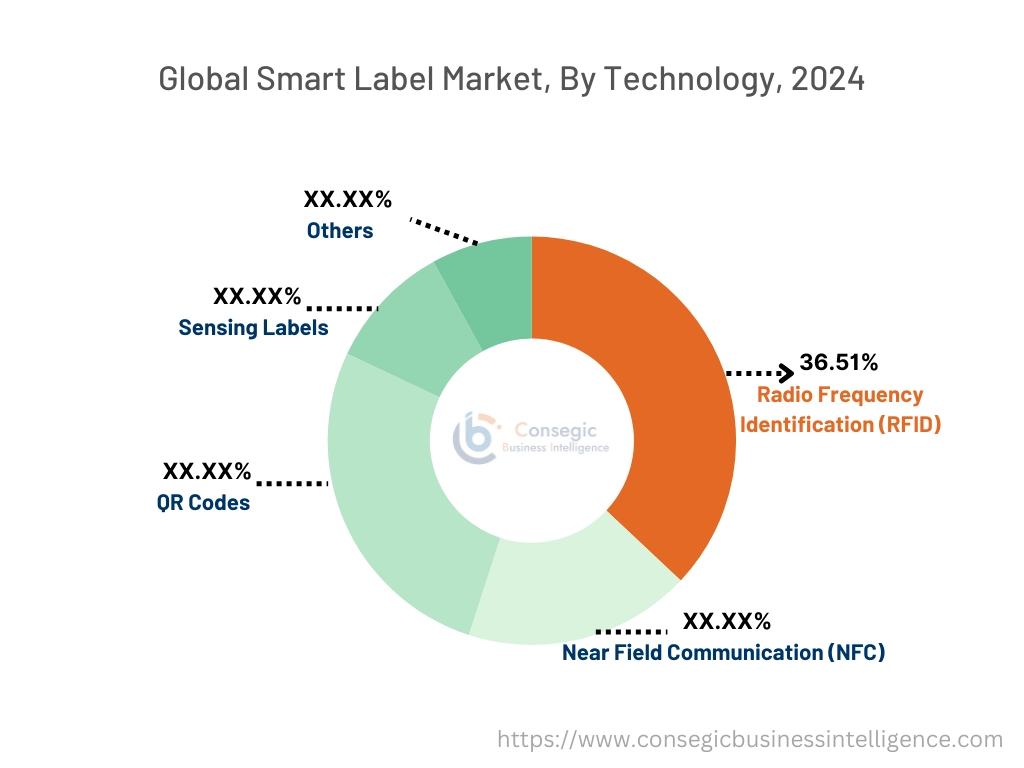
Based on the technology, the market is segmented into near field communication (NFC), radio frequency identification (RFID), QR codes, sensing labels, and others.
Trends in the Technology:
- Rising trend in adoption of QR codes due to their accessibility and ease of use is boosting the smart label market size.
- There is an increasing demand and adoption of sensing labels to detect temperature, tampering, and others.
The radio frequency identification (RFID) segment accounted for the largest revenue share of 36.51% in the market in 2024.
- RFID technology uses radio frequency to transfer data to readers and terminals. It is used for inventory management, and asset tracking, among others.
- For instance, in August 2023, SML launched Clarity RFID in delivery vehicle solution for proof-of-delivery. The solution delivered 99% accurate inventory levels.
- Therefore, the smart label market analysis depicts that the wide applications of RFID technology are boosting the market growth.
The near field communication (NFC) segment is expected to register the fastest CAGR during the forecast period.
- The NFC technology allows devices to read data from label by tapping it. This enables rapid access to data and product information.
- NFC technology is typically used within a short range in different stages of the supply chain.
- For instance, in October 2024, Tageos launched EOS-915 I3, based on NFC and HF inlay. It is used for item-level tagging, supply-chain visibility, product authentication, and smart packaging.
- Thus, the aforementioned factors are expected to boost the smart label market trends during the forecast period.
By End-User:
Based on the end user, the market is segmented into retail, manufacturing, transportation & logistics, healthcare, and others.
Trends in the End User:
- Rising demand and adoption of smart labels in manufacturing sector to track the products in real-time is boosting the smart label market size.
- Increasing trend in adoption of labels in automotive sector to track vehicle lifecycle.
The retail segment accounted for the largest revenue share in the smart label market share in 2024.
- In retail industry, the smart labels are used for inventory management, tracking of products in the supply chain, enhancing customer engagement by providing information about the products manufacturing and others.
- For instance, in May 2022, Avery Dennison launched dual frequency RFID inlays for retail and medical applications. It offers significant cost advantages compared to separate inlays operating in both HF and UHF RFID frequency ranges.
- Therefore, the wide applications of these labels in the retail sector are proliferating the market growth.
The healthcare segment is expected to register the fastest CAGR during the forecast period.
- Smart labels in healthcare allow tracking of medical devices to ensure real-time inventory management, drug authenticity verification, and patient medication remainders, among others.
- For instance, in January 2025, Avery Dennison with its partners showcased RFID-enabled digital ID solution for pre-filled syringe traceability, wherein RFID tags are integrated into the rigid needle shield of the syringe.
- Thus, as per the market analysis, the aforementioned factors are projected to boost the smart label market expansion during the forecast period.
Regional Analysis:
The regions covered are North America, Europe, Asia Pacific, the Middle East and Africa, and Latin America.
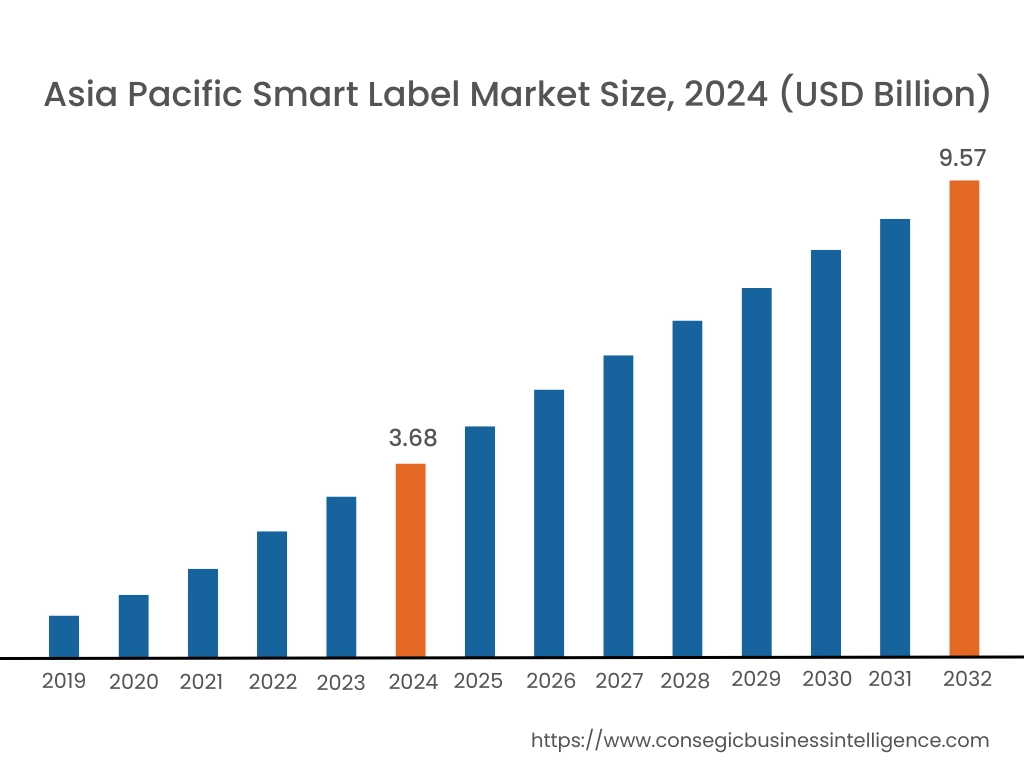
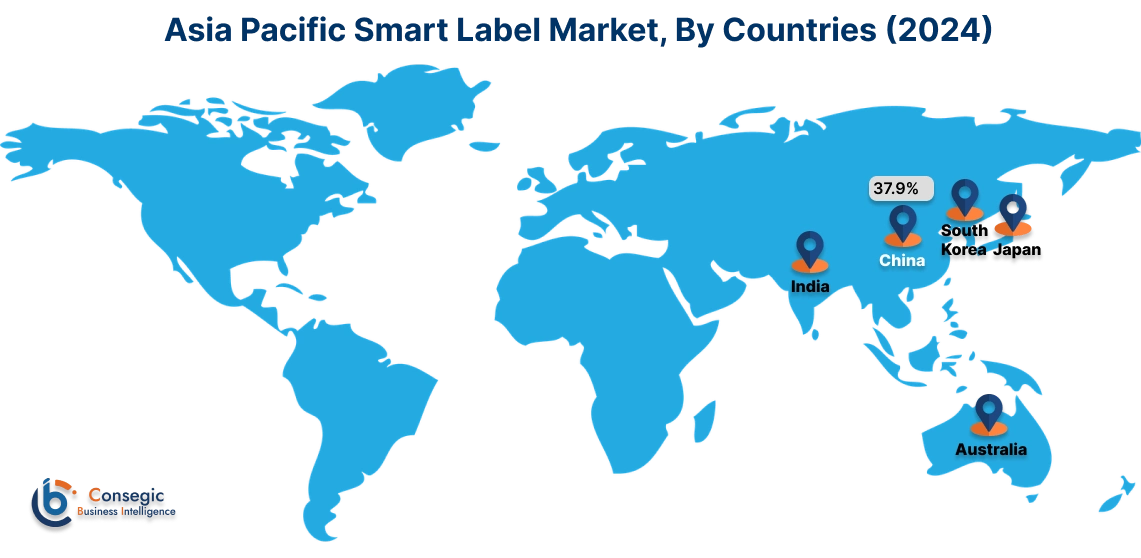
Asia Pacific region was valued at USD 3.68 Billion in 2024. Moreover, it is projected to grow by USD 4.08 Billion in 2025 and reach over USD 9.57 Billion by 2032. Out of this, China accounted for the maximum revenue share of 37.9%. The region’s market growth is driven by wide applications of smart labels in retail sector. Moreover, the fast-growing e-commerce sector and rising adoption of technological advancements in countries including China, India, and South Korea, are boosting the smart label market trends.
- For instance, in December 2021, Avery Dennison showcased its smart label solutions in India. These solutions are integrated with RFID technology for providing efficient logistics by avoiding counterfeiting of products.
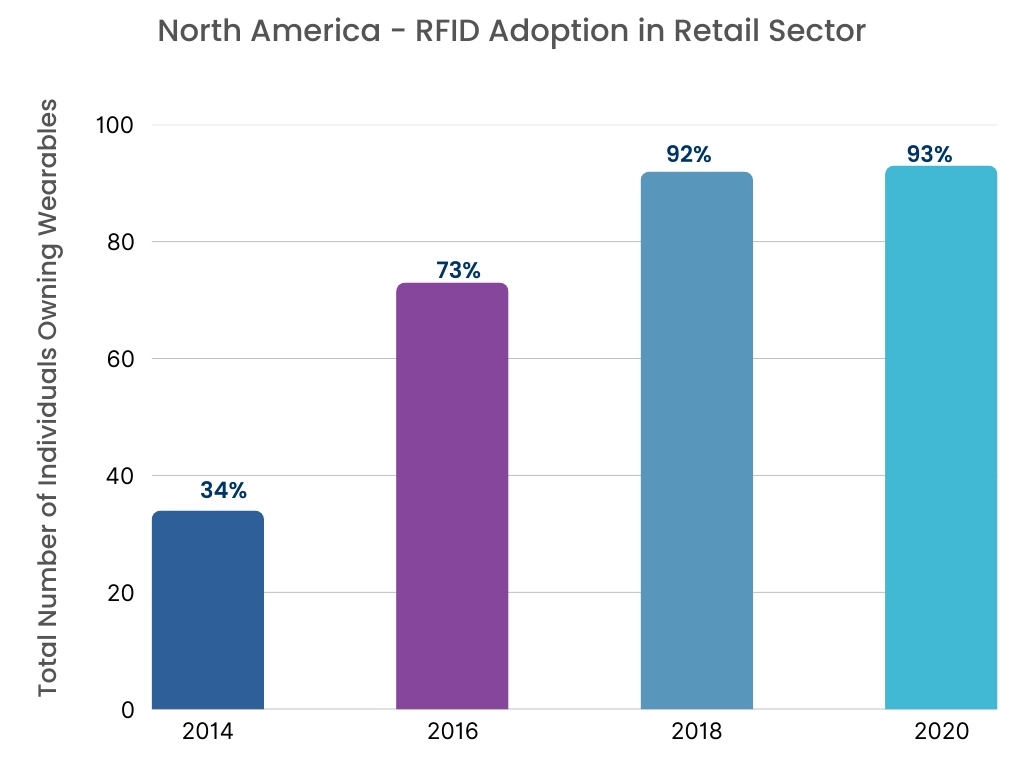
North America is estimated to reach over 11.59 Billion by 2032 from a value of USD 4.65 Billion in 2024 and is projected to grow by USD 5.14 Billion in 2025. The market in the region is growing due to rising adoption of advanced smart labels technologies including RFID, and NFC, among others. These technologies provide higher accuracy of inventory and enhance omnichannel operations, in turn, boosting the market.
- For instance, according to a research published by Accenture in 2021, RFID adoption in retailers in North America increased from 34% in 2014 to 93% in 2020.
As per the smart label market analysis, the rising adoption of smart labels in the European market is driven by government approvals of frequency ranges associated with RFID labels and focus on sustainable packaging, among others. The rising e-commerce sector is driving the adoption of smart labels to provide real-time data and information of the products to consumers, which is boosting the smart label market expansion in the Latin American region. Additionally, in Middle East and Africa, the market is driven due to usage of these labels in the oil and gas, logistics, and retail sectors, among others.
Top Key Players and Market Share Insights:
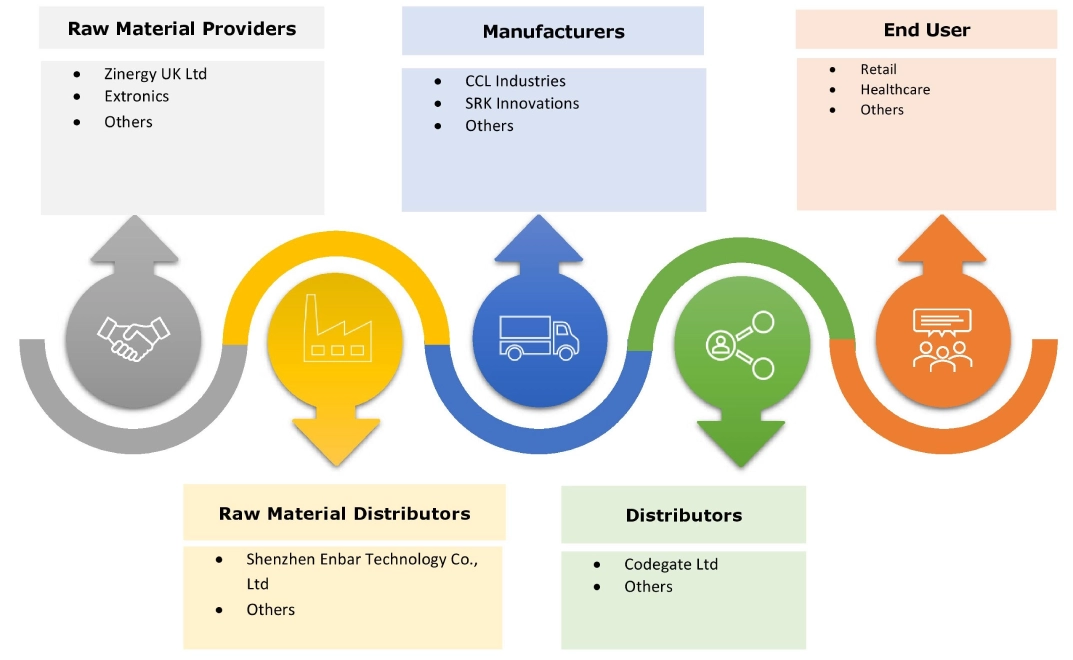
The smart label industry is highly competitive with major players providing solutions to the national and international markets. Key players are adopting several strategies in research and development (R&D), product innovation, and end-user launches to hold a strong position in the global smart label market. Key players in the smart label industry include -
- Alien Technology, LLC. (U.S.)
- Avery Dennison Corporation (U.S.)
- CCL Industries (Canada)
- Covectra, Inc. (U.S.)
- HID Global Corporation (U.S.)
- Honeywell International Inc (U.S.)
- Impinj Inc. (U.S.)
- Invengo Information Technology Co., Ltd. (China)
- Keonn Technologies (Spain)
- Laird (U.S.)
- MoreRfid (China)
- MTI Wireless Edge (Israel)
- Multi-Color Corporation (U.S.)
- Omni- ID Ltd. (U.S.)
- SRK Innovations (India)
- VCQRU (India)
- Vizinex RFID (U.S.)
- Zebra Technologies Corp. (U.S.)
Recent Industry Developments :
Product Launches:
- In October 2024, Schreiner Medipharm launched RFID labels. The label also consists of digital first-opening indication and a special construction to protect the integrated chip against mechanical stress.
Smart Label Market Report Insights :
| Report Attributes | Report Details |
| Study Timeline | 2019-2032 |
| Market Size in 2032 | USD 34.83 Billion |
| CAGR (2025-2032) | 13.6% |
| By Component |
|
| By Technology |
|
| By End-User |
|
| By Region |
|
| Key Players |
|
| North America | U.S. Canada Mexico |
| Europe | U.K. Germany France Spain Italy Russia Benelux Rest of Europe |
| APAC | China South Korea Japan India Australia ASEAN Rest of Asia-Pacific |
| Middle East and Africa | GCC Turkey South Africa Rest of MEA |
| LATAM | Brazil Argentina Chile Rest of LATAM |
| Report Coverage |
|
Key Questions Answered in the Report
How big is the smart label market? −
Smart Label Market size is estimated to reach over USD 34.83 Billion by 2032 from a value of USD 13.89 Billion in 2024 and is projected to grow by USD 15.34 Billion in 2025, growing at a CAGR of 13.6% from 2025 to 2032.
What are the major segments covered in the smart label market report? +
The segments covered in the report are component, technology, end user, and region.
Which region holds the largest revenue share in 2024 in the smart label market? +
North America holds the largest revenue share in the smart label market in 2024.
Who are the major key players in the smart label market? +
The major key players in the market are Alien Technology, LLC. (U.S.), Avery Dennison Corporation (U.S.), CCL Industries (Canada), Covectra, Inc. (U.S.), HID Global Corporation (U.S.), Honeywell International Inc (U.S.), Impinj Inc. (U.S.), Invengo Information Technology Co., Ltd. (China), Keonn Technologies (Spain), Laird (U.S.), MoreRfid (China), MTI Wireless Edge (Israel), Multi-Color Corporation (U.S.), Omni- ID Ltd. (U.S.), SRK Innovations (India), VCQRU (India). Vizinex RFID (U.S.), and Zebra Technologies Corp. (U.S.).
Overview
Reputation & Certifications


Our Services
- Market Intelligence & Forecasting
- Custom Research Solutions
- Market Entry Strategy
- Competitive Intelligence
- Customer Insights
- Industry Innovation Analysis
- Investment Advisory