Jump to Content
Smart Port Market - Size, Industry Share, Growth Trends and Forecasts (2025 - 2035)
Smart Port Market Size:
Smart Port Market size is estimated to reach over USD 40.70 Billion by 2035 from a value of USD 2.74 Billion in 2024 and is projected to grow by USD 3.50 Billion in 2025, growing at a CAGR of 27.8% from 2025 to 2035
Smart Port Market Scope & Overview:
Smart ports are advanced port infrastructure systems that provide automated operations, real-time monitoring, and connectivity services using digital technologies such as IoT, artificial intelligence, and cloud computing to ensure efficient and optimized port management. The smart port system operates by transmitting and analyzing data between port equipment, vessels, and management platforms to deliver improved operational efficiency and seamless communication. The smart port system is made up of hardware and software components that provide real-time asset tracking, traffic management, and infrastructure monitoring functions in container terminals, cargo handling, and other port operations to optimize operational efficiency.
In addition, the key factors driving the smart port market include the growing demand for port automation, the rise in global maritime trade, and the need for efficient and secure port operations. In addition, the smart port system has several benefits, such as improved operational efficiency, enhanced safety and security, ease of management, and better resource utilization. The smart port market is experiencing growth as a result of the aforementioned factors.
How is the Smart Port Market Affected by AI?
AI uses machine learning and data analysis algorithms to process data associated with port activities and equipment behaviour in a more accurate and efficient manner, thus optimizing performance and port efficiency. The AI system learns from past and present operational data, which helps in predictive maintenance, traffic optimization, and enhances the accuracy of the system for various operational scenarios. Furthermore, AI allows real-time monitoring and decision-making based on the level of cargo flow, vessel movement, and congestion of the port, thus optimizing overall port performance.

Smart Port Market Dynamics - (DRO):
Key Drivers:
Expansion of Global Trade & Cargo Volumes Around the Globe.
The growing extension of global trade and shipments worldwide is one of the key factors driving the adoption of smart port solutions. Port authorities, as well as logistics operators and transportation organizations, are adopting advanced digital solutions such as smart port technologies and automated port management systems to enhance operational efficiency and convenience. These solutions allow operators to enjoy the benefits of real-time monitoring and efficient and seamless port operations in various cargo handling and maritime logistics applications.
- According to the World Trade Organization, the volume of world merchandise trade, measured by the average of exports and imports, registered a 5.5% year-on-year growth in the first quarter of 2025. This growth reflects rising cross-border cargo movement and increasing pressure on port infrastructure and logistics networks.
Therefore, the smart port market is experiencing growth as a result of the increasing utilization of smart and automated solutions in port infrastructure and maritime transportation.
Key Restraints:
High Initial Investment and Implementation Costs Limit Adoption of Smart Port Solutions Among Budget-Constrained Port Authorities
The high initial investment and implementation costs related to smart port solutions, including expenses for digital infrastructure, automated equipment, IoT devices, and system integration, are also slowing down the adoption rate of smart port solutions among budget-constrained port authorities. In addition, the complexity involved in the upgrade of the existing port infrastructure, including installation, is also a factor contributing to the cost-related issues. Budgetary limited port authorities are also experiencing challenges related to budget constraints, technical knowledge, and long return on investment periods, which are hindering the adoption of smart port solutions for small and medium-sized ports.
Therefore, the smart port market is being impeded by the high initial investment and implementation costs.
Future Opportunities:
Large-scale port infrastructure investments to accelerate digital and automated port development and create opportunities for the market.
The rising global investment in the modernization of port infrastructure is anticipated to generate significant growth opportunities for the smart port market. Governments and port authorities are investing heavily in automated terminals, digital trade platforms, logistics systems based on AI, and cargo visibility solutions to enhance efficiency and minimize supply chain disruptions. Furthermore, the development of multimodal logistics infrastructure and smart warehousing is also increasing the adoption of IoT-based monitoring systems and real-time data analytics platforms in port infrastructure.
- For instance, in May 2025, DP World revealed a plan to invest in logistics infrastructure worth USD 2.5 billion in logistics infrastructure to enhance its capabilities in the global port and supply chain. The investment will be focused on improving terminal capacity, digital trade infrastructure, and logistics solutions.
Therefore, the growing capital investment in digital port infrastructure and logistics automation networks is expected to boost the adoption of smart technology, which will further create opportunities for the smart port market in the future period.
Smart Port Market Segmental Analysis:
By Technology:
On the basis of technology, the smart port market is segmented into IoT, Blockchain, Process Automation, and AI.
Trends in the technology:
- The growing digitalization of port infrastructure and increasing demand for real-time monitoring solutions are fueling the adoption of smart port technologies across various applications.
- The increasing use of connected devices, intelligent systems, and automated solutions is driving the demand across different technology areas.
The IoT segment held the highest revenue share in 2024.
- IoT is the primary technology of smart port systems and helps in delivering real-time monitoring and efficient operational management.
- Also, the growing use of connected sensors, smart devices, and asset tracking systems is driving segment dominance.
- Moreover, the adoption of IoT technology is also being fueled by the need for real-time data visibility, remote monitoring, and operational efficiency.
- Furthermore, the increasing focus on improving port efficiency and enhancing cargo tracking capabilities is also adding to the revenue generation.
- Hence, the dominance of the IoT segment is being fueled by the widespread use of connected devices for daily port operations.
It is anticipated that the AI segment will exhibit the highest compound annual growth rate (CAGR) during the forecast period.
- AI helps in predictive maintenance and intelligent decision-making, which is increasing the adoption of AI in smart ports.
- Also, the rising demand for automated operations and traffic optimization is fueling the adoption of AI technology for port management purposes.
- Moreover, the introduction of AI-enabled systems with advanced analytics and automation capabilities is enhancing operational efficiency.
- Therefore, the increasing trend of intelligent port management and demand for automated and efficient port operations is increasing the growth of the AI segment.
By Throughput Capacity:
On the basis of throughput capacity, the market is divided into high, medium, and low throughput capacity.
Trends in throughput capacity:
- The rising number of shipments and the need for ports to process high volumes of cargo are driving the adoption of smart port solutions in different throughput capacity segments.
- The rising need for efficient cargo handling, monitoring, and optimizing infrastructure is driving the demand in different throughput capacity segments.
The high throughput capacity segment was responsible for the highest revenue Share in 2024.
- High throughput capacity ports need smart solutions and help in handling high volumes of cargo efficiently.
- Also, the rising number of prominent international ports handling high container volumes is also driving the segment.
- In addition, the adoption of smart port solutions is also driven by the need to reduce congestion, improve efficiency, and optimize turnaround time.
- Furthermore, the increasing investment in port modernization and rising global trade activities are also adding to the revenue generation.
- Hence, the dominance of the high throughput capacity segment is being fueled by the widespread adoption of smart technologies in large and busy ports.
It is anticipated that the medium throughput capacity segment will exhibit the highest compound annual growth rate (CAGR) during the forecast period.
- Medium throughput ports are increasingly adopting smart technologies to improve operational efficiency and competitiveness.
- Also, the rising focus on port expansion and modernization is fueling the adoption of smart port solutions in medium-sized ports.
- Moreover, the introduction of cost-effective and scalable smart port technologies is enhancing adoption in these ports.
- Therefore, the increasing trend of port digitalization and growing cargo volumes is increasing the growth of the medium throughput capacity segment.
By Port Type:
On the basis of port type, the market is divided into sea ports and inland ports.
Trends in port type:
- The rising maritime trade and the need for efficient cargo transportation are driving the adoption of smart port solutions across different types of ports.
- The rising need for improving operational efficiency, cargo tracking, and port connectivity is driving the demand across different port type segments.
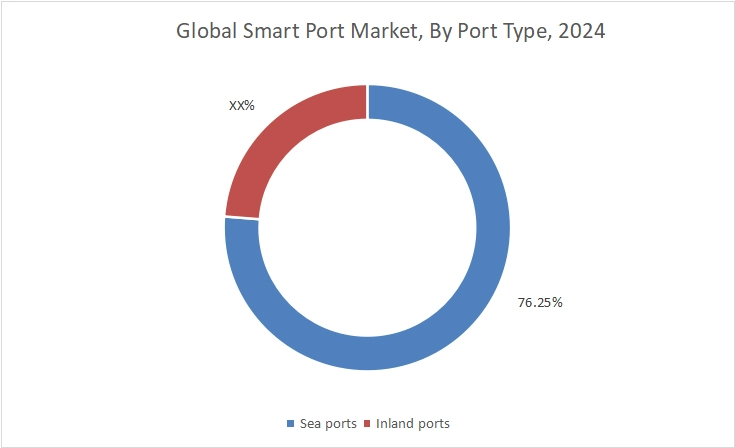
The sea ports segment was responsible for the highest revenue share of 76.25% in 2024.
- Sea ports are the main centers for international trade and assist in managing large volumes of cargo and container traffic.
- Also, the growing number of container shipments and rising global shipping activities are driving segment dominance.
- In addition to this, the rising investment in port infrastructure and the need for efficient maritime logistics are also contributing to the revenue generation.
- For instance, in 2024, the Port of Rotterdam Authority has further enhanced its smart port and digital infrastructure projects by developing its digital twin platform. The platform combines real-time sensor information related to ship movements, berth usage, infrastructure status, and environmental factors to enable informed decision-making.
- Therefore, the dominance of the sea ports segment is being driven by the adoption of smart technologies in international sea ports.
It is anticipated that the inland ports segment will exhibit the highest compound annual growth rate (CAGR) during the forecast period.
- Inland ports are also increasingly adopting smart solutions to enhance cargo handling and efficiency.
- Furthermore, the growing emphasis on enhancing connectivity between inland and sea ports is contributing to the adoption of smart port solutions.
- In addition, the implementation of digital systems for cargo tracking and port management is also improving efficiency.
- Therefore, the increasing trend of logistics network expansion and demand for efficient cargo transportation is increasing the growth of the inland ports segment.
By Function:
On the basis of function, the market is divided into port traffic management system, terminal automation & cargo handling, and smart port safety & security.
Trends in function:
- The rising need for efficient port management and the emphasis on automation and safety are driving the adoption of smart port solutions in the various functional segments.
- The rising need for real-time monitoring, efficiency, and safe port infrastructure is driving the demand in the various function segments.
The terminal automation & cargo handling segment was responsible for the highest revenue share in 2024.
- Terminal automation & cargo handling is the major function of smart ports and assists in increasing operational efficiency and cargo handling.
- In addition, the rising adoption of automated cranes, robotics, and digital cargo management solutions is also driving the segment dominance.
- In addition, the adoption of smart port solutions is also driven by the rising need for fast cargo handling, error-free operations, and increased productivity.
- Furthermore, the rising cargo traffic and investment in port automation are also contributing to the revenue generation.
- Hence, the dominance of the terminal automation & cargo handling segment is being fueled by the widespread adoption of automation technologies in port terminals.
It is anticipated that the smart port safety & security segment will exhibit the highest compound annual growth rate (CAGR) during the forecast period.
- Safety & security solutions help in improving surveillance, access control, and threat detection, which is increasing their adoption in ports.
- Additionally, the rising focus on port security and protection of critical infrastructure is fueling the adoption of smart safety technologies.
- Moreover, the introduction of advanced surveillance systems and intelligent monitoring solutions is enhancing port security.
- Therefore, the increasing trend of secure port operations and demand for advanced safety solutions is increasing the growth of the smart port safety & security segment.
Regional Analysis:
North America, Europe, Asia Pacific, the Middle East and Africa, and Latin America are the regions of coverage.
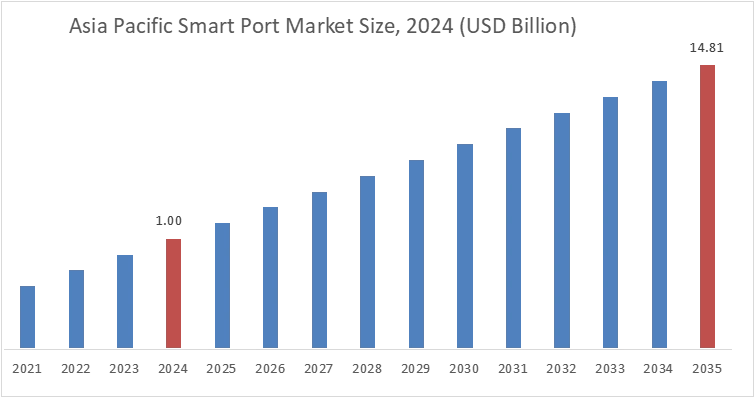
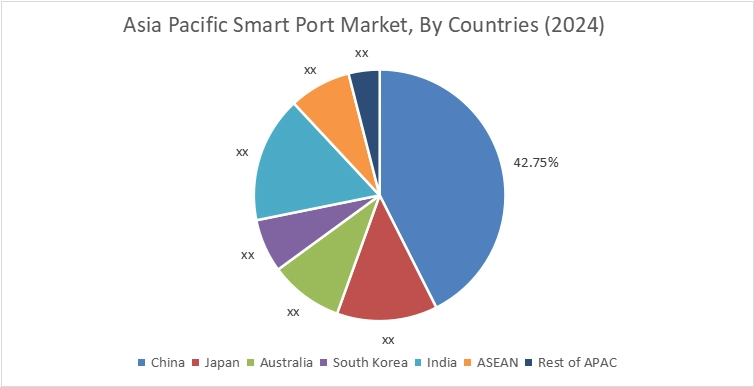
In 2024, Asia Pacific accounted for the highest market share at 36.40% and was valued at USD 1.00 Billion, and is expected to reach USD 14.81 Billion by 2035. In Asia Pacific, China accounted for the highest market share of 42.75% during the base year of 2024. Market growth is primarily driven by the rapid expansion of maritime trade, large-scale port modernization projects, and significant government investments in digital port infrastructure, which supports regional leadership. Furthermore, the increasing trade volumes through major hubs such as Singapore, South Korea, and Japan and the adoption of advanced smart port technologies are propelling market adoption. While other regions are expected to drive market demand in the Asia-Pacific region over the forecast period.
- For instance, in January 2025, according to the government of China, the nation’s total goods import and export rose to USD 6.1 billion in 2024, with a 5% year-on-year growth.
In North America, the Smart Port market is projected to witness the fastest growth, with an estimated CAGR of 30.96% during the forecast period 2025–2035. The growth in this region is fueled by continued investments in port automation and digitalization, as well as a focus on enhancing the efficiency of cargo handling. The ports are increasingly adopting the use of advanced technologies such as IoT-based monitoring systems, AI-powered analytics, and robotics to optimize their operations and optimize vessel turnaround times. The trade environment in this region also supports the adoption of smart ports.
- For instance, the U.S. is the biggest consumer market in the world, with a GDP of about USD 20 trillion and a population of about 325 million, contributing to almost one-third of the total global household consumption. The higher the consumption, the higher the imports, which in turn results in higher cargo volumes entering and exiting the major ports in North America, thus increasing the complexity and driving the need for smart port solutions.
Europe smart port industry is growing owing to rising adoption of port automation technologies and increasing demand for efficient cargo handling solutions are driving growth of the smart port market in this region.
Market growth in the Middle East & Africa is expanding due to growing investment in port modernization and digital infrastructure and increasing focus on improving port efficiency and maritime trade operations are driving demand in this region, supported by expanding logistics and transportation infrastructure.
Latin America smart port market is driven by increasing development of port infrastructure and rising adoption of digital and automated port management solutions are driving demand for smart port technologies in this region, supported by growing maritime trade activities and improving logistics networks.
Top Key Players & Market Share Insights:
The smart port market is highly competitive at the global level, with leading technology providers and industrial automation companies offering solutions for both developed and developing regions. The companies operating in the market are providing a wide range of solutions such as port management systems, terminal automation solutions, cargo handling automation, smart safety and security systems, and AI-enabled port operation technologies. In addition, companies are using strategies such as innovation in technologies, partnerships, mergers and acquisitions, and entry into new regions to improve their market presence and gain a competitive advantage. The key players operating in the smart port market include:
Recent Industry Developments:
- In November 2025, IBM Impact Accelerator announced its 2025 cohort with emphasis on AI-driven solutions for the modernization of supply chain and logistics networks around the world, including cloud + AI pilots for fleet and cargo optimization.
- In June 2025, ABB reported advancements in AI-driven automation and electrification solutions for container terminals, integrating machine vision, predictive analytics, and remote control functionality for port cranes and terminal solutions to improve productivity and safety.
- In March 2025, Siemens completed the acquisition of Altair Engineering Inc., a major player in the software industry for industrial simulation and analysis, to further solidify its position in the field of simulation and industrial artificial intelligence.
Smart Port Market Report Insights:
| Report Attributes | Report Details |
|---|---|
| Study Timeline | 2024-2035 |
| Market Size in 2035 (USD Trillion) | USD 40.70 Billion |
| CAGR (2025-2035) | 27.8% |
| By Technology |
|
| By Throughput Capacity |
|
| By Port Type |
|
| By Function |
|
| By Region |
|
| Key Players |
|
| Report Coverage |
|
Key Questions Answered in the Report
How big is the smart port market? −
Smart port market size is estimated to reach over USD 40.70 Billion by 2035 from a value of USD 2.74 Billion in 2024 and is projected to grow by USD 3.50 Billion in 2025, growing at a CAGR of 27.8% from 2025 to 2035.
Which segmentation details are covered in the smart port report? +
The smart port report includes specific segmentation details for technology, throughput capacity, port type, function, and regions.
Which is the fastest segment anticipated to impact the market growth? +
In the smart port market, the AI segment is the fastest-growing segment during the forecast period, driven the rising demand for automated operations and traffic optimization.
Who are the major players in the smart port market? +
The key participants in the smart port marketare IBM (U.S.), Wipro (India), TCS (India), Siemens (Germany), Accenture (Ireland), Microsoft (U.S.), Royal Haskoning (Netherlands), ABB (Switzerland), GE Vernova (U.S.), Kalmar Corporation (Finland), and others.Top of Form
Overview
Reputation & Certifications


Our Services
- Market Intelligence & Forecasting
- Custom Research Solutions
- Market Entry Strategy
- Competitive Intelligence
- Customer Insights
- Industry Innovation Analysis
- Investment Advisory