Jump to Content
Soldier Systems Market - Size, Share, Industry Trends, and Forecasts (2025-2035)
Soldier Systems Market Size:
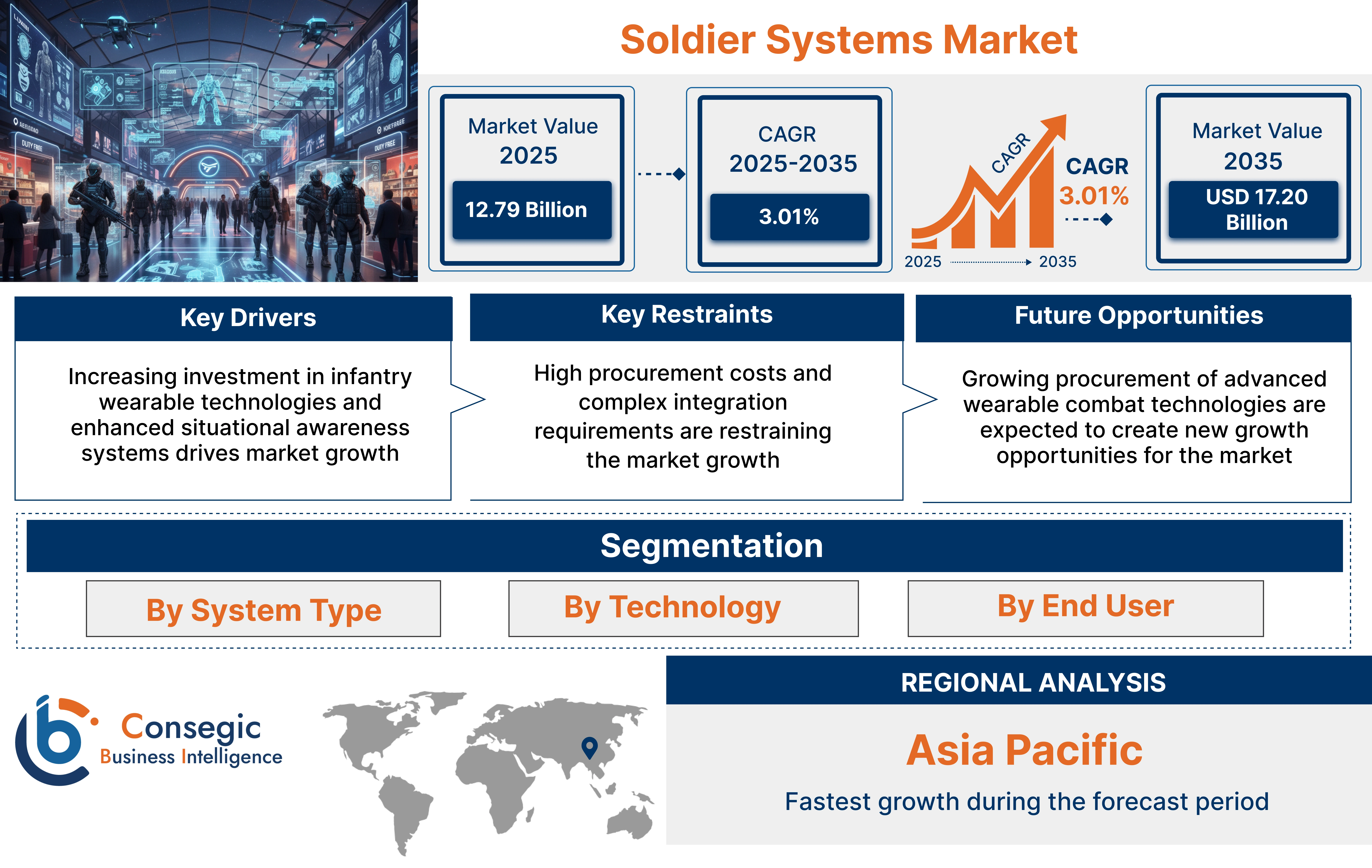
Soldier Systems Market size is estimated to reach over USD 17.20 Billion by 2035 from a value of USD 12.41 Billion in 2024 and is projected to grow by USD 12.79 Billion in 2025, growing at a CAGR of 3.01% from 2025 to 2035
Soldier Systems Market Scope & Overview:
Soldier systems are defined as the collective equipment and technologies that are designed to improve the effectiveness, protection, and communication of military personnel. These systems include body armor, helmets, communication devices, night vision equipment, weapon accessories, power management systems, and wearable electronics. They are developed to improve situational awareness, survivability, mobility, and mission performance in modern combat environments.
The growth of the soldier systems market is driven by rising defense modernization programs and increasing investments in advanced battlefield technologies. Governments are focusing on improving soldier protection and communication efficiency. The combination of smart sensors, light materials, and advanced power solutions is helping to drive system upgrades. The increasing focus on network-centric warfare and tactical coordination is further adding to the market growth.
Soldier Systems Market Dynamics - (DRO):
Key Drivers:
Increasing investment in infantry wearable technologies and enhanced situational awareness systems drives market growth
The soldier systems market is growing as the military around the world is spending on advanced wearable technology that can increase soldier safety, awareness, and combat effectiveness. The latest military projects are equipping infantry soldiers with digital systems such as helmet-mounted displays, advanced communication systems, and sensor suites that enable the sharing of battlefield information in real time.
The increasing geopolitical tensions and changing combat strategies are encouraging military forces to upgrade individual soldier equipment and communication technology. This has led to an increase in the demand for ruggedized soldier systems that provide strategic benefits such as navigation support, threat recognition, and secure communication.
- For example, in May 2024, the U.S. Army issued contract options to Microsoft Corporation and Anduril Industries to further develop the Integrated Visual Augmentation System (IVAS), an augmented reality headset program, which aims to improve situational awareness and decision-making capabilities for infantry soldiers.
Thus, the increasing spending on soldier technology and augmented reality systems is fueling the soldier systems market.
Key Restraints:
High procurement costs and complex integration requirements are restraining the market growth
Soldier systems include advanced equipment like communication systems, night vision solutions, body armor, weapon accessories, and wearable power solutions. The acquisition of these integrated solutions is a costly affair in terms of defense budgets, thereby hindering their adoption in nations with limited defense budgets. Moreover, the modernization process may include the upgrade of existing systems, thereby adding to the overall costs of the programs.
Moreover, the adoption of various technologies in a single soldier system requires compatibility, cybersecurity, and upgrade solutions. The complexity of soldier system integration result in delays in deployment and increase maintenance costs. Export controls and approvals for defense technologies is acting as a hindrance in international markets.
Thus, the high costs of procurement and complexities in soldier system integration are factors that are hindering the growth of the soldier systems market.
Future Opportunities:
Growing procurement of advanced wearable combat technologies are expected to create new growth opportunities for the market
The increasing modernization of infantry equipment across major defense forces is expected to create substantial growth opportunities in the soldier systems market. Military agencies are investing in advanced wearable systems, including augmented reality headsets, next-generation communication devices, enhanced night-vision equipment, and integrated situational awareness platforms to improve operational coordination and combat effectiveness. The move towards digitally networked battle environments is propelling the demand for light, power-efficient, and data-integrated soldier systems.
- For example, in February 2025, Anduril Industries took over the responsibility of manufacturing and developing the U.S. Army’s Integrated Visual Augmentation System (IVAS) program, which aims to develop soldier-worn augmented reality systems that will enhance training and battlefield awareness capabilities.
Hence, the continued deployment of wearable augmented reality platforms and integrated digital combat systems is anticipated to increase defense procurement activities, thereby promoting future opportunities for the soldier systems market during the forecast period.
Soldier Systems Market Segmental Analysis:
By System Type:
Based on system type, the soldier systems market is segmented into personal protection systems, communication & navigation systems, weapon systems, power supply systems, and C4ISR systems.
Trends in the System Type:
- The rising use of network-centric warfare tactics is fueling the need for communication & navigation and C4ISR systems.
- The growing emphasis on enhancing soldier mobility and endurance in modern combat environments is accelerating the deployment of advanced power supply systems.
Communication & Navigation Systems accounted for the largest revenue share in the year 2024.
- Communication & navigation systems are critical for enabling real-time coordination, location tracking, and secure information exchange during operations.
- Communication & navigation systems comprise tactical radios, GPS-enabled devices, and battlefield communication solutions that improve situational awareness.
- Additionally, the integration of advanced encryption technologies and satellite-based navigation is strengthening operational security and precision.
- Furthermore, defense modernization programs are prioritizing connected soldier frameworks to improve mission effectiveness.
- Thus, as per the soldier systems market analysis, the rising need for seamless connectivity and accurate navigation is driving the dominance of communication & navigation systems.
C4ISR Systems are anticipated to register the fastest CAGR during the forecast period.
- C4ISR systems combine command, control, communications, computers, intelligence, surveillance, and reconnaissance capabilities within a single framework.
- Also, C4ISR systems support data-driven decision-making through real-time battlefield intelligence and threat analysis.
- Additionally, advancements in wearable sensors, augmented reality displays, and AI-enabled analytics are supporting segment growth.
- Furthermore, the growing need for enhanced situational awareness and rapid response capabilities is boosting demand for C4ISR integration at the soldier level.
- Therefore, as per the market analysis, the expanding focus on digital warfare and intelligence-driven operations is anticipated to boost the C4ISR systems segment during the forecast period.
By Technology:
Based on technology, the soldier systems market is segmented into night vision, thermal imaging, augmented reality, wearable electronics, and exoskeleton systems.
Trends in the Technology:
- The rising need for improved situational awareness in low-light and complex combat operations is fueling the use of night vision and thermal imaging technology.
- The rising need for improved soldier mobility, endurance, and real-time battlefield awareness is accelerating the use of wearable electronics and augmented reality technology.
Night Vision accounted for the largest revenue share in the year 2024.
- Night vision technology is still widely used in infantry forces to support operations in low-light and nighttime environments.
- Also, these technologies improve visibility, target detection, and navigation in covert and tactical operations.
- In addition, ongoing improvements in image intensification and digital night vision technology are enhancing clarity and effectiveness.
- Moreover, ongoing military modernization initiatives in different countries are upgrading outdated optical systems with modern night vision technology.
- Therefore, based on soldier systems market research, the key importance of low-light operational capability is fueling the dominance of night vision technology.
Exoskeleton Systems are anticipated to register the fastest CAGR during the forecast period.
- The exoskeleton systems are intended to boost the strength of the soldiers, alleviate fatigue, and increase the carrying capacity of the loads during prolonged missions.
- Also, the exoskeleton systems help in the movement of heavy equipment and ammunition while ensuring that the soldiers are mobile and do not experience fatigue.
- In addition, research and development activities are being conducted to improve the efficiency of the batteries, ergonomics, and integration of the systems with other soldier systems.
- Further, defense agencies are increasingly investing in advanced human augmentation technologies to improve mission performance.
- Furthermore, the growing need to enhance soldier endurance in demanding operational environments is accelerating adoption.
- Therefore, as per the market analysis, the increasing focus on human performance enhancement and operational efficiency is anticipated to boost the exoskeleton systems segment during the forecast period.
By End User:
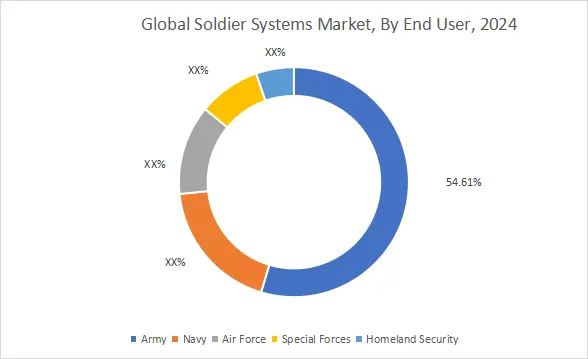
Based on end user, the soldier systems market is segmented into army, navy, air force, special forces, and homeland security.
Trends in the End User:
- The rising trend of modernization in ground-based combat forces is fueling the demand for advanced soldier systems in the army market.
- The rising emphasis on counter-terrorism missions and quick response activities is accelerating the demand from special forces and homeland security organizations.
Army accounted for the largest revenue share of 54.61% in the year 2024.
- The army is the primary end-user due to the significant number of ground forces employed in combat and homeland security missions.
- Also, the modern infantry force needs communication, protection, surveillance, and power solutions to improve operational efficiency.
- In addition, the ongoing soldier modernization initiatives to enhance mobility, survivability, and situational awareness are also fueling the market.
- Moreover, the need for real-time battlefield awareness and network-centric operations is accelerating the demand for advanced soldier systems.
- Thus, as per the soldier systems market analysis, large-scale deployment and modernization initiatives are driving dominance in the army segment.
Special Forces segment is anticipated to register the fastest CAGR during the forecast period.
- The special forces units demand highly advanced and light-weight equipment designed for covert and high-risk operations.
- The special forces give utmost importance to advanced communication, augmented reality, and surveillance technologies to ensure their superiority in operations.
- Moreover, the rising number of cross-border operations and asymmetric warfare is fueling the development of specialized soldier systems.
- In addition, the emphasis on enhancing agility, stealth, and rapid response is driving the demand in this market.
- Furthermore, continuous technological innovation in wearable electronics and integrated combat systems is enhancing adoption among special forces.
- Therefore, as per the market analysis, the growing emphasis on specialized mission capabilities and advanced equipment is anticipated to boost the special forces segment during the forecast period.
Regional Analysis:
North America, Europe, Asia Pacific, the Middle East and Africa, and Latin America are the regions of coverage.
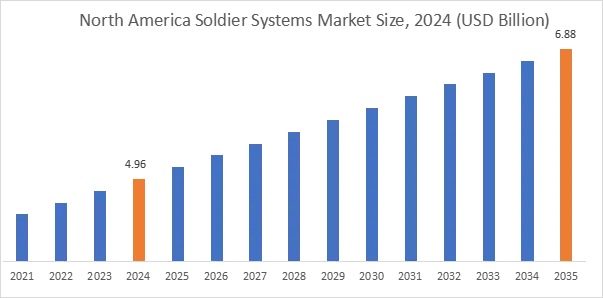
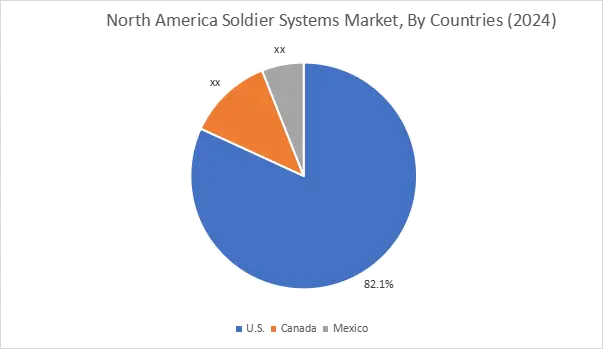
North America region was valued at USD 4.96 billion in 2024. Furthermore, it is expected to reach USD 5.12 billion in 2025 and exceed USD 6.88 billion by 2035. Out of which, the US accounted for the highest revenue share of 82.10% during the base year of 2024. The largest market share is held by North America, which is driven by continued modernization funding and defense budgets.
- For instance, the defense budget of the U.S. for FY2025 was considered to be USD 850 billion, which aided in the procurement of advanced soldier protection systems, communication systems, night vision systems, and integrated combat systems. The increased budgetary allocation leads to a direct increase in the procurement of next-generation soldier systems.
Additionally, the U.S. Army is also undergoing modernization initiatives as part of the Soldier Lethality Cross-Functional Team, which includes advanced optics, night vision, and integrated wearable systems. The ongoing modernization initiatives lead to an increased demand for wearable electronics, body armor, and communication systems.
In Asia Pacific, the soldier systems market is experiencing the fastest growth with a CAGR of 4.2% over the forecast period. The Asia Pacific soldier systems market is driven by rising defense modernization programs and procurement of next-generation infantry equipment across China, India, South Korea, and Australia. The governments are improving body armor, communication systems, night vision equipment, and integrated battlefield management solutions.
- For example, in 2025, the People’s Liberation Army Ground Force (PLAGF) of China has launched new body armor systems that are expected to provide better ballistic protection with reduced weight on the soldier. The trend towards lighter and more protective body armor configurations is driving the demand for advanced materials and soldier protection solutions in the region.
Europe soldier systems market growth is supported by NATO capability enhancement commitments and national defense spending increases in Germany, France, and the UK. Armed forces in this region are integrating digital battlefield systems, wearable sensors, and advanced optics to improve situational awareness and survivability, thereby driving market growth.
In Latin America, soldier systems demand is emerging from internal security modernization efforts and equipment replacement programs in Brazil, Colombia, and Chile. Armed forces are upgrading protective gear and communication devices to strengthen border security and counter-narcotics operations.
The Middle East & Africa soldier systems market is fueled by rising defense budgets and procurement of advanced infantry gear in Saudi Arabia, UAE, and South Africa. National security strategies are emphasizing improved battlefield connectivity, personal protection systems, and surveillance integration.
Top Key Players & Market Share Insights:
The soldier systems market is highly competitive, with key defense manufacturers providing end-to-end solutions to national defense forces and international defense agencies. The key players in the soldier systems market are adopting various strategies such as R&D in advanced protection systems, battlefield communication systems, wearable electronics, and situational awareness technologies to maintain a strong foothold in the soldier systems market. The key players operating in the soldier systems market are:
- BAE Systems plc (UK)
- Raytheon Technologies Corporation (US)
- Lockheed Martin Corporation (US)
- Northrop Grumman Corporation (US)
- Thales Group (France)
- Saab AB (Sweden)
- Elbit Systems Ltd. (Israel)
- Leonardo S.p.A. (Italy)
- Rheinmetall AG (Germany)
- General Dynamics Corporation (US)
Recent Industry Developments:
Product Launches
- In February 2025, Rheinmetall was awarded a framework contract worth over USD 3.7 billion by the German defense procurement agency to supply and upgrade digitalized soldier-systems (including new platoon systems and enhancement of existing ones), supporting the Bundeswehr’s modernization and networked battlefield capabilities.
- In December 2025, Syntec Optics Holdings, Inc. received a new order to supply advanced lightweight, high-clarity optics for next-generation augmented reality (AR) systems for the U.S. military, enabling soldiers to have enhanced AR displays readable in both daytime and nighttime operational conditions.
Soldier Systems Market Report Insights:
| Report Attributes | Report Details |
|---|---|
| Study Timeline | 2019-2035 |
| Market Size in 2035 (USD Million) | USD 17.20 Million |
| CAGR (2025-2035) | 3.01% |
| By System Type |
|
| By Technology |
|
| By End User |
|
| By Region |
|
| Key Players |
|
| Report Coverage |
|
Key Questions Answered in the Report
Overview
Reputation & Certifications


Our Services
- Market Intelligence & Forecasting
- Custom Research Solutions
- Market Entry Strategy
- Competitive Intelligence
- Customer Insights
- Industry Innovation Analysis
- Investment Advisory