Jump to Content
Space Cybersecurity Market - Size, Share, Industry Trends, and Forecasts (2025-2032)
Space Cybersecurity Market Size:
Space Cybersecurity Market size is estimated to reach over USD 9.76 Billion by 2032 from a value of USD 4.43 Billion in 2024 and is projected to grow by USD 4.89 Billion in 2025, growing at a CAGR of 10.4% from 2025 to 2032
Space Cybersecurity Market Scope & Overview:
Space Cybersecurity refers to the security solutions that are used to safeguard satellites, ground control stations, launch vehicles, and space-based communication systems against cyber threats. The solutions provide protection for command-and-control communications, data transmission, space-based software, and critical infrastructure. The solutions involve the use of encryption technology, network security solutions, threat detection solutions, and continuous monitoring solutions. The aim is to ensure that there is no unauthorized access, signal jamming, data breaches, and disruptions to the space-based systems.
The space cybersecurity market is growing due to the increasing number of satellites launches and the use of space-based communication and navigation systems. Governments and space companies are enhancing their cybersecurity frameworks to safeguard their national security and space-based assets. The expansion of low Earth orbit satellite constellations has increased the attack surface. Regulatory focus on secure space operations is further supporting market expansion.
How is the Space Cybersecurity Market Affected by AI?
AI enhances space cybersecurity by processing large amounts of satellite telemetry and network traffic data with greater speed and accuracy. Machine learning algorithms detect irregular command activity, signal interference, and irregular traffic flow in space and ground networks. This enhances the speed of response and minimizes the chances of a space mission being disrupted. AI systems facilitate automated threat detection in a satellite constellation.
AI-based systems allow for the continuous monitoring of space resources and dynamic security measures according to risk levels. Predictive algorithms evaluate possible cyberattacks before they affect space mission operations. As space networks expand, AI integration is strengthening long-term cybersecurity frameworks across the industry.
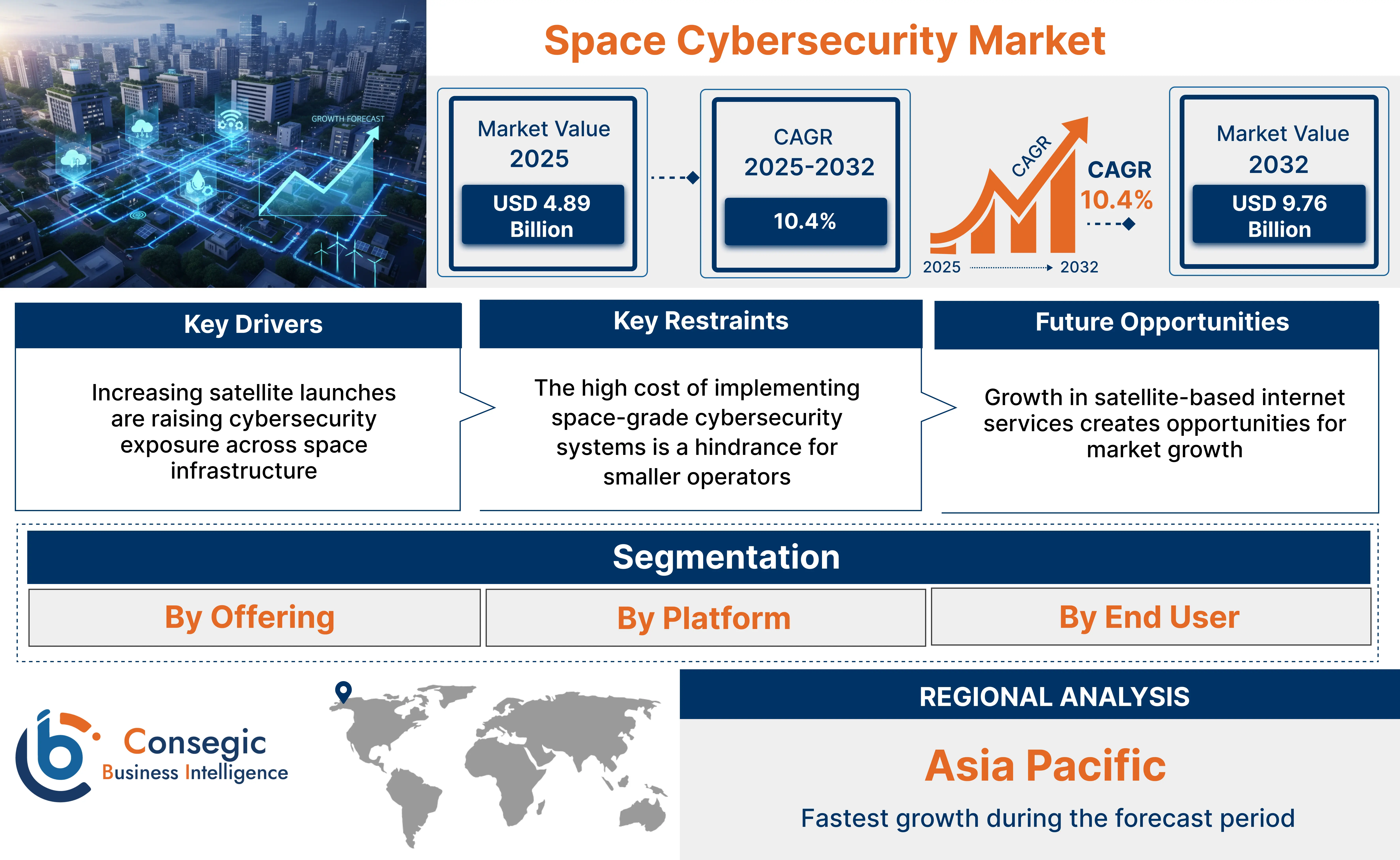
Space Cybersecurity Market Dynamics - (DRO):
Key Drivers:
Increasing satellite launches are raising cybersecurity exposure across space infrastructure
The rising number of satellite launches is increasing the exposure of space assets to cyber threats. Each new satellite adds command links, software systems, and communication interfaces that require protection. Space agencies and companies are enhancing their cybersecurity measures to ensure the security of their operations and data transfer.
For instance, the latest data from the United Nations Office for Outer Space Affairs (UNOOSA), the total number of satellites in orbit as of June 2023 stands at 11,330. This represents a 37.94% increase from January 2022, signifying a significant increase in the number of satellites launches globally.
Hence, the space cybersecurity market is growing due to the increasing number of satellites launches and the associated risks of cyberattacks.
Key Restraints:
The high cost of implementing space-grade cybersecurity systems is a hindrance for smaller operators
Advanced space cybersecurity systems involve the use of secure hardware modules, encryption systems, and continuous monitoring platforms. The overall investment includes integration, testing, and long-term system maintenance. Smaller satellite operators and emerging space startups face budget constraints, which slow adoption of advanced security frameworks.
Therefore, high implementation costs are restricting wider penetration of space cybersecurity solutions among cost-sensitive operators.
Future Opportunities:
Growth in satellite-based internet services creates opportunities for market growth
The development of satellite-based internet services is expanding global connectivity coverage. These networks have the capacity to process high volumes of data traffic and are used for commercial and defense communication. The growth in the use of these networks has led to an increased need for secure network management, encryption, and threat detection systems in satellite constellations and ground infrastructure.
- For example, in July 2025, more than 44.7% of the population is offline, and the slow development of the BharatNet program has led to the need for satellite connectivity as a solution.
Hence, the growth of satellite internet services is creating new solution requirements and long-term opportunities for the space cybersecurity market.
Space Cybersecurity Market Segmental Analysis:
By Offering:
On the basis of offering, the space cybersecurity market is segmented into solution (network security, endpoint and IoT security, application security, cloud security, and others), and services (professional services and managed services).
Trends in the Offering:
- Increasing cyber threats targeting satellite networks are strengthening demand for dedicated security solutions.
- Rising deployment of secure communication frameworks across space missions is supporting solution integration.
The solution offering was responsible for the highest revenue share in 2024.
- Solutions are encryption platforms, network security systems, intrusion detection tools, and threat monitoring software.
- Also, satellite operators are investing in advanced protection frameworks to secure command links and onboard systems.
- Moreover, growing risk of signal interference and data breaches is increasing reliance on end-to-end cybersecurity architecture.
- Therefore, strong adoption of technology-driven protection systems is supporting segment dominance.
It is anticipated that the services offering will exhibit the highest compound annual growth rate (CAGR) during the forecast period.
- Services include risk assessment, security consulting, system integration, and continuous monitoring support.
- Moreover, rising number of private space operators is increasing demand for managed cybersecurity services.
- In addition, ongoing need for system upgrades and compliance management is strengthening service adoption.
- Hence, expansion of commercial space activity is driving rapid growth of the services segment.
By Platform:
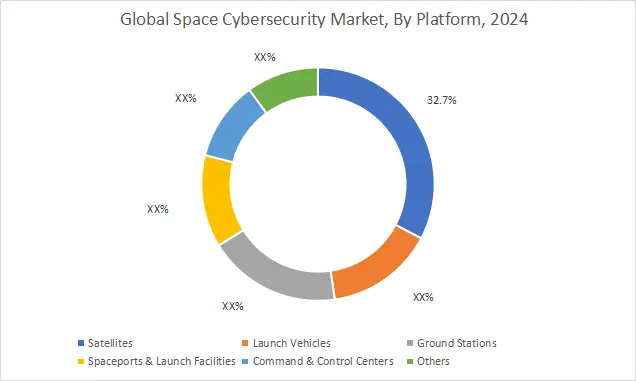
On the basis of platform, the market is divided into satellites, launch vehicles, ground stations, spaceports & launch facilities, command & control centers, and others.
Trends in the Platform:
- Expansion of satellite constellations is increasing focus on securing orbital communication networks.
- Rising digitalization of mission control infrastructure is strengthening cybersecurity deployment across ground systems.
Satellites represented the highest revenue share in 2024.
- Satellites function through continuous data exchange and remote command execution, which increases vulnerability to cyber intrusion.
- Moreover, telemetry, tracking, and control system protection is becoming a priority for satellite operators.
- Additionally, growth in satellite-based internet and navigation services is increasing security investment at the spacecraft level.
- Therefore, high asset value and operational risk are supporting dominance of the satellite segment.
Ground stations is anticipated to exhibit the most rapid compound annual growth rate (CAGR) throughout the forecast period.
- Ground stations manage data transmission between satellites and terrestrial networks.
- Moreover, increasing use of cloud-connected ground infrastructure is expanding cyber risk exposure.
- In addition, operators are strengthening network monitoring and access control systems at ground facilities.
- Hence, modernization of ground infrastructure is accelerating cybersecurity demand within this segment.
Defense accounted for the largest revenue share in the year 2024.
- Space cybersecurity solutions protect military satellites, surveillance systems, and secure communication networks during strategic operations.
- Moreover, the increasing risk of cyberattacks on defense command links is also boosting the use of sophisticated security frameworks.
- In addition, the integration of cybersecurity systems with defense ground control and intelligence platforms is strengthening adoption.
- Furthermore, the requirement to safeguard classified mission data and navigation systems is accelerating investment in resilient space security architecture.
- In June 2026, the Pentagon's proposed budget of USD 1.01 trillion for FY2026 has increased funding for cybersecurity and space-related programs to enhance satellite security and protect US space resources against the rising threat of cyberattacks.
- Therefore, the defense segment is being driven by the growing emphasis on national security and protection of critical space assets.
Commercial is anticipated to register the fastest CAGR during the forecast period.
- Space cybersecurity solutions support private satellite operators, satellite internet providers, and Earth observation companies.
- Additionally, the rising need to secure customer data and service continuity is increasing adoption among commercial operators.
- In addition, the need to integrate satellite communications with the existing telecommunication infrastructure demands efficient security management solutions.
- Moreover, growing private investment in space-based services is strengthening long-term cybersecurity spending.
- Thus, expanding commercialization of space activities is expected to drive growth of the commercial segment during the forecast period.
By End User:
On the basis of end user, the space cybersecurity market is divided into defense, commercial, and government.
Trends in the End User:
- Growing reliance on satellite-based intelligence and surveillance is increasing defense sector security focus.
- Rapid growth of private satellite operators is expanding commercial cybersecurity growth.
Defense accounted for the largest revenue share in the year 2024.
- Space cybersecurity solutions protect military satellites, surveillance systems, and secure communication networks during strategic operations.
- Moreover, the increasing risk of cyberattacks on defense command links is also boosting the use of sophisticated security frameworks.
- In addition, the integration of cybersecurity systems with defense ground control and intelligence platforms is strengthening adoption.
- Furthermore, the requirement to safeguard classified mission data and navigation systems is accelerating investment in resilient space security architecture.
- In June 2026, the Pentagon's proposed budget of USD 1.01 trillion for FY2026 has increased funding for cybersecurity and space-related programs to enhance satellite security and protect US space resources against the rising threat of cyberattacks.
- Therefore, the defense segment is being driven by the growing emphasis on national security and protection of critical space assets.
Commercial is anticipated to register the fastest CAGR during the forecast period.
- Space cybersecurity solutions support private satellite operators, satellite internet providers, and Earth observation companies.
- Additionally, the rising need to secure customer data and service continuity is increasing adoption among commercial operators.
- In addition, the need to integrate satellite communications with the existing telecommunication infrastructure demands efficient security management solutions.
- Moreover, growing private investment in space-based services is strengthening long-term cybersecurity spending.
- Thus, expanding commercialization of space activities is expected to drive growth of the commercial segment during the forecast period.
Regional Analysis:
North America, Europe, Asia Pacific, the Middle East and Africa, and Latin America are the regions of coverage.
North America region was valued at USD 1.77 billion in 2024. Furthermore, it is expected to increase steadily during the forecast period. Market growth is primarily driven by high defense expenditure and strong deployment of military and commercial satellites, which supports regional leadership. Furthermore, the presence of established space agencies and private satellite operators is strengthening investment in secure communication frameworks. While Canada and Mexico are expected to contribute to market demand across the North American region over the forecast period.
- For instance, in January 2026, Boeing and Ben-Gurion University of the Negev launched a USD 10 million, five-year aviation cybersecurity research centre in Israel to develop advanced cyber protection for future autonomous and connected aviation and space systems.
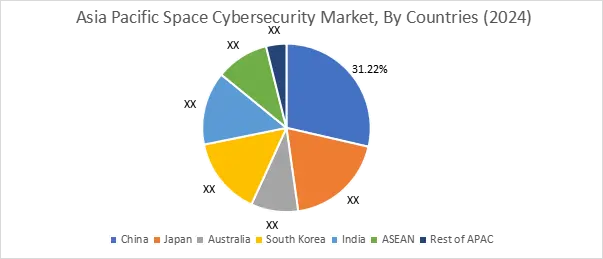
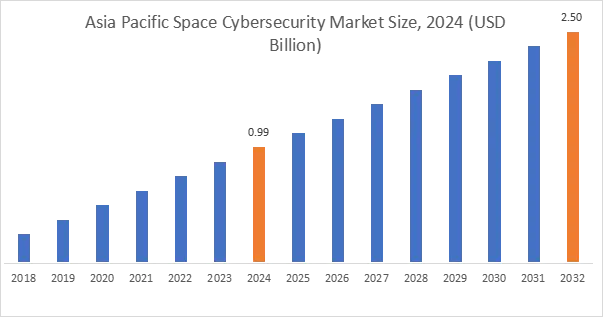
Asia Pacific region was valued at USD 0.99 Billion in 2024. Moreover, it is projected to grow by USD 1.12 Billion in 2025 and reach over USD 2.50 Billion by 2032. Out of this, China accounted for the maximum revenue share of 31.22%. Asia Pacific is expected to witness robust growth during the forecast period. The market is expanding due to the rising number of satellites launches across China, India, and Japan. In addition, the growing emphasis of the government on indigenous space initiatives and satellite internet services is encouraging the adoption of cybersecurity in the region.
- For example, in May 2025, according to IBEF, India has announced the launch of 52 spy satellites in the next five years, which will enhance the space-based intelligence and security of the country.
Europe space cybersecurity market is driven by regional space sovereignty initiatives, satellite navigation security requirements, and defense-focused cyber resilience programs. Protection of the Galileo navigation system and Copernicus Earth observation infrastructure is strengthening investment in secure satellite communications and encryption technologies.
Latin America space cybersecurity market is driven by expanding satellite communication services, national space agency programs, and growing reliance on space-based data for agriculture and disaster management in Brazil, Argentina, and Mexico. Governments are strengthening digital security standards for ground stations and satellite data transmission systems.
Middle East & Africa space cybersecurity market is driven by sovereign satellite programs, defense communication systems, and expanding space investments in the UAE, Saudi Arabia, and South Africa. Governments are incorporating cybersecurity safeguards into national space strategies to protect satellite infrastructure and communication networks.
Top Key Players & Market Share Insights:
The global space cybersecurity market is moderately competitive, with established defense contractors, cybersecurity firms, and emerging space technology companies offering solutions across domestic and international markets. Moreover, market players are also employing techniques such as technology collaborations, secure platform integration, capability enhancement, and government contracts to enhance their presence in the space cybersecurity market. Key participants in the market for space cybersecurity include:
- Airbus SE – Netherlands
- BAE Systems plc – UK
- The Boeing Company – US
- L3Harris Technologies, Inc. – US
- Leonardo S.p.A. – Italy
- Lockheed Martin Corporation – US
- Northrop Grumman Corporation – US
- RTX Corporation – US
- SpaceX – US
- Thales Group – France
Recent Industry Developments:
Product Launches
- In February 2026, WISESAT planned the launch of its 21st LEO satellite with SpaceX in March 2026 to enhance its secure satellite network and enhance space-based cybersecurity and encrypted communication infrastructure.
- In June 2025, Wisesat Space and SEALSQ launched a satellite via SpaceX to create the first DePIN satellite network in space, which enhances quantum-secure cybersecurity and communication.
- In May 2025, the European Space Agency launched a new Cyber Security Operations Centre to improve cyber resilience and safeguard ESA space systems and services.
Space Cybersecurity Market Report Insights:
| Report Attributes | Report Details |
|---|---|
| Study Timeline | 2019-2032 |
| Market Size in 2032 (USD Billion) | USD 9.76 Billion |
| CAGR (2025-2032) | 10.4% |
| By Offering |
|
| By Platform |
|
| By End User |
|
| By Region |
|
| Key Players |
|
| Report Coverage |
|
Key Questions Answered in the Report
How big is the space cybersecurity market? −
The space cybersecurity market size is estimated to reach over USD 9.76 Billion by 2032 from a value of USD 4.43 Billion in 2024 and is projected to grow by USD 4.89 Billion in 2025, growing at a CAGR of 10.4% from 2025 to 2032.
Which segmentation details are covered in the space cybersecurity report? +
The space cybersecurity report includes specific segmentation details for offering, platform, end user, and regions.
Which is the fastest segment anticipated to impact the market growth? +
The commercial segment is the fastest-growing, driven by rising private satellite launches and expansion of satellite internet services.
Who are the major players in the space cybersecurity market? +
The key participants in the space cybersecurity market are Airbus SE (Netherlands), BAE Systems plc (UK), The Boeing Company (US), L3Harris Technologies, Inc. (US), Leonardo S.p.A. (Italy), Lockheed Martin Corporation (US), Northrop Grumman Corporation (US), RTX Corporation (US), SpaceX (US), Thales Group (France), and others.
What are the key trends in the space cybersecurity market? +
The space cybersecurity market is shaped by key trends including rising satellite launches, AI-based threat detection, expansion of low Earth orbit constellations, and stronger regulatory focus on space security.
Overview
Reputation & Certifications


Our Services
- Market Intelligence & Forecasting
- Custom Research Solutions
- Market Entry Strategy
- Competitive Intelligence
- Customer Insights
- Industry Innovation Analysis
- Investment Advisory