Jump to Content
Stainless Steel Market - Size, Share, Industry Trends, and Forecasts (2025-2035)
Stainless Steel Market:
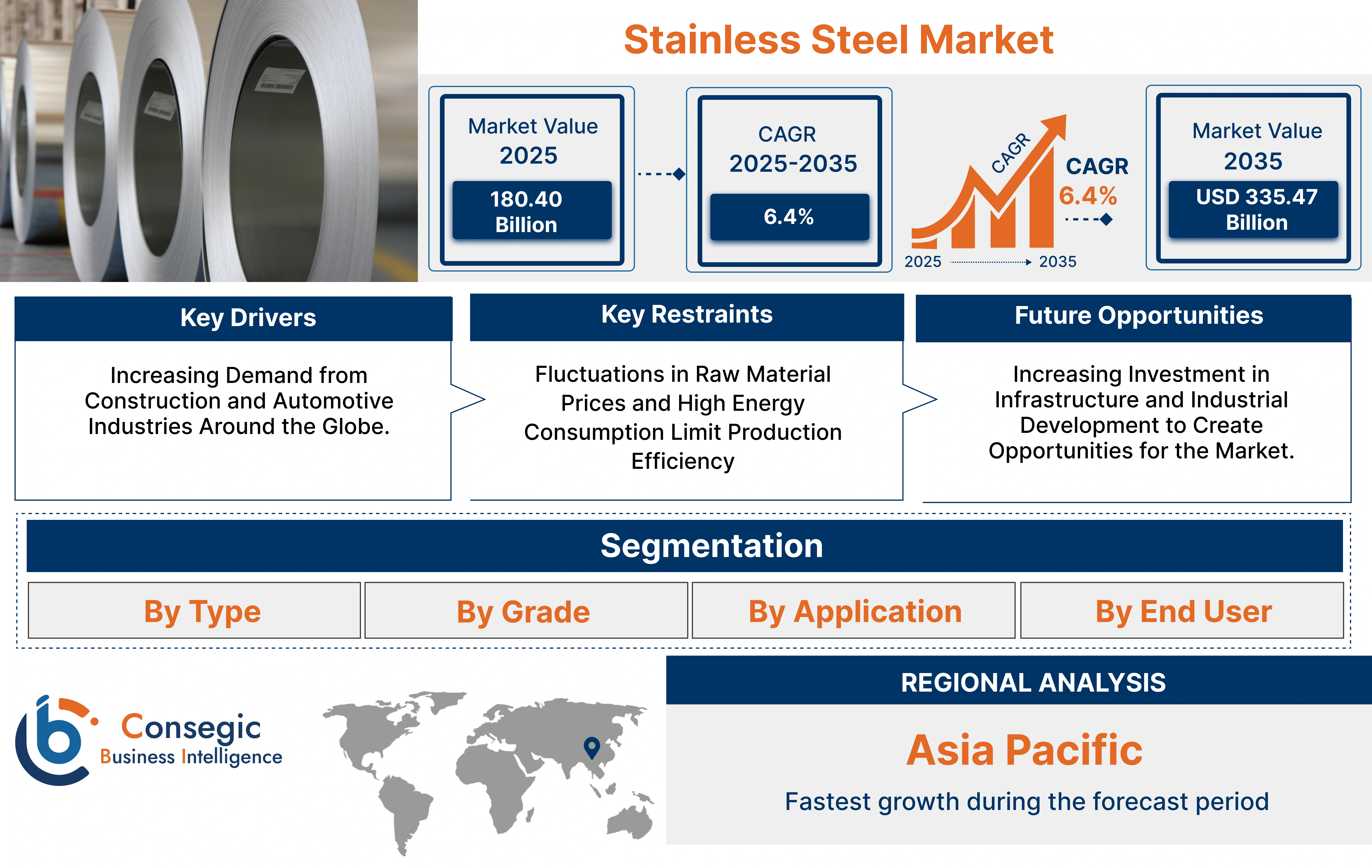
Stainless Steel Market size is estimated to reach over USD 335.47 Billion by 2035 from a value of USD 169.55 Billion in 2024 and is projected to grow by USD 180.40 Billion in 2025, growing at a CAGR of 6.4% from 2025 to 2035
Stainless Steel Market Scope & Overview:
Stainless steel production refers to the manufacturing and processing of stainless steel alloys that offer strength, corrosion resistance, and durability in different applications such as construction, automotive, industrial equipment, and consumer goods using advanced technologies such as controlled melting, alloy refining, and precision forming. The stainless steel industry operates by preparing, melting, and refining raw materials such as iron ore, chromium, nickel, and scrap metal to produce flat and long products for effective industrial use and structural performance.
In addition, the key factors driving the stainless steel market include the growing demand from construction and infrastructure development, the rise in automotive and transportation production, and the need for durable and corrosion-resistant materials in industrial and consumer applications. In addition, the stainless steel has several benefits, such as high strength, excellent corrosion resistance, long service life, and ease of fabrication. The stainless steel market is experiencing growth as a result of the aforementioned factors.
Stainless Steel Market Size & Forecast
- 2024 Market Size : USD 169.55 Billion
- 2025 Market Size : USD 180.40 Billion
- 2035 Estimated Market Size : USD 335.47 Billion
- CAGR (2025-2035) : 6.4%
How is the Stainless Steel Market Affected by Tariff?
Tariffs apply import duties and trade regulations to stainless steel products to control international trade and protect domestic manufacturers, thus influencing pricing and market competitiveness. The tariff system affects the cost of imported raw materials and finished stainless steel, which impacts production expenses, supply chain stability, and procurement strategies. In addition, tariffs influence domestic production and investment decisions based on the level of import competition, trade policies, and global supply dynamics, thus affecting overall stainless steel market growth and profitability.
Regional Analysis:
North America, Europe, Asia Pacific, the Middle East and Africa, and Latin America are the regions of coverage.
In 2024, Asia Pacific accounted for the highest market share at 49.20% and was valued at USD 83.42 Billion, and is expected to reach USD 165.05 Billion by 2035. In Asia Pacific, China accounted for the highest market share of 56.80% during the base year of 2024. Market growth is mainly fueled by the fast growth of construction, automotive manufacturing, and large-scale industrialization, which helps to achieve regional dominance. Furthermore, the increasing demand for infrastructure materials, rising urbanization projects, and the growing use of stainless steel in construction, consumer goods, and industrial machinery industries in major economies such as China, India, and Japan are propelling market adoption. Although other regions are expected to fuel market demand, the Asia Pacific is anticipated to remain the dominant revenue contributor during the forecast period.
- According to the World Steel Association, the crude steel production in India in 2024 stood at around 149.6 million tons, up from 140.8 million tons in 2023, registering a growth of 6.3% on a year-on-year basis. The constant rise in steel production is thus contributing to the growth of the stainless steel market, as steel production growth enhances the use of raw materials.
In North America, the stainless steel market is expected to register the fastest growth during the forecast period 2025-2035. The growth in this region is the increasing investment in infrastructure development, as well as a strong focus on improving the quality of construction and industrial production. The governments and industries are increasingly adopting the use of stainless steel in construction, automotive production, and industrial equipment production to improve product durability and efficiency. The industrial base and infrastructure development in this region further increase the demand for stainless steel.
- For instance, under the Infrastructure Investment and Jobs Act, the U.S. government has allocated approximately USD 550 billion in new infrastructure spending over five years 2022–2026 toward projects including roads, bridges, public transit, rail, ports and waterways, broadband, and water systems. This broad investment in transportation and construction infrastructure is expected to increase demand for materials such as stainless steel, supporting market growth.
Europe stainless steel market is growing owing to the increasing demand from construction, automotive, and industrial machinery industries, along with the rising focus on durable and high-performance materials. The rising renovation demands and infrastructure development projects are fueling the demand for stainless steel, owing to the region’s robust manufacturing sector and the rising emphasis on enhancing industrial efficiency.
Latin America stainless steel market is driven by increasing development of construction infrastructure and rising demand from automotive and consumer goods industries. The growing adoption of stainless steel in industrial processing and construction applications is driving demand in this region, supported by expanding manufacturing activities and improving industrial and infrastructure development.
Market growth in the Middle East & Africa is expanding due to the rising investments in construction and industrial development, as well as the increasing use of stainless steel in the construction materials, oil & gas, and industrial equipment sectors. The growing infrastructure projects and expanding industrial activities are driving demand in this region, supported by ongoing urbanization and economic diversification initiatives.
Stainless Steel Market Segmental Analysis:
By Type:
On the basis of type, the stainless steel market is segmented into cold rolled flat, hot plate & sheets, cold bars & wire, hot bars & wire rod, and others.
Trends in type:
- The growing demand for stainless steel across construction, automotive, industrial machinery, and consumer goods industries is fueling the adoption of different product types based on application requirements.
- The increasing need for high strength, corrosion resistance, and improved surface finish is driving the demand across various stainless steel product forms.
The cold rolled flat segment held the highest revenue share in 2024.
- Cold rolled flat stainless steel helps in providing superior surface finish, precise dimensions, and enhanced mechanical properties, which is increasing its adoption.
- Also, the growing use of cold rolled flat products in automotive components, appliances, and construction applications is driving segment dominance.
- Moreover, its ability to provide improved durability, aesthetic appeal, and corrosion resistance is supporting its widespread use.
- Furthermore, the increasing production of consumer appliances and architectural structures is contributing to higher consumption.
- Therefore, the dominance of the cold rolled flat segment is being fueled by its extensive use in high-quality and precision-based applications.
It is anticipated that the hot bars & wire rod segment will exhibit the highest compound annual growth rate (CAGR) during the forecast period.
- Hot bars & wire rods help in providing high strength and durability, which is increasing their adoption in heavy industrial applications.
- Also, the rising demand from construction, automotive, and infrastructure sectors is fueling segment growth.
- Moreover, their increasing use in manufacturing fasteners, reinforcement components, and engineering products is supporting adoption.
- Therefore, the increasing industrialization and infrastructure development are accelerating the growth of the hot bars & wire rod segment.
By Grade:
On the basis of grade, the market is divided into 200 series, 300 series, 400 series, and duplex series.
Trends in grade:
- The growing demand for corrosion-resistant and high-performance materials across construction, automotive, and industrial sectors is driving the adoption of different stainless steel grades.
- The increasing focus on improving strength, durability, and cost efficiency is fueling the demand for various stainless steel grades.
The 300 series segment held the highest revenue share in 2024.
- 300 series stainless steel helps in providing excellent corrosion resistance, strength, and durability, which is increasing its adoption.
- Also, the growing use of 300 series stainless steel in construction, food processing equipment, and chemical industries is driving segment dominance.
- Moreover, its superior performance in harsh environments and long service life are supporting higher consumption.
- Furthermore, the increasing demand for high-quality and reliable materials in industrial and infrastructure applications is contributing to segment growth.
- Hence, the dominance of the 300 series segment is being fueled by its superior properties and widespread industrial usage.
It is anticipated that the duplex series segment will exhibit the highest compound annual growth rate (CAGR) during the forecast period.
- Duplex stainless steel helps in providing higher strength and improved corrosion resistance compared to conventional grades.
- Also, the rising demand from oil & gas, marine, and chemical industries is increasing its adoption.
- Moreover, its ability to provide longer service life and reduced maintenance costs is supporting segment growth.
- Therefore, the growing demand for advanced and high-performance materials is accelerating the growth of the duplex series segment.
By Application:
On the basis of application, the market is divided into metal products, electrical machinery, engineering, building materials, kitchen appliances, and others.
Trends in application:
- The growing demand for stainless steel across building materials, kitchen appliances, and engineering applications is increasing its adoption across major application segments.
- The increasing focus on improving product durability, corrosion resistance, and performance efficiency is fueling the demand across various industrial and consumer applications.
The building materials segment held the highest revenue share in 2024.
- Stainless steel is widely used in building material applications such as structural components, roofing, cladding, railings, and reinforcement, which is driving its demand.
- Also, the increasing infrastructure development, urbanization, and commercial construction projects are fueling the adoption of stainless steel.
- Moreover, the growing demand for durable, corrosion-resistant, and low-maintenance construction materials is supporting segment growth.
- Furthermore, the rising investment in residential, commercial, and industrial infrastructure is contributing to increased consumption.
- Hence, the dominance of the building materials segment is being fueled by the extensive use of stainless steel in improving structural strength and service life.
It is anticipated that the electrical machinery segment will exhibit the highest compound annual growth rate (CAGR) during the forecast period.
- Stainless steel is widely used in electrical machinery for manufacturing components such as motor housings, enclosures, and industrial electrical systems, which is increasing its adoption.
- Also, the rising production of electrical equipment, industrial machinery, and power generation systems is driving segment growth.
- Moreover, the increasing expansion of industrial automation and manufacturing industries is fueling its consumption.
- Furthermore, the growing focus on improving machinery durability, efficiency, and corrosion resistance is supporting the use of stainless steel.
- Therefore, the increasing global demand for electrical equipment and industrial machinery is accelerating the growth of the electrical machinery segment.
By End User:
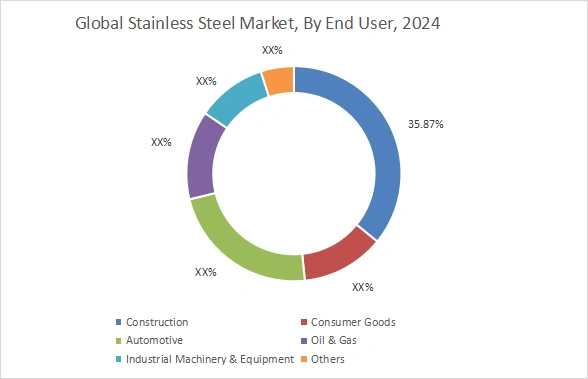
On the basis of end user, the market is divided into construction, consumer goods, automotive, oil & gas, industrial machinery & equipment, and others.
Trends in end user:
- The growing demand for stainless steel across construction, consumer goods, and automotive industries is increasing its adoption across major end-user segments.
- The increasing focus on improving product durability, corrosion resistance, and operational efficiency is fueling the demand from various industrial sectors.
The construction segment held the highest revenue share of 35.87% in 2024.
- Stainless steel is widely used in construction applications such as structural frameworks, roofing, cladding, railings, and reinforcement, which is driving its demand.
- Also, the increasing infrastructure development, urbanization, and commercial construction projects are fueling the adoption of stainless steel.
- Moreover, the growing demand for durable, corrosion-resistant, and low-maintenance construction materials is supporting segment growth.
- Furthermore, the rising investment in residential, commercial, and industrial infrastructure is contributing to increased consumption.
- Hence, the dominance of the construction segment is being fueled by the extensive use of stainless steel in improving structural strength, corrosion resistance, and service life.
The automotive segment is anticipated to exhibit the highest compound annual growth rate (CAGR) during the forecast period.
- Stainless steel is widely used in automotive applications such as exhaust systems, structural components, and fuel tanks, which is increasing its adoption in vehicle manufacturing.
- Also, the rising demand for passenger vehicles, commercial vehicles, and electric vehicles is driving segment growth.
- Moreover, the increasing focus on improving vehicle durability, safety, and emission control is fueling its consumption.
- Furthermore, the growing adoption of strong, heat-resistant, and corrosion-resistant materials is supporting the use of stainless steel.
- For example, the total number of vehicles manufactured in India increased to 31.03 million in FY25 from 25.93 million in FY23. The rise in the production of vehicles is thus propelling the demand for stainless steel, which is used in exhaust systems, structural parts, and vehicle parts, thus fueling the stainless steel market.
- Therefore, the increasing global vehicle production and automotive industry expansion are accelerating the growth of the automotive segment.
Stainless Steel Market Dynamics - (DRO):
Key Drivers:
Increasing Demand from Construction and Automotive Industries Around the Globe.
The increasing demand from construction and automotive industries around the globe is one of the major drivers pushing the adoption of stainless steel. Manufacturers, as well as construction companies and automotive producers, are adopting high-quality stainless steel solutions to enhance product performance and operational efficiency. These solutions allow manufacturers to enjoy the benefits of high strength, corrosion resistance, and efficient and reliable performance in various structural, transportation, and industrial applications, where stainless steel is used in buildings, bridges, vehicles, and equipment as a structural material to improve durability, safety, and overall performance.
- As per the Indian Ministry of Housing and Urban Affairs, the urban population in India is expected to touch 600 million by 2030 and 800 million by 2050. The increasing urbanization is leading to more construction and development of infrastructure, thus increasing the demand for stainless steel and hence the growth of the stainless steel market.
Therefore, the stainless steel market is experiencing growth as a result of the increasing utilization of stainless steel in construction and automotive applications.
Key Restraints:
Fluctuations in Raw Material Prices and High Energy Consumption Limit Production Efficiency
The price variability of raw materials and the high energy use associated with the production of stainless steel, such as the price of iron ore, chromium, nickel, and the energy-intensive furnace process, are also slowing down the production efficiency of the manufacturers. Additionally, the complexity associated with the high-temperature processing, such as the energy-intensive refining and alloying, is also responsible for the cost issues. The manufacturers are also dealing with problems such as increasing operational costs, supply chain disruptions, and profit margin pressures, which are hindering the mass production of stainless steel among small and medium-sized manufacturers.
Therefore, the stainless steel market is being impeded by fluctuations in raw material prices and high energy consumption.
Future Opportunities:
Increasing Investment in Infrastructure and Industrial Development to Create Opportunities for the Market.
The rising global investment in infrastructure and industrial development is anticipated to generate significant growth opportunities for the stainless steel market. The governments and corporations are making significant investments in the transportation infrastructure, energy infrastructure, and manufacturing facilities to improve efficiency and sustainability. Moreover, the development of urban infrastructure and advanced manufacturing facilities is also adding to the growing demand for stainless steel in the industrial sector.
- For instance, in 2025, ArcelorMittalannounced an investment of over USD 324 million to establish a new production line for electrical steels at its Mardyck site in France. This move will help the company improve its production capacity for high-performance steel grades in the automotive and industrial sectors, thus contributing to the growth of the stainless steel market.
Hence, the increasing allocation of capital toward infrastructure and industrial development is anticipated to accelerate stainless steel adoption, thereby promoting future opportunities for the stainless steel market during the forecast period.
Top Key Players & Market Share Insights:
The stainless steel market is quite competitive at the global level, with major steel producers and metal manufacturers providing products for both developed and developing countries. The companies operating in the market are providing a wide range of products such as flat stainless steel, long stainless steel, and customized stainless steel grades for applications including construction and infrastructure, automotive manufacturing, consumer goods and kitchen appliances, industrial machinery, and energy sectors. In addition, companies are using strategies such as product innovation, capacity expansion, partnerships, mergers and acquisitions, and expansion into new regions to improve their market presence and gain a competitive advantage. The key players operating in the stainless steel market include:
- Tata Steel (India)
- AcelorMittal (Luxembourg)
- Jindal Stainless Ltd. (India)
- Nippon Steel Corporation (Japan)
- Yieh United Steel Corp. (Taiwan)
- Baosteel Group (China)
- ThyssenKrupp Stainless GmbH (Germany)
- Acerinox S.A (Spain)
- Aperam S.A. (Luxembourg)
- POSCO (South Korea)
Recent Industry Developments:
Product Launches
- In December 2025, Tata Steel has approved an expansion of 4.8 MTPA at Neelachal Ispat Nigam Limited and is also planning to establish new rolling and processing units to enhance the production of finished steel. This expansion is also enhancing the production capacity of stainless steel and helping to develop the stainless steel market due to increasing demand from the automotive and industrial sectors.
- In January 2024, Jindal Stainless Ltd. announced a joint venture in Indonesia with New Yaking Pte. Ltd. to set up a 1.2 MTPA stainless steel melt shop, which will enhance its total melting capacity by 40% to 4.2 MTPA.
- In January 2023, Acerinox has invested in expanding production capacity at its North American operations. An investment of about $244 million will increase annual capacity by 200,000 tons at its stainless steel facility in the USA, boosting overall production output and market reach.
Stainless Steel Market Report Insights:
| Report Attributes | Report Details |
|---|---|
| Study Timeline | 2019-2035 |
| Market Size in 2035 (USD Billion) | USD USD 335.47 Billion |
| CAGR (2025-2035) | 6.4% |
| By Type |
|
| By Grade |
|
| By Application |
|
| By End User |
|
| By Region |
|
| Key Players |
|
| Report Coverage |
|
Key Questions Answered in the Report
How big is the stainless steel market? −
Stainless steel market size is estimated to reach over USD 335.47 Billion by 2035 from a value of USD 169.55 Billion in 2024 and is projected to grow by USD 180.40 Billion in 2025, growing at a CAGR of 6.4% from 2025 to 2035.
Which segmentation details are covered in the stainless steel report? +
The stainless steel report includes specific segmentation details for type, grade, application, end user, and region.
Which is the fastest segment anticipated to impact the market growth? +
In the stainless steel market, the electrical machinery segment is the fastest-growing segment during the forecast period, driven by the rising production of electrical equipment, industrial machinery, and power generation systems.
Who are the major players in the stainless steel market? +
The key participants in the stainless steel market are Tata Steel (India), ArcelorMittal (Luxembourg), Jindal Stainless Ltd. (India), Nippon Steel Corporation (Japan), Yieh United Steel Corp. (Taiwan), Baosteel Group (China), ThyssenKrupp Stainless GmbH (Germany), Acerinox S.A. (Spain), Aperam S.A. (Luxembourg), and POSCO (South Korea), and others.
What are the key trends in the stainless steel market? +
The stainless steel market is shaped by key trends including the increasing demand from construction and automotive industries around the globe.
Overview
Reputation & Certifications


Our Services
- Market Intelligence & Forecasting
- Custom Research Solutions
- Market Entry Strategy
- Competitive Intelligence
- Customer Insights
- Industry Innovation Analysis
- Investment Advisory