Jump to Content
Structural Steel Market - Size, Share, Industry Trends, and Forecasts (2025-2035)
Structural Steel Market:
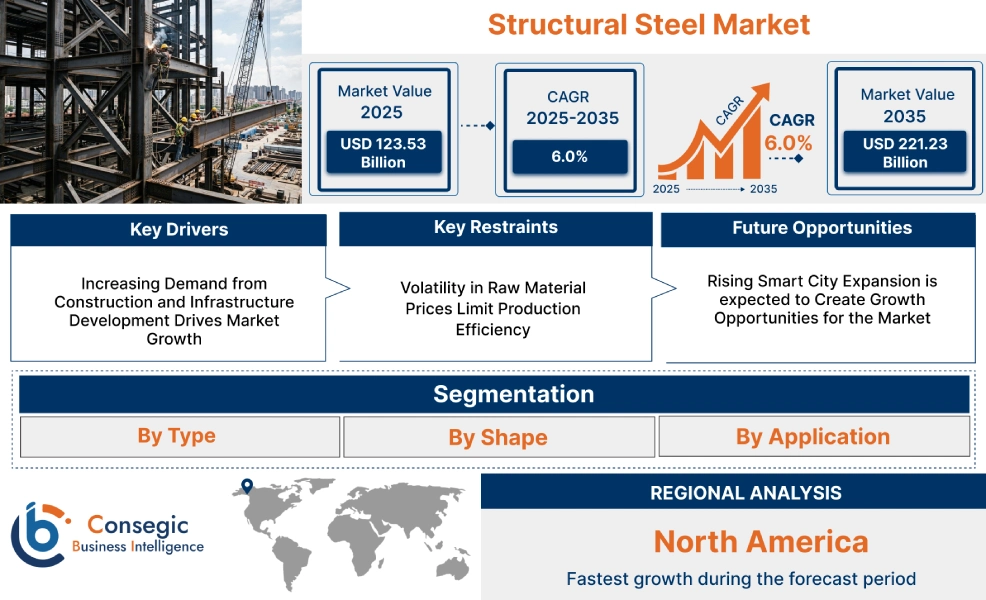
Structural Steel Market size is estimated to reach over USD 221.23 Billion by 2035 from a value of USD 116.54 Billion in 2024 and is projected to grow by USD 123.53 Billion in 2025, growing at a CAGR of 6.0% from 2025 to 2035
Structural Steel Market Scope & Overview:
Structural steel is a category of steel products designed for use in construction and infrastructure projects. It is used in the fabrication of beams, columns, bridges, industrial buildings, and high-rise structures due to its strength, durability, and load-bearing capacity. The material supports large-scale projects that require structural stability and long service life.
In addition, the key factors driving the structural steel market include the growing demand from residential and non-residential construction. Moreover, the need for high-strength and cost-effective materials in industrial and commercial applications further drives growth of the market. Furthermore, the structural steel system has several benefits, such as high tensile strength, design flexibility, recyclability, long service life, and faster construction timelines. The structural steel market is experiencing growth as a result of the aforementioned factors.
Market Size & Forecast
- 2024 Market Size : USD 116.54 Billion
- 2025 Market Size : USD 123.53 Billion
- 2035 Estimated Market Size : USD 221.23 Billion
- CAGR (2025-2035) : 6.0%
- Largest growing region : Asia Pacific
- Fastest growing region : North America
How is the Structural Steel Market Affected by Tariff?
Tariffs apply import duties and trade regulations to structural steel products to regulate international trade and protect domestic steel manufacturers, thus influencing pricing structures and market competitiveness. The tariff system influences the cost of the imported raw materials and finished structural steel, thereby effecting the production costs and procurement strategies. In addition, the tariffs influence the domestic production capacities, infrastructure investment strategies, and construction plans depending on the level of import competition. Moreover, trade policies, and global steel supply, also influences the structural steel market growth and profitability, considering the fact that the steel market is largely affected by the tariff measures.
Structural Steel Market Dynamics - (DRO):
Key Drivers:
Increasing Demand from Construction and Infrastructure Development Drives Market Growth
The increasing demand from construction and infrastructure development activities around the world is considered to be one of the major drivers that is contributing to the adoption of structural steel. Construction companies, and infrastructure development companies are increasingly choosing high-quality structural steels for enhancing structural efficiency and integrity. The structural steels enable the benefits of high tensile strength, durability, and flexibility in various residential, commercial, and industrial applications.
- According to the Indian Ministry of Housing and Urban Affairs, the urban population of India is expected to rise to 600 million by 2030 and 800 million by 2050.
Therefore, the structural steel market is experiencing growth as a result of the increasing utilization of structural steel in construction and infrastructure applications.
Key Restraints:
Volatility in Raw Material Prices Limit Production Efficiency
The price volatility of raw materials associated with structural steel production, such as fluctuations in the prices of iron ore, coking coal, and scrap steel, is slowing down the production efficiency of manufacturers. Additionally, the uncertainty associated with frequent price changes and procurement challenges contributes to higher operational costs. Manufacturers are also facing challenges that include unstable input costs, supply chain disruptions, and margin pressures, which are hindering large-scale production among small and medium-sized producers.
Therefore, the structural steel market is impacted by volatility in raw material prices.
Future Opportunities:
Rising Smart City Expansion is expected to Create Growth Opportunities for the Market
Increasing investments in smart city projects are anticipated to generate significant growth opportunities for the structural steel market. The government and the private sector are investing heavily in urban infrastructures such as smart transport systems, metro rail, and digital connectivity. Moreover, the development in the urban infrastructures in developing countries and in the developed countries are creating new demand drivers in the form of structural steel products in smart cities.
- For instance, in 2025, the Government of India reported that the Smart Cities Mission involved investments of approximately USD 20 billion toward infrastructure development projects across multiple cities. Such large-scale investments in commercial complexes, public utilities, transport infrastructure, and urban redevelopment projects are increasing the requirement for structural frameworks, beams, and columns, thereby supporting structural steel consumption.
Hence, the increasing allocation of capital toward smart city expansion is anticipated to accelerate structural steel adoption, thereby promoting future opportunities for the structural steel market during the forecast period.
Structural Steel Market Segmental Analysis:
By Type:
On the basis of type, the structural steel market is segmented into high sectional steel, light sectional steel, and rebar.
Trends in type:
- The growing demand for structural steel across residential, commercial, industrial, and infrastructure projects is fueling the adoption of different product types based on load-bearing and design requirements.
- The increasing need for high strength, durability, and cost-effective structural solutions is driving the demand across various structural steel product types.
The high sectional steel segment held the highest revenue share in 2024.
- High sectional steel helps in providing superior load-bearing capacity, structural stability, and enhanced performance in large-scale construction, which is increasing its adoption.
- Also, the growing use of high sectional steel in high-rise buildings, bridges, industrial plants, and infrastructure projects is driving segment dominance.
- Moreover, its ability to provide improved strength-to-weight ratio and long service life is supporting its widespread use.
- Furthermore, the increasing investment in commercial and industrial construction projects is contributing to higher consumption.
- Therefore, the dominance of the high sectional steel segment is being fueled by its extensive use in heavy-duty and large infrastructure applications.
It is anticipated that the rebar segment will exhibit the highest compound annual growth rate (CAGR) during the forecast period.
- Rebar helps in providing enhanced tensile strength and reinforcement in concrete structures, which is increasing its adoption in construction activities.
- Also, the rising demand from residential housing, transportation infrastructure, and urban development projects is fueling segment growth.
- Moreover, its increasing use in foundations, columns, beams, and road construction is supporting adoption.
- Therefore, the increasing urbanization and infrastructure development are accelerating the growth of the rebar segment.
By Shape:
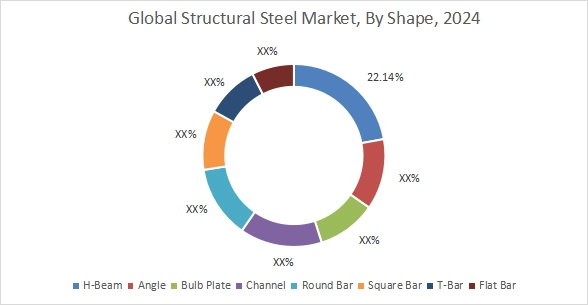
On the basis of shape, the market is divided into H-beam, angle, bulb plate, channel, round bar, square bar, T-bar, and flat bar.
Trends in shape:
- The growing demand for versatile structural components across residential and non-residential construction is driving the adoption of different structural steel shapes.
- The increasing focus on improving load distribution, structural stability, and design flexibility is fueling the demand for various structural steel shapes.
The H-beam segment held the highest revenue share of 22.14% in 2024.
- H-beams help in providing high load-bearing capacity and structural support, which is increasing their adoption in large construction projects.
- Also, the growing use of H-beams in commercial buildings, bridges, and industrial facilities is driving segment dominance.
- Moreover, their ability to distribute weight evenly and enhance structural integrity is supporting higher consumption.
- Furthermore, the increasing number of high-rise and infrastructure projects is contributing to segment growth.
- Hence, the dominance of the H-beam segment is being fueled by its superior structural performance and widespread usage in heavy construction.
It is anticipated that the channel segment will exhibit the highest compound annual growth rate (CAGR) during the forecast period.
- Channels help in providing structural reinforcement and framing support in buildings and infrastructure projects.
- Also, the rising demand from residential housing and light commercial construction is increasing their adoption.
- Moreover, their flexibility and ease of fabrication are supporting segment growth.
- Therefore, the growing construction activities and infrastructure modernization are accelerating the growth of the channel segment.
By Application:
On the basis of application, the market is divided into residential, and non-residential.
Trends in application:
- The growing demand for structural steel across residential and non-residential construction is increasing its adoption across major application segments.
- The increasing focus on improving building strength, durability, and construction efficiency is fueling the demand across various construction activities.
The non-residential segment held the highest revenue share in 2024.
- Structural steel is widely used in non-residential applications such as commercial complexes, industrial plants, warehouses, airports, and bridges, which is driving its demand.
- Also, the increasing infrastructure development, and industrial construction projects are fueling the adoption of structural steel.
- Moreover, the growing demand for durable, high-strength, and cost-efficient construction materials is supporting segment growth.
- Furthermore, the rising investment in transportation, warehouse, and public infrastructure is contributing to increased consumption.
- Hence, the dominance of the non-residential segment is being fueled by the extensive use of structural steel in large-scale and heavy-duty construction projects.
It is anticipated that the residential segment will exhibit the highest compound annual growth rate (CAGR) during the forecast period.
- Structural steel is increasingly used in residential applications such as multi-story housing, modular homes, and reinforcement structures, which is increasing its adoption in housing construction.
- Also, the rising demand for affordable housing and urban residential projects is driving segment growth.
- Moreover, the increasing focus on faster construction timelines and sustainable building materials is fueling its consumption.
- Furthermore, the growing adoption of durable and earthquake-resistant construction materials is supporting the use of structural steel.
- Therefore, the increasing global housing demand and urbanization are accelerating the growth of the residential segment.
Regional Analysis:
North America, Europe, Asia Pacific, the Middle East and Africa, and Latin America are the regions of coverage.
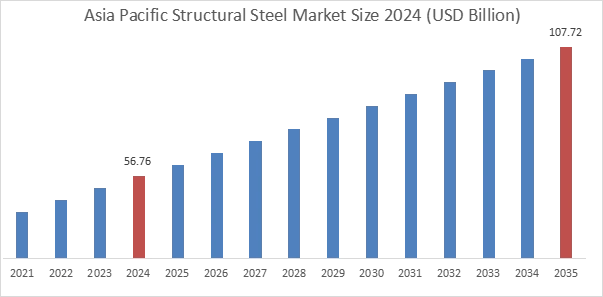
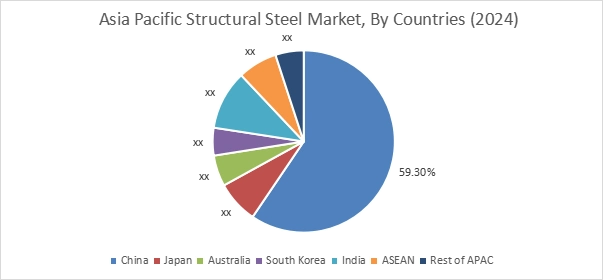
In 2024, Asia Pacific accounted for the highest market share at 48.70% and was valued at USD 56.76 Billion, and is expected to reach USD 107.72 Billion by 2035. In Asia Pacific, China accounted for the highest market share of 59.30% during the base year of 2024. Market growth is mainly fueled by the rapid expansion of construction activities, large-scale infrastructure projects, and increasing industrialization, which helps to achieve regional dominance. Furthermore, the growing urbanization initiatives in major economies such as China, India, and Japan are propelling market adoption. Although other regions are expected to fuel market demand, Asia Pacific is anticipated to remain the dominant revenue contributor during the forecast period.
- According to the World Steel Association, the crude steel production in India in 2024 stood at around 149.6 million tons, up from 140.8 million tons in 2023, registering a growth of 6.3% on a year-on-year basis. The constant rise in steel production is thus contributing to the growth of the structural steel market.
In the North American region, the structural steel market is expected to register the fastest growth during the forecast period 2025–2035. The growth in this region is driven by increasing investment in commercial construction, and infrastructure development projects. Moreover, governments and private players are increasingly adopting the use of structural steel in bridges, highways, and industrial facilities to improve structural strength, thereby contributing to the growth of the market.
- For instance, in June 2025, the U.S. Department of Transportation announced USD 5.4 billion in federal funding for bridge construction, replacement, and repair projects across the U.S. under the national infrastructure program. These investments are directed toward modernizing critical bridge infrastructure and strengthening transportation networks, significantly increasing demand for structural steel used in bridge frameworks and load-bearing structures.
Europe structural steel market is growing owing to the increasing demand from construction, infrastructure, and industrial development sectors, with the rising focus on durable and high-strength structural materials. The rising renovation activities and large-scale infrastructure modernization projects are fueling the demand for structural steel, hence driving the growth of the structural steel market.
Latin America structural steel market is driven by increasing development of construction infrastructure and rising demand from commercial and industrial sectors. Additionally, the growing adoption of structural steel in residential buildings, warehouses, and infrastructure applications is driving demand in this region, thereby supporting growth of the market.
Market growth in the Middle East & Africa is expanding due to the rising investments in large infrastructure projects, as well as the increasing use of structural steel in commercial buildings, and transportation networks. Moreover, the growing infrastructure initiatives and expanding industrial activities are driving demand in this region, supported by ongoing economic diversification programs.
Top Key Players & Market Share Insights:
The structural steel market is highly competitive at the global level, with major steel manufacturers and construction material producers supplying products for developed and developing economies. The companies operating in the market are offering a wide range of products such as high sectional steel, light sectional steel, rebar, and various structural shapes for application in residential and non-residential construction. In addition, companies are adopting strategies such as capacity expansion, strategic partnerships, and geographic expansion to strengthen their market presence and gain a competitive advantage. The key players operating in the structural steel market include:
- Tata Steel– India
- ArcelorMittal– Luxembourg
- Jindal Structural Ltd.– India
- Nippon Steel Corporation – Japan
- Steel Authority of India Ltd. – India
- JSW Steel Ltd. – India
- Baosteel Group – China
- United States Steel Corporation – U.S.
- ThyssenKrupp Structural GmbH – Germany
- POSCO – South Korea
Recent Industry Developments:
- In February 2026, ArcelorMittal announced the development of a new electric arc furnace at its Dunkirk integrated steel production unit as part of its decarbonization strategy in France. This project reflects a strategic investment of USD 1.41 billion, which is a major step towards reducing carbon emissions in the region.
- In December 2025, Tata Steel has approved an expansion of 4.8 MTPA at Neelachal Ispat Nigam Limited and is also planning to establish new rolling and processing units to enhance the production of finished steel. This expansion is also enhancing the production capacity of structural steel and helping to develop the structural steel market due to increasing demand from the construction sector.
- In January 2024, Jindal Structural Ltd. announced a joint venture in Indonesia with New Yaking Pte. Ltd. to set up a 1.2 MTPA steel melt shop, which will enhance its total melting capacity by 40% to 4.2 MTPA.
Structural Steel Market Report Insights:
| Report Attributes | Report Details |
|---|---|
| Study Timeline | 2024-2035 |
| Market Size in 2035 (USD Billion)) | USD 221.23 Billion |
| CAGR (2025-2035) | 6.0% |
| By Type |
|
| By Shape |
|
| By Application |
|
| By Region |
|
| Key Players |
|
| Report Coverage |
|
Key Questions Answered in the Report
How big is the structural steel market? −
Structural steel market size is estimated to reach over USD 221.23 Billion by 2035 from a value of USD 116.54 Billion in 2024 and is projected to grow by USD 123.53 Billion in 2025, growing at a CAGR of 6.0% from 2025 to 2035.
Which segmentation details are covered in the structural steel report? +
The structural steel report includes specific segmentation details for type, shape, application, and region.
Which is the fastest segment anticipated to impact the market growth? +
In the structural steel market, the channel segment is the fastest-growing segment during the forecast period, driven by the rising demand from residential housing and light commercial construction.
Who are the major players in the structural steel market? +
The key participants in the structural steel market are Tata Steel (India), ArcelorMittal (Luxembourg), Jindal Structural Ltd. (India), Nippon Steel Corporation (Japan), Steel Authority of India Ltd. (India), JSW Steel Ltd. (India), Baosteel Group (China), United States Steel Corporation (U.S.), ThyssenKrupp Structural GmbH (Germany), POSCO (South Korea), and others.
What are the key trends in the structural steel market? +
The structural steel market is shaped by key trends including the increasing demand from construction and infrastructure development activities around the globe.
Overview
Reputation & Certifications


Our Services
- Market Intelligence & Forecasting
- Custom Research Solutions
- Market Entry Strategy
- Competitive Intelligence
- Customer Insights
- Industry Innovation Analysis
- Investment Advisory