Jump to Content
Sugar Substitute Market - Size, Share, Industry Trends, and Forecasts (2025-2035)
Sugar Substitute Market Size:
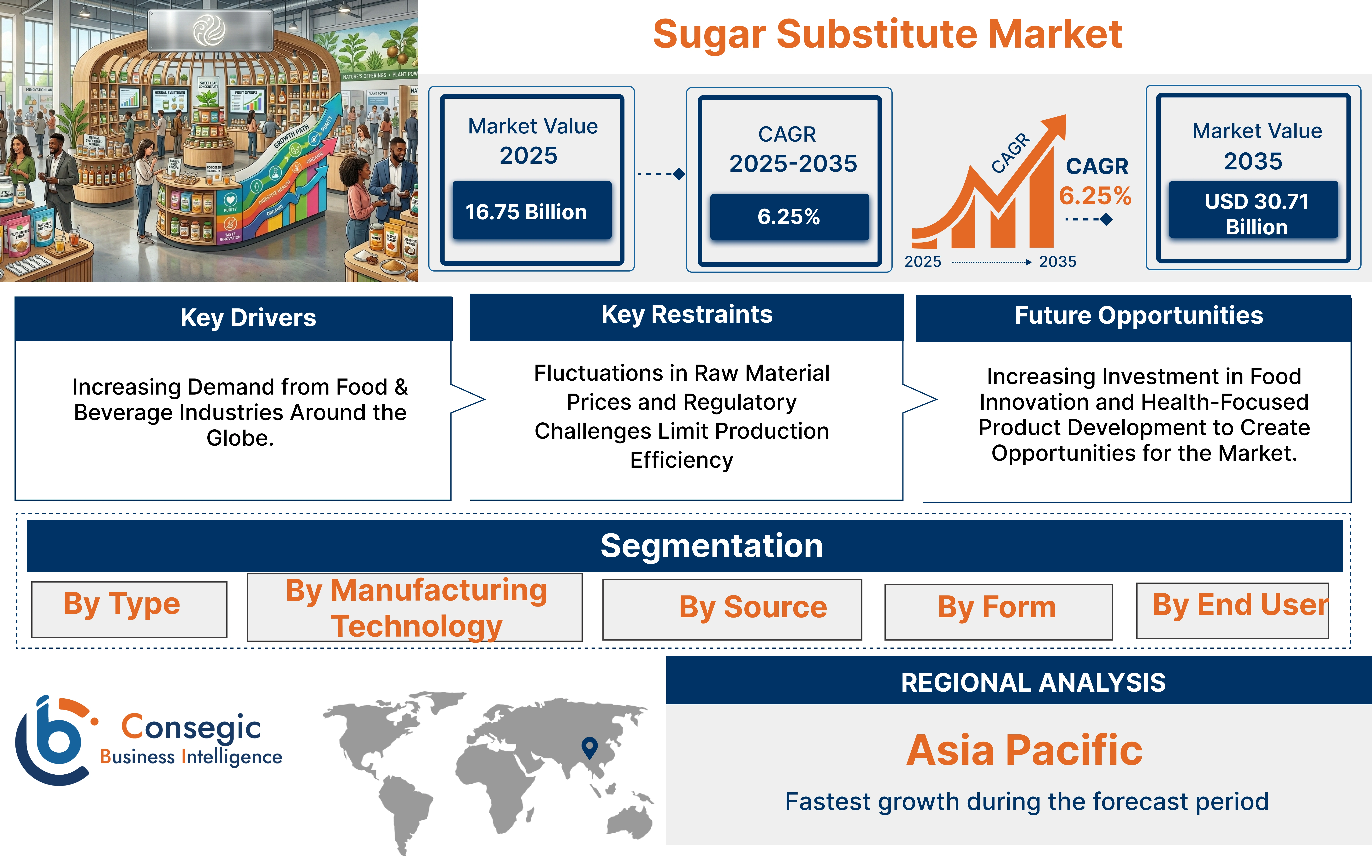
Sugar Substitute Market size is estimated to reach over USD 30.71 Billion by 2035 from a value of USD 15.77 Billion in 2024 and is projected to grow by USD 16.75 Billion in 2025, growing at a CAGR of 6.25% from 2025 to 2035
Sugar Substitute Market Scope & Overview:
The sugar substitute production refers to the production and processing of alternative sweetening ingredients that offer sweetness, low calories, and functional benefits in different applications such as food and beverages, pharmaceuticals, bakery, and dietary products using advanced technologies such as extraction, fermentation, and purification. The sugar substitute manufacturing system operates by preparing, processing, and refining raw materials such as stevia leaves, corn, sugar alcohols, and other natural and synthetic sources to produce high-intensity and bulk sweeteners for effective industrial use and product performance. The sugar substitute process system includes chemical, biological, and process control components that provide precise composition control, quality, and efficiency in the production of food and beverages, pharmaceuticals, nutritional products, and other industries.
In addition, the key factors driving the sugar substitute market include the growing demand for low-calorie and diabetic-friendly products, the rise in health awareness and obesity concerns, and the need for alternative sweetening solutions in food, beverage, and pharmaceutical applications. In addition, the sugar substitute system has several benefits, such as low-calorie content, suitability for diabetic consumption, high sweetness intensity, and ease of formulation. The sugar substitute market is experiencing growth as a result of the aforementioned factors.
Regional Analysis:
North America, Europe, Asia Pacific, the Middle East and Africa, and Latin America are the regions of coverage.
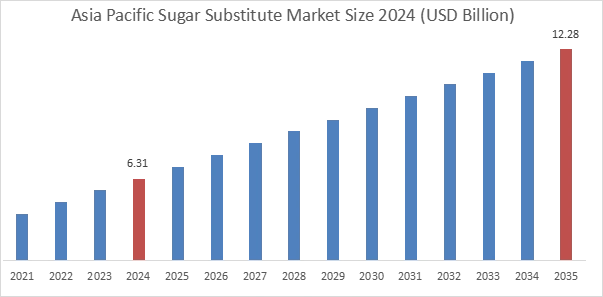
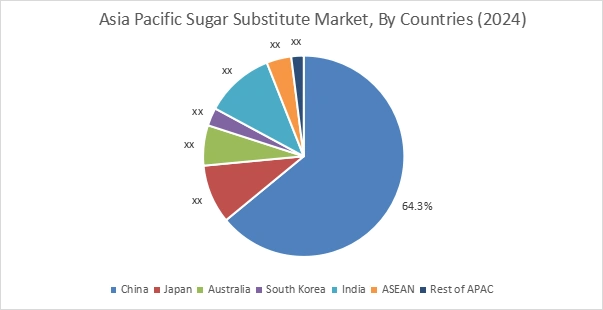
In 2024, Asia Pacific accounted for the highest market share at 40% and was valued at USD 6.31 Billion, and is expected to reach USD 12.28 Billion by 2035. In Asia Pacific, China accounted for the highest market share of 64.3% during the base year of 2024. Market growth is mainly fueled by the fast growth of the food and beverage industry, rising health awareness, and increasing prevalence of diabetes, which helps to achieve regional dominance. Furthermore, the increasing demand for low-calorie food products, rising urbanization, and the growing use of sugar substitutes in food & beverages, pharmaceuticals, and nutraceutical industries in major economies such as China, India, and Japan are propelling market adoption. Although other regions are expected to fuel market demand, Asia Pacific is anticipated to remain the dominant revenue contributor during the forecast period.
- For example, according to the International Diabetes Federation, China had approximately 148 million adults living with diabetes in 2024, the highest globally. The continuous rise in the diabetic population is increasing the demand for low-calorie and sugar-free food and beverage products, which is driving the adoption of sugar substitutes as an alternative sweetening solution, thereby contributing to the growth of the sugar substitute market.
In the North American region, the sugar substitute market is expected to register the fastest CAGR growth during the forecast period 2025-2035. The growth in this region is driven by the increasing demand for low-calorie food and beverages, as well as a strong focus on health and wellness. The food and beverage companies and pharmaceutical manufacturers are increasingly adopting the use of sugar substitutes in beverages, dietary products, and medicines to improve product health benefits and consumer acceptance. The strong presence of major food manufacturers and increasing health-focused product development in this region further increase the demand for sugar substitutes.
- For instance, according to the Centers for Disease Control and Prevention(CDC), about 40.1 million people in the United States had diagnosed or undiagnosed diabetes in 2023. This is increasing the demand for sugar substitutes, hence contributing to the growth of the sugar substitute market.
Europe sugar substitute market is growing owing to the increasing demand from food & beverages, pharmaceuticals, and nutraceutical industries, along with the rising focus on low-calorie, diabetic-friendly, and high-performance sweetening solutions. The rising health awareness, reformulation of processed foods, and development of functional products are fueling the demand for sugar substitutes, owing to the region’s robust food manufacturing sector and the rising emphasis on improving product health benefits and consumer acceptance.
Market growth in the Middle East & Africa is expanding due to the rising investments in food innovation, health-focused products, and pharmaceutical development, as well as the increasing use of sugar substitutes in beverages, confectionery, and dietary products. The growing consumer awareness regarding obesity and diabetes, along with expanding processed food and pharmaceutical markets, is driving demand in this region, supported by ongoing urbanization and economic diversification initiatives.
Latin America sugar substitute market is driven by increasing development of the food & beverage sector and rising demand from health-conscious and diabetic populations. The growing adoption of sugar substitutes in soft drinks, bakery, and dietary products is driving demand in this region, supported by expanding manufacturing activities and improving industrial and infrastructure development in the food sector.
Sugar Substitute Market Segmental Analysis:
By Type:
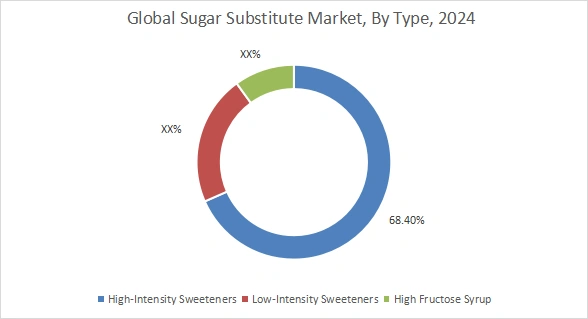
On the basis of type, the sugar substitute market is segmented into high-intensity sweeteners, low-intensity sweeteners, and high fructose syrup.
Trends in type:
- The growing demand for sugar substitutes across food and beverages, pharmaceuticals, dietary supplements, and personal care industries is fueling the adoption of different product types based on application requirements.
- The increasing need for low-calorie sweetening, diabetic-friendly ingredients, and improved taste profiles is driving the demand across various sugar substitute product forms.
The high-intensity sweeteners segment held the highest revenue share of 68.4% in 2024.
- High-intensity sweeteners help in providing high sweetness with very low-calorie content, which is increasing their adoption.
- Also, the growing use of high-intensity sweeteners in beverages, bakery products, and dietary foods is driving segment dominance.
- Moreover, their ability to provide effective sugar replacement without compromising taste and quality is supporting their widespread use.
- Furthermore, the increasing demand for low-calorie and sugar-free products is contributing to higher consumption.
- Therefore, the dominance of the high-intensity sweeteners segment is being fueled by their extensive use in health-focused and reduced-calorie applications.
It is anticipated that the low-intensity sweeteners segment will exhibit the highest compound annual growth rate (CAGR) during the forecast period.
- Low-intensity sweeteners help in providing bulk, texture, and mild sweetness, which is increasing their adoption in food formulations.
- Also, the rising demand from bakery, confectionery, and processed food sectors is fueling segment growth.
- Moreover, their increasing use in diabetic-friendly and functional food products is supporting adoption.
- Therefore, the increasing demand for balanced sweetness and functional benefits is accelerating the growth of the low-intensity sweeteners segment.
By Manufacturing Technology:
On the basis of manufacturing technology, the market is divided into precision fermentation, enzymatic conversion, and chemical synthesis.
Trends in manufacturing technology:
- The growing demand for efficient, sustainable, and high-purity sweetener production is driving the adoption of advanced manufacturing technologies.
- The increasing focus on improving production efficiency, scalability, and product quality is fueling the demand for different manufacturing methods.
The enzymatic conversion segment held the highest revenue share in 2024.
- Enzymatic conversion helps in providing efficient production and high-quality sweetener output, which is increasing its adoption.
- Also, the growing use of enzymatic processes in the production of high fructose syrup and other sweeteners is driving segment dominance.
- Moreover, its ability to provide cost-effective and scalable production is supporting higher utilization.
- Furthermore, the increasing demand for processed and convenience foods is contributing to segment growth.
- Hence, the dominance of the enzymatic conversion segment is being fueled by its efficiency and widespread industrial usage.
- Hence, the dominance of the 300 series segment is being fueled by its superior properties and widespread industrial usage.
It is anticipated that the precision fermentation segment will exhibit the highest compound annual growth rate (CAGR) during the forecast period.
- Precision fermentation helps in providing sustainable and high-purity sweetener production.
- Also, the rising demand for natural and next-generation sweeteners is increasing its adoption.
- Moreover, its ability to produce innovative and functional sweetening ingredients is supporting segment growth.
- Therefore, the growing focus on sustainable and advanced production technologies is accelerating the growth of the precision fermentation segment.
By Source:
On the basis of source, the market is divided into artificial and natural.
Trends in source:
- The growing demand for healthier and low-calorie food products is driving the adoption of both artificial and natural sugar substitutes.
- The increasing focus on clean-label, natural ingredients is fueling the demand for natural sweeteners such as stevia, monk fruit, and sugar alcohols.
The natural segment held the highest revenue share in 2024.
- Natural sugar substitutes help provide low-calorie sweetness with minimal processing, which is increasing their adoption.
- Also, the growing consumer preference for plant-based and clean-label products is driving segment dominance.
- Moreover, their ability to offer health benefits, such as supporting diabetes management and weight control, is supporting higher utilization.
- Furthermore, the increasing demand for reduced-sugar beverages, snacks, and processed foods is contributing to segment growth.
- Hence, the dominance of the natural segment is being fueled by its health benefits and widespread consumer preference.
It is anticipated that the artificial segment will exhibit the highest compound annual growth rate (CAGR) during the forecast period.
- Artificial sugar substitutes help provide cost-effective sweetness with high stability in various applications.
- Also, the rising demand from food manufacturers for consistent and scalable sweeteners is increasing its adoption.
- Moreover, their ability to produce high-intensity sweetness without adding calories is supporting segment growth.
- Therefore, the growing focus on affordability, consistency, and industrial applications is accelerating the growth of the artificial segment.
By Form:
On the basis of form, the market is divided into tablets, powder, and liquid.
Trends in form:
- The growing demand for convenient and easy-to-use sugar substitutes is driving adoption across tablets, powders, and liquid forms.
- The increasing focus on application versatility in beverages, confectionery, and pharmaceuticals is fueling the demand for various forms.
The powder segment held the highest revenue share in 2024.
- Powdered sugar substitutes are widely used in food and beverage manufacturing due to their ease of blending and consistent sweetness.
- Also, their compatibility with dry mixes, bakery products, and nutritional supplements is driving segment dominance.
- Moreover, the ability to provide high solubility and controlled dosage is supporting higher utilization.
- Furthermore, the rising demand for reduced-sugar processed foods is contributing to segment growth.
- Hence, the dominance of the powder segment is being fueled by its versatility and widespread industrial usage.
It is anticipated that the liquid segment will exhibit the highest compound annual growth rate (CAGR) during the forecast period.
- Liquid sugar substitutes help in providing ready-to-use solutions for beverages and syrups.
- Also, the growing demand for convenient and functional sweeteners is increasing its adoption.
- Moreover, their ability to enhance solubility, flavor, and application flexibility is supporting segment growth.
- Therefore, the increasing focus on ready-to-use formulations and beverage industry applications is accelerating the growth of the liquid segment.
By End User:
On the basis of end user, the market is divided into food & beverages, pharmaceuticals, nutraceuticals, health & personal care, and others.
On the basis of end user, the market is divided into food & beverages, pharmaceuticals, nutraceuticals, health & personal care, and others.
Trends in End User:
- The growing demand for sugar substitutes in low-calorie foods, beverages, and personal care products is driving the adoption across different applications.
- The increasing focus on health, wellness, and sugar reduction is fueling the demand in multiple end-use sectors.
The food & beverages segment held the highest revenue share in 2024.
- Sugar substitutes help in providing sweetness with reduced calorie content in food and beverage products, which is increasing their adoption.
- Also, the growing use of sugar substitutes in soft drinks, bakery, and confectionery products is driving segment dominance.
- Moreover, their ability to support sugar reduction and improve product appeal is supporting higher consumption.
- Furthermore, the increasing consumer preference for healthy and low-sugar food products is contributing to segment growth.
- For instance, according to the Ministry of Food Processing Industries (MoFPI), India’s non-alcoholic beverages market was valued at USD 14.95 billion in 2024 and is anticipated to grow at a CAGR of 7.36 % through 2030. This growth in the beverage industry is increasing the demand for low-calorie, reduced-sugar, and sugar-free drink options, which is driving the adoption of sugar substitutes as key sweetening ingredients, thereby contributing to the growth of the sugar substitute market in the beverage segment.
- Hence, the dominance of the food & beverages segment is being fueled by its extensive use in everyday consumable products.
It is anticipated that the health & personal care segment will exhibit the highest compound annual growth rate (CAGR) during the forecast period.
- Sugar substitutes help in providing functional benefits in personal care and health-related products.
- Also, the rising demand for low-calorie and health-focused products is increasing their adoption.
- Moreover, their increasing use in oral care and nutraceutical products is supporting segment growth.
- Therefore, the growing focus on health, wellness, and functional product development is accelerating the growth of the health & personal care segment.
Sugar Substitute Market Dynamics - (DRO):
Key Drivers:
Increasing Demand from Food & Beverage Industries Around the Globe.
The increasing demand from the food & beverage industry around the globe is one of the major drivers pushing the adoption of sugar substitutes. Manufacturers, as well as food & beverage companies, are adopting high-quality sugar substitute solutions to enhance product performance and consumer acceptance. These solutions allow consumers to enjoy the benefits of low calorie content, high sweetness intensity, and efficient and reliable performance in various food and beverage applications, where sugar substitutes are used in soft drinks, bakery products, confectionery, and dietary products as a sweetening ingredient to improve taste, reduce calorie intake, and support health-focused consumption.
- For instance, in January 2026, the scientist at Tufts University have developed an advanced method to produce tagatose, a rare sugar that provides a taste similar to conventional sugar while containing fewer calories and having a lower impact on blood glucose levels. Produced using engineered bacteria, this innovation offers a healthier and more natural alternative to traditional sweeteners. This development is supporting the advancement of next-generation sugar alternatives, thereby contributing to the growth of the sugar substitute market.
Therefore, the sugar substitute market is experiencing growth as a result of the increasing utilization of sugar substitutes in food and beverage applications.
Key Restraints:
Fluctuations in Raw Material Prices and Regulatory Challenges Limit Production Efficiency
The price variability of raw materials and the regulatory requirements associated with the production of sugar substitutes, such as the price of stevia, corn, and other natural and synthetic sweetener sources, and the compliance-intensive approval process, are also slowing down the production efficiency of the manufacturers. Additionally, the complexity associated with the purification and formulation process, such as the advanced extraction and refining, is also responsible for the cost issues. The manufacturers are also dealing with problems such as increasing operational costs, supply chain disruptions, and profit margin pressures, which are hindering the mass production of sugar substitutes among small and medium-sized manufacturers.
Therefore, the sugar substitute market is being impeded by fluctuations in raw material prices and regulatory challenges.
Future Opportunities:
Increasing Investment in Food Innovation and Health-Focused Product Development to Create Opportunities for the Market.
The increasing global investment in food innovation and health-oriented product development is expected to create numerous growth opportunities for the sugar substitute market. The food processing companies are investing heavily in low-calorie drinks, functional foods, and health-oriented products to enhance their health benefits and consumer acceptance. In addition, the innovation in natural sweeteners and advanced processing technology is also contributing to the increasing demand for sugar substitutes in the food and healthcare industry.
- For instance, in February 2026, Tate & Lyle PLC and Manus launched Yume™ M Stevia Sweetener, a stevia-derived ingredient designed for scalable and cost-effective sugar reduction in food and beverage applications. This launch is supporting the development of healthier, low-calorie products, thereby contributing to the growth of the sugar substitute market.
Hence, the increasing allocation of capital toward food innovation and health-focused product development is anticipated to accelerate sugar substitute adoption, thereby promoting future opportunities for the sugar substitute market during the forecast period.
Top Key Players & Market Share Insights:
The sugar substitute market is quite competitive at the global level, with major food ingredient manufacturers and specialty sweetener producers providing products for both developed and developing countries. The companies operating in the market are providing a wide range of products such as high-intensity sweeteners, low-intensity sweeteners, and high fructose syrup for applications including food & beverages, pharmaceuticals, nutraceuticals, and personal care products. In addition, companies are using strategies such as product innovation, capacity expansion, partnerships, mergers and acquisitions, and expansion into new regions to improve their market presence and gain a competitive advantage. The key players operating in the sugar substitute market include:
- Cargil Incorporated – US
- International Flavors & Fragrances Inc. – US
- Foodchem International Corporation – China
- PCIPL – India
- Van Wankum Ingredients – Netherlands
- Tag Ingredients India Pvt Ltd. – India
- Sweetly Stevia – US
- JK Sucralose Inc. – India
- Tate & Lyle – UK
- Savana Ingredients – Germany
Recent Industry Developments:
- In January 2024, Cargill launched its next‑generation stevia sweetener EverSweet®, produced via advanced fermentation and containing high‑purity steviol glycosides Reb M and Reb D, which is approved for use in the EU and UK. This launch is enhancing the production capacity of sugar substitutes and helping to develop the sugar substitute market.
- In July 2023, Tate & Lyle introduced its TASTEVA® SOL Stevia Sweetener, a high‑solubility stevia product that improves taste and functional performance, particularly in dairy and syrup applications. This product is providing consumers with better‑tasting, low‑calorie, and sugar‑reduced food and beverage options, enhancing overall sweetness experience without compromising flavor.
Sugar Substitute Market Report Insights:
| Report Attributes | Report Details |
|---|---|
| Study Timeline | 2019-2035 |
| Market Size in 2035 (USD Billion) | USD USD 30.71 Billion |
| CAGR (2025-2035) | 6.25% |
| By Type |
|
| By Manufacturing Technology |
|
| By Source |
|
| By Form |
|
| By End User |
|
| By Region |
|
| Key Players |
|
| Report Coverage |
|
Key Questions Answered in the Report
How big is the sugar substitute market? −
Sugar substitute market size is estimated to reach over USD 30.71 Billion by 2035 from a value of USD 15.77 Billion in 2024 and is projected to grow by USD 16.75 Billion in 2025, growing at a CAGR of 6.25% from 2025 to 2035.
Which segmentation details are covered in the sugar substitute report? +
The sugar substitute report includes specific segmentation details for type, manufacturing technology, source, form, end user, and region.
Which is the fastest segment anticipated to impact the market growth? +
In the sugar substitute market, the health & personal care segment is the fastest-growing segment during the forecast period, driven by the rising demand for low-calorie and health-focused products.
Who are the major players in the sugar substitute market? +
The key participants in the sugar substitute market are Cargill Incorporated (US), International Flavors & Fragrances Inc. (US), Foodchem International Corporation (China), PCIPL (India), Van Wankum Ingredients (Netherlands), Tag Ingredients India Pvt Ltd. (India), Sweetly Stevia (US), JK Sucralose Inc. (India), Tate & Lyle (UK), and Savana Ingredients (Germany), and others.
What are the key trends in the sugar substitute market? +
The sugar substitute market is shaped by key trends including the increasing demand from food and beverage and pharmaceutical industries around the globe.
Overview
Reputation & Certifications


Our Services
- Market Intelligence & Forecasting
- Custom Research Solutions
- Market Entry Strategy
- Competitive Intelligence
- Customer Insights
- Industry Innovation Analysis
- Investment Advisory