Jump to Content
Synthetic Fibers Market - Size, Share, Industry Trends, and Forecasts (2025-2032)
Synthetic Fibers Market:
Synthetic Fibers Market size is estimated to reach over USD 109.31 Billion by 2032 from a value of USD 74.55 Billion in 2024 and is projected to grow by USD 76.88 Billion in 2025, growing at a CAGR of 4.9% from 2025 to 2032.
Synthetic Fibers Market Scope & Overview:
Synthetic fibers are man-made materials produced through chemical processes using polymers or petrochemical-based raw materials. These fibers are designed to replicate or surpass natural fiber properties.They are lightweight, durable, and resistant to moisture, shrinkage, and stretching. They offer enhanced performance, affordability, and versatility for various applications.Key benefits include high tensile strength, ease of maintenance, and adaptability to different conditions, making them suitable for diverse end-use applications.These fibers usage are trending in textiles, automotive interiors, home furnishings, and industrial products. They also play a critical role in sportswear and technical fabrics.End-use industries include fashion, automotive, construction, and healthcare, where they are essential for delivering reliable, high-performance solutions.
How is AI Transforming the Synthetic Fibers Market?
AI is increasingly being used in the synthetic fibers market, particularly for optimizing production, enhancing quality control, and improving sustainability. AI-powered systems can monitor yarn quality during the spinning process, automatically adjusting spinning parameters such as speed, tension, and temperature to ensure consistent yarn quality and maximize output. Moreover, AI-powered vision systems can analyze images of yarns and fabrics to detect defects such as uneven thickness, color variations, tears, or weave inconsistencies with high precision and speed, in turn reducing the need for manual inspection. Additionally, AI-powered systems can monitor manufacturing processes in real-time, identifying deviations and predicting potential quality issues, which enables proactive adjustments to maintain consistent product quality. Therefore, the aforementioned factors are expected to positively impact the market growth in upcoming years.

Synthetic Fibers Market Dynamics - (DRO) :
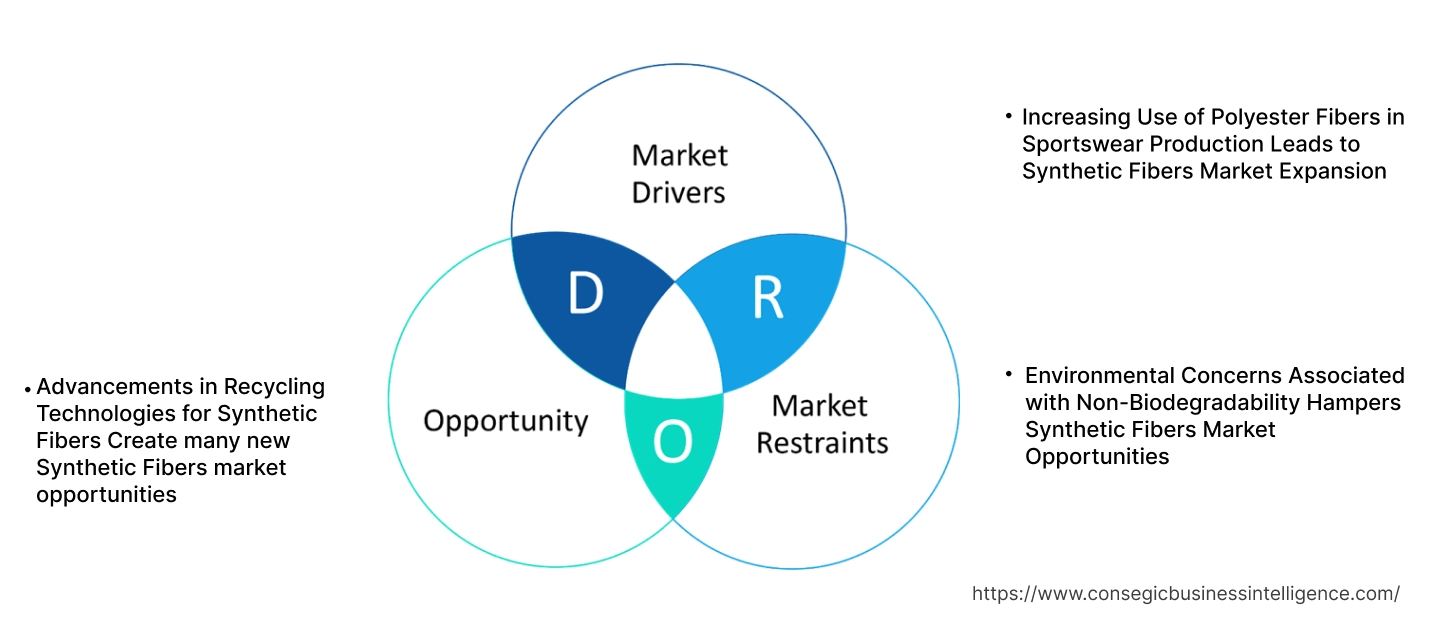
Key Drivers:
Increasing Use of Polyester Fibers in Sportswear Production Leads to Synthetic Fibers Market Expansion
The growing adoption of polyester fibers in the production of sportswear is boosting synthetic fibers market demand. Polyester fibers are highly durable, lightweight, and moisture-wicking, making them suitable for activewear applications. These properties enhance user comfort and performance, particularly in athletic and outdoor activities.For instance, leading sportswear brands are incorporating polyester fibers into their product lines to meet the rising consumer preference for breathable and quick-drying materials. The availability of innovative polyester blends further enhances fabric functionality.Thus, the expansion of sportswear manufacturing, supported by the performance benefits of polyester fibers, is driving synthetic fibers market demand.
Key Restraints:
Environmental Concerns Associated with Non-Biodegradability Hampers Synthetic Fibers Market Opportunities
The environmental impact of fibers, primarily due to their non-biodegradable nature, poses challenges to growth. Fibers like nylon and polyester take hundreds of years to decompose, contributing to pollution in landfills and water bodies. Moreover, the production process of fibers relies heavily on fossil fuels, releasing significant greenhouse gases. This environmental footprint has prompted regulatory bodies and consumers to prioritize sustainable alternatives, such as natural or recycled fibers.These environmental concerns and the resulting shift toward eco-friendly materials hinder the growth of the market, especially in regions with stringent environmental regulations.
Future Opportunities:
Advancements in Recycling Technologies for Synthetic Fibers Create many new Synthetic Fibers market opportunities
The development of advanced recycling technologies for fibers is expected to create significant growth opportunities. These innovations enable the efficient recycling of polyester and nylon into high-quality materials, reducing environmental impact.For instance, chemical recycling processes that break down fibers to their monomers allow manufacturers to produce new fibers with properties equivalent to virgin materials. As sustainability becomes a priority for consumers and industries, recycled fibers are likely to gain traction. The adoption of these technologies is anticipated to support the synthetic fibers market growth by aligning with sustainability goals and meeting the trending Synthetic Fibers market expansion for eco-friendly materials.
Synthetic Fibers Market Segmental Analysis :
By Type:
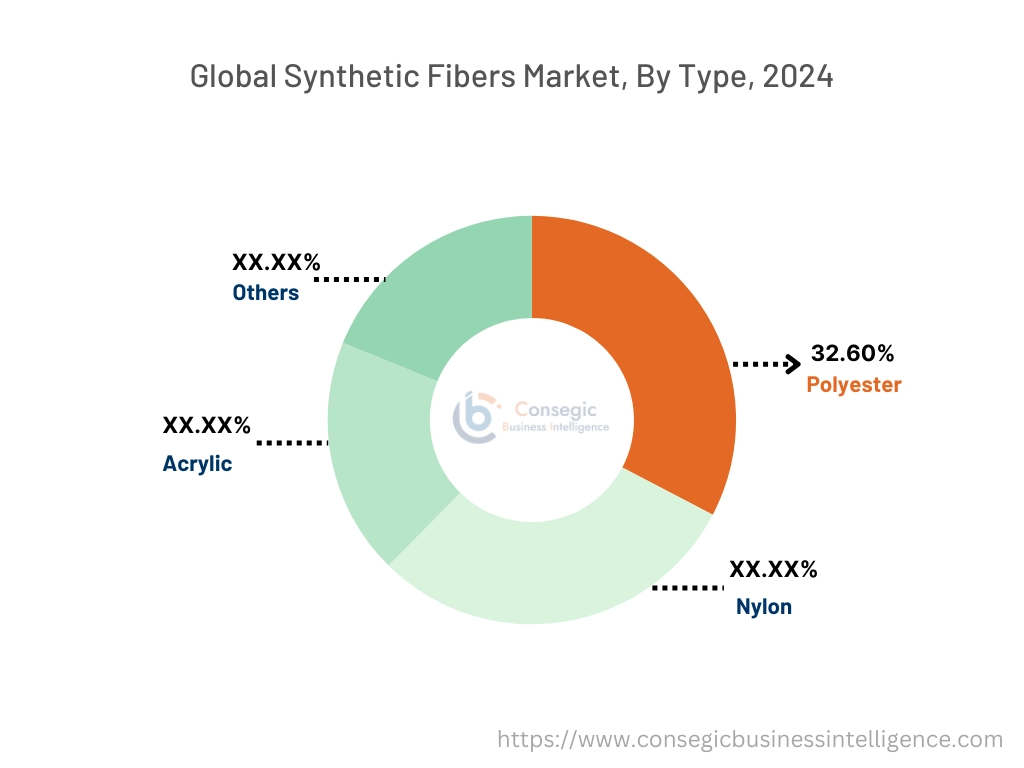
Based on type, the market is segmented into polyester, nylon, acrylic, and others.
The polyester segment accounted for the largest revenue in Synthetic Fibers market share by 32.60% in 2024.
- Polyester is widely used due to its durability, lightweight nature, and cost-effectiveness.
- It finds extensive applications in clothing, home textiles, and industrial fabrics.
- Polyester fibers also offer resistance to wrinkles, shrinking, and stretching, making them highly suitable for diverse end-use industries.
- Additionally, advancements in recycling technologies have bolstered the demand for recycled polyester, further expanding Synthetic Fibers market share.
- Therefore, according to Synthetic Fibers market analysis, polyester's trending use in apparel, household furnishings, and technical textiles significantly contributes to its dominance in the market.
The nylon segment is anticipated to register the fastest CAGR during the forecast period.
- Nylon, known for its high strength, elasticity, and abrasion resistance, is increasingly used in automotive, industrial, and textile applications.
- Its thermal and chemical resistance properties make it ideal for demanding applications like carpets, airbags, and tire cords.
- Innovations in nylon production, such as bio-based alternatives, further enhance its market appeal.
- Thus, according to Synthetic Fibers market analysis, nylon's versatile properties and trending adoption in automotive and industrial sectors are expected to accelerate Synthetic Fibers market growth trajectory.
By Application:
Based on application, the market is segmented into clothing, home furnishing, automotive, filtration, and others.
The clothing segment accounted for the largest revenue share in 2024.
- Synthetic fibers market trends in the clothing sector due to their affordability, easy maintenance, and adaptability to various fashion trends.
- Polyester and nylon are commonly used for casual wear, sportswear, and activewear, owing to their moisture-wicking and quick-drying capabilities.
- The rise of e-commerce and fast fashion further drives synthetic fiber market demand in the clothing industry.
- Therefore, according to market trends analysis, synthetic fibers' ability to offer affordable, durable, and fashionable alternatives makes them integral to the clothing market.
The filtration segment is anticipated to register the fastest CAGR during the forecast period.
- Filtration applications require fibers with precise porosity, chemical resistance, and mechanical strength, making synthetic fibers a preferred choice.
- These fibers are extensively used in air and water filtration systems for industrial and environmental applications.
- Increasing environmental regulations and awareness regarding pollution control contribute to the segment’s rapid development.
- Thus, according to market trends analysis, the enhanced performance of fibers in filtration applications supports their adoption across environmental and industrial processes.
By Form:
Based on form, the market is segmented into filament, staple fiber, and tow.
The filament segment accounted for the largest revenue share in 2024.
- Filaments offer continuous fiber lengths, which are ideal for producing smooth, durable, and high-strength fabrics.
- They are widely used in applications requiring superior aesthetics, such as apparel, upholstery, and industrial fabrics.
- The adaptability of filaments in creating intricate patterns and textures boosts their demand.
- Hence, according to market trends analysis, filaments' versatility and ability to cater to diverse fabric requirements ensure their strong presence in the market.
The staple fiber segment is anticipated to register the fastest CAGR during the forecast period.
- Staple fibers, characterized by short lengths, are widely used in spinning processes to produce blended yarns and nonwoven textiles.
- Their application in hygiene products, automotive interiors, and geotextiles is growing due to advancements in fiber technology.
- Moreover, the demand for eco-friendly staple fibers, especially those made from recycled materials, is on the rise.
- Thus, according to market trends analysis, staple fibers' increasing use in blended textiles and innovative nonwoven solutions fuels their rapid market growth.
By Manufacturing Process:
Based on the manufacturing process, the market is segmented into melt spinning, solution spinning, gel spinning, and others.
The melt spinning process accounted for the largest revenue share in 2024.
- Melt spinning is the most common and cost-efficient method for producing fibers like polyester and nylon.
- It involves melting the polymer and extruding it through spinnerets to form fibers.
- This process is highly scalable, making it suitable for large-scale production across industries.
- The efficiency and scalability of melt spinning solidify its leading position in manufacturing.
The gel spinning process is anticipated to register the fastest CAGR during the forecast period.
- Gel spinning is used for high-performance applications requiring fibers with superior tensile strength and thermal resistance.
- This process is particularly prominent in the production of aramid and ultra-high-molecular-weight polyethylene (UHMWPE) fibers, which are used in ballistic protection, aerospace, and medical devices.
- The growing demand for high-strength and specialty fibers is driving the adoption of gel spinning techniques in advanced applications.
By End-Use Industry:
Based on end-use industry, the market is segmented into textile, construction, healthcare, automotive, and others.
The textile accounted for the largest revenue share in 2024.
- Synthetic fibers are foundational to the textile industry, catering to diverse applications, from apparel and home textiles to industrial fabrics.
- The ability to produce customized fibers with specific properties, such as elasticity and strength, enhances their usability across textile products.
- The demand for sustainable synthetic alternatives is also reshaping the textile industry’s landscape.
- Synthetic fibers' critical role in shaping modern textiles ensures their continued dominance in the market trends.
The automotive is anticipated to register the fastest CAGR during the forecast period.
- In the automotive sector, fibers are used in seat covers, airbags, carpets, and insulation materials.
- Their high strength-to-weight ratio, thermal stability, and aesthetic versatility make them indispensable in vehicle interiors and safety components.
- The rising trend of lightweight vehicles to improve fuel efficiency further propels demand in automotive applications.
- The automotive industry's increasing reliance on lightweight, durable, and high-performance materials drives the synthetic fibers market.
Regional Analysis:
The regions covered are North America, Europe, Asia Pacific, the Middle East and Africa, and Latin America.
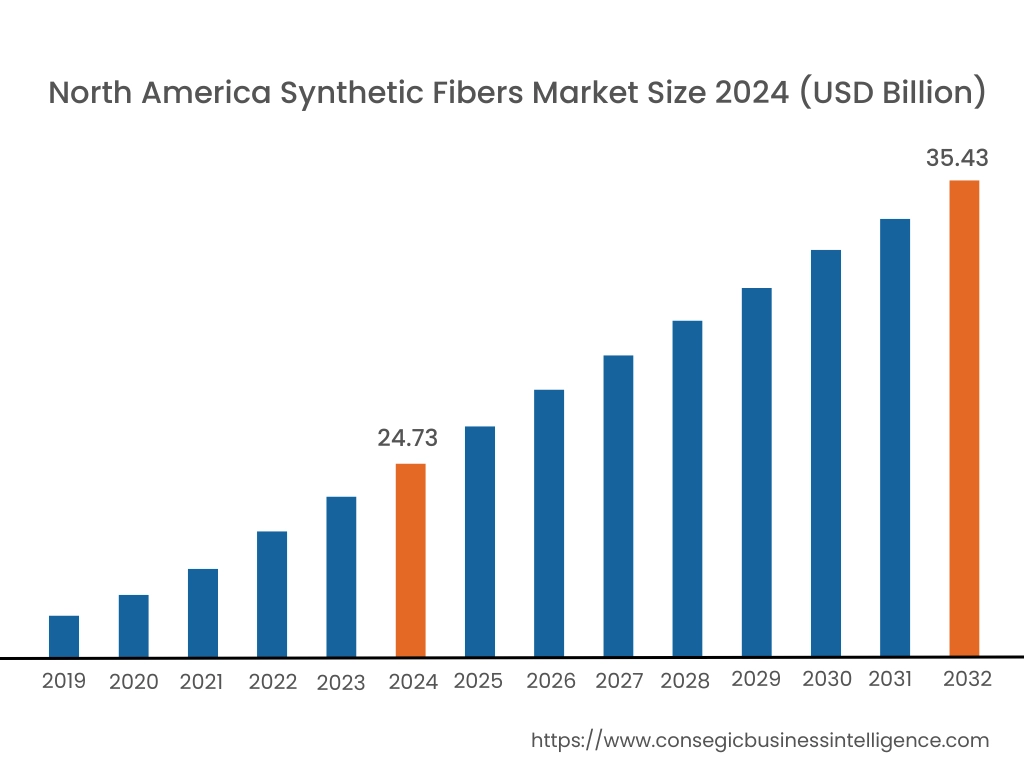
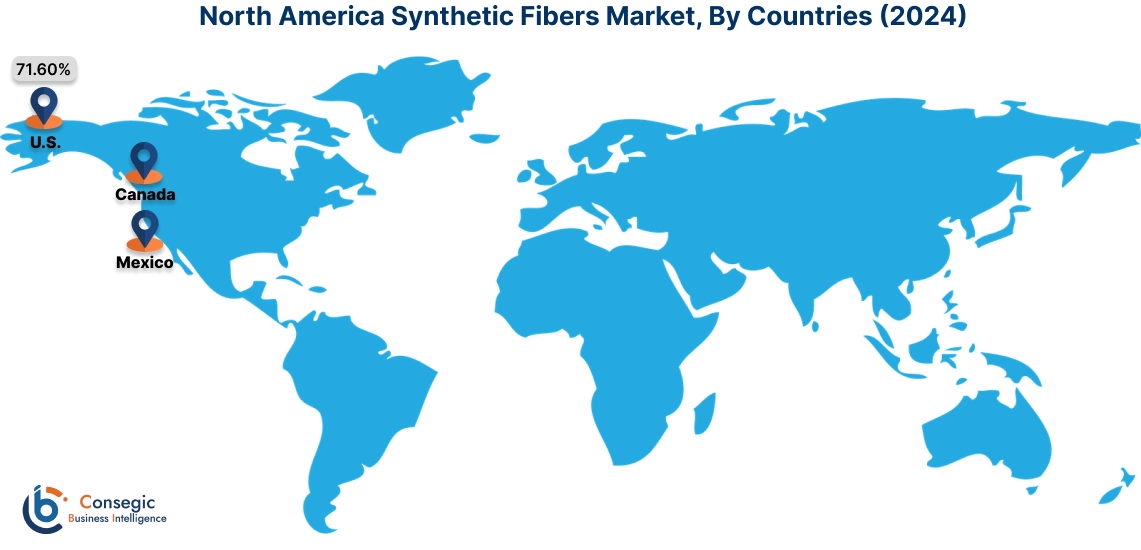
In 2024, North America was valued at USD 24.73 Billion and is expected to reach USD 35.43 Billion in 2032. In North America, the U.S. accounted for the highest share of 71.60% during the base year of 2024. The Synthetic Fibers Industry in North America is influenced by increasing demand from the apparel and home furnishings industries. The United States leads in product innovation, focusing on lightweight and durable fibers for activewear and industrial applications. The rising adoption of fibers in automotive and construction sectors supports market performance. Environmental concerns drive efforts to develop recyclable synthetic fiber variants.
In Asia Pacific, the market is experiencing the fastest growth with a CAGR of 5.3% over the forecast period. Asia-Pacific dominates the Synthetic Fibers Industry due to high production capacity and growing demand from the textile industry. Countries like China and India benefit from low manufacturing costs and abundant raw material availability. The region also sees strong demand for polyester and nylon fibers in the apparel, automotive, and industrial sectors. Government incentives for export-oriented textile industries further enhance market activity in Asia-Pacific.
In Europe, the industry is shaped by stringent environmental regulations and a focus on sustainability. Countries like Germany, Italy, and France emphasize the use of eco-friendly production techniques. The region witnesses significant demand from the fashion industry, which promotes biodegradable and recycled fibers. Research on high-performance technical fibers supports market growth in industrial and defense applications.
The industry in the Middle East and Africa benefits from rising urbanization and increasing demand for durable and cost-effective materials. Countries like Saudi Arabia and the UAE see growing use of fibers in construction, automotive, and home furnishings. Limited local manufacturing capabilities lead to reliance on imports for high-quality fibers, impacting market dynamics in this region.
In Latin America, the market is driven by rising consumption in the textile and packaging industries. Brazil and Mexico showcase increasing demand for versatile fibers, particularly for sportswear and industrial applications. Local producers are adopting modern production techniques to compete with imported fibers. Economic disparities and infrastructure challenges affect market penetration in certain areas.
Top Key Players and Market Share Insights:
The global synthetic fibers market is highly competitive with major players providing products to the national and international markets. Key players are adopting several strategies in research and development (R&D), product innovation, and end-user launches to hold a strong position in the global synthetic fibers market. Key players in the synthetic fibers industry include-
- Indorama Ventures Public Company Limited (Thailand)
- Toray Industries, Inc. (Japan)
- Teijin Limited (Japan)
- Alpek S.A.B. de C.V. (Mexico)
- Mitsubishi Chemical Corporation (Japan)
- Reliance Industries Limited (India)
- Eastman Chemical Company (United States)
- Lenzing AG (Austria)
- Asahi Kasei Corporation (Japan)
- Kolon Industries, Inc. (South Korea)
Synthetic Fibers Market Report Insights :
| Report Attributes | Report Details |
| Study Timeline | 2019-2032 |
| Market Size in 2032 | USD 109.31 billion |
| CAGR (2025-2032) | 4.9% |
| By Type |
|
| By Application |
|
| By Form |
|
| By Manufacturing Process |
|
| By End-Use Industry |
|
| By Region |
|
| Key Players |
|
| North America | U.S. Canada Mexico |
| Europe | U.K. Germany France Spain Italy Russia Benelux Rest of Europe |
| APAC | China South Korea Japan India Australia ASEAN Rest of Asia-Pacific |
| Middle East and Africa | GCC Turkey South Africa Rest of MEA |
| LATAM | Brazil Argentina Chile Rest of LATAM |
| Report Coverage |
|
Key Questions Answered in the Report
How big is the Synthetic Fibers Market? −
In 2024, the Synthetic Fibers Market was USD 74.55 billion.
What will be the potential market valuation for the Synthetic Fibers Market by 2032? +
In 2032, the market size of Synthetic Fibers Market is expected to reach USD 109.31 billion.
What are the segments covered in the Synthetic Fibers Market report? +
The types, applications, forms, manufacturing processes and end-user industries are the segments covered in this report.
Who are the major players in the Synthetic Fibers Market? +
Indorama Ventures Public Company Limited (Thailand), Toray Industries, Inc. (Japan), Teijin Limited (Japan), Alpek S.A.B. de C.V. (Mexico), Mitsubishi Chemical Corporation (Japan), Reliance Industries Limited (India), Eastman Chemical Company (United States), Lenzing AG (Austria), Asahi Kasei Corporation (Japan), Kolon Industries, Inc. (South Korea), are the major players in the Synthetic Fibers market.
Overview
Reputation & Certifications


Our Services
- Market Intelligence & Forecasting
- Custom Research Solutions
- Market Entry Strategy
- Competitive Intelligence
- Customer Insights
- Industry Innovation Analysis
- Investment Advisory