Jump to Content
Technical Textiles Market - Size, Share, Industry Trends, and Forecasts (2025-2035)
Technical Textiles Market
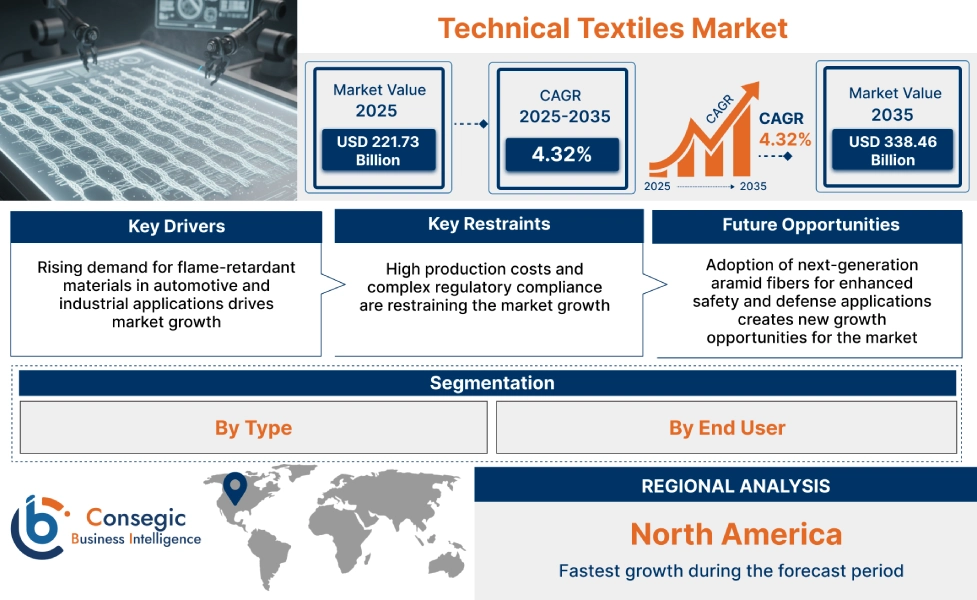
Technical Textiles Market size is estimated to reach over USD 338.46 Billion by 2035 from a value of USD 212.55 Billion in 2024 and is projected to grow by USD 221.73 Billion in 2025, growing at a CAGR of 4.32% from 2025 to 2035
Technical Textiles Market Scope & Overview:
Technical textiles are engineered textile materials that are designed for functional and performance-based applications, and not for aesthetic purposes. Technical textiles are developed with desired properties such as durability, strength, flexibility, flame resistance, and chemical resistance. Technical textiles have various applications in different industries such as the automotive industry, construction industry, medical industry, agriculture industry, defense industry, and manufacturing industry. These applications include protective clothing, geotextiles, medical textiles, filtration fabrics, and automotive parts.
The market for technical textiles is growing due to the increasing demand for high-performance materials in industrial and infrastructure applications. Rising investments in construction and transportation sectors are supporting product adoption. Growing awareness regarding workplace safety and protective solutions is increasing the use of specialized fabrics. Rapid improvements in fiber technology and processing methods are adding to the growth of the market.
How are Tariffs Impacting the Technical Textiles Market?
Tariffs on imported synthetic fibers, specialty yarns, and coating chemicals have increased raw material costs for technical textile manufacturers. Also, trade restrictions on finished textile products have influenced export competitiveness and pricing strategies in international markets. In addition, customs duties on industrial equipment and high-tech machinery have impacted capital expenditures, especially in emerging countries. Further, shifting trade policies are encouraging regional manufacturing expansion and supplier diversification, which is reshaping supply chain structures and long-term procurement strategies in the market.
Technical Textiles Market Dynamics - (DRO):
Key Drivers:
Rising demand for flame-retardant materials in automotive and industrial applications drives market growth
The technical textiles market is also growing due to the rising need for fire safety in the automotive and industrial sectors. Automakers are under pressure to improve vehicle safety while maintaining lightweight design. This is increasing the use of advanced flame-retardant nonwoven materials in areas such as battery components and interior parts.
The transition toward electric vehicles is also raising the need for materials that can withstand higher temperatures and reduce fire risks. With the increasing heat generated by battery systems, companies are now using specialized technical textiles that ensure thermal stability and safety standards.
- For instance, in September 2024, Asahi Kasei Corporation introduced a new type of LASTAN flame-retardant nonwoven fabric, which is suitable for use in automotive interior components and applications requiring improved flame resistance and moldability.
Thus, the rising importance of fire safety and electric vehicle thermal protection is fueling the growth of the technical textiles market.
Key Restraints:
High production costs and complex regulatory compliance are restraining the market growth
Technical textiles need specific raw materials, sophisticated manufacturing technology, and quality control requirements, which make them costlier than conventional textiles. The addition of high-performance fibers like aramid, carbon, and specialty polymers further increases the material costs. Moreover, the investment in sophisticated equipment and testing apparatuses increases the capital outlay for the manufacturers.
Further, technical textiles used in medical, automotive, and construction applications must comply with stringent safety and performance regulations. Certification procedures, testing, and changing government regulations increase the costs of compliance and the time taken for product approvals. Small-scale manufacturers may find it challenging to comply with these requirements because of their limited financial and technical capabilities.
Therefore, high production costs and regulatory complexities are restraining the technical textiles market expansion.
Future Opportunities:
Adoption of next-generation aramid fibers for enhanced safety and defense applications creates new growth opportunities for the market
The growing use of high-performance textiles in the defense sector, infrastructure strengthening, and industrial protection is anticipated to generate robust growth opportunities in the technical textiles industry. Governments and contractors are incorporating advanced woven and nonwoven textiles into ballistic protection gear, geotextiles for soil reinforcement, and fire-resistant industrial fabrics. Furthermore, the growing need for lightweight reinforcement materials in the construction and transportation sectors is driving the use of specialty fibers and textile solutions.
- For instance, in December 2025, in December 2025, DuPont launched Kevlar EXO, a new-generation aramid fiber with broadened applications in hard armor, including helmets and ballistic plate inserts, to improve protection capabilities with enhanced impact resistance and energy absorption properties.
Therefore, the development and commercialization of advanced aramid fiber technology are expected to enhance product offerings in protective textiles, stimulate the development of new applications, and stimulate investment from the defense and industrial safety industries.
Technical Textiles Market Segmental Analysis:
By Type:
Based on type, the technical textiles market is segmented into agrotech, buildtech, clothtech, geotech, hometech, indutech, meditech, mobiltech, oekotech, packtech, protech, and sportech.
Trends in the Type:
- The increasing infrastructure development and urbanization activities are driving the demand for buildtech and geotech textiles.
- The increasing emphasis on healthcare hygiene and protective requirements is propelling the use of meditech and protech textiles.
Mobiltech accounted for the largest revenue share in the year 2024.
- Mobiltech textiles are used extensively in the automotive, aerospace, railway, and marine sectors for interior parts, insulation, airbags, and seat belts.
- These textiles offer lightweight characteristics, durability, and high strength, which help in fuel efficiency and performance improvement.
- Additionally, the rising production of electric vehicles is increasing demand for advanced textile materials used in thermal insulation and lightweight structures.
- Further, stringent safety regulations in the transportation sector are boosting the use of high-performance technical textiles.
- Furthermore, continuous innovation in composite textiles and reinforced fabrics is strengthening their application in mobility solutions.
- Thus, as per the technical textiles market analysis, increasing transportation production and demand for lightweight materials are driving the dominance of mobiltech.
Meditech is anticipated to register the fastest CAGR during the forecast period.
- Meditech textiles are employed in surgical suits, masks, wound dressings, implants, and other medical products.
- The rising importance of infection control and hospital hygiene is driving the adoption of meditech textiles.
- In addition, rising healthcare spending and surgical procedures are fueling the growth of the market.
- Further, improvements in nonwoven technology and antimicrobial textiles are improving product performance.
- Moreover, the increasing demand for disposable meditech textiles in developed and emerging markets is fueling market growth.
- Hence, based on market analysis, the rising importance of healthcare safety and advanced medical applications is expected to drive the meditech market during the forecast period.
- Therefore, as per the market analysis, the increasing emphasis on healthcare safety and advanced medical applications is anticipated to boost the meditech segment during the forecast period.
By End User:
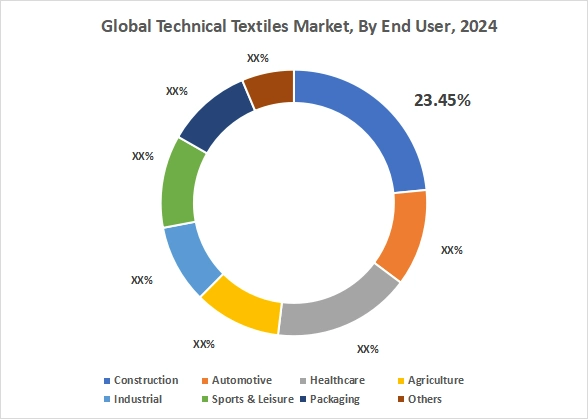
Based on end user, the technical textiles market is segmented into construction, automotive, healthcare, agriculture, industrial, sports & leisure, packaging, and others.
Trends in the End User:
- The increasing rate of development in infrastructure and construction projects is fueling the demand for technical textiles in construction.
- The increasing production of lightweight and fuel-efficient vehicles is accelerating demand for technical textiles in the automotive sector.
Construction accounted for the largest revenue share of 23.45% in the year 2024.
- Technical textiles have numerous applications in the construction industry, including roofing membranes, insulation materials, scaffolding nets, tarpaulins, and reinforced concrete.
- Technical textiles improve the durability and stability of infrastructure projects.
- In addition, the increasing use of geotextiles in soil stabilization, erosion control, and drainage applications is also fueling the growth of this segment.
- Further, increasing investments in smart cities and sustainable infrastructure are boosting demand for advanced textile-based construction solutions.
- Furthermore, stringent safety and quality standards in the construction industry are encouraging the use of high-performance technical textiles.
- Thus, as per the technical textiles market analysis, expanding infrastructure projects and performance advantages are driving dominance in construction applications.
Healthcare is anticipated to register the fastest CAGR during the forecast period.
- Technical textiles in the healthcare sector are used in surgical suits, masks, wound dressings, implants, and hygiene items.
- The growing focus on infection control and patient safety is propelling the use of medical-grade textile materials.
- Additionally, rising healthcare expenditure and the growing number of surgical procedures are supporting demand growth.
- Further, advancements in antimicrobial and nonwoven textile technologies are enhancing product performance and reliability.
- Furthermore, the growing demand for disposable and high-quality healthcare products is accelerating segment expansion.
- Thus, the growing awareness about healthcare and advancements in medical textile technology are expected to drive the healthcare market in the forecast period.
Regional Analysis:
North America, Europe, Asia Pacific, the Middle East and Africa, and Latin America are the regions of coverage.
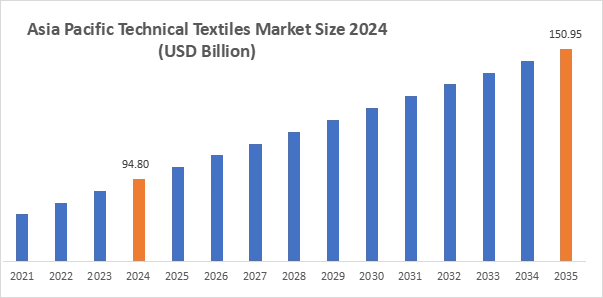
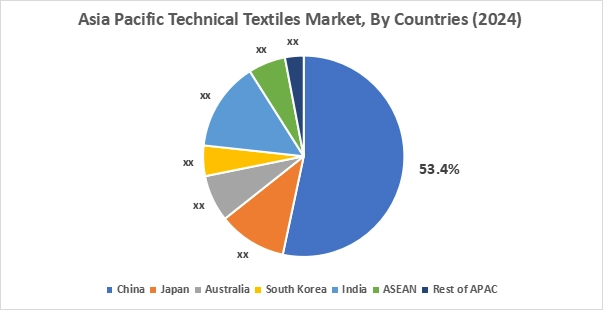
In 2024, Asia Pacific accounted for the highest market share at 44.60% and was valued at USD 94.80 Billion, and is expected to reach USD 150.95 Billion by 2035. In Asia Pacific, China accounted for the highest market share of 53.40% in 2024. Asia Pacific technical textiles market is fueled by the growing production of automobiles, development of infrastructure, and increasing demand for industrial textiles in China, India, Japan, and South Korea. The growing demand in construction, filtration, medical textiles, and protective clothing is fueling the demand for nonwovens and high-performance fibers, thus driving the market growth.
- For instance, China’s automobile production and sales volume both surpassed 34 million units in 2025, thus retaining its leading position as the world’s largest automotive producer. The increasing production levels of vehicles are thereby driving the demand for automotive technical textiles such as seat fabrics, airbags, tire cord materials, insulation textiles, and interior reinforcement fabrics, thus supporting the overall technical textile demand in the Asia Pacific region.
In North America, the technical textiles market is projected to witness the fastest growth with an estimated CAGR of 5.86% over the forecast period 2025–2035. North America technical textiles market is driven by the growing demand for defense purchases, medical textiles, and the increasing demand for industrial safety standards in the U.S. and Canada. The growing investments in protective clothing, geotextiles for infrastructure development, filtration materials, and performance-engineered fabrics are fueling the demand for high-strength and performance-engineered textile materials in the military, healthcare, infrastructure, and industrial applications.
- For instance, the U.S. Department of Defense was authorized a total budget of about USD 849 billion for fiscal year 2025, which will continue to fuel the demand for the purchase of defense equipment and protective materials, including performance textiles used in uniforms, armor systems, and other performance-engineered fabric applications that support soldier safety and effectiveness. The growing demand for overall defense spending will continue to fuel the demand for technical textiles used in protective clothing and other applications in North America.
Europe technical textiles market is driven by the automotive engineering requirements, sustainability regulations, and industrial filtration demands in the German, French, and Italian markets. The market is also driven by the integration of advanced composite textiles and sustainable technical fabrics in the transportation and construction sectors by manufacturers.
Latin America technical textiles market growth is supported by infrastructure expansion, agricultural applications, and industrial development across Brazil and Argentina. Rising use of geotextiles in road construction and agro-textiles in farming operations is increasing regional consumption of functional textile materials, thereby driving market growth.
Middle East & Africa technical textiles market is driven by construction projects, oil and gas filtration demand, and protective apparel requirements in Saudi Arabia, UAE, and South Africa. Industrial diversification programs are increasing procurement of specialized fabrics for infrastructure and industrial safety applications, thereby driving market growth in this region.
Top Key Players & Market Share Insights:
The global technical textiles market is a highly competitive market, with prominent material science and specialty fiber producers providing advanced textile solutions to the domestic and global markets. The key players are using various approaches in research and development, high-performance fiber development, strategic partnerships, and new product development to ensure their dominance in the technical textiles market. The companies are focusing on protective textiles, industrial filtration textiles, medical textiles, automotive composites, and sustainable fiber technologies to ensure their dominance in the technical textiles market. The key players operating in the technical textiles market are:
- DuPont de Nemours, Inc. (U.S.)
- Freudenberg Performance Materials (Germany)
- Toray Industries, Inc. (Japan)
- SRF Limited (India)
- Ahlstrom (Finland)
- Johns Manville (U.S.)
- Kimberly-Clark Corporation (U.S.)
- Low & Bonar (UK)
- Teijin Limited (Japan)
- Milliken & Company (U.S.)
Recent Industry Developments:
- In April 2025, YKK Corporation opened the Global Product Innovation Center (GPIC) in Silicon Valley, USA, to foster greater collaboration with startups and research institutions to co-create innovative fastening and technical textile solutions. The innovation center is expected to focus on new product development and enhance YKK’s technical textiles portfolio based on a better understanding of customer needs.
- In November 2025, DuPont introduced Tyvek APX, a new-generation breathable protective fabric for disposable chemical protective suits, which is expected to provide greater wearer comfort without sacrificing protection. This innovation is part of DuPont’s continued efforts to develop protective technical textile solutions.
Technical Textiles Market Report Insights:
| Report Attributes | Report Details |
|---|---|
| Study Timeline | 2019-2035 |
| Market Size in 2035 (USD Trillion) | USD 338.46 Billion |
| CAGR (2025-2035) | 4.32% |
| By Type |
|
| By End User |
|
| By Region |
|
| Key Players |
|
| Report Coverage |
|
Key Questions Answered in the Report
How big is the technical textiles market? −
The technical textiles market size is estimated to reach over USD 338.46 Billion by 2035 from a value of USD 212.55 Billion in 2024 and is projected to grow by USD 221.73 Billion in 2025, growing at a CAGR of 4.32% from 2025 to 2035.
Which segmentation details are covered in the technical textiles report? +
The technical textiles report includes specific segmentation details for type, end user, and regions.
Which is the fastest segment anticipated to impact the market growth? +
In the technical textiles market, the meditech segment is anticipated to be the fastest-growing segment during the forecast period due to increasing demand for advanced medical fabrics, surgical disposables, and hygiene products.
Who are the major players in the technical textiles market? +
The key participants in the technical textiles marketare DuPont de Nemours, Inc. (U.S.), Freudenberg Performance Materials (Germany), Toray Industries, Inc. (Japan), SRF Limited (India), Ahlstrom (Finland), Johns Manville (U.S.), Kimberly-Clark Corporation (U.S.), Low & Bonar (UK), Teijin Limited (Japan), and Milliken & Company (U.S.), and others.
What are the key trends in the technical textiles market? +
The technical textiles market is being shaped by several key trends including rising adoption of nonwoven technologies, increasing use of high-performance synthetic fibers, growing demand for lightweight and durable materials in automotive and construction, and development of sustainable and recyclable textile solutions.
Overview
Reputation & Certifications


Our Services
- Market Intelligence & Forecasting
- Custom Research Solutions
- Market Entry Strategy
- Competitive Intelligence
- Customer Insights
- Industry Innovation Analysis
- Investment Advisory