Jump to Content
Temporary Labor Market - Size, Share, Industry Trends, and Forecasts (2025-2032)
Temporary Labor Market Size:
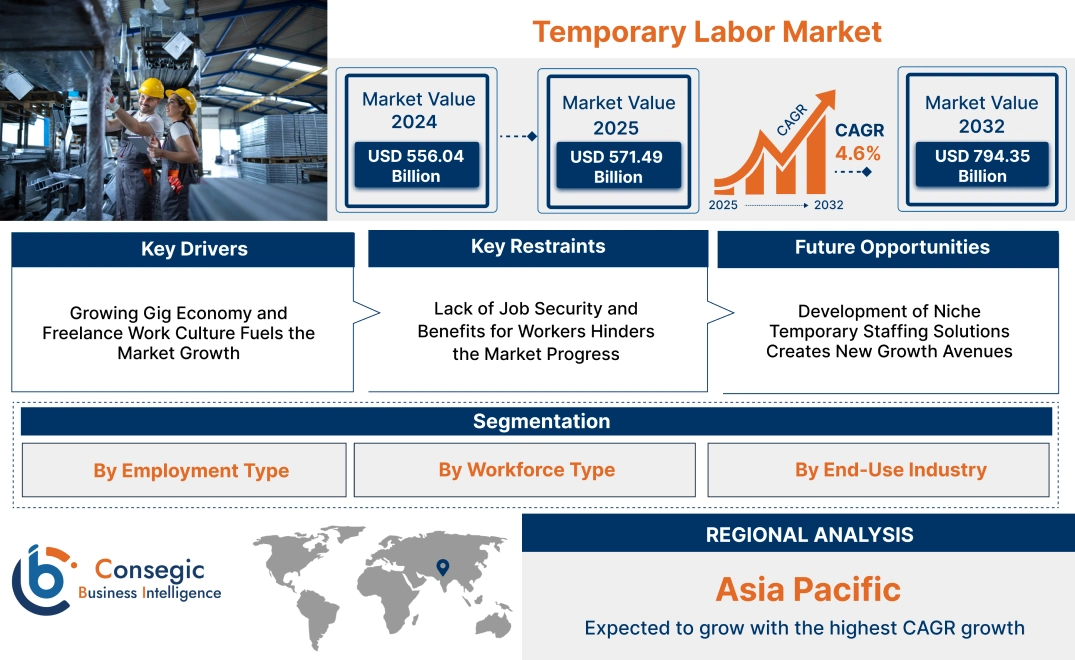
Temporary Labor Market size is estimated to reach over USD 794.35 Billion by 2032 from a value of USD 556.04 Billion in 2024 and is projected to grow by USD 571.49 Billion in 2025, growing at a CAGR of 4.6% from 2025 to 2032.
Temporary Labor Market Scope & Overview:
Temporary labor refers to a workforce employed for short-term assignments, contractual projects, or seasonal work across various industries. These workers are hired on a non-permanent basis to fulfill specific roles, address workforce shortages, or support business operations during peak demand periods. They are widely utilized in sectors such as manufacturing, healthcare, construction, retail, and administrative services.
These employment arrangements are facilitated through staffing agencies, direct contracts, or freelance platforms, providing businesses with workforce flexibility while allowing workers to gain experience in diverse roles. Temporary roles range from entry-level positions to specialized assignments requiring industry-specific skills. Employers benefit from access to a scalable workforce, while workers gain opportunities for short-term employment based on their availability and expertise.
End-users include businesses, government agencies, and organizations requiring adaptable staffing solutions to meet project-based or fluctuating workforce needs. Temporary labor plays a crucial role in supporting industries with dynamic employment requirements.
Temporary Labor Market Dynamics - (DRO) :
Key Drivers:
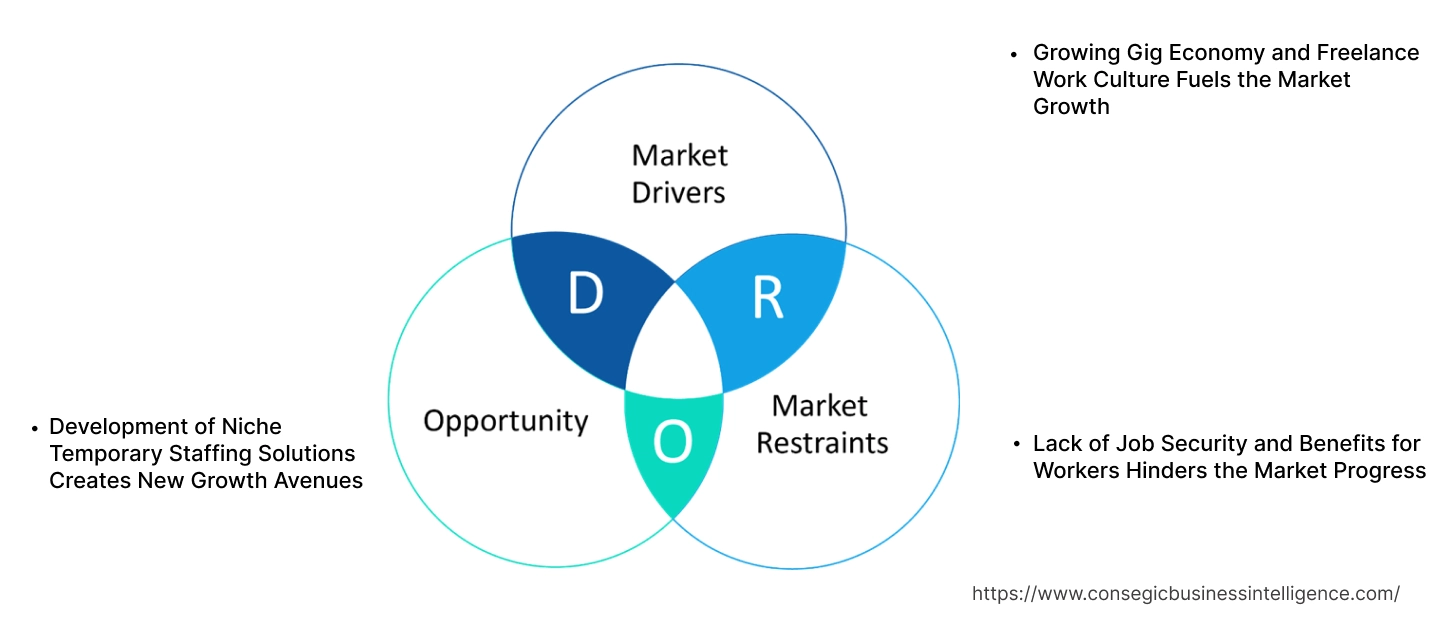
Growing Gig Economy and Freelance Work Culture Fuels the Market Growth
As businesses shift towards more flexible staffing models to accommodate varying workload demands, they increasingly rely on short-term workers for specific projects or seasonal tasks. This trend is particularly evident in industries such as technology, transportation, and retail, where businesses need to quickly scale their workforce based on project timelines, seasonal sales, or peak periods. Temporary labor offers a cost-effective solution for companies to maintain operational efficiency without the long-term commitments associated with permanent hires. The flexibility inherent in gig work allows both workers and employers to adapt to changing business needs, promoting a dynamic and responsive workforce. This shift toward on-demand labor is accelerating temporary labor market growth, as businesses seek more agile and scalable workforce solutions to stay competitive in a fast-evolving business environment.
Key Restraints:
Lack of Job Security and Benefits for Workers Hinders the Market Progress
A significant restraint for this market is the lack of job security, benefits, and long-term career prospects for workers. Temporary positions typically do not offer health insurance, paid time off, or retirement plans, making them less attractive than full-time roles. Workers in industries with high turnover or seasonal requirement, such as hospitality, agriculture, and retail, often face unstable employment, leaving them without a predictable income or career growth opportunities. The absence of these essential benefits and the lack of job security leads to dissatisfaction among workers, causing high turnover rates and difficulty in attracting and retaining skilled labor. This lack of stability also discourages individuals from pursuing temporary roles, especially in markets where full-time, benefits-rich positions are more desirable. Consequently, this restraint limits the temporary labor market demand, especially in sectors where long-term workforce retention is critical.
Future Opportunities :
Development of Niche Temporary Staffing Solutions Creates New Growth Avenues
Industries such as technology, healthcare, and finance require workers with specific technical skills or certifications for short-term assignments, such as IT professionals for system upgrades, healthcare workers for seasonal demands, or financial analysts for project-based work. Companies that offer targeted staffing solutions to meet these specialized needs capitalize on this growing market. By focusing on high-demand skill sets, such as data analytics, cybersecurity, or medical expertise, staffing firms attract qualified workers and provide businesses with flexible, expert solutions. This trend toward niche temporary staffing allows companies to fill critical gaps without the long-term commitment of permanent hires, making it an attractive option for businesses looking to manage fluctuating workloads or specific project requirements. As industries continue to evolve, the need for specialized labor is expected to rise, creating new temporary labor market opportunities for staffing firms.
Temporary Labor Market Segmental Analysis :
By Employment Type:
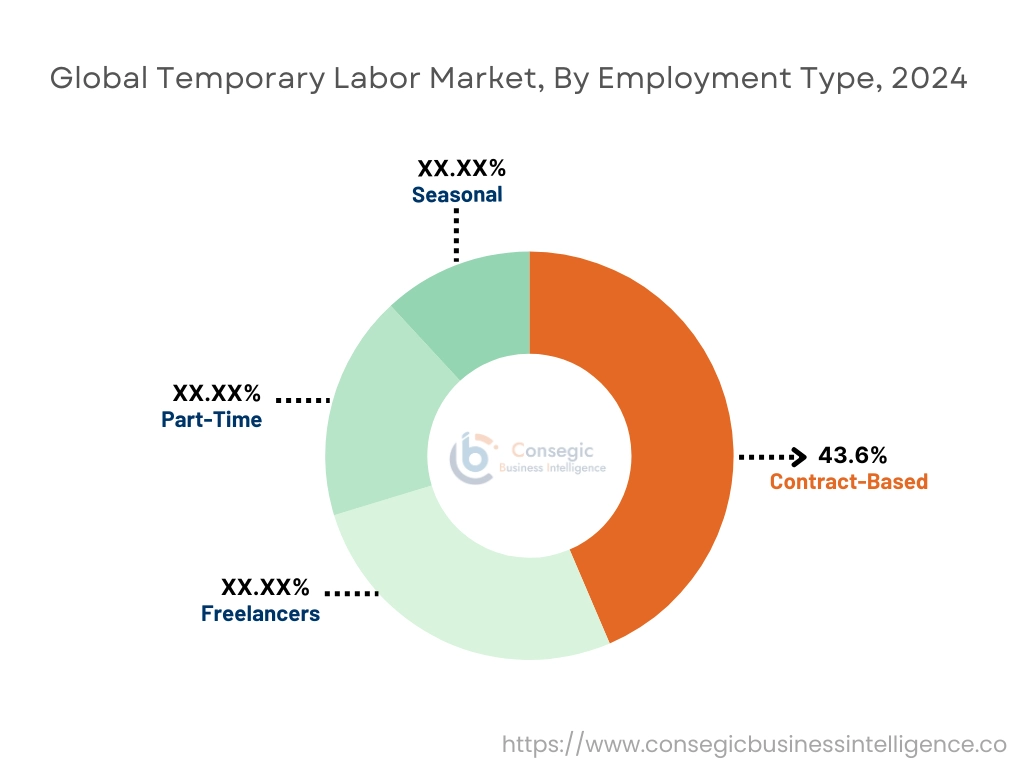
Based on employment type, the market is segmented into contract-based, freelancers, part-time, and seasonal.
The contract-based segment accounted for the largest revenue of 43.6% of the total temporary labor market share in 2024.
- Contract-based workers are widely employed across industries such as healthcare, IT, and construction, offering businesses flexibility in managing workforce needs.
- These roles provide companies with access to specialized talent for specific projects, reducing long-term employment costs.
- The segment benefits from regulatory policies that support independent contracting, making it a preferred option for companies requiring skilled labor on a project basis.
- As per temporary labor market analysis, contract-based employment aligns with trends in workforce optimization, allowing companies to adapt to fluctuating labor needs efficiently.
The freelancers segment is anticipated to grow at the fastest CAGR during the forecast period.
- Freelancers play a crucial role in industries like IT & telecommunications, media, and consulting, where remote work and independent contracting are prevalent.
- Digital platforms and gig economy marketplaces facilitate freelancer-client connections, increasing access to temporary labor opportunities.
- Many businesses prefer freelancers for cost-effective project execution without the need for long-term employment commitments.
- As per temporary labor market trends, the rise of remote work and the expansion of online freelancing platforms are driving significant changes in workforce structuring.
By Workforce Type:
Based on workforce type, the market is segmented into blue-collar and white-collar.
The blue-collar segment accounted for the largest revenue of the total temporary labor market share in 2024.
- Blue-collar temporary labor is extensively used in industries such as manufacturing, construction, and logistics, where short-term or project-based work is common.
- These roles typically involve hands-on tasks, requiring specialized or semi-skilled labor to meet industry-specific operational requirements.
- The segment benefits from companies seeking to manage labor costs efficiently by hiring temporary workers for peak production periods or seasonal projects.
- As per temporary labor market analysis, blue-collar workforce trends indicate an increasing reliance on staffing agencies to source skilled and semi-skilled labor across various industrial sectors.
The white-collar segment is anticipated to grow at the fastest CAGR during the forecast period.
- White-collar temporary labor is prevalent in professional sectors such as IT, finance, and administration, where specialized skills are required for short-term roles.
- Employers leverage white-collar temporary staffing to address workload fluctuations, fill skill gaps, and execute specialized projects.
- Consulting roles and short-term assignments in management, legal, and marketing fields are increasingly filled through temporary contracts.
- The extension of remote work opportunities and contract-based employment has further facilitated the integration of white-collar temporary workers, further contributing to the temporary labor market growth.
By End-Use Industry:
Based on end-use industry, the market is segmented into healthcare, manufacturing, IT & telecommunications, retail, construction, and others.
The manufacturing segment accounted for the largest revenue share in 2024.
- The manufacturing sector heavily relies on temporary labor for assembly lines, machine operation, and material handling during peak production periods.
- Companies hire temporary workers to maintain production efficiency without committing to permanent workforce expansion.
- The segment benefits from staffing agencies that specialize in sourcing skilled workers for short-term manufacturing contracts.
- Thus, the use of temporary labor in manufacturing supports cost-effective workforce management and operational flexibility, driving the temporary labor market expansion.
The IT & telecommunications segment is anticipated to grow at the fastest CAGR during the forecast period.
- Temporary workers in IT & telecommunications are employed for roles such as software development, technical support, and network administration on a project basis.
- The growth in need for cybersecurity experts, data analysts, and cloud computing professionals has fueled the adoption of temporary IT labor.
- Businesses prefer contract-based IT professionals to handle system upgrades, software implementations, and specialized IT projects without permanent hiring commitments.
- As per temporary labor market trends, the shift toward digital transformation and cloud-based infrastructure continues to drive the need for temporary IT professionals.
Regional Analysis:
The regions covered are North America, Europe, Asia Pacific, the Middle East and Africa, and Latin America.
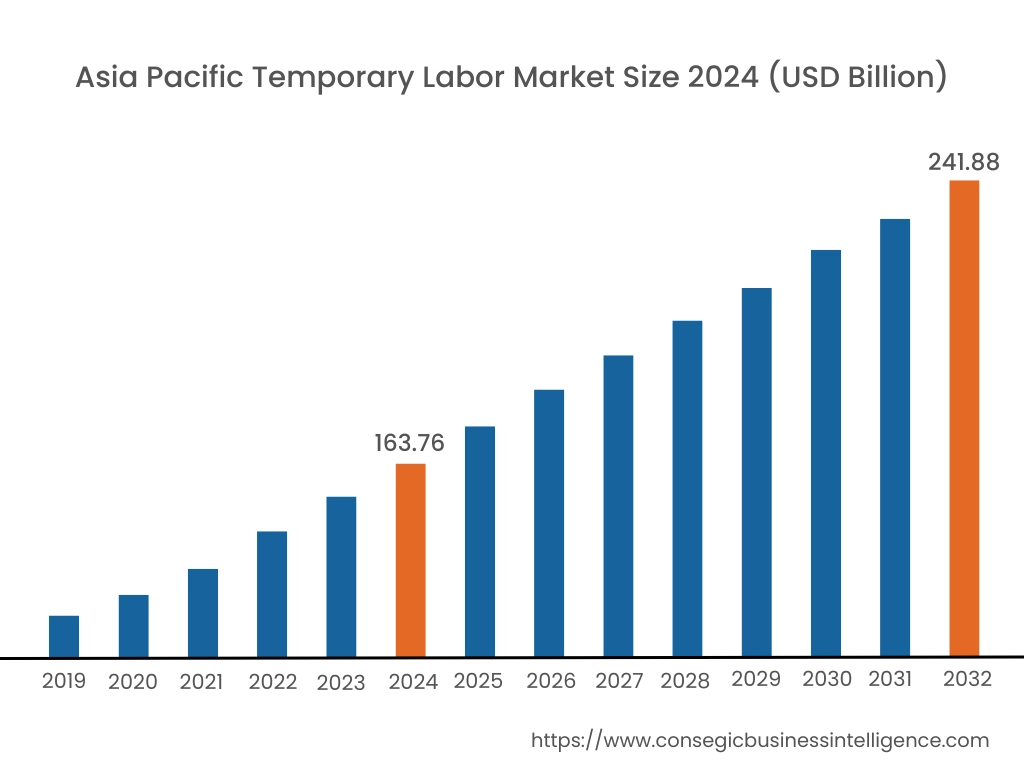
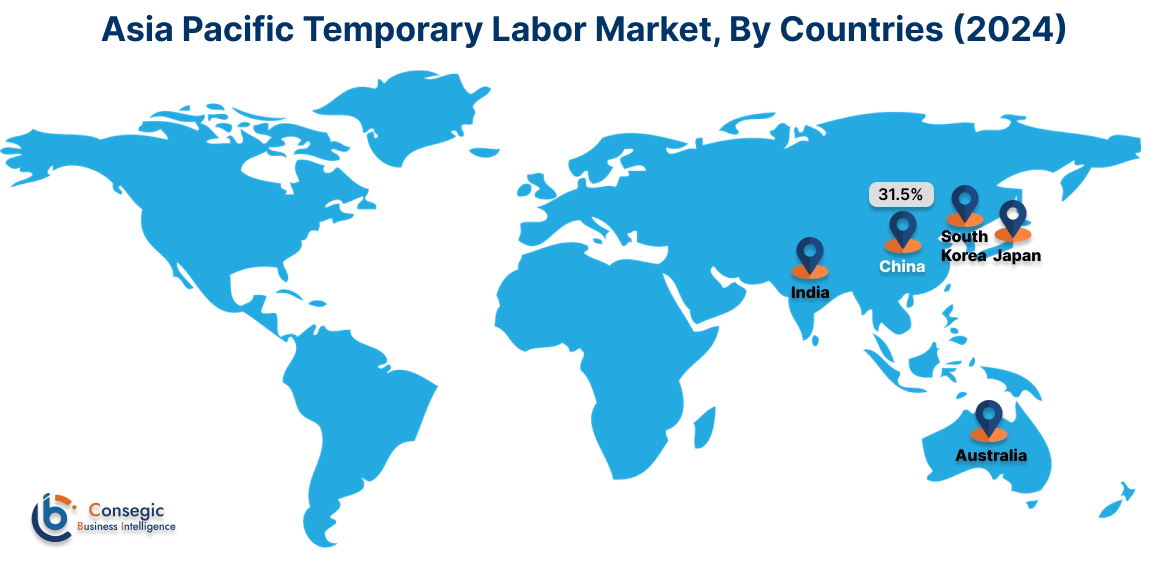
Asia Pacific region was valued at USD 163.76 Billion in 2024. Moreover, it is projected to grow by USD 168.78 Billion in 2025 and reach over USD 241.88 Billion by 2032. Out of this, China accounted for the maximum revenue share of 31.5%. The Asia-Pacific region holds significant share and is experiencing dynamic changes in its temporary labor market. A prominent trend is the rapid industrialization and the corresponding need for a flexible workforce to meet project-based requirements. Analysis indicates that countries in this region are increasingly adopting temporary labor solutions to support sectors such as manufacturing, construction, and information technology, thereby fueling the temporary labor market expansion in this region.
North America is estimated to reach over USD 257.45 Billion by 2032 from a value of USD 184.44 Billion in 2024 and is projected to grow by USD 189.21 Billion in 2025. In this region, the temporary labor sector is adapting to evolving workforce dynamics. A notable trend is the increasing reliance on temporary staffing to manage fluctuating workloads and specialized project requirements. Analysis indicates that businesses are leveraging temporary labor to maintain operational flexibility and cost-effectiveness.
European countries are witnessing a nuanced landscape in the temporary labor market. A significant trend is the emphasis on regulatory compliance and worker protections, shaping the deployment of temporary labor across various sectors. Analysis suggests that while temporary employment offers flexibility, it is balanced by stringent labor laws ensuring fair treatment and job security for temporary workers. This regulatory environment influences the utilization and perception of temporary labor within the region.
In the Middle East and Africa, the temporary labor market is shaped by ongoing infrastructure development and diversification efforts. The focus is on utilizing temporary labor to fulfill short-term project needs, particularly in construction and energy sectors. Analysis suggests that while temporary labor provides the necessary workforce flexibility, there is a growth in emphasis on developing local talent to reduce reliance on foreign temporary workers and promote sustainable employment practices within the region, creating substantial temporary labor market opportunities.
Latin American countries are increasingly recognizing the role of temporary labor in addressing economic fluctuations and sector-specific labor shortages. A notable trend is the integration of temporary workers in industries such as agriculture, manufacturing, and services to manage seasonal peaks and project-based tasks. Analysis indicates that while temporary labor offers adaptability, there is an ongoing dialogue about ensuring adequate labor rights and protections to maintain a balanced and fair labor market, which further boosts the temporary labor market demand.
Top Key Players and Market Share Insights:
The Temporary Labor market is highly competitive with major players providing products and services to the national and international markets. Key players are adopting several strategies in research and development (R&D), product innovation, and end-user launches to hold a strong position in the global Temporary Labor market. Key players in the Temporary Labor industry include -
- Allegis Group (Hanover, Maryland, USA)
- Randstad NV (Diemen, Netherlands)
- Insight Global (Atlanta, Georgia, USA)
- Aerotek (Hanover, Maryland, USA)
- Kforce Inc. (Tampa, Florida, USA)
- Adecco Group (Zürich, Switzerland)
- ManpowerGroup Inc. (Milwaukee, Wisconsin, USA)
- Kelly Services Inc. (Troy, Michigan, USA)
- Robert Half International Inc. (Menlo Park, California, USA)
- Express Employment Professionals (Oklahoma City, Oklahoma, USA)
Temporary Labor Market Report Insights :
| Report Attributes | Report Details |
| Study Timeline | 2019-2032 |
| Market Size in 2032 | USD 794.35 Billion |
| CAGR (2025-2032) | 4.6% |
| By Employment Type |
|
| By Workforce Type |
|
| By End-Use Industry |
|
| By Region |
|
| Key Players |
|
| North America | U.S. Canada Mexico |
| Europe | U.K. Germany France Spain Italy Russia Benelux Rest of Europe |
| APAC | China South Korea Japan India Australia ASEAN Rest of Asia-Pacific |
| Middle East and Africa | GCC Turkey South Africa Rest of MEA |
| LATAM | Brazil Argentina Chile Rest of LATAM |
| Report Coverage |
|
Key Questions Answered in the Report
What is the size of the Temporary Labor Market? −
The Temporary Labor Market size is estimated to reach over USD 794.35 Billion by 2032 from a value of USD 556.04 Billion in 2024 and is projected to grow by USD 571.49 Billion in 2025, growing at a CAGR of 4.6% from 2025 to 2032.
What are the key segments in the Temporary Labor Market? +
The market is segmented by employment type (contract-based, freelancers, part-time, seasonal), workforce type (blue-collar, white-collar), and end-use industry (healthcare, manufacturing, IT & telecommunications, retail, construction, others).
Which segment is expected to grow the fastest in the Temporary Labor Market? +
The freelancers segment is anticipated to grow at the fastest CAGR during the forecast period, driven by the increasing shift towards remote work and the expansion of online freelancing platforms.
Who are the major players in the Temporary Labor Market? +
Key players in the Temporary Labor Market include Allegis Group (USA), Randstad NV (Netherlands), Adecco Group (Switzerland), ManpowerGroup Inc. (USA), Kelly Services Inc. (USA), Robert Half International Inc. (USA), Express Employment Professionals (USA), Insight Global (USA), Aerotek (USA), Kforce Inc. (USA).
Overview
Reputation & Certifications


Our Services
- Market Intelligence & Forecasting
- Custom Research Solutions
- Market Entry Strategy
- Competitive Intelligence
- Customer Insights
- Industry Innovation Analysis
- Investment Advisory