Jump to Content
Test and Measurement Equipment Market - Size, Share, Industry Trends, and Forecasts (2025 - 2035)
Test and Measurement Equipment Market Scope & Overview
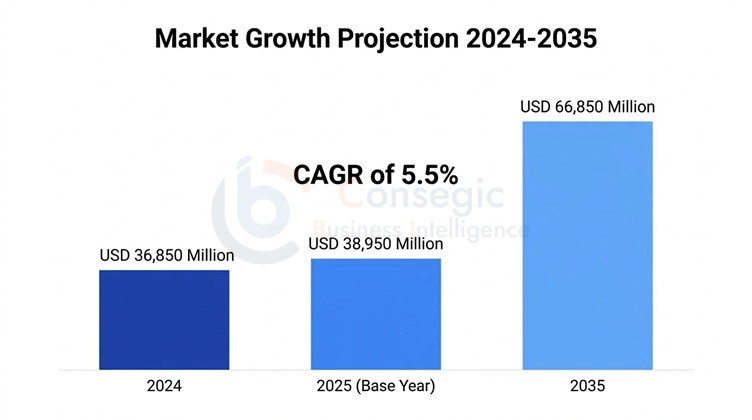
One of the mission-critical segments in the electronics, telecommunications, automotive, aerospace, and industrial manufacturing ecosystems is the global test and measurement equipment market, which is a mission-critical instrumentation that allows engineers, researchers, and quality assurance staff to verify performance specifications, regulatory compliance, system faults, and product quality in ever-increasing complex electronic systems in the DC to millimeter-wave frequencies (≥110 GHz) range. In 2024, the market is seen to have reached USD 36,850 Million and by 2025, the market is projected to have expanded to USD 38,950 Million (base year) and then continue to expand to USD 66,850 Million in 2035. This is a growth trend reflecting a compounded annual growth rate (CAGR) of 5.5 percent over the outlook between 2026 and 2035 as a result of accelerating 5G and new technologies 6G infrastructures, automotive electrification and autonomous driving, proliferating Internet of Things (IoT) devices, growing complexity of semiconductor fabrication at advanced process gates, and high-quality requirements across safety-critical sectors.
Symmetry Test and measurement equipment are classified into a variety of instrumentation categories, including oscilloscopes with bandwidth up to 70+ GHz, spectrum and network analyzers up to millimeter-wave frequencies, signal generator with complex modulation capability, automated test equipment (ATE) of high-volume semiconductor-level production, environmental test chamber, power analyzer of electric vehicle verification, more advanced software-defined platforms enabling remote operation and AI-powered analytics. The installed base was more than 32.5 million units in 2024 and serves up to 9.8 million engineers and technicians in electronics design, telecommunications infrastructure, automotive development, aerospace systems, defence applications and academic research institutions globally.
Key Market Insights
- Asia-Pacific
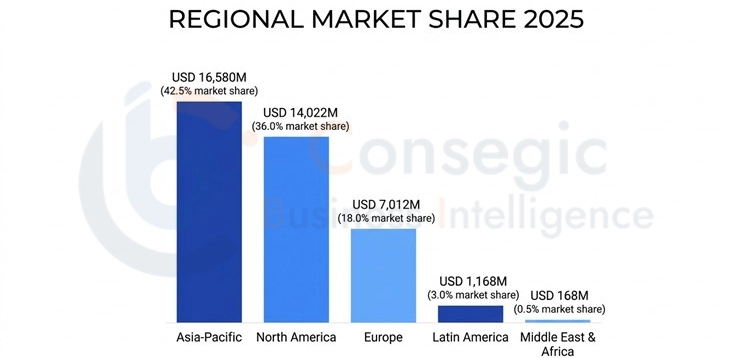
- Valued at USD 16,580 Million in 2025 (42.5% share)
- Projected to reach USD 29,445 Million by 2035 at 5.9% CAGR
- China holds 48.5% of the regional market
- North America
- Valued at USD 14,022 Million in 2025 (36% share)
- Expected to reach USD 24,066 Million by 2035
- United States accounts for 89.5% of regional demand
- Europe
- Market size is USD 7,012 Million in 2025 (18% share)
- Projected to reach USD 12,033 Million by 2035
- Growth driven by automotive, telecom, and aerospace industries
- Latin America
- Market valued at USD 1,168 Million
- Growth supported by expanding telecom infrastructure and industrial development
- Middle East & Africa
- Market valued at USD 168 Million
- Growth driven by increasing telecom infrastructure and industrial expansion
Market Channel Distribution Analysis:
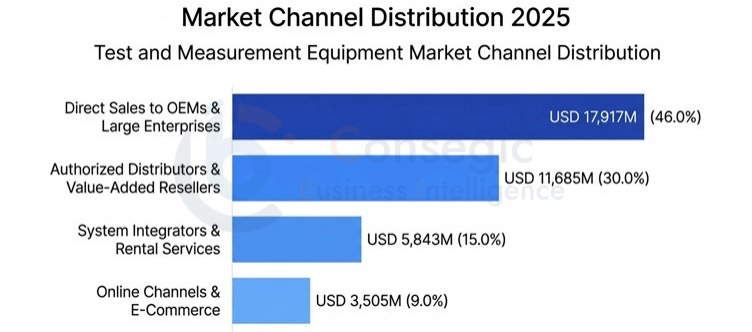
The test and measurement equipment market is also sold and delivered to four separate delivery channels each of which has a particular customer segment with differentiated value propositions and model of technical support. The overall market revenue distribution indicates a large difference based on the customer type, complexity of application and geographical aspects:
- Direct Sales to OEMs and Big Businesses: USD 17,917 Million (46.0% of total market value)
- Authorized Distributors and Value-added Resellers: USD 11,685 Million (30.0% of market revenue)
- System Integrators and Rental Services: USD 5,843 Million (15.0% of the market share)
- Online Channels and E-Commerce: USD 3,505 Million (9.0% of total market value)
In 2024, the global investment in the development of test and measurement technology, software-defined instrumentation platforms and artificial intelligence integration hit USD 4,250 Million, with key equipment manufacturers spending about 10.8% of revenue on the development of next-generation solutions based on real-time signal processing, cloud-based analytics, modular architectures, and interoperability standards to provide integrated test ecosystems. The software-based modular platforms used in place of traditional monolithic instruments are inherently transforming the industry, and software-based platforms are now being extensively adopted in semiconductor manufacturing, 5G telecommunications infrastructure, automotive electronics validation, and aerospace systems testing applications.
Dynamics of Test and Measurement Equipment Market (DRO).
Key Drivers:
5G Infrastructure implementation and 6G Research Projects.
The largest structural force is the tremendous worldwide implementation of 5G telecom infrastructure demanding advanced testing equipment that can confirm millimeter-wave operation, massive MIMO antenna scenarios, beamforming options and ultra-low latency attributes with frequency range to FR2 spectrum allocations up to 71 GHz. Investment in the infrastructure of 5G network reached USD 295,000 Million, in 2024, and network operators installed nearly 4.2 million 5G base stations spread across the world, which have to be tested comprehensively during the installation process, optimisation, and maintenance services.
Compared to earlier generations of wireless technology, the 5G technology presents new levels of complexity in design and construction, including, but not limited to, 256-QAM and beyond modulation schemes, carrier aggregation between multiple frequency bands, dynamic spectrum sharing, network slices, integration of edge computing, making it require new specialized test equipment such as vector network analyzers, spectrum analyzers with bandwidth exceeding 2 GHz in real time, signal generators that support complex modulation formats, and over-the-air (OTA) test systems to validate both MIMO performance in realistic
The early 6G research efforts operating at frequencies in the sub-terahertz of over 100 GHz today have already generated a need to characterize wide-bandwidth communications, combined communication-sensing applications and AI-based network architectures, which is creating significant opportunities to test equipment vendors developing next-generation platforms.
Car revolutionization and the electric revolution.
The overall revolutionization of the automotive industry in the direction of electric vehicles, advanced driver assistance systems (ADAS), and autonomous driving systems has established an impressive level of demand in specialized test equipment to verify the safety of battery management systems, power electronics, high-voltage safety system, radar and lidar sensors, vehicle-to-everything (V2X) communication, and safety-critical electronic control units. Electric vehicle manufacturing in the world reached a high of 16.8 million vehicles in 2024 with an electronic content value of USD 4,200-8,500 in each vehicle based on automation and the complexity of electrification.
Some examples of automotive test requirements include power analyzer validation of inverter efficiency greater than 95, using oscilloscopes to examine switching transient behavior in silicon carbide (SiC) and gallium nitride (GaN) power devices, network analyzer testing of antenna systems in V2X communication, environmental chamber testing to verify operation over temperatures of -40C to +150C, and hardware-in-the-loop (HIL) simulation systems that verify autonomous driving algorithms in a variety of traffic conditions.
Semiconductor Process Nodes and Complexity of Semiconductor Manufacturing.
The future development of semiconductor processes to 3nm, 2nm and emerging 1.4nm nodes plus the complex packaging technologies such as chiplets, 3D stacking, and heterogeneous integration have resulted in the high demand of high-precision test equipment to guarantee the performance, reliability, and yield optimization of devices. In 2024, global semiconductor capital equipment investment was USD 118,000 Million and test equipment comprised of about 13-16% of all semiconductor manufacturing equipment spending.
More modern semiconductor testing is done with automated test equipment (ATE) that can test hundreds of devices parallel, 56+ Gbps serial interface characterization with high bandwidth oscilloscopes, sub-milliamp precision power measurements, and environmental test equipment to verify performance over -550 C down to +150 C temperature and humidity cycles and thermal shock.
Key Restraints:
High Capital Costs and Technology Obsolescence Concerns
Professional test and measurement devices are also significant capital outlays; high-performance instruments, such as real-time oscilloscopes (70+ GHz bandwidth) cost USD 185,000-485,000, vector network analyzers (up to 110+ GHz bandwidth) cost USD 285,000-785,000 and automated test equipment systems in semiconductor factories cost USD 4.5-12.5 million per system including handlers, probers,
These high acquisition costs pose great challenges to the small firms, educational institutions and organizations in the developing markets. Also, accelerating technology development poses obsolescence issues, whereby the latest technologies may become obsolete in 4-7 years when new standards, frequencies, and technology advance and force organizations to continue equipment refresh cycles that become a strain on capital budgets.
Expert Personnel Needs and Multidimensionality of Integration.
The use of modern test and measurement equipment needs high levels of technical expertise, and complicated instruments need knowledge of RF engineering principles, signal processing concepts, measurement uncertainty, and test specific methodology. The industry survey reveals that 68 percent of the organizations complain of problems in identifying qualified personnel with suitable test engineering skills that introduces utilization problems and curtails the returns on equipment investment.
Complexity in integration with current design tools, manufacturing execution systems, and data analytics platforms demand specialized expertise and large implementation efforts, which can lengthen deployment schedules and raise the overall cost of ownership on top of the cost of acquiring equipment.
Future Opportunities:
Software-Defined Instrumentation and Modular Architectures.
The development of software-defined test platforms with modular hardware architectures such as PXI (PCI eXtensions for Instrumentation), AXIe (AdvancedTCA Extensions for Instrumentation) and LXI (LAN eXtensions for Instrumentation) opens up radical possibilities of scalable and reconfigurable test systems that can be updated with software but not with hardware changes. In 2024, the modular instrumentation market is USD 3,450 Million and growing at 14.5% per year, mostly because of semiconductor ATE, aerospace systems testing and automotive production test environment.
Artificial Intelligence (AI) Test Automation and Forecasting.
The combination of test equipment and artificial intelligence, machine learning and cloud-based analytics offers significant possibilities of automated test program generation, intelligent fault diagnosis, predictive maintenance as well as continuous optimization of test coverage and effectiveness. With 94-98% accuracy at the anomaly of measurement data patterns, AI-augmented test systems are able to adjust test parameters to give optimal signal quality, anticipate equipment calibration requirements prior to loss of measurement accuracy, and improve test sequences by 25-40% decreasing overall test time and increasing fault coverage.
Analysis of Market Segmentation.
By Product Type
General Purpose Test Equipment.
The general purpose test equipment will have commanding market leadership of USD 19,475 Million or 50.0% of the total market value in the year 2025 and is projected to increase to USD 33,425 Million at a CAGR of 5.5% in 2035. This market includes nearly oscilloscopes, multimeters, function generators, power supplies, spectrum analyzers, and other versatile measuring devices used in a wide variety of applications in electronics design, manufacturing, maintenance and education.
Digital oscilloscopes are the biggest sub-market with approximated USD 7,790 Million per year and are core devices used in time-domain signal analysis in embedded systems debugging applications, through to power electronics characterization. In recent mixed-signal oscilloscopes (MSOs) combine 4-8 analog channels with 16-64 digital ones, 100 MHz to 110 GHz bandwidth, and may sample rates up to 256 GSa/s in high-frequency applications.
By Application
Telecommunications
The biggest segment in terms of USD is telecommunications applications which will have USD 11,685 Million in 2025 and its share of total market will be 30.0 with a projected growth of USD 20,055 Million in 2035 at 5.5% CAGR. This includes wireless infrastructure, optical network, satellite communication, and new technology such as 5G, Wi-Fi 6E/7, and low-earth-orbit (LEO) satellite constellations testing equipment.
Electronics Manufacturing and Semiconductor.
Electronics manufacturing and semiconductor testing has USD 9,738 Million (25.0%), which is used in PCB assembly testing, semiconductor device testing, semiconductor device characterization, and production test operation with high-throughput automated systems.
Carmobilities and Transportation.
Automotive usage forms USD 7,790 Million (20.0%), which includes powertrain electronics testing, ADAS sensor testing, battery management system testing, EVE charging infrastructure testing and vehicle communication system testing.
Aerospace and Defense
Aerospace and defense applications USD 5,843 Million (15.0%): aerospace and defense applications are used in the avionics testing, radar system characterization, testing of electronic warfare equipment, satellite payload testing, and military communication systems that demand high-reliability and precision instrumentation to a stringent military standard.
Other Applications
The energy systems, industrial automation, medical devices, and research institutions represent USD 3,894 Million (10.0) in aggregate.
Regional Market Analysis
Asia-Pacific
With growth of 5.9% CAGR and USD 29,445 Million at the world level, the Asia-Pacific test and measurement equipment market has a command of USD 16,580 Million in 2025, which is 42.5% of the global market; the growth is projected to be robust to USD 29,445 Million with 5.9% growth in 2035. China has the biggest national market with a share of 48.5 percent of the regional value, next comes Japan with 20.5 percent, South Korea 14.5 percent, Taiwan 9.0 percent and other Asian countries execute the remainder 7.5 percent.
The test equipment market of China is projected to reach USD 8,041 Million by 2025 owing to its huge electronics manufacturing capacity, which produces about 35% of the world electronics, growing 5G infrastructure with over 3.5 million base stations, rising semiconductor industry expenditures of USD 195,000 Million to manufacture self-sufficiency and large automobile electronics manufacturing that supports local and international export markets.
North America
In the year 2025, the market value of the North American test and measurement equipment made USD 14,022 Million; this represents 36.0% of the global market value, and the market is expected to grow to USD 24,066 Million in the year 2035, at the rate of 5.5% CAGR. United States controls the demand of the region with 89.5 percent of market value with United States hosting major equipment manufacturers, leading semiconductor firms, telecommunications infrastructure manufactures, aerospace prime contractors, and automotive OEMs that innovate technology and adopt advanced equipment.
The area boasts the best implementation of the latest test equipment such as real-time oscilloscopes with bandwidth up to and above 50 GHz, millimeter-wave band vector network analyzers, and high-tech automated test systems that are used to produce advanced semiconductors. Each year the North American firms spend USD 195,000 Million in R&D in the electronics, telecommunications, aerospace, and automotive spheres.
Europe
EU test and measurement equipment is projected to be USD 7,012 Million in 2025 which is 18.0 of the total market value and this is expected to increase to USD 12,033 Million by 2035 at 5.5% CAGR. The 68 percent of the regional demand is concentrated in Germany, United Kingdom, France, and Italy which have high levels of automotive manufacturing, telecommunications infrastructure, aerospace industries and precision manufacturing industries which promotes uptake of equipment.
Other Regions
The Latin America is USD 1,168 Million (3.0%), the Middle East and Africa USD 168 Million (0.5%), with both exhibiting growth opportunities due to the growing telecommunications infrastructure, industry development, and technology adoption endeavors.
The Competitive Environment and Major Market participants.
Leadership in the Market and Strategic Positioning.
Key-est Technologies, Inc. (United States).
Keysight is still in strong command of the market with forecasted USD 5,850 Million test and measurement market revenue in 2024, which is 15.0% world market share. The company offers a wide range of instrumentation portfolios in oscilloscopes, spectrum analyzers, network analyzers, signal generators, and automated test systems to wireless communications, aerospace/defense, automotive, semiconductor and general electronics markets via sales and services networks worldwide.
Rohde & Schwarz GmbH KG (Germany).
With a revenue amounting to USD 4,095 Million in 2024, Rohde and Schwarz has about 10.5% market share across the world with special strength in the European and telecommunications markets, focusing on RF and microwave testing equipment, wireless communications testing equipment, broadcasting technologies, and cybersecurity equipment.
Fortive Corporation (Tektronix and Fluke) (United States)
Fortive has a market share of about 11.8 percent worldwide through subsidiaries Tektronix and Fluke with the combined revenue projected to be USD 4,596 Million in 2024. Tektronix is the market leader in oscilloscopes technologies used in the design and manufacturing of electronics, and Fluke is the market leader in handheld industrial test instruments, used in maintenance and troubleshooting.
Other Key Market players:
- Advantest Corporation (Japan) 9.2% market share, semiconductor ATE leadership.
- Anritsu Corporation (Japan) - 7.8% market share, telecommunications testing specialization.
- 24 National Instruments Corporation (Emerson) (United States) - modular instrumentation pioneer with 6.5% market share.
- VIAVI Solutions Inc. (United States) - 4.8% market share, network testing and optical communications.
- Yokogawa Electric Corporation (Japan) - 4.2% market share, precision measurement and industrial applications.
Latest Industry Trends.
Keysight Technologies
In early 2025, Keysight introduced its PathWave X-Series 6G Research Platform, which has signal generation and analysis capabilities up to 500 GHz to support sub-terahertz research in support of next-generation wireless technologies. The platform also has AI-based measurement automation that saves 70 percent of the time to develop tests and allows researchers to consider the spectrum of 140 GHz and higher to build 6G in the future to be implemented in commercial deployment in 2030.
Rohde & Schwarz
Rohde and Schwarz presented test solutions based on 77/79 GHz radar system validation by simulating targets, emulating the environment, and providing hardware-in-the-loop support in realistic traffic conditions. The combined platform speeds up ADAS validation by 45 percent and meets automotive safety standards such as the ISO 26262.
Fortive/Tektronix
Tektronix introduced its MSO80000 Series real-time oscilloscopes with 120 GHz bandwidth, 512 GSa/s sample rate, and 16-bit vertical resolution which supports next-generation high-speed digital interfaces such as PCIe 7.0, USB4 Version 2.0, and 800G Ethernet applications.
Test and Measurement Equipment Market Report Insights
| Report Attributes | Report Details |
|---|---|
| Study Timeline | 2022–2035 |
| Base Year | 2025 |
| Forecast Period | 2026-2035 |
| Market Size in 2025 | USD 38,950 Million |
| Market Size in 2035 | USD 66,850 Million |
| CAGR (2026-2035) | 5.5% |
| By Product Type | General Purpose (Oscilloscopes, Multimeters, Function Generators), Specialized (Network Analyzers, Spectrum Analyzers, ATE, Environmental Test) |
| By Application | Telecommunications, Electronics Manufacturing, Automotive, Aerospace & Defense, Energy, Industrial, Medical Devices, Others |
| By Technology | Analog & RF Test Equipment, Digital Test Equipment, Mixed-Signal Test Equipment |
| By End-User | OEMs, Service Providers, Research & Academic Institutions, Government & Defense |
| By Region | Asia-Pacific, Europe, North America, Latin America, Middle East & Africa |
| Key Players | Keysight Technologies, Rohde & Schwarz, Fortive (Tektronix/Fluke), Advantest, Anritsu, National Instruments (Emerson), VIAVI Solutions, Yokogawa Electric |
Key Questions Answered in the Report
How big is the Test and Measurement Equipment market? −
The test and measurement equipment market is very robust and has growth potential with projected growth of USD 38,950 Million in 2025 and USD 66,850 Million in 2035 with sustained growth due to 5G/6G infrastructure, automotive electrification, development of autonomous driving, semiconductor manufacturing complexity, proliferation of IoT devices and high quality expectation across telecommunication, aerospace, automotive, and electronics manufacturing industries.
What is the fastest-expanding market in the Test and Measurement Equipment market? +
Asia-Pacific is not only the largest regional market, but the fastest-growing with a 5.9% CAGR which is fuelled by mammoth-sized electronics manufacturing capacity, 5G telecommunications infrastructure, growing semiconductor industry inventions, and the automotive electronics production growth, and growing domestic R&D in China, Japan, South Korea, Taiwan and emerging Southeast Asian technology centres.
Which specific segmentation information is discussed in the Test and Measurement Equipment report? +
The report gives an in-depth segmentation of by Product Type (General Purpose including Oscilloscopes, Multimeters, Function Generators; Specialized including Network Analyzers, Spectrum Analyzers, ATE, Environmental Test), Application (Telecommunications, Electronics Manufacturing, Automotive, Aerospace and Defense, Energy), Technology (Analog and RF, Digital, Mixed-Signal), End-User (OEMs, Service Providers, Research Institutions), and Regional markets with a sub segment analysis and technology adoption rate.
What are the key competitors in Test and Measurement Equipment? +
The competitive environment is dominated by Keysight technologies, Inc. (15.0% market share), Fortive corporation in the form of Tektronix and Fluke (11.8% market share), Rohde and Schwarz GmbH and Co. KG (10.5% market share), Advantest corporation (9.2% market share), Anritsu Corporation (7.8% market share), National Instruments Corporation/Emerson (6.5% market share) and many specialized suppliers of specific applications, frequency ranges and vertical markets with differentiated technology profiles.
Overview
Reputation & Certifications


Our Services
- Market Intelligence & Forecasting
- Custom Research Solutions
- Market Entry Strategy
- Competitive Intelligence
- Customer Insights
- Industry Innovation Analysis
- Investment Advisory