Jump to Content
Timber Cutting Machine Market - Size, Share, Industry Trends, and Forecasts (2025-2032)
Timber Cutting Machine Market Size:
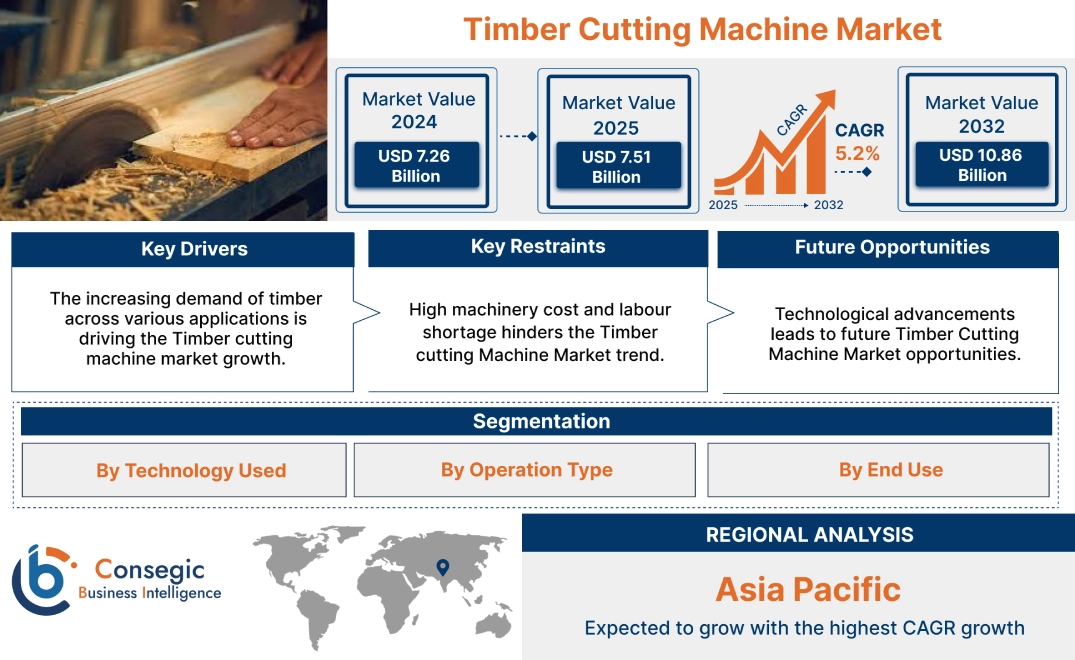
Timber Cutting Machine Market size is estimated to reach over USD 10.86 Billion by 2032 from a value of USD 7.26 Billion in 2024 and is projected to grow by USD 7.51 Billion in 2025, growing at a CAGR of 5.2% from 2025 to 2032.
Timber Cutting Machine Market Scope & Overview:
Timber cutting machines are specialized equipment used to cut and process wood, including logs and timber, into finished products like lumber, planks, and panels. Many wood cutting tools are available in the market which easily cut the wood and save time. These various types include band saws, circular saws, table saws, miter saws, CNC routers, and chainsaws, each designed for specific tasks and wood types. The cutting process is quick and uncomplicated as long as the right wood-cutting tool is used for the task. While some of the tools work with charged battery or direct electricity, some require man power. CNC timber cutting is a great invention in the industrial sector. Its benefits includes increased production rate, enhanced efficiency, high efficiency, accuracy and precision, cost saving, and low human involvement requirement. They are used by industries involved in forestry, logging, construction, furniture manufacturing, and pulp and paper production.
Timber Cutting Machine Market Dynamics - (DRO):
Key Drivers:
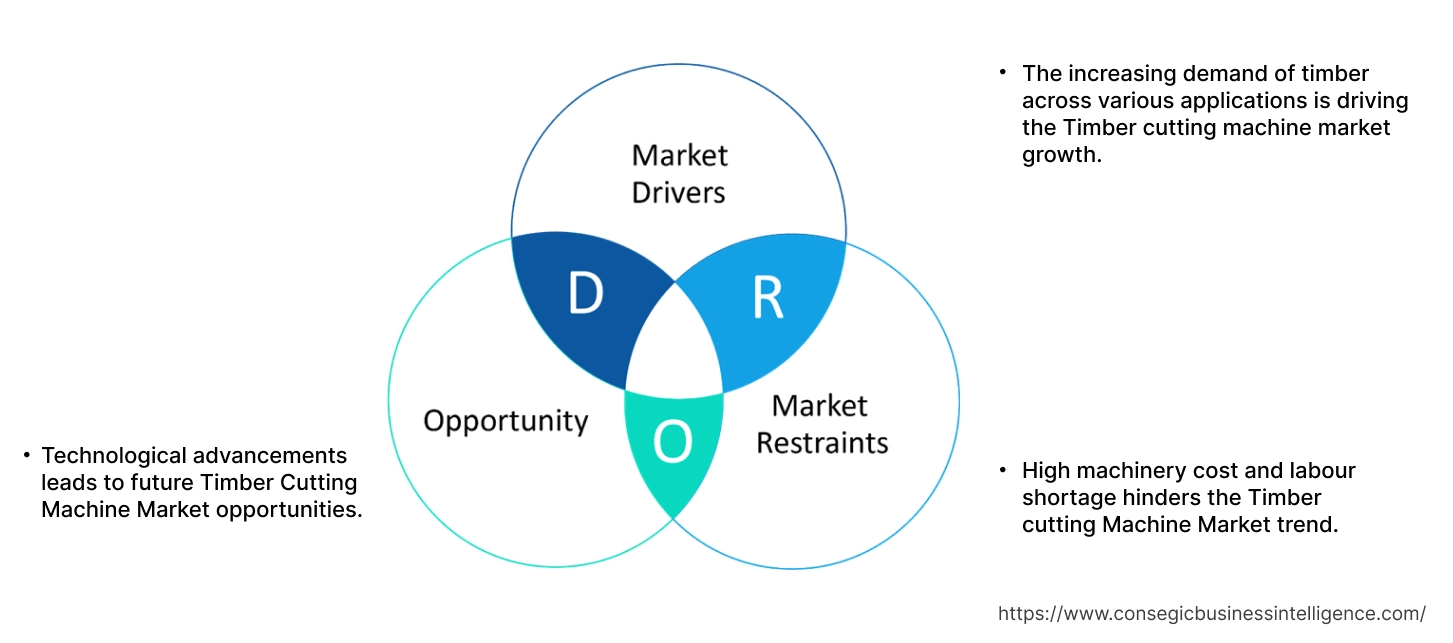
The increasing demand of timber across various applications is driving the Timber cutting machine market growth.
Increased timber demand directly fuels the timber cutting machine market as it necessitates more efficient and technologically advanced equipment to meet the rising production and processing needs across various industries. The construction, furniture, paper, and packaging industries are major consumers of timber, and their growth drives up the requirement for these cutting machines. As cities expand and infrastructure projects increase, the need for timber for building materials and other applications surges, boosting the appeal for these machines. The growing popularity of wooden furniture and other timber-based products further contributes to the demand for efficient machines. The market is also driven by the adoption of more efficient and automated timber cutting technologies, like automated sawmills and laser-guided cutting, which increase productivity and contribute to market expansion.
- For instance, in July 2024, Tyvok announced the launch of the latest innovation in laser engraving and cutting: the Tyvok Spider S1. Featuring the second-generation Artist Precision Module, the Spider S1 excels in high-precision laser cutting, wood cutting, and intricate relief engraving tasks. This module allows for seamless transitions between relief and precision wood drilling, making it perfect for handling thicker materials and producing more commercialized products.
Thus, the increasing utilization of timber in applications such as construction, furniture, paper, and packaging industries are driving the timber cutting machine market demand.
Key Restraints:
High machinery cost and labour shortage hinders the Timber cutting Machine Market trend.
The high cost of timber cutting machinery stems from factors like precision, speed, and the need for robust engineering to handle large volumes of timber. Machines designed for industrial applications and those offering high precision and speed are priced higher. Machines designed for high precision and fast cutting speeds are priced higher, as they offer greater efficiency in industrial applications. Cutting machines, especially those used in sawmills and industrial settings, need to be built to withstand the rigors of processing large volumes of timber. This requires heavy duty components and robust construction, which adds to the cost.
Labor shortages in operating and maintaining these machines pose challenges, especially for skilled operators and technicians. While automation is increasing, the need for skilled labor to operate and maintain these machines may be a challenge. Fewer skilled workers could lead to reduced production capacity and potentially higher costs.
Therefore, the high cost of these cutting machines and the lack of availability of skilled workers restrains the Timber Cutting Machine Market expansion.
Future Opportunities:
Technological advancements leads to future Timber Cutting Machine Market opportunities.
Technological advancements in wood cutters include the integration of CNC (Computer Numerical Control) technology for precision and automation, laser cutting for intricate details, and the use of robotics and automation for efficiency and smart manufacturing. CNC machines are transforming woodworking by automating complex cutting, shaping, and drilling processes. They allow for precise and detailed designs, enabling the creation of high-quality pieces. Integration of CNC technology with Industry 4.0 (the fourth industrial revolution) includes the Internet of Things (IoT), analytics, and automation, leading to smart manufacturing.
Laser cutting technology provides unmatched precision and quality in cutting and engraving tasks. Lasers are used with different types of wood, including hardwood, softwood, and plywood. The laser cutting process involves a powerful and precise laser that emits a high-power beam with pinpoint accuracy, focusing on a small material area.
- For instance, in January 2024, Hilti North America,launched new cordless tools on the 22V Nuron battery platform. The SC 6WP-22 Plunge saw, launched in spring 2024, is designed for more precise cutting in wood, fiber board, drywall and solid surfaces, including straight and bevel cuts, and intricate cut-outs. Another product, the SM 60-22 Miter saw, launched in fall of 2024, is a compound 12” miter saw designed for precision cutting in wood, PVC, and aluminum.
Therefore, the technological advancements in timber cutting increases the Timber Cutting Machine Market opportunities.
Timber Cutting Machine Market Segmental Analysis :
By Technology Used:
Based on technology used, the market is segmented into laser cutting machines, milling cutting machines, saw cutting machines, and waterjet cutting machines.
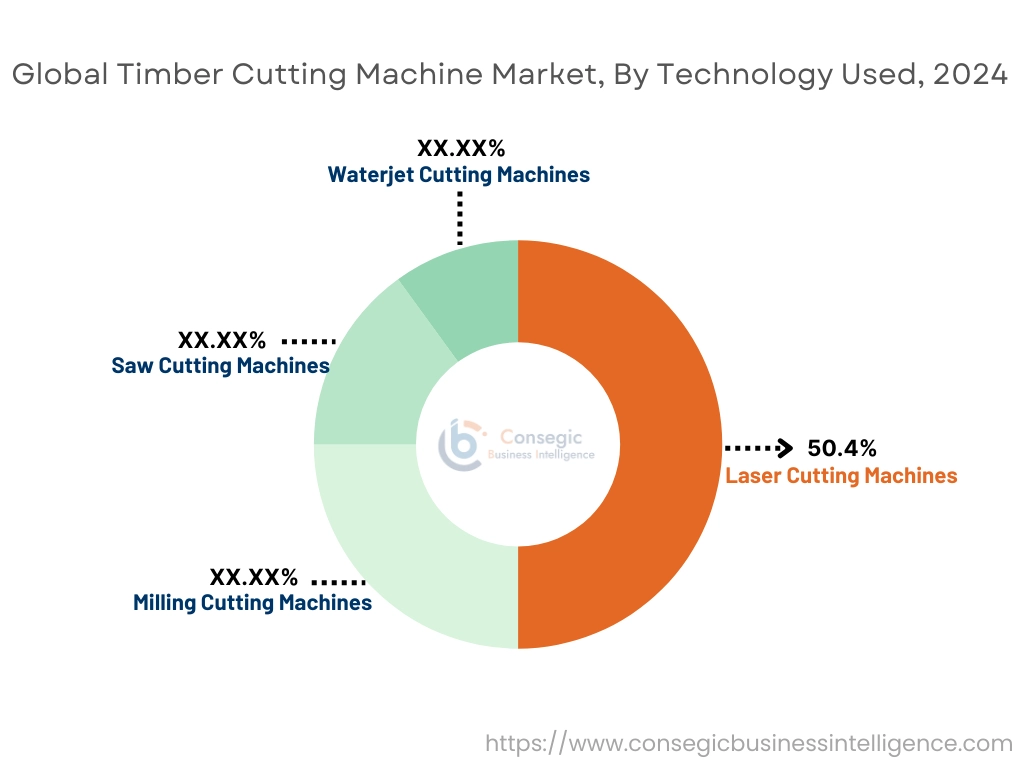
Laser Cutting machines accounted for the largest revenue in the Timber Cutting Machine Market share by 50.40% in 2024 and is anticipated to have the fastest CAGR during the forecast period.
- Laser cutting machines are gaining rapid traction due to their high-precision capabilities, minimal material wastage, and clean edge finishes.
- These systems are increasingly adopted in high-end furniture manufacturing and decorative woodwork where accuracy and intricate patterns are essential.
- Advancements in CO₂ and fiber laser technology are enabling improved penetration in thick wooden panels, expanding their application scope.
- As per market trends, the integration of CNC automation and software-controlled systems in laser machines is enhancing efficiency and flexibility in timber processing.
- The shift towards smart manufacturing and digital fabrication workflows in the woodworking sector is fueling the adoption of laser-based cutting technologies.
- Thus, the segmental analysis shows that the trend of laser cutting machine has developed tremendously and is expected to grow rapidly in the market.
By Operation Type:
Based on operation type, the market is segmented into manual, semi-automatic, and automatic.
The manual segment accounted for the largest revenue in the Timber cutting machine market in 2024.
- Manual timber cutters are devices that use manual or foot-operated levers and mechanisms to cut wood, often employing principles of inertia and leverage for efficient sawing.
- These machines are designed to cut wood, including logs and wood for furniture, by utilizing a lever-based system where the vertical movement of a connecting rod is achieved manually, either by hand or foot pedal.
- They are known for being cost effective and improving productivity compared to traditional wood cutting methods.
- Manual wood cutting machines primarily include power saws, chain saws, and routers.
- These machines are used for various woodworking tasks, including cutting down trees and logs, cutting frames in wood, and cutting wood for furniture.
- For instance, in May 2023,Festool introduced its new plunge-cut saw with scoring function. With a 60 mm cutting depth, it produces splinter-free sawing on both sides, right from the very first cut. The new plunge-cut saw with scoring function is robust and sophisticated and handles both precise cutting in solid wood and efficient panel cutting with aplomb – and all this whilst splinter-free on both sides.
- Thus, the wide use of manual segment for timber cutting accounts for its large revenue in the market.
The automatic segment is anticipated to register the fastest CAGR during the forecast period.
- Automatic wood cutters, also known as automated wood sawing machines, are designed to efficiently and precisely cut wood planks, timber, and lumber to desired sizes.
- They often use computer-controlled systems and automated feeding mechanisms to cut wood. Many models utilize computer-controlled systems, allowing for pre-programmed cutting plans and easy adjustments.
- These machines automate the cutting process, reducing manual labor and increasing production efficiency. They are designed for high-precision cutting, ensuring accurate dimensions and minimal waste.
- These machines are designed for high-volume production and require maximum efficiency and consistency, typically featuring advanced automation features and sophisticated control systems.
- Thus, the surge in the trend of automatic segment is expected to grow in the coming years reducing human labour and driving timber cutting machine market demand.
By End Use:
Based on end-use, the market is segmented into furniture manufacturing, building and construction, forestry and logging, and others.
The building and construction segment accounted for the largest revenue share in the Timber Cutting Machine Market and is expected to register the fastest CAGR during the forecast period.
- Wood cutters, like circular saws and band saws, are essential tools in building and construction, used for efficiently and accurately cutting timber into various shapes and sizes for framing, cladding, and other structural elements.
- They are used to cut timber into lumber, planks, beams, and other structural components for various construction projects, ensuring efficient and precise cutting of wood for building and carpentry.
- Machines cut timber much faster than manual methods, increasing productivity. They ensure precise cuts, reducing waste and errors.
- Different types of machines cater to various cutting needs, from simple straight cuts to complex shapes. They also reduce the risk of accidents associated with manual sawing.
- Thus, building and construction holds large revenue share leading to growing trend in the market.
Regional Analysis:
The regions covered are North America, Europe, Asia Pacific, the Middle East and Africa, and Latin America.
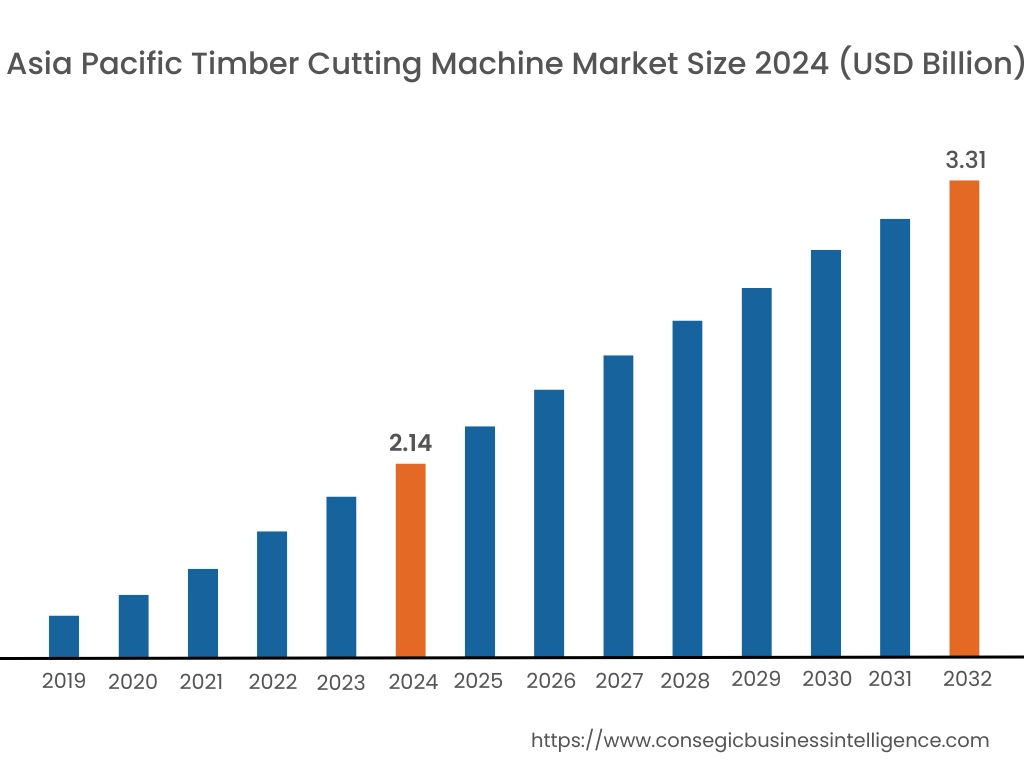
Asia Pacific region was valued at USD 2.14 Billion in 2024. Moreover, it is projected to grow by USD 2.22 Billion in 2025 and reach over USD 3.31 Billion by 2032. Out of this, China accounted for the maximum revenue share of 42.0%.
In Asia, wood cutting, or logging, plays a vital role in various aspects of life, from firewood production for cooking and heating to the construction of homes and furniture, and even the creation of tools and other essentials. There's a growing trend of these machines adoption in Asia, driven by factors like increasing product launches, technological advancements, and the rising appeal for precision engineering in the woodworking field. Timber cutting machines, ranging from basic hand saws to sophisticated industrial saws, are used for various purposes, including cutting logs for construction, furniture, and other wood products, with a focus on efficiency and precision. They are crucial for industries like construction, furniture manufacturing, and pulp/paper production, with advancements in automation and sustainable materials. In China, wood cutters, like saws and other woodworking tools, are used to process raw wood logs into various shapes and sizes for applications ranging from furniture and construction materials to pallets and other wood products.
- For instance, in July 2023, HOMAG India introduced SAWTEQ O-100, to address the growing industry-level challenge. The newest model of the HOMAG panel dividing saws is equipped with everything needed for cutting single panels & small batches. A clear material flow around the saw & material handling working at the saw further increases the capacity. SAWTEQ O-100 is suitable for all woodworking factories with all types of furniture production, giving excellent cutting quality, improving productivity and reducing manpower.
Thus, the timber cutting machine market analysis highlights the growing need of timber cutting in the woodworking sector leading to a rise in the trend of timber cutting.

North America is estimated to reach over USD 3.52 Billion by 2032 from a value of USD 2.41 Billion in 2024 and is projected to grow by USD 2.48 Billion in 2025.
North America holds a significant share in the global timber cutting machine market. Wood cutters, like sawmills and other woodworking machinery, are used to process logs into lumber, furniture, and other wood products. Increased investments in forestry are fueling the need for efficient and precise timber cutting technologies. The expanding forest product sector in North America necessitates larger timber extractions, creating opportunities for equipment manufacturers. These cutters are used across various industries, including construction, furniture manufacturing, and pulp & paper production, to efficiently process timber and produce lumber and other wood products. In construction, cutting machines are crucial for producing lumber and other wood products used in building construction, such as framing, roofing, and siding. These machines are used to cut wood into precise shapes and sizes for various furniture components, from table legs to cabinet doors.
Therefore, the timber cutting machine market analysis highlights the dominance of North American region in the wood cutting market to process timber and produce lumber for an array of applications such as construction, forestry and manufacturing.
The European market is a significant part of the global woodworking machinery sector, with Europe having a significant share in the global market and experiencing steady growth, driven by construction activities, sustainable building materials, and automation technology. Europe is one of the leading region for wood cutting machine manufacturers, with established companies in countries like Italy, Germany, and the UK. Increased construction activities contribute to the demand for timber and thus, timber cutting machines. These machines, including harvesters and feller bunchers, play a crucial role in modern forestry operations, enabling efficient and large-scale timber harvesting. The use of timber cutters in Europe helps to increase efficiency, reduce labor costs, and optimize timber processing, while also minimizing wood waste.
Thus, the market analysis shows the growth of wood cutting and wood working in European countries leading to surge in timber cutting machine market trend.
The market in the Middle East and Africa is experiencing growth, driven by construction and infrastructure projects, with investments in advanced machinery and a focus on sustainable building materials. The Middle East is seeing a growing trend towards timber construction, with the UAE and Saudi Arabia leading the way, as they shift from traditional concrete and steel construction to more sustainable, timber-based alternatives. These cutters are primarily used to support the construction and infrastructure industries, with growing need for timber due to urbanization and development projects, and also for furniture manufacturing. The rapid urbanization and infrastructural development in the region drive the demand for timber, leading to increased usage of timber cutting machines for processing wood used in building materials and construction projects. The woodworking sector, including furniture manufacturing, also relies heavily on timber cutting machines to produce engineered wooden furniture for residential and commercial use.
Therefore, the market analysis shows the emergence of timber cutting in Middle East and African region.
There's a growing requirement of timber cutting machine adoption in Latin America, driven by factors like the expanding forestry and construction industries, and the need for more efficient timber processing. The timber cutting machine market in Latin America is projected to experience steady growth, with the region adopting modern machinery to improve efficiency in timber processing. These cutting machines, ranging from sawmills to specialized equipment, are used to process wood into usable formats for various industries, including construction, furniture manufacturing, and pulp/paper production, with a focus on efficient and optimized cutting.
Thus, the market analysis highlights the requirement of wood cutting machines in the developing countries of Latin America.
Top Key Players & Market Share Insights:
The Timber Cutting Machine market is highly competitive with major players providing products and services to the national and international markets. Key players are adopting several strategies in research and development (R&D), product innovation, and end-user launches to hold a strong position in the global Timber Cutting Machine market. Key players in the Timber Cutting Machine industry include -
- Wood-Mizer (US)
- Gelgoog company (China)
- WEINIG (Germany)
- Weho machinery (China)
- Nihar Industries (India)
- Grizzly industrial (US)
- Timber Automation (US)
- Salvador (Italy)
- SCM (Italy)
- HOMAG (Germany)
Recent Industry Developments :
Mergers & Acquisitions:
- In December 2024, Burton Mill Solutions announced its acquisition of Menominee Saw & Supply, based in Menominee, Michigan. Menominee specializes in supporting wood processors in the Northern Great Lakes region and across the Midwest by supplying and reconditioning a variety of industrial cutting tools, including machine knives, small- and large-diameter circle saws, and wide and narrow band saws. This acquisition significantly expanded Burton's geographic footprint and enhanced its technical capabilities, enabling it to provide better service to primary wood producers.
Timber Cutting Machine Market Report Insights:
| Report Attributes | Report Details |
| Study Timeline | 2019-2032 |
| Market Size in 2032 | USD 10.86 Billion |
| CAGR (2025-2032) | 5.2% |
| By Technology Used |
|
| By Operation Type |
|
| By End Use |
|
| By Region |
|
| Key Players |
|
| North America | U.S. Canada Mexico |
| Europe | U.K. Germany France Spain Italy Russia Benelux Rest of Europe |
| APAC | China South Korea Japan India Australia ASEAN Rest of Asia-Pacific |
| Middle East and Africa | GCC Turkey South Africa Rest of MEA |
| LATAM | Brazil Argentina Chile Rest of LATAM |
| Report Coverage |
|
Key Questions Answered in the Report
What are Timber Cutting Machines? −
Timber cutting machines are specialized equipment used to cut and process wood into finished products such as lumber and planks. The cutting process is simple and easy to perform with the correct cutting tool. They provide increased production rate, enhanced efficiency, accuracy and precision.
What are the major drivers of timber cutting machine market growth? +
The increasing demand of timber for various applications is driving the timber cutting machine market growth. The rising demand of timber across the construction, furniture, and packaging industries require more technologically advanced cutting machines, driving their growth. Expansion of cities and increase in the infrastructure projects also fuels the market growth.
What are the major segments covered in the timber cutting machine market report? How is the dominating segment impacting the market growth? +
The timber cutting machine market is segmented on the basis of technology used, operation type and end-use. Among these, the subsegment Saw Cutting machines accounted for the largest revenue in the market due to their precision and efficiency in processing logs into different shapes and sizes. They have evolved and became high-performance, and safe and are used in numerous applications.
Who are the major key players in the Timber cutting machine market? +
Wood-Mizer (US), Gelgoog company (China), Grizzly industrial (US), Timber Automation (US), Salvador (Italy), SCM (Italy), HOMAG (Germany), WEINIG (Germany), Weho machinery (China), Nihar Industries (India).
Overview
Reputation & Certifications


Our Services
- Market Intelligence & Forecasting
- Custom Research Solutions
- Market Entry Strategy
- Competitive Intelligence
- Customer Insights
- Industry Innovation Analysis
- Investment Advisory