Jump to Content
Ultrafiltration Market - Size, Share, Industry Trends, and Forecasts (2026-2034)
Ultrafiltration Market Size:
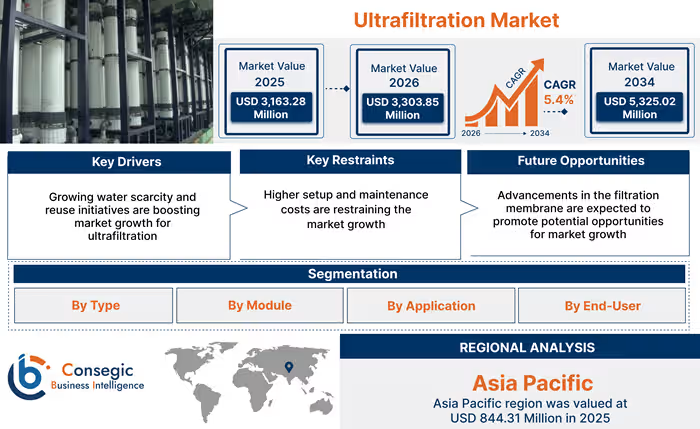
Ultrafiltration Market size is estimated to reach over USD 5,325.02 Million by 2034 from a value of USD 3,163.28 Million in 2025 and is projected to grow by USD 3,303.85 Million in 2026, growing at a CAGR of 5.4% from 2026 to 2034
Ultrafiltration Market Scope & Overview:
The ultrafiltration (UF) is a purification process that uses a semi-permeable membrane to separate microscopic impurities from liquid, such as solids, colloids, and high molecular weight substances. Also, the filtration hole sizes range from 0.01 to 0.1 microns, which makes it an essential pretreatment step for reverse osmosis systems. The ability to eliminate bacteria, viruses, and other microscopic contaminants is driving the ultrafiltration market growth. Additionally, the advanced filtration system does not require frequent backwashing and maintenance, which in turn helps in improving operational efficiency and cost-effectiveness. Further, the rigid standards for industrial discharge and drinking water purity are driving the ultrafiltration market demand.
Ultrafiltration Market Dynamics - (DRO) :
Key Drivers:
Growing water scarcity and reuse initiatives are boosting market growth for ultrafiltration
The depleting freshwater resources and rapid urbanization are forcing municipalities and heavy industries to implement smart water management systems. The advanced filtration technology plays a crucial role in sustainable initiatives due to its ability to efficiently filter out suspended solids, bacteria, viruses, and colloidal particles, which is boosting the ultrafiltration market demand. Further, various industries are incorporating advanced wastewater recycling plants that integrate ultrafiltration technology for redirected filtered water for industrial processes and agricultural irrigation.
- For instance, according to the World Health Organization, over 2 billion people lived in water-scarce countries in 2021. Also, in 2022, 1.7 billion people utilized contaminated drinking water sources, which possess higher risk.
Therefore, the depleting freshwater resources and the adoption of advanced wastewater recycling plants are driving the ultrafiltration market growth.
Key Restraints:
Higher setup and maintenance costs are restraining the market growth
The filtration system requires automated monitoring systems, pressure vessels, high-pressure pumps, and pretreatment modules, which adds up to the initial setup cost, hindering the ultrafiltration market expansion. Also, the high setup and maintenance costs hinder the market adoption by small and medium-sized enterprises. Additionally, the filtration membranes are prone to clogging by organic, inorganic, or microbial matter, which in turn requires frequent chemical cleaning, intensive labor, and periodic membrane replacements, driving the overall cost of the system.
Therefore, the high costs of maintenance and installation of the system are restraining the ultrafiltration market expansion.
Future Opportunities :
Advancements in the filtration membrane are expected to promote potential opportunities for market growth
The rising demand for lowering lifecycle and energy costs while improving anti-fouling capabilities is driving the advancement of membrane technology, which in turn is creating ultrafiltration market opportunities. The advancement is driving membrane applications in municipal water treatment, pharmaceutical, and food and beverage industries. Further, the increasing need for high-purity separations, eco-friendly water reuse, and reliable microbial barriers is boosting advancement in membrane technology.
- For instance, in November 2025, PPG launched an antifouling membrane for water purification and treatment in industrial ultrafiltration applications. The membrane offers sustainable filtration solutions by enabling safe and economical disposal or reuse of waste. Also, the membrane features a super-hydrophobic surface, which resists fouling of membranes from oil, grease, and other substances.
Hence, the increasing need for purity, water reuse, and reliable microbial barriers is anticipated to increase the utilization of advanced membranes, in turn promoting prospects for ultrafiltration market opportunities during the forecast period.
Ultrafiltration Market Segmental Analysis :
By Type:
Based on the type, the ultrafiltration market is bifurcated into polymeric and ceramic.
Trends in the Type:
- The pharmaceuticals, biotechnology, and dairy processing industries are increasingly adopting ceramic membranes, which in turn is fueling the ultrafiltration market trends.
- The shifting toward hydrophilic PVDF and integrating block polymers into fabrication formulas to create uniform pores and naturally repel organic matter is fueling the polymeric ultrafiltration market trends.
The polymeric accounted for the largest revenue share in the year 2025.
- The polymeric system is a pressure-driven separation process utilizing synthetic polymer membranes with pores ranging from 0.01 to 0.1 μ m to filter out bacteria, viruses, and colloids while allowing dissolved minerals to pass.
- Also, advantages of polymeric systems, including high filtration efficiency, no chemical additives needed, mineral retention, ease of operation, and energy & cost efficiency, are boosting the polymeric ultrafiltration market share.
- Further, the increasing global awareness regarding water purification and the need to produce ultrapure municipal water is driving the polymeric ultrafiltration market size.
- Furthermore, the polymeric filtration systems are significantly cheaper to manufacture and install, making them highly scalable for mass-volume deployments, which is boosting the market adoption.
- Thus, as per the ultrafiltration market analysis, the increasing global awareness and cost-effective solutions are driving the market progress.
The ceramic is anticipated to register the fastest CAGR during the forecast period.
- The ceramic membranes are advanced, inorganic filtration systems engineered to separate suspended solids, pathogens, and oils from liquids.
- Also, the membrane offers exceptional durability, thermal stability, handles harsh chemicals, and has a longer lifespan, among others.
- Further, the rising need for water reclamation, zero-liquid-discharge implementation, and stringent water safety regulations is driving the ceramic ultrafiltration market size.
- Furthermore, the global government norms against industrial wastewater contamination are forcing industries to adopt highly efficient filtration systems, which is driving the ceramic ultrafiltration market share.
- Therefore, as per the market analysis, the government norms and rising need for water reclamation, zero-liquid-discharge implementation are anticipated to boost the market during the forecast period.
By Module:
Based on the module, the market is segmented into hollow fiber, plate and frame, and tubular.
Trends in the Module:
- The rapid shift toward single-use/disposable hollow fiber modules to reduce cross-contamination is boosting the market trend.
- The shift toward composite membranes, hydrophilic coatings, and fouling-resistant designs is increasing the adoption of plate and frame modules, which in turn is fueling the market trends.
The hollow fiber accounted for the largest revenue share in the year 2025.
- A hollow fiber module is a highly efficient, pressure-driven filtration unit. It has thousands of microscopic, tube-like, semi-permeable membranes in a single cylindrical housing to physically remove suspended solids, bacteria, viruses, and large colloids from liquids.
- The primary advantages offered by the hollow fiber module include high surface area, exceptional pathogen and colloid removal, and low energy consumption.
- Further, the rapid expansion of biologics, vaccines, and monoclonal antibody production drives demand for hollow fiber modules.
- Furthermore, the high surface-area-to-volume ratio enables easy backwashing and air scouring, which helps to mitigate fouling, boosting the hollow fiber module adoption.
- Thus, as per the ultrafiltration market analysis, the aforementioned factors are driving the market progress.
The tubular is anticipated to register the fastest CAGR during the forecast period.
- The tubular module is a rugged, cylindrical filtration system where membranes are cast inside porous tubes. The module is designed to handle highly viscous, solid-heavy, and abrasive liquids.
- Additionally, the tubular modules are used in membrane bioreactors for tertiary effluent polishing and helping industries achieve zero-liquid-discharge mandates.
- Further, the zero-liquid-discharge norms and aggressive pollution control policies across emerging economies are forcing industries to propel the need for tubular modules.
- Furthermore, the rising water scarcity and rapid urbanization require municipalities and industries to recycle wastewater, which is boosting the market progress.
- Therefore, as per the market analysis, the rising water scarcity and rapid urbanization are anticipated to boost the market during the forecast period.
By Application:
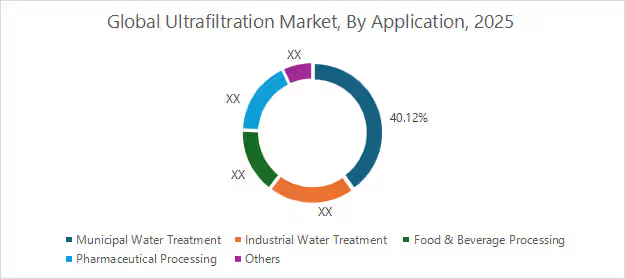
Based on the application, the market is segmented into municipal water treatment, industrial water treatment, food & beverage processing, pharmaceutical processing, and others.
Trends in the Application:
- The trend towards the integration of digital sensors, automation, and IoT-enabled platforms into industrial water treatment systems is driving the market progress.
- The food & beverage processing application is shifting toward advanced modules to bypass highly thermal, energy-intensive processes, such as evaporation, which is fueling the market progress.
The municipal water treatment accounted for the largest revenue share of 40.12% in the year 2025.
- The filtration system is mainly used in municipalities during various stages of water purification, such as primary drinking water production, pretreatment for RO systems, wastewater reuse & tertiary treatment.
- The key advantages of a filtration system in municipal water treatment applications include consistent quality, energy efficiency, reduced chemical dependency, and compact footprint, among others.
- Further, the municipal water treatment is increasingly relying on technology to efficiently produce safe drinking water and enable sustainable wastewater recycling.
- Furthermore, the municipal water treatment is increasingly being integrated with UF due to evolving public health and environmental mandates.
- Thus, as per the market analysis, the aforementioned factors are driving the market progress.
The pharmaceutical processing is anticipated to register the fastest CAGR during the forecast period.
- The filtration system is a critical component used in the pharmaceutical processing applications to purify therapeutic proteins, vaccines, and enzymes by removing cell debris, concentrating biological macromolecules, and eliminating toxic endotoxins, among others.
- Additionally, the key advantages driving the market adoption in pharmaceutical processing applications include easy validation, minimal chemical use, preservation of biomolecules, energy & cost efficiency, among others.
- Further, the pharma sector is transitioning from batch processing to continuous processing, which in turn is fueling the market adoption in pharmaceutical processing applications.
- Furthermore, the global regulatory bodies are enforcing highly rigorous requirements for product purity, sterility, and the absence of contaminants, which is driving the market demand for pharmaceutical processing applications.
- Therefore, the transition from batch processing to continuous processing and stringent regulations is anticipated to boost the market during the forecast period.
By End-User:
Based on the end-user, the market is segmented into industrial, municipal, and commercial.
Trends in the End-User:
- The manufacturers of filtration systems are developing advanced modules that allow for higher throughput with fewer modules for driving applications in industrial sectors.
- The proliferation of circular water economy initiatives and the need for wastewater recycling are propelling municipalities to invest in advanced filtration systems.
The municipal accounted for the largest revenue share in the year 2025.
- The municipalities rely on ultrafiltration industry to supply clean water and treat wastewater on a massive scale.
- Also, the increasing demands for safe, high-quality drinking water and stricter environmental regulations are propelling the market adoption by municipalities.
- Further, the growing urbanization and water scarcity are propelling municipalities to drive initiatives related to water reuse and recycling, which in turn is fueling the market.
- Municipalities are increasingly utilizing hollow-fiber and polymeric membranes for public drinking water treatment, desalination pretreatment, and wastewater reuse to deliver water without bacteria, viruses, and suspended solids.
- Thus, as per the market analysis, the growing urbanization and water scarcity are driving the market progress.
The industrial is anticipated to register the fastest CAGR during the forecast period.
- The industrial sectors rely on filtration membranes for high-efficiency water purification and wastewater reuse.
- Also, the industries are leveraging the filtration system to produce highly purified water for product formulation, equipment cleaning, and to remove bacteria from sensitive bioprocess streams.
- Further, the government mandates for environmental protection and zero liquid discharge are forcing industries to adopt the advanced filtration system.
- Furthermore, the global reduction of freshwater resources is pushing large manufacturing facilities to adopt onsite water recycling, which in turn is fueling the market progress.
- Therefore, as per the market analysis, the reduction of freshwater resources and government mandates for environmental protection are anticipated to boost the market during the forecast period.
Regional Analysis:
The regions covered are North America, Europe, Asia Pacific, Middle East and Africa, and Latin America.
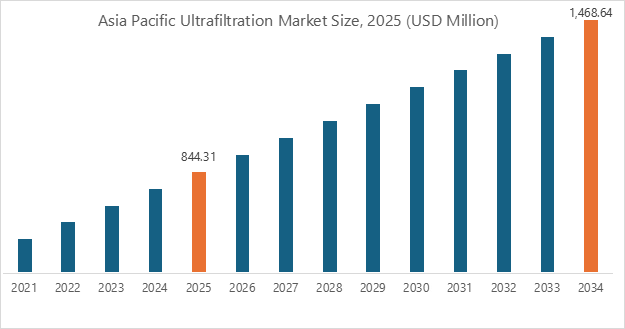
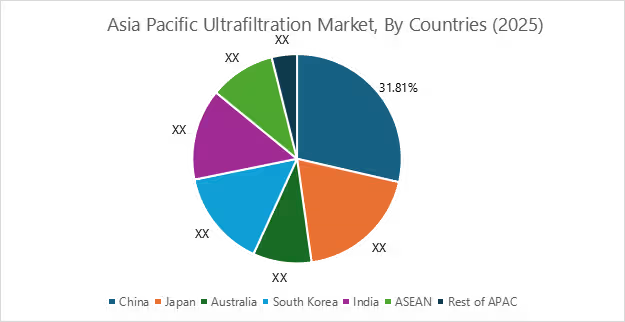
Asia Pacific region was valued at USD 844.31 Million in 2025. Moreover, it is projected to grow by USD 885.10 Million in 2026 and reach over USD 1,468.64 Million by 2034. Out of this, China accounted for the maximum revenue share of 31.81%. The market progress is mainly driven by freshwater scarcity and stringent environmental regulations. Furthermore, factors including the expanding pharmaceutical & biopharma sector are projected to drive the market growth in Asia Pacific region during the forecast period.
- For instance, in April 2026, Ion Exchange (India) Ltd collaborated with MANN+HUMMEL for the production of advanced PVDF UF membranes integrated with UltraSKID systems. Also, the collaboration aims to support both domestic and international demand.
North America is estimated to reach over USD 1,733.83 Million by 2034 from a value of USD 1,021.25 Million in 2025 and is projected to grow by USD 1,067.64 Million in 2026. The North American region's rapid development of the biopharmaceutical industry and the urgent need for sustainable water management offer lucrative growth prospects for the market. Additionally, the growing awareness of water quality and aging local infrastructure is driving the market progress.
- For instance, in March 2023, DuPont launched PES in-out ultrafiltration membranes for driving applications in desalination, municipal drinking water, and industrial water.
The regional analysis depicts that the stricter EU directives on municipal and industrial wastewater management are driving the market in Europe. Additionally, the key factor driving the market is the government investments in municipal desalination and wastewater recycling as well as limited natural freshwater supplies is propelling the market adoption in the Middle East and African region. Further, the need to upgrade aging municipal water infrastructure and rapid industrialization is paving the way for the progress of the market in Latin America region.
Top Key Players & Market Share Insights:
The global ultrafiltration market is highly competitive with major players providing solution to the national and international markets. Key players are adopting several strategies in research and development (R&D), product innovation, and end user launches to hold a strong position in the ultrafiltration industry. Key players in the ultrafiltration market include-
- Pentair plc(USA)
- DuPont(USA)
- 3M (USA)
- Pall Corporation (USA)
- SUEZ Water Technologies & Solutions (France)
- Koch Membrane Systems (USA)
- Hydranautics (USA)
- Alfa Laval AB (Sweden)
- Toray Industries, Inc. (Japan)
- Asahi Kasei Corporation (Japan)
Ultrafiltration Market Ecosystem:
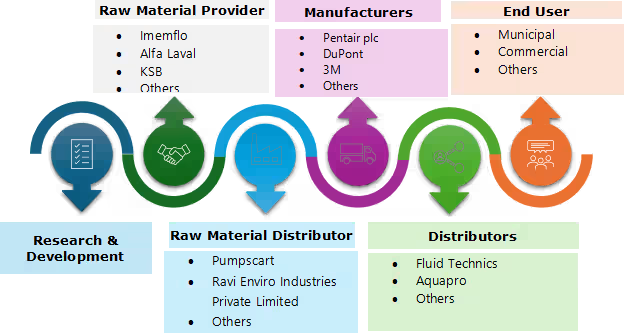
Recent Industry Developments:
Product launches
- In April 2026, Cerafiltec launched a new brand and website for the sale of ceramic UF solutions. The launch aims to increase digital presence across the globe.
Partnerships & Collaborations
- In June 2026, Acuriant Technologies, Inc collaborated with PureGen Classic for the development of a semiconductor wastewater reclamation project in Malaysia. The project utilizes advanced ceramic UF technology to reuse wastewater generated from semiconductor manufacturing.
Ultrafiltration Market Report Insights:
| Report Attributes | Report Details |
| Study Timeline | 2021-2034 |
| Market Size in 2034 (USD Million) | USD 5,325.02 Million |
| CAGR (2026-2034) | 5.4% |
| By Type |
|
| By Module |
|
| By Application |
|
| By End-User |
|
| By Region |
|
| Key Players |
|
| Report Coverage |
|
Key Questions Answered in the Report
How big is the ultrafiltration market? −
Theultrafiltration market size is estimated to reach over USD 5,325.02 Million by 2034 from a value of USD 3,163.28 Million in 2025 and is projected to grow by USD 3,303.85 Million in 2026, growing at a CAGR of 5.4% from 2026 to 2034.
Which segmentation details are covered in the ultrafiltration report? +
The ultrafiltration report includes specific segmentation details for type, module, application, end-user, and regions.
Which is the fastest segment anticipated to impact the market growth? +
In the ultrafiltration market, the industrial end-user is the fastest-growing segment during the forecast period due to the reduction of freshwater resources and government mandates for environmental protection.
Who are the major players in the ultrafiltration market? +
The key participants in the ultrafiltration marketare Pentair plc (USA), DuPont (USA), 3M (USA), Pall Corporation (USA), SUEZ Water Technologies & Solutions (France), Koch Membrane Systems (USA), Hydranautics (USA), Alfa Laval AB (Sweden), Toray Industries, Inc. (Japan), Asahi Kasei Corporation (Japan) and others.
What are the key trends in the ultrafiltration market? +
The ultrafiltration marketis being shaped by several key trends including proliferation of circular water economy initiatives and the need for wastewater recycling and the integration of digital sensors, automation, and IoT-enabled platforms into industrial water treatment systems are the key trends driving the market.
Overview
Reputation & Certifications


Our Services
- Market Intelligence & Forecasting
- Custom Research Solutions
- Market Entry Strategy
- Competitive Intelligence
- Customer Insights
- Industry Innovation Analysis
- Investment Advisory