Jump to Content
Ursolic Acid Market - Size, Share, Industry Trends, and Forecasts (2025-2032)
Ursolic Acid Market Size:
Ursolic Acid Market size is growing with a CAGR of 6.4% during the forecast period (2025-2032), and the market is projected to be valued at USD 208.34 Million by 2032 from USD 127.50 Million in 2024. Additionally, the market value for the 2025 attributes to USD 135.18 Million.
Ursolic Acid Market Scope & Overview:
Ursolic acid (UA) is a naturally occurring pentacyclic triterpenoid compound. It is found in various plants such as herbs like rosemary, basil, and thyme, as well as fruits like apples, cranberries, and grapes. It has received significant attention for its diverse range of biological activities. It demonstrates promising properties as an anti-inflammatory, antioxidant, anticancer, and cardioprotective agent. The purity of this acid varies, ranging from below 50% to over 90%, influencing its potency and suitability for different applications. The primary end-use sectors include personal care and cosmetics, where it is used for its anti-aging and skin-soothing effects. In food and beverage, it has potential as a functional ingredient. In nutraceuticals, it is used in dietary supplements for its health benefits. In pharmaceuticals, it is used for its therapeutic potential in various diseases. Ongoing research continues to explore and validate its wide-ranging applications.
How is AI Transforming the Ursolic Acid Market?
The integration of AI is considerably transforming the ursolic acid market. AI-powered systems are being used for streamlining R&D for new applications and drug discovery, optimizing extraction and purification processes through automation, enhancing product formulation and quality assurance in supplements, and providing personalized consumer health insights. AI-powered automation streamlines manufacturing by standardizing processes, improving consistency, and optimizing extraction efficiency. Further, the use of AI-powered automated systems in production lines enhances quality control, in turn ensuring consistent batch quality and reducing human error. Consequently, the above factors are anticipated to drive the market growth in upcoming years.

Ursolic Acid Market Dynamics - (DRO) :
Key Drivers:
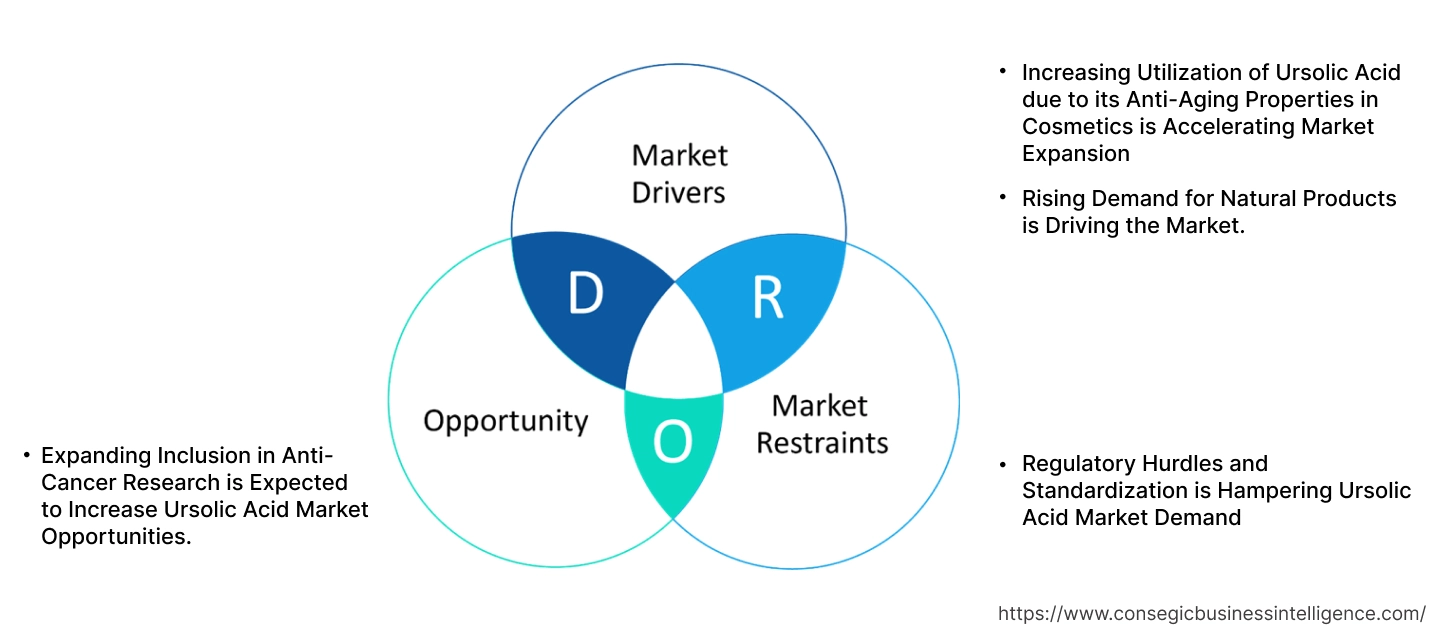
Increasing Utilization of Ursolic Acid due to its Anti-Aging Properties in Cosmetics is Accelerating Market Expansion
Ursolic acid has the ability to stimulate collagen production, provide potent antioxidant and anti-inflammatory effects, and enhance skin barrier function. It has become a lucrative ingredient for formulations targeting wrinkles, elasticity, and overall skin rejuvenation. Additionally, the need for innovative formulations in cosmetics is driving its manufacturers to incorporate UA into a diverse range of products.
For instance,
- In 2022, Malin+Goetz introduced a new sunscreen into its diverse range of products. The ingredients used in this sunscreen formulation are ursolic acid, vitamin E, and antioxidants amongst others to defend against different types of skin tones from UV rays.
Thus, due to the aforementioned factors, the increasing cosmetic manufacturing is accelerating the ursolic acid market expansion.
Rising Demand for Natural Products is Driving the Market.
There is increasing consumer awareness of the drawbacks associated with synthetic ingredients, leading to a growing preference for natural products. Additionally, consumers are inclined towards plant-based alternatives due to the perception of them being more natural, healthier, and often associated with fewer side effects compared to animal-derived options. UA is a naturally occurring compound with demonstrated health benefits, creating its high utilization in industries such as pharmaceuticals and nutraceuticals amongst others. Consumers seeking natural products is driving the need for UA in different industries.
For instance,
- In 2024, according to New Hope Network's Nutrition Business Journal, the annual sale of organic and natural products increased by 5.7% from 2023 to 2024 across the globe.
Thus, the rising focus on natural ingredients is accelerating the global ursolic acid market growth.
Key Restraints:
Regulatory Hurdles and Standardization is Hampering Ursolic Acid Market Demand
The lack of balanced global regulations and robust standardization presents significant hurdles. The absence of universally accepted quality standards and testing methodologies across different regions creates inconsistencies in product quality and hinders seamless international trade. Varying regulatory frameworks for dietary supplements and pharmaceuticals in different countries lead to complex and time-consuming approval processes for ursolic acid-based products. This lack of harmonization increases compliance costs for manufacturers seeking global market access. Furthermore, concerns regarding the purity, source, and potential adulteration of UA extracts erode consumer trust and impede the market. Hence, the regulatory hurdles and standardization are hampering the ursolic acid market demand.
Future Opportunities :
Expanding Inclusion in Anti-Cancer Research is Expected to Increase Ursolic Acid Market Opportunities.
The utilization of ursolic acid in oncology lies in the growing emphasis on inclusive anti-cancer research. The participation of diverse populations in preclinical and clinical studies has helped to gain a more comprehensive understanding of UA's efficacy and safety across various demographic and genetic backgrounds, potentially revealing targeted benefits for specific patient subgroups. This approach not only addresses health disparities but also expands the pool of potential patients and drives personalized medicine strategies amongst others creating the potential for the market adoption of UA-based anticancer therapies.
For instance,
- In 2024, according to a study published by Spandidos Publications, a combination of ursolic acid and sorafenib has led to the restrain in cell growths of cancer by inducing SLC7A11-dependent ferroptosis or apoptosis.
Thus, the inclusion of UA in anti-cancer research is expected to increase ursolic acid market opportunities.
Ursolic Acid Market Segmental Analysis :
By Purity:
Based on purity, the market is categorized into upto 50%, 51% to 90%, and above 90%.
Trends in Purity:
- There is a growing shift towards the usage of higher purity (especially 90% and above) in the market. This is driven by the increasing need for potent ingredients in pharmaceutical and nutraceutical applications where efficacy and minimal impurities are crucial.
- The 90% purity grade also shows growth. It balances between efficacy and cost. This makes it a preferred choice for various cosmetic formulations aiming for significant anti-aging benefits.
The 51% to 90% segment accounted for the largest market share in 2024.
- 51% to 90% purity segment dominated the ursolic acid market trends. This purity grade is generally more affordable than highly purified forms. It provides properties, such as antioxidants, and antimicrobial.
- This purity is used in products such as anti-aging creams, serums, lotions, and sunscreens. It is also used in the food and beverage industry.
- There is increasing consumer awareness of personal appearance and grooming, leading to personal care and cosmetic sector growth.
- For instance, according to Happi, U.S. skincare product sales have increased by 10% in the last five years. This requires ursolic acid of moderate concentration, utilized for its antioxidant properties in a diverse range of products, thus driving the segment.
- Overall, as per the market analysis, the increased personal care and cosmetics manufacturing is driving a segment in ursolic acid market growth.
The above 90% segment is expected to grow at the fastest CAGR over the forecast period.
- The above 90% is an emerging segment in the market trends. This purity signifies a highly concentrated form.
- It is crucial in pharmaceuticals for the development of therapeutic agents due to its significant anti-inflammatory, and potential anti-cancer properties.
- This grade is also preferred for dietary supplements and functional foods aimed at delivering maximum health benefits, such as anti-aging, immune support, and metabolic health improvement.
- The aging population, increasing prevalence of chronic diseases, and a rising focus on preventative healthcare have led to the increase in both industries, driving the need for ursolic acid in medications and supplements.
- According to market analysis, the growing pharmaceutical and nutraceutical sector will drive segment in the ursolic acid market expansion.
By Source:
Based on source, the market is categorized into herbs, fruits, and others.
Trends in Source:
- Herbs such as rosemary and sage remain dominant due to their high UA content and established extraction processes.
- There's a rising utilization of apple pomace (a byproduct of juice production) as a sustainable and cost-effective source of UA.
The herbs segment accounted for the largest market share in 2024 and is expected to grow at the fastest CAGR over the forecast period.
- The herbs segment dominated and is expected to growth at the fastest rate in the ursolic acid market. Rosemary, holy basil, thyme, oregano, and sage amongst other herbs are used to extract UA.
- Herbs naturally contain significantly higher concentrations of UA compared to many fruits. This makes extraction more efficient and cost-effective.
- Additionally, herbs are cultivated widely and are readily available in large quantities, ensuring a consistent supply for extraction purposes.
- Herb-derived UA in the nutraceutical industry as it provides anti-inflammatory properties. A shift towards preventive healthcare has led to increased demand for dietary supplements.
- For instance, according to Vitaquest, the global dietary supplements market is expected to grow at a CAGR of 6.7% between 2022 and 2032. This will require UA for anti-inflammatory properties.
- According to ursolic acid market analysis, the growing nutraceuticals sector will drive the segment in the upcoming years.
By End Use:
Based on end-use, the market is categorized into personal care & cosmetics, food & beverage, nutraceuticals, pharmaceuticals, and others.
Trends in the End-Use
- Consumer preference for clean beauty is driving demand for ursolic acid as a plant-derived active ingredient in natural and organic cosmetic
- Its benefits in muscle growth, recovery, and fat loss are driving its inclusion in pre-workout, post-workout, and weight management supplements.
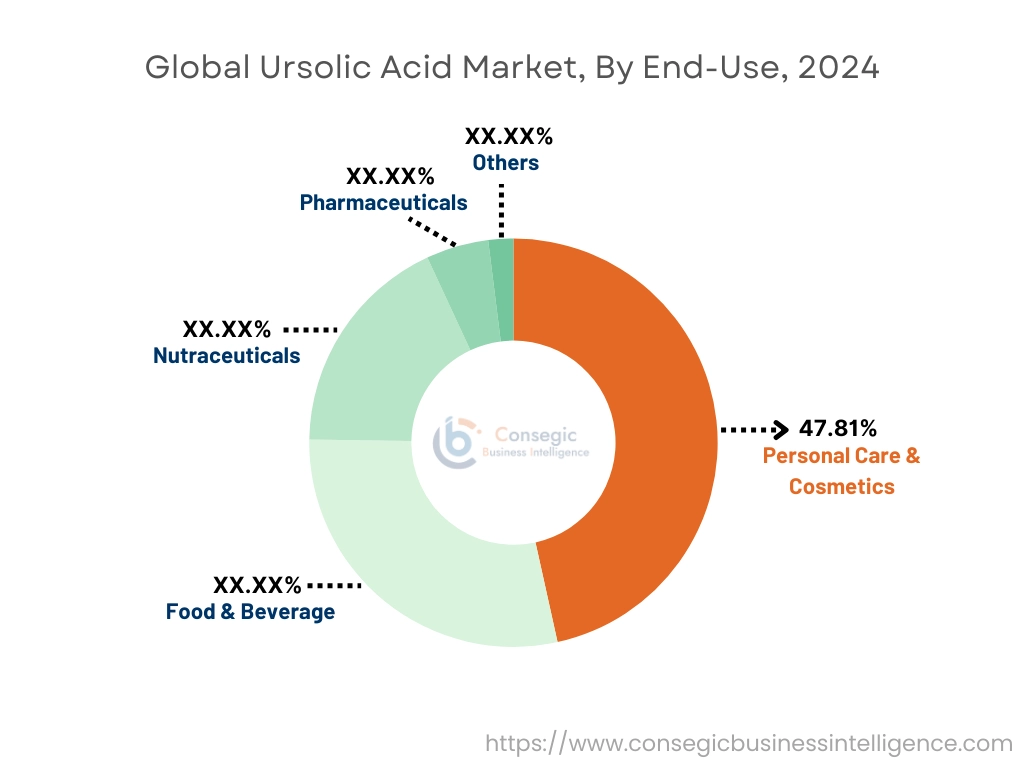
The personal care & cosmetics segment accounted for the largest market share of 47.81% in 2024.
- The personal care and cosmetic segment dominated the market trends. The anti-inflammatory, antimicrobial, and antioxidant properties of UA make it a highly desirable ingredient in various anti-aging creams, lotions, serums, and other skincare formulations.
- Additionally, its ability to diminish wrinkles, improve skin elasticity, and stimulate collagen production further contributes to its popularity.
- The increasing consumer preference for natural and plant-derived components in skincare and cosmetic products is contributing to the substantial need for this compound.
- For instance, as per the survey analysis provided by Milieu in 2023, it is stated that 66% of Southeast Asian consumers prioritize natural ingredients in skin care products.
- Overall, as per the market analysis, the rising personal care and cosmetic sector is driving segment in the ursolic acid industry.
The nutraceuticals segment is expected to grow at the fastest CAGR over the forecast period.
- The nutraceuticals segment is emerging in the ursolic acid market trends. It is driven by its health benefits, encompassing its anti-inflammatory, antioxidant, anti-obesity, and muscle-building properties, which makes it a suitable ingredient for nutraceutical consumers.
- A significant driver for the expanding utilization of this ingredient is increasing health and wellness awareness among consumers, who are actively seeking natural supplements for preventive healthcare and overall well-being.
- The growing preference for natural and plant-derived health solutions is further contributing to the segment's revenue over future years.
- Moreover, the expanding sports nutrition market is contributing to the demand for UA due to its potential to promote muscle development and recovery.
- Thus, the expanding nutraceuticals sector will drive segment for the forecasted years.
Regional Analysis:
The regional segment includes North America, Europe, Asia Pacific, the Middle East and Africa, and Latin America.
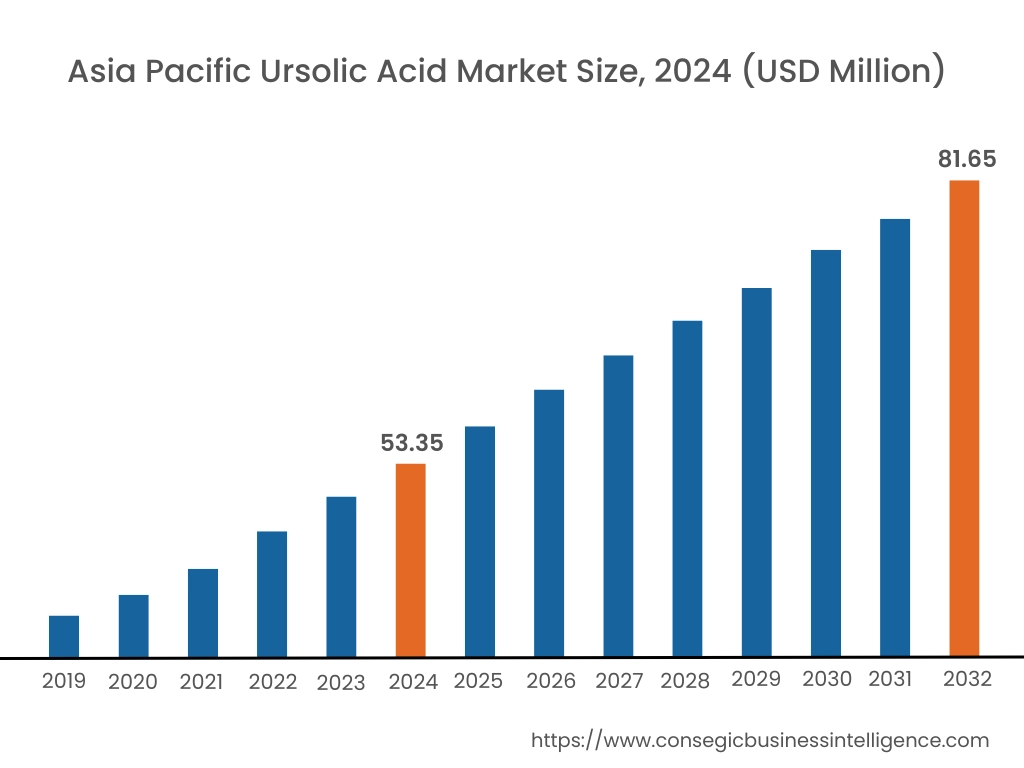
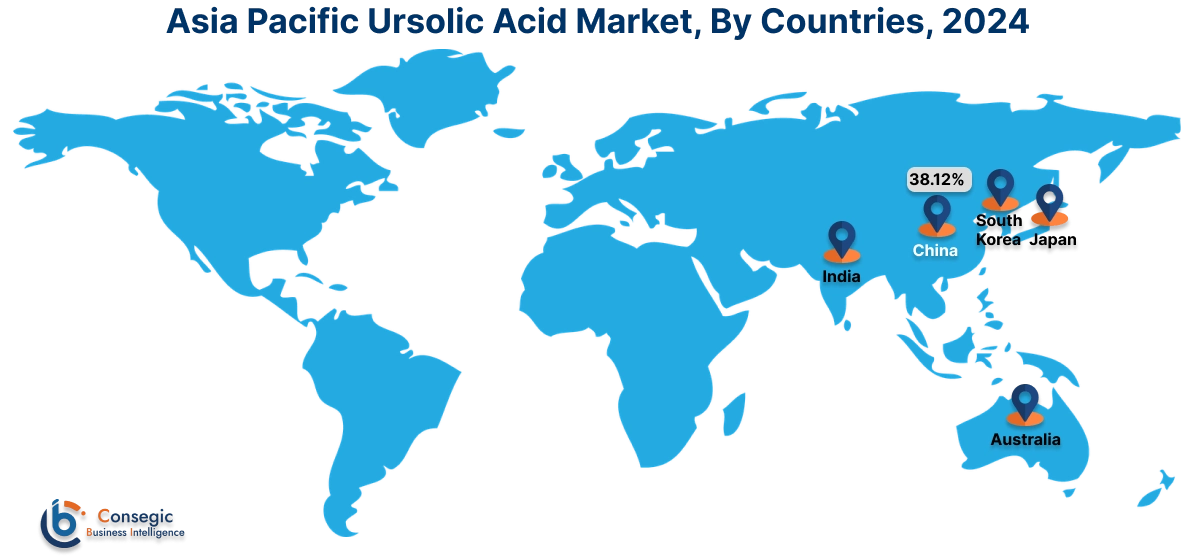
In 2024, Asia Pacific accounted for the highest ursolic acid market share at 41.85% and was valued at USD 53.35 Million and is expected to reach USD 81.65 Million in 2032. In Asia Pacific, the China accounted for the ursolic acid market share of 38.12% during the base year of 2024. The rising demand for natural products in the MEA is also creating a market for Ursolic Acid as a dietary supplement. Consumers seeking natural support for overall well-being, including potential benefits related to inflammation management, metabolic health, and even muscle health, are drawn to UA-based supplements. As awareness of its diverse potential health benefits grows within the region, the nutraceutical market also expands.
For instance,
- In 2022, South Korean Company CJ Group, through its subsidiary CJ Cheiljedang, is focused on developing sarcopenia-preventing materials based on ursolic acid. This natural compound, sourced from fruit peels and common herbs and spices like rosemary and thyme, will serve as a base ingredient for creating more powerful bioactive derivatives targeting muscle loss in older adults.
Thus, due to the aforementioned factors, Asia Pacific is expected to dominate the market in 2024
In Europe, the ursolic acid market is experiencing the fastest growth with a CAGR of 7.3% over the forecast period. Improved and more efficient methods are making UA production more cost-effective and sustainable, facilitating greater access to this compound for research purposes. This enhanced availability encourages further investigation into its potential anti-cancer properties and the development of novel therapies. As extraction becomes more scalable and economical, it supports the growing interest in exploring UA’s therapeutic applications in oncology across the European pharmaceutical landscape.
North America ursolic acid market analysis indicates that several key trends are contributing to its growth in the region. Ongoing scientific investigations are continuously unveiling new potential health benefits, expanding its applications beyond traditional uses. Simultaneously, the growing exploration of UA as a natural preservative and health-enhancing ingredient within the food and beverage sector is creating new market potential and further fueling its need across the region. The growing preference for plant-derived ingredients in various industries, including nutraceuticals favors UA extracted from herbs and fruits.
The increasing requirements for natural products across the cosmetics sector in the Middle East and Africa (MEA) creates potential for the market. As consumers become more conscious about personal grooming and well-being, the need for natural and effective ingredients in skincare, haircare, and other beauty products rises. UA is recognized as an antioxidant, making it an appealing component for manufacturers catering to this growing consumer base seeking natural formulations. This trend, coupled with rising disposable incomes, further supports the market in the region.
The Latin America market presents a lucrative opportunity for the market. The rising prevalence of chronic diseases, including inflammation, diabetes, and cardiovascular issues, is a significant driver for ursolic acid's adoption in both nutraceuticals and pharmaceuticals due to its potential to manage these conditions. Furthermore, emerging evidence highlighting its positive effects on muscle health and weight management is fueling its increasing use in sports nutrition and dietary supplements aimed at promoting muscle development and fat loss.
Top Key Players and Market Share Insights:
The Ursolic Acid market is highly competitive with major players providing products to the national and international markets. Key players are adopting several strategies in research and development (R&D) and product innovation to hold a strong position in the global Ursolic Acid market. Key players in The Ursolic Acid industry include-
- Merck KGaA (Germany)
- Cayman Chemical Company (U.S.)
- Biosynth (Switzerland)
- Nutragreenlife Biotechnology Co., Ltd (China)
- Enzo Biochem Inc. (UK)
- Matrix Life Science Pvt. Ltd. (India)
- Sabinsa Corporation (U.S.)
- BECARRE Natural (France)
- Xi'an Healthful Biotechnology Co., Ltd (China)
- Santa Cruz Biotechnology, Inc. (U.S.)
Ursolic Acid Market Report Insights:
| Report Attributes | Report Details |
| Study Timeline | 2019-2032 |
| Market Size in 2032 | USD 208.34 Million |
| CAGR (2025-2032) | 6.4% |
| By Purity |
|
| By Source |
|
| By End User |
|
| By Region |
|
| Key Players |
|
| North America | U.S. Canada Mexico |
| Europe | U.K. Germany France Spain Italy Russia Benelux Rest of Europe |
| APAC | China South Korea Japan India Australia ASEAN Rest of Asia-Pacific |
| Middle East and Africa | GCC Turkey South Africa Rest of MEA |
| LATAM | Brazil Argentina Chile Rest of LATAM |
| Report Coverage |
|
Key Questions Answered in the Report
How big is the Ursolic Acid market? −
In 2024, the Ursolic Acid market is USD 127.50 Million.
Which is the fastest-growing region in the Ursolic Acid market? +
Europe is the fastest-growing region in the Ursolic Acid market.
What specific segmentation details are covered in the Ursolic Acid market? +
Purity, Source, and End-Use segmentation details are covered in the Ursolic Acid market.
Who are the major players in the Ursolic Acid market? +
Merck KGaA (Germany), Cayman Chemical Company (U.S.), Matrix Life Science Pvt. Ltd. (India), Sabinsa Corporation (U.S.), BECARRE Natural (France), and Xi'an Healthful Biotechnology Co., Ltd (China) are some major players in the market.
Overview
Reputation & Certifications


Our Services
- Market Intelligence & Forecasting
- Custom Research Solutions
- Market Entry Strategy
- Competitive Intelligence
- Customer Insights
- Industry Innovation Analysis
- Investment Advisory