Jump to Content
Vehicle-to-Grid Market - Size, Share, Industry Trends, and Forecasts (2025-2032)
Vehicle-to-Grid Market Size:
Vehicle-to-Grid Market size is estimated to reach over USD 32.28 Billion by 2032 from a value of USD 5.18 Billion in 2024 and is projected to grow by USD 6.42 Billion in 2025, growing at a CAGR of 29.0% from 2025 to 2032.
Vehicle-to-Grid Market Scope & Overview:
Vehicle-to-grid is a technology which offers bidirectional charging by pushing and pulling energy to and from connected vehicles based on the demand for electricity. Also, the advantages including grid stabilization, renewable energy integration, reducing carbon emission and others are driving the vehicle-to-grid market demand. Also, the bidirectional flow of electricity in EV charging stations act as energy storage solution to support grid during peak demand time. Further, the development of EV charging infrastructure is boosting the vehicle-to-grid market growth.
How is AI Transforming the Vehicle-To-Grid Market?
AI transforms the V2G market by enabling dynamic, real-time control of EV batteries as distributed energy resources, optimizing charging and discharging schedules to balance grid load, integrate intermittent renewables, and reduce costs. Also, AI optimizes charging and discharging schedules for EVs, ensuring power availability when required as well as leveraging renewable energy sources to charge batteries. Further, AI-powered models predict renewable energy generation and grid demand, allowing for better coordination of EV charging and discharging to match supply and demand effectively. Thus, AI helps manage battery health and degradation, ensuring fair compensation for EV owners and promoting the longevity of EV batteries in V2G systems.

Vehicle-to-Grid Market Dynamics - (DRO) :
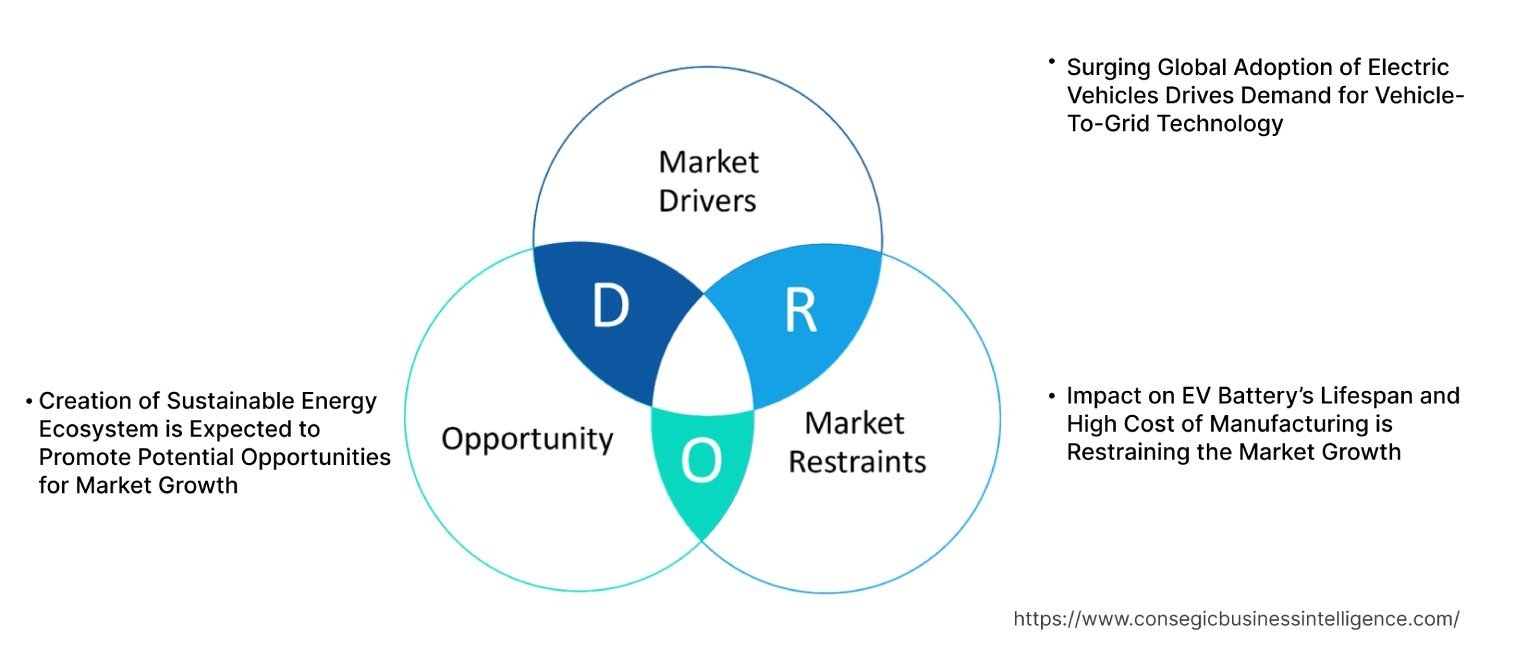
Key Drivers:
Surging Global Adoption of Electric Vehicles Drives Demand for Vehicle-To-Grid Technology
The rapidly growing adoption of electric vehicles across the globe is paving the way for turning EV into mobile electricity storage which in turn drives the vehicle-to-grid market growth. Additionally, the technology transforms EVs into dynamic energy assets as well as helping to accelerate us along the road to emission-free driving. Further, the government support and investment in expanding EV adoption as well as V2G technology is driving the vehicle-to-grid market demand.
- For instance, according to IEA, global new EV car sales reached 14 million in 2023. Also, China accounted for 8.1 million which is under 60% of the global new EV car registration.
Therefore, the rapidly growing adoption of electric vehicles as well as government support and investment are driving the vehicle-to-grid industry, in turn proliferating the growth of the market.
Key Restraints:
Impact on EV Battery’s Lifespan and High Cost of Manufacturing is Restraining the Market Growth
The increased degradation due to the increased charging and discharging cycles which in turn shortens the battery lifespan is hindering the vehicle-to-grid market expansion. Further, the technology requires hardware and software infrastructure for smooth functioning of the technology which incurs higher cost for manufacturers which in turn limits the adoption of bidirectional charging technology.
Therefore, the high costs of manufacturing as well as battery degradation issue due to bidirectional charging is restraining the vehicle-to-grid market expansion.
Future Opportunities :
Creation of Sustainable Energy Ecosystem is Expected to Promote Potential Opportunities for Market Growth
The increasing focus towards generation of sustainable solutions such as bidirectional charging solutions which enhances grid stability, promotes renewable energy integration and others is propelling the vehicle-to-grid market opportunities. Further, the technology potentially reduces electricity bills during off-peak hours is paving the way for unlocking new revenue generation stream.
- For instance, in October 2024, Nissan announced the launch of affordable bidirectional charging solution on selected electric vehicles. The aim of the launch is to create a sustainable energy ecosystem as well as to unlock new revenue generation stream.
Hence, the increasing focus towards sustainable solution is anticipated to increase the utilization, in turn promoting prospect for vehicle-to-grid market opportunities during the forecast period.
Vehicle-to-Grid Market Segmental Analysis :
By Service:
Based on the service, the market is segmented into time shifting, frequency response & reserve, distribution services, emergency backup, and arbitrage.
Trends in the Service:
- The trend towards rise in arbitrage services for financial gains and grid stability is driving the market progress.
- The trend towards adoption of energy stored in EV batteries as a temporary home power source is driving the time shifting service segment.
Time Shifting accounted for the largest revenue share in the market in 2024.
- Time shifting service adjust the charging time of EV by shifting the time of charging when electricity cost is cheaper and utilize stored energy during peak electricity requirements.
- Further, controlled charging significantly reduces battery degradation, carbon emission, grid usage and energy cost which in turn drives the adoption of time shifting service.
- Thus, according to the vehicle-to-grid market analysis, the advantage of controlled charging is driving the adoption of time shifting service.
Frequency Response & Reserve is anticipated to register the fastest CAGR during the forecast period.
- Frequency response & reserve service utilizes EV battery to help stabilize the power grid by adjusting frequency fluctuations and providing backup power when needed.
- Further, the increasing need to adjust the supply and demand of electricity is driving the frequency response & reserve service.
- Therefore, as per the market analysis, the need to adjust the supply and demand for electricity is anticipated to boost the market during the forecast period.
By Charger:
Based on the charger, the market is segmented into AC, DC, and both.
Trends in the Charger:
- The increasing focus towards interoperability between chargers, vehicles, and charging network is driving the vehicle-to-grid market trend.
- The increasing focus towards reducing carbon emissions and lowering energy costs is driving the adoption of AC charger which in turn drives the vehicle-to-grid market trend.
DC accounted for the largest revenue share in the year 2024.
- DC charging capability offers efficient and bi-directional power capabilities which enhances energy management system and improves faster charging time.
- Further, the technological advancements in DC charger by improving efficiency, reliability and interoperability are driving the adoption of DC charging which in turn fuels the vehicle-to-grid market size.
- For instance, in January 2024, Enteligent collaborated with PIONIX to utilize BaseCamp as OS for TLCEV EVSE. The TLCEV EVSE is a direct DC-coupled solar-powered EV charger. Additionally, the charger supports 25 kW of fast DC charging as well as V2G and V2H.
- Thus, as per the market analysis, technological advancements in DC charging are driving the vehicle-to-grid market share.
AC is anticipated to register the fastest CAGR during the forecast period.
- The AC charger is suitable for domestic and workplace settings as well as cost effectiveness fuels the vehicle-to-grid market size.
- Further, the key factors driving the adoption of AC charger include lowered costs, wider availability, and optimized battery usage is in turn driving the vehicle-to-grid market share.
- Therefore, according to the vehicle-to-grid market analysis, the aforementioned key factors are anticipated to boost the market during the forecast period.
By Application:
Based on the application, the market is segmented into commercial, individual, and both.
Trends in the Application:
- The trend towards growing focus on renewable energy integration is driving the market adoption by commercial applications.
- The trend towards adoption of energy aggregators which combines stored energy sources from EV batteries and other distributed energy assets to cater surging need for electricity is driving the adoption by commercial as well as individual applications.
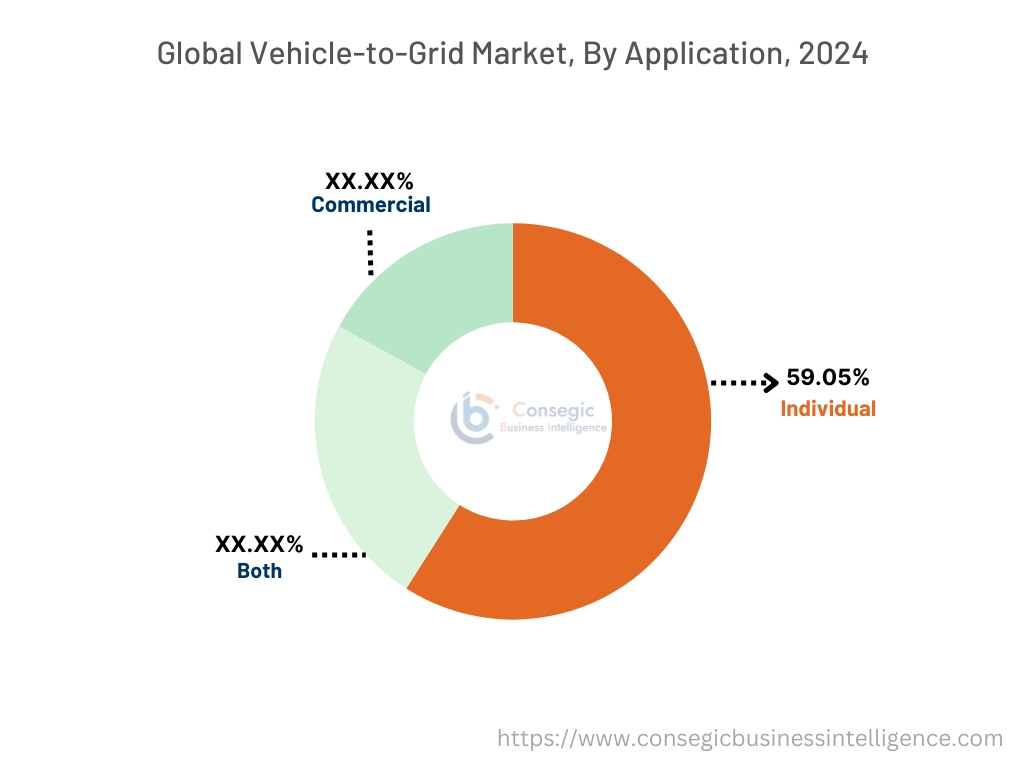
Individual accounted for the largest revenue share of 59.05% in the year 2024.
- The reduced energy cost and increased energy resilience due to adoption of technology is driving the segment progress.
- Further, the increasing focus towards grid stabilization is driving the adoption of technology by individual segment.
- For instance, in March 2025, Essential Energy deployed vehicle-to-grid technology to Francis Clarke which is an energy trailblazer. The trial is conducted over 500-hectare property in Lower Boro.
- Thus, as per the market analysis, increasing focus towards grid stabilization and reduced energy cost is driving the adoption by individual segment.
Both is anticipated to register the fastest CAGR during the forecast period.
- EV spends most of the time in parking zone making EV an attractive flexibility solution for the power system by effectively becoming a micro grid-connected storage unit.
- Additionally, the adoption of renewable electricity significantly lowers dependency over electricity grid and reduces the energy bill is driving the need for technology.
- Further, the adoption of technology by individuals and commercial segments provide backup power to homes and businesses, in turn enhancing energy security and resilience.
- Therefore, as per the market analysis, the adoption of renewable electricity is anticipated to boost the market during the forecast period.
Regional Analysis:
The regions covered are North America, Europe, Asia Pacific, the Middle East and Africa, and Latin America.
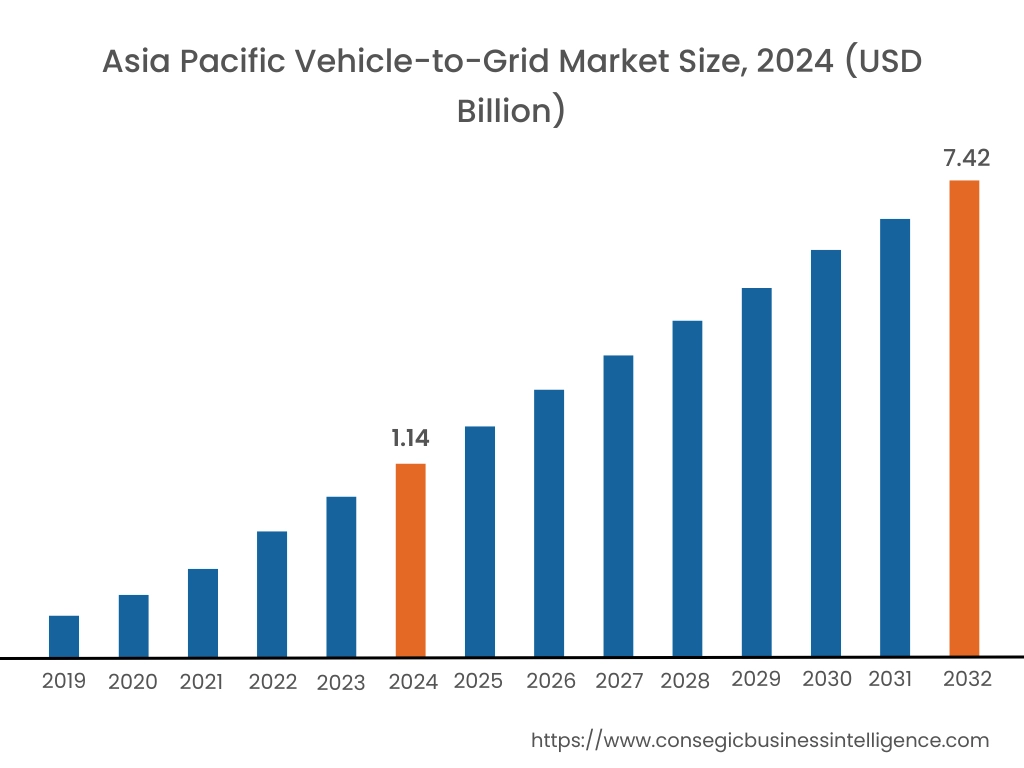
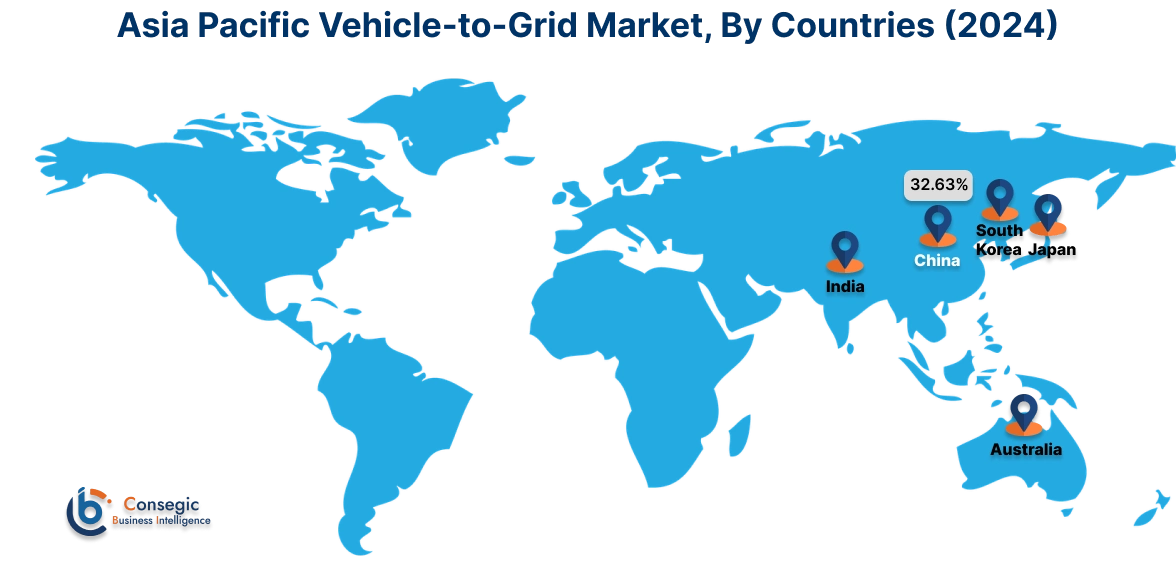
Asia Pacific region was valued at USD 1.14 Billion in 2024. Moreover, it is projected to grow by USD 1.41 Billion in 2025 and reach over USD 7.42 Billion by 2032. Out of this, China accounted for the maximum revenue share of 32.63%. The market is mainly driven by increasing governmental initiatives and investments in EV and V2G technologies. Furthermore, factors including growing environmental concerns and increasing integration of renewable energy sources are projected to drive the market growth in Asia Pacific region during the forecast period.
- For instance, in February 2021, Absolute Public Company Limited received a loan from Asian Development Bank of USD 47.62 million for expanding electric vehicle charging network in Thailand.
Europe is estimated to reach over USD 11.62 Billion by 2032 from a value of USD 1.88 Billion in 2024 and is projected to grow by USD 2.33 Billion in 2025. The Europe region's growing need for grid stability offers lucrative growth prospects for the market. Additionally, the stringent rules and regulations as well as widespread EV adoption is driving the market progress.
- For instance, in October 2024, Nuvve joined Environmental Valorization of Virtual Energy storage project to enhance the penetration rate of bidirectional charging stations for electric vehicles across Europe.
The regional evaluation depicts that the increasing adoption of electric vehicles is driving the market in North America. Additionally, the key factor driving the market is increasing investment in sustainable energy projects is propelling the market adoption in the Middle East and African region. Further, the government support towards integrating EV charging with grid industry is paving the way for the progress of market in Latin America region.
Top Key Players and Market Share Insights:
The global vehicle-to-grid market is highly competitive with major players providing vehicle-to-grid to the national and international markets. Key players are adopting several strategies in research and development (R&D), product innovation, and end user launches to hold a strong position in the vehicle-to-grid industry. Key players in the vehicle-to-grid market include-
- Nuvve Holding Corp. (U.S.)
- ON U.K. plc (U.K.)
- ABB Ltd. (Switzerland)
- Honda Motor Co., Ltd. (Japan)
- Enel Spa (Italy)
- The Mobility House GmbH (Germany)
- Mitsubishi Electric Corporation (Japan)
- Virta Global (Finland)
- Ovo Energy (U.K.)
- Flexitricity (Scotland)
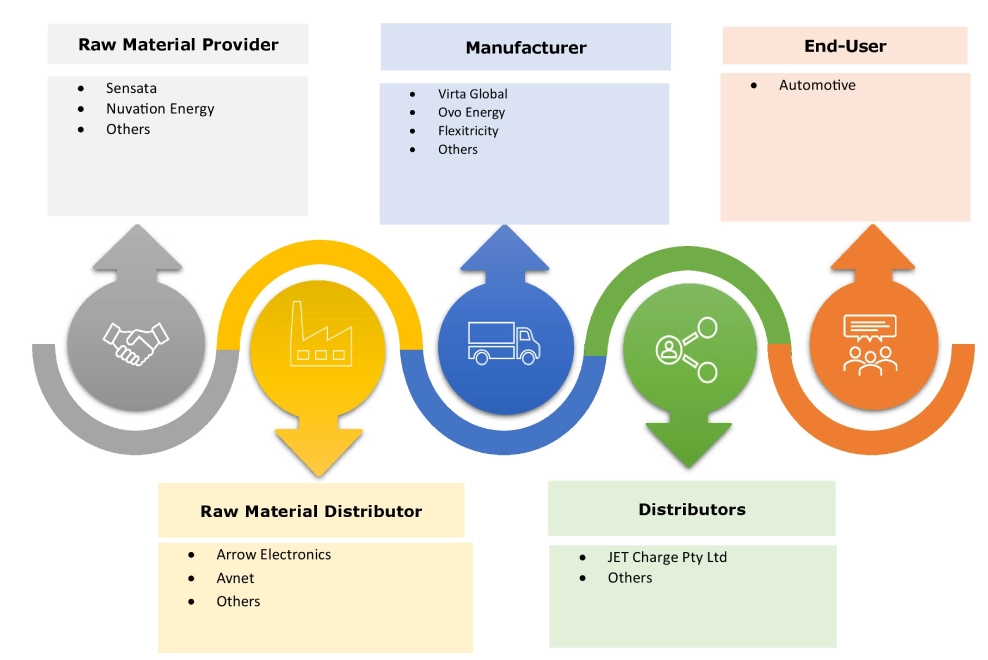
Vehicle-to-Grid Market Ecosystem:
Recent Industry Developments :
Product Launch:
- In January 2025, Nuvve Holding Corp. launched portfolio of advanced bidirectional and unidirectional charging solutions. Additionally, the charger is ideal for heavy to medium sized vehicles such as school buses and trucks.
Collaborations and Partnerships:
- In February 2025, Nuvve Holding Corp. partnered with Resource Innovations led by ComEd to advance V2G technology using electric school buses.
Vehicle-to-Grid Market Report Insights :
| Report Attributes | Report Details |
| Study Timeline | 2019-2032 |
| Market Size in 2032 | USD 32.28 Billion |
| CAGR (2025-2032) | 29.0% |
| By Service |
|
| By Charger |
|
| By Application |
|
| By Region |
|
| Key Players |
|
| North America | U.S. Canada Mexico |
| Europe | U.K. Germany France Spain Italy Russia Benelux Rest of Europe |
| APAC | China South Korea Japan India Australia ASEAN Rest of Asia-Pacific |
| Middle East and Africa | GCC Turkey South Africa Rest of MEA |
| LATAM | Brazil Argentina Chile Rest of LATAM |
| Report Coverage |
|
Key Questions Answered in the Report
How big is the vehicle-to-grid market? −
The vehicle-to-grid market size is estimated to reach over USD 32.28 billion by 2032 from a value of USD 5.18 billion in 2024 and is projected to grow by USD 6.42 billion in 2025, growing at a CAGR of 29.0% from 2025 to 2032.
What specific segmentation details are covered in the vehicle-to-grid report? +
The vehicle-to-grid report includes specific segmentation details for service, charger, application, and regions.
Which is the fastest segment anticipated to impact the market growth? +
In the vehicle-to-grid market, the AC charger is the fastest-growing segment during the forecast period due to lowered costs, wider availability, and optimized battery usage.
Who are the major players in the vehicle-to-grid market? +
The key participants in the vehicle-to-grid market are Nuvve Holding Corp. (U.S.), E.ON U.K. plc (U.K.), ABB Ltd. (Switzerland), Honda Motor Co., Ltd. (Japan), Enel Spa (Italy), The Mobility House GmbH (Germany), Mitsubishi Electric Corporation (Japan), Virta Global (Finland), Ovo Energy (U.K.), Flexitricity (Scotland) and others.
What are the key trends in the vehicle-to-grid market? +
The vehicle-to-grid market is being shaped by several key trends including trend towards rise in arbitrage services for financial gains and grid stability as well as growing focus on renewable energy integration and others are the key trends driving the market.
Overview
Reputation & Certifications


Our Services
- Market Intelligence & Forecasting
- Custom Research Solutions
- Market Entry Strategy
- Competitive Intelligence
- Customer Insights
- Industry Innovation Analysis
- Investment Advisory