Jump to Content
Video Intercom Devices Market - Size, Share, Industry Trends, and Forecasts (2025-2032)
Video Intercom Devices Market Size:
Video Intercom Devices Market size is estimated to reach over USD 61,074.63 Million by 2032 from a value of USD 23,635.26 Million in 2024 and is projected to grow by USD 26,192.16 Million in 2025, growing at a CAGR of 12.6% from 2025 to 2032.
Video Intercom Devices Market Scope & Overview:
Video intercom devices are communication systems designed to enable two-way audio and video interaction, enhancing security and convenience in residential, commercial, and industrial environments. These devices feature integrated video cameras, microphones, and speakers, allowing real-time communication and visitor identification. Key properties include high-definition video, noise reduction, and durable construction for indoor and outdoor use. Advanced models offer wireless connectivity, touchscreens, and compatibility with smartphones or building management systems.
The benefits include enhanced security, streamlined access control, and convenience for managing visitor entry. These devices support remote monitoring, reducing the need for on-site personnel and providing a reliable communication solution.
Applications of video intercom devices extend to apartment complexes, office buildings, educational institutions, healthcare facilities, and gated communities. End-use industries include real estate, construction, corporate sectors, and government facilities. The adoption of video intercom devices aligns with the demand for efficient security and communication solutions in modern infrastructure.
How is AI Transforming the Video Intercom Devices Market?
AI is transforming the video intercom market by adding intelligent features like facial recognition, automated responses, and anomaly detection, which enhance security and user experience. Also, the integration with other smart devices, creating a cohesive smart building ecosystem. Furthermore, AI-powered edge computing improves local data processing, leading to faster decisions, greater data privacy, and more efficient operations, such as predictive maintenance and remote access via mobile apps. Moreover, AI helps to monitor system health and identify potential issues before they become critical, streamlining maintenance and reducing downtime.

Video Intercom Devices Market Dynamics - (DRO) :
Key Drivers:
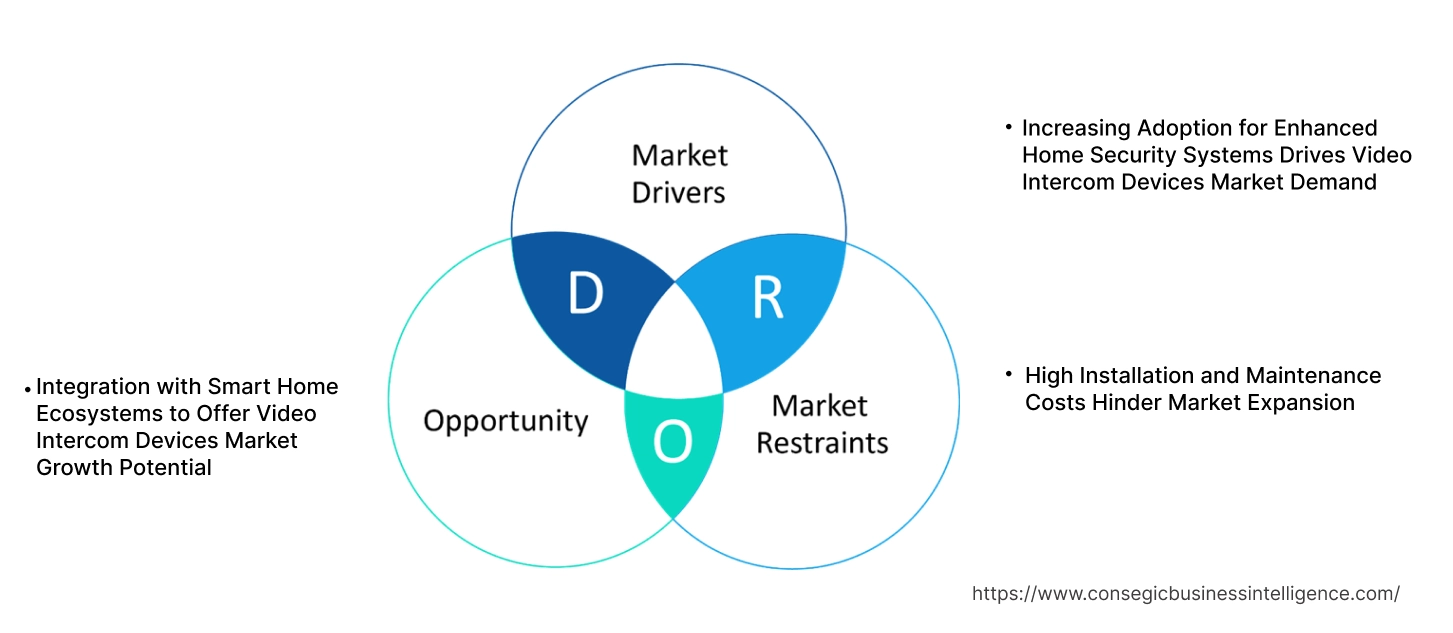
Increasing Adoption for Enhanced Home Security Systems Drives Video Intercom Devices Market Demand
The growing need for advanced home security solutions has led to an increased preference for video intercom devices. These systems enable real-time visual and audio communication, allowing users to identify and communicate with visitors before granting access. This feature enhances security in residential complexes and single-family homes. For example, video intercom systems with remote access enable users to monitor their property even when they are away, providing an added layer of safety.
Thus, the rising emphasis on improving home security is fueling the adoption of video intercom devices.
Key Restraints:
High Installation and Maintenance Costs Hinder Market Expansion
The adoption of video intercom systems is hindered by the significant costs associated with their installation and maintenance. These systems often require professional setup, which includes wiring, mounting, and system configuration, increasing the overall expenses. Additionally, periodic maintenance, software updates, and repairs further add to the cost burden for users. This financial barrier particularly impacts small businesses and low-income households.
Consequently, the high cost of installation and maintenance limits the widespread adoption of video intercom devices, particularly in cost-sensitive markets.
Future Opportunities :
Integration with Smart Home Ecosystems to Offer Video Intercom Devices Market Growth Potential
The integration of video intercom devices with smart home ecosystems is expected to create significant opportunities for video intercom devices market expansion. Future advancements will enable seamless compatibility of these systems with other smart devices, such as door locks, lighting, and surveillance cameras, to create a comprehensive security solution. For instance, voice-controlled video intercoms that integrate with smart assistants will enhance user convenience and accessibility.
Therefore, the growing adoption of smart home technologies is projected to open new avenues for the video intercom devices market.
Video Intercom Devices Market Segmental Analysis :
By Device Type:
Based on device type, the video intercom devices market is segmented into door entry systems, handheld devices, video baby monitors, and others.
The door entry systems sector accounted for the largest revenue in video intercom devices market share in 2024.
- Door entry systems are essential components in residential, commercial, and government buildings, enabling users to see and communicate with visitors before granting access.
- These systems typically consist of a video camera, a monitor, and an intercom feature.
- They provide enhanced security, convenience, and communication, especially in buildings with multiple entry points.
- Therefore, according to video intercom devices market analysis, with the rising adoption for security and the increasing need for smart home technologies, the adoption of door entry systems is expected to continue growing.
The handheld devices sector is anticipated to register the fastest CAGR during the forecast period.
- Handheld devices, which include mobile phones and tablets integrated with video intercom functions, are becoming increasingly popular.
- These devices offer flexibility, allowing users to monitor their property from virtually anywhere.
- The growing video intercom devices market trend toward mobile applications and remote access is a key factor contributing to the sector's rapid growth.
- Thus, according to video intercom devices market analysis, additionally, their integration with home automation systems is boosting demand, especially in residential settings.
By Access Control:
Based on access control, the video intercom devices market is segmented into fingerprint readers, password access, proximity cards, wireless access, and others.
The fingerprint readers sector accounted for the largest revenue in video intercom devices market share in 2024.
- Fingerprint-based access control offers a high level of security and convenience, eliminating the need for traditional keys or cards.
- This technology is gaining significant traction due to its accuracy, ease of use, and ability to prevent unauthorized access.
- The growing focus on security in both residential and commercial spaces is driving the requirement for fingerprint readers in video intercom systems.
- Therefore, according to market analysis, fingerprint readers segment accounted for the largest revenue share.
The wireless access segment is anticipated to register the fastest CAGR during the forecast period.
- Wireless access systems offer convenience, ease of installation, and flexibility.
- As the adoption for smart homes and IoT devices increases, wireless access control integrated with video intercom devices is expected to experience substantial growth.
- These systems can be easily upgraded, making them a preferred choice for both new installations and retrofits.
- Thus, according to market analysis wireless access segment will continue to expand.
By Technology:
Based on technology, the video intercom devices market is segmented into analog and IP-based.
The IP-based segment accounted for the largest revenue share in 2024 and is also anticipated to register the fastest CAGR during the forecast period.
- IP-based video intercom systems offer enhanced functionality, allowing users to access their intercoms via the internet, which provides the advantage of remote access.
- These systems are increasingly being integrated with other home automation technologies.
- As more businesses and households adopt smart technologies, IP-based video intercom systems are expected to continue growing due to their superior capabilities and integration potential.
- Therefore, according to market analysis, IP-based segment will continue to grow.
- With the continued trend of digitalization and the rise of internet-connected devices, the IP-based segment is set to experience rapid growth.
- The increased need for remote access and control in both residential and commercial spaces is driving this growth, making IP-based systems a preferred choice.
- Therefore, according to market analysis, IP-based segment accounted for the largest revenue share and will continue to expand.
By End-Use:
Based on end use, the video intercom devices market is segmented into residential, commercial, government, industrial.
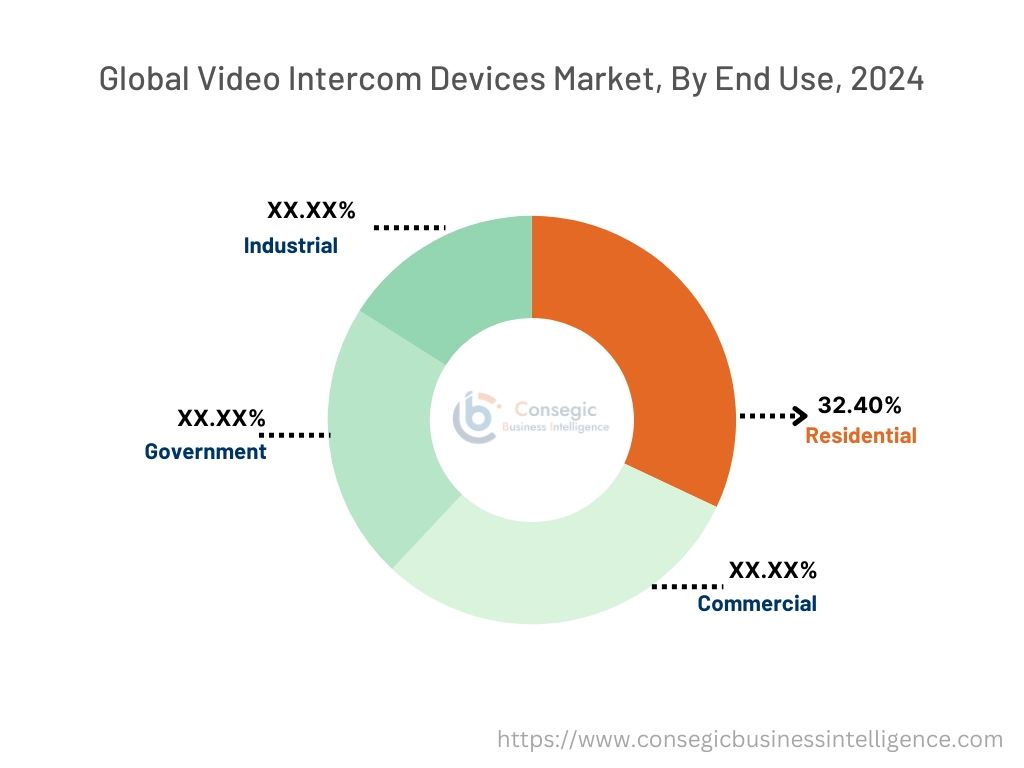
The residential segment accounted for the largest revenue share by 32.40% in 2024.
- In the residential segment, video intercom systems are increasingly used to enhance security and convenience, particularly in multi-unit dwellings and gated communities.
- These systems allow homeowners to monitor visitors and manage access securely. The growing trend of smart home technologies and the adoption of improved home security are key factors driving the growth in this segment.
- Therefore, according to market analysis, residential segment accounted for the largest revenue share.
The commercial segment is anticipated to register the fastest CAGR during the forecast period.
- As businesses increasingly focus on enhancing security and streamlining access control, the trend for video intercom systems in commercial settings is expected to grow.
- These systems offer improved security, efficiency, and convenience in managing visitor access to commercial properties, making them highly sought after in offices, retail spaces, and industrial facilities.
- Thus, according to market analysis, commercial segment is expected to expand.
Regional Analysis:
The regional segment includes North America, Europe, Asia Pacific, Middle East and Africa, and Latin America.
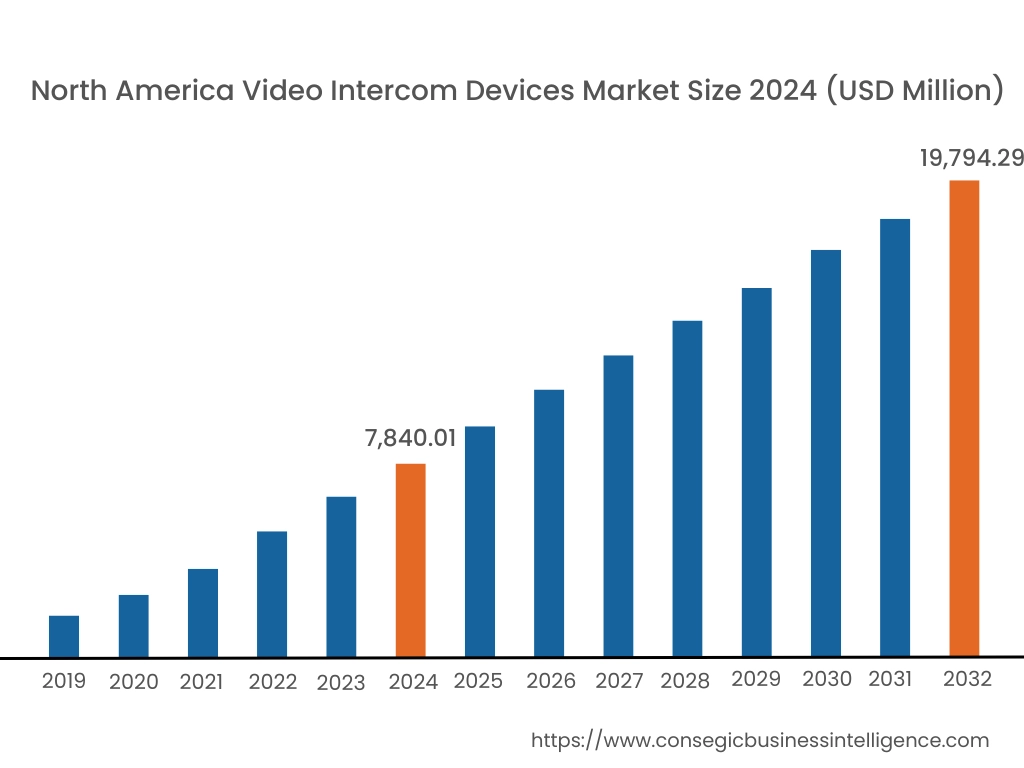
In 2024, North America was valued at USD 7,840.01 Million and is expected to reach USD 19,794.29 Million in 2032. In North America, the U.S. accounted for the highest share of 70.80% during the base year of 2024.
In North America, the video intercom devices market is expanding, fueled by increasing demand for home security and smart home technologies. The United States leads the market, with a high adoption rate of advanced video intercom systems in residential and commercial sectors. The integration of artificial intelligence and smart home ecosystems further boosts video intercom devices growth. Additionally, growing concerns over security and rising criminal activity drive the video intercom devices trend.

In Asia Pacific, the market is experiencing the fastest growth with a CAGR of 13.1% over the forecast period.
Asia-Pacific holds significant potential in the video intercom devices market, particularly in countries like China, Japan, and India. Rapid urbanization, rising disposable income, and the increasing adoption of smart technologies contribute to the growing trend for video intercom systems. Additionally, the residential segment is seeing a higher demand for smart security solutions. As more consumers prioritize security, the region is poised for considerable video intercom devices market expansion.
Europe experiences steady demand for video intercom devices, with countries like Germany, the United Kingdom, and France leading the market. Increased awareness of security concerns, coupled with advancements in wireless and video technology, stimulates trend for video intercom systems in both residential and commercial segments. The growing trend of smart homes and connected devices also plays a key role in driving market adoption across the region.
In the Middle East and Africa, the video intercom devices market is emerging, with increasing adoption in both urban and suburban areas. Countries like the UAE, Saudi Arabia, and South Africa show growing interest in advanced security systems for residential and commercial use. The rapid pace of urbanization, along with a rising focus on safety and security, contributes to the expansion of the market in this region.
Latin America is witnessing a gradual increase in the adoption of video intercom devices, particularly in countries like Brazil and Mexico. Growing urbanization, rising security concerns, and increased disposable income are key factors influencing market development. Although the market is still in the early stages compared to other regions, demand for advanced security solutions is on the rise, creating video intercom devices market opportunities for growth.
Top Key Players & Market Share Insights:
The global video intercom devices market is highly competitive with major players providing products and services to the national and international markets. Key players are adopting several strategies in research and development (R&D), product innovation, and end-user launches to hold a strong position in the Global Video Intercom Devices Market. Key players in the Video Intercom Devices industry include-
- Aiphone Corporation (Japan)
- 2N Telekomunikace (Czech Republic)
- Honeywell International Inc. (United States)
- Toshiba Corporation (Japan)
- Kocom Co., Ltd. (South Korea)
- Samson Technology (United States)
- TCS (Telecommunication Systems) (United States)
- AMOCOM Technologies (China)
- Panasonic Corporation (Japan)
- VTech Communications, Inc. (Hong Kong)
Recent Industry Developments :
Product Launches:
- Unveiled at CES 2025, Aqara’s Doorbell Camera Hub G410 device offers 2K video quality with a 4:3 aspect ratio and end-to-end encryption. It features an mmWave sensor for improved person detection and supports dual-band Wi-Fi, integrating Thread and Zigbee radios to function as a comprehensive smart home hub. The G410 is compatible with Amazon Alexa, Google Home, and Samsung SmartThings, and includes on-device facial recognition and local storage options.
- In late 2024, Verkada expanded its intercom lineup with models featuring built-in access readers, keypads, and a mullion form factor. Devices like Verkada's TD33, TD53, and TD63 Video Intercoms aim to enhance communication, streamline entry decisions, and bolster security for organizations.
Video Intercom Devices Market Report Insights:
| Report Attributes | Report Details |
| Study Timeline | 2019-2032 |
| Market Size in 2032 | USD 61,074.63 Million |
| CAGR (2025-2032) | 12.6% |
| By Device Type |
|
| By Access Control |
|
| By Technology |
|
| By End-Use |
|
| By Region |
|
| Key Players |
|
| North America | U.S. Canada Mexico |
| Europe | U.K. Germany France Spain Italy Russia Benelux Rest of Europe |
| APAC | China South Korea Japan India Australia ASEAN Rest of Asia-Pacific |
| Middle East and Africa | GCC Turkey South Africa Rest of MEA |
| LATAM | Brazil Argentina Chile Rest of LATAM |
| Report Coverage |
|
Key Questions Answered in the Report
How big is the Video Intercom Devices Market? −
In 2024, the Video Intercom Devices Market was USD 23,635.26 million.
What will be the potential market valuation for the Video Intercom Devices Market by 2032? +
In 2032, the market size of Video Intercom Devices Market is expected to reach USD 61,074.63 million.
What are the segments covered in the Video Intercom Devices Market report? +
The device type, access control, technology, and end-user are the segments covered in this report.
Who are the major players in the Video Intercom Devices Market? +
Aiphone Corporation (Japan), 2N Telekomunikace (Czech Republic), Samson Technology (United States), TCS (Telecommunication Systems) (United States), AMOCOM Technologies (China), Panasonic Corporation (Japan), VTech Communications, Inc. (Hong Kong), Honeywell International Inc. (United States), Toshiba Corporation (Japan), Kocom Co., Ltd. (South Korea) are the major players in the Video Intercom Devices market.
Overview
Reputation & Certifications


Our Services
- Market Intelligence & Forecasting
- Custom Research Solutions
- Market Entry Strategy
- Competitive Intelligence
- Customer Insights
- Industry Innovation Analysis
- Investment Advisory