Jump to Content
Virtual Production Market - Size, Share, Industry Trends, and Forecasts (2025-2035)
Virtual Production Market:
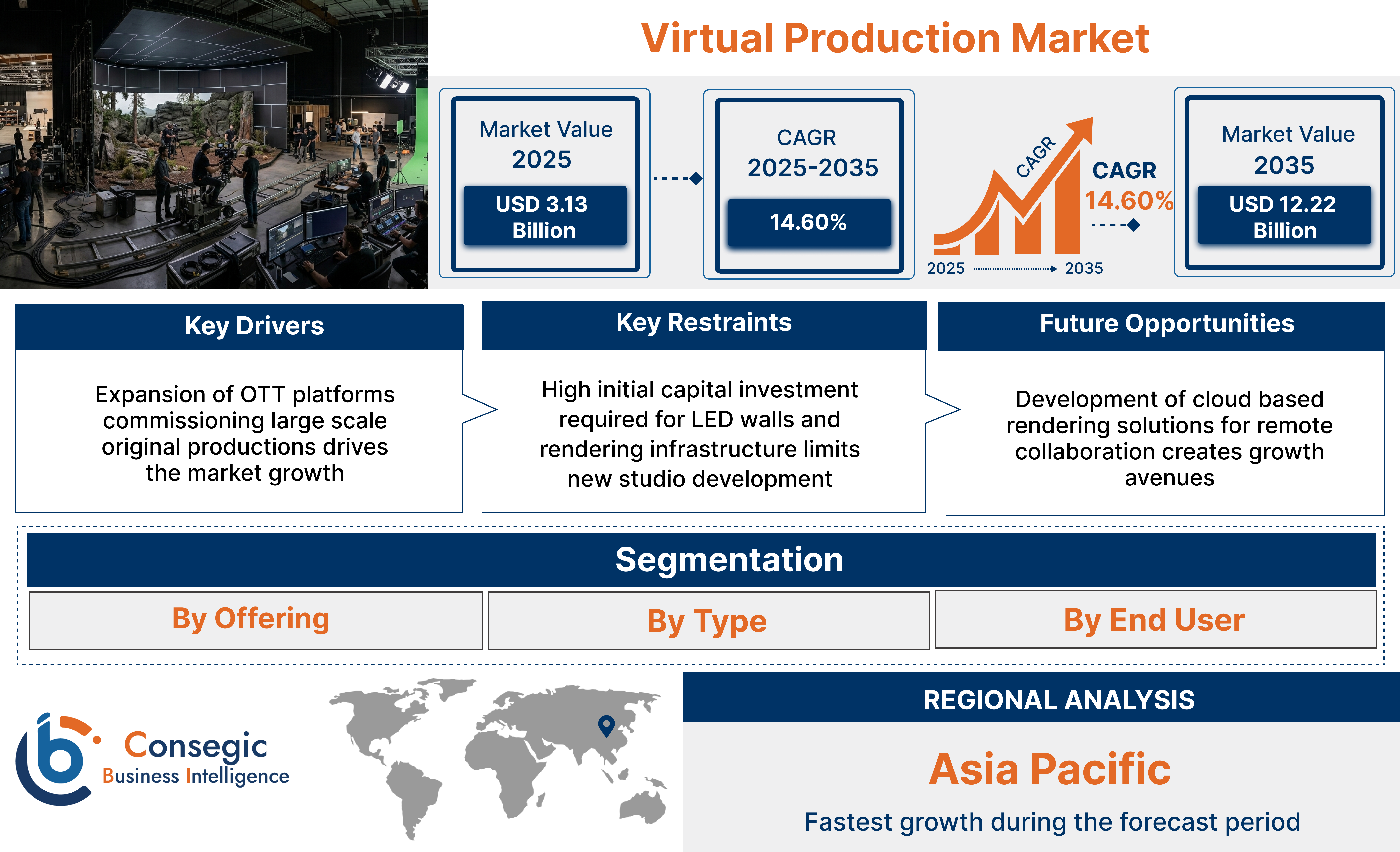
Virtual Production Market size is estimated to reach over USD 12.22 Billion by 2035 from a value of USD 2.73 Billion in 2024 and is projected to grow by USD 3.13 Billion in 2025, growing at a CAGR of 14.60% from 2025 to 2035.
Virtual Production Market Scope & Overview:
Virtual production can be described as the use of real-time digital technologies to create and integrate visual environments during the filmmaking and content creation process. This industry involves the deployment of LED volume stages, real-time rendering engines, motion capture systems, camera tracking hardware, extended reality platforms, visual effects pipelines, and cloud-based collaboration tools. The objective is to produce high-quality visual content in a controlled environment while reducing dependence on location shoots and post-production rework. The infrastructure supports large-scale studio productions, independent content creation, live broadcast integration, and real-time creative decision-making across global production teams.
The virtual production space is expanding because of the growing need for streaming content and the use of game engine technology in films and television shows. The major production studios and technology companies are investing in permanent LED stage facilities, real-time rendering, and previsualization technologies. The expansion of content platforms and the growing need for faster production timelines are also pushing studios and independent producers to shift toward virtual production workflows at a faster rate.
Market Size & Forecast
- 2024 Market Size : USD 2.73 Billion
- 2025 Market Size : USD 3.13 Billion
- 2035 Evaluate Market Size : USD 12.22 Billion
- CAGR (2025-2035) : 14.60%
- Largest growing region : North America
- Fastest growing region : Asia Pacific
How is the Virtual Production Market Affected by AI?
Artificial intelligence technologies help improve virtual production processes by processing large amounts of camera data, rendering parameter data, and composition data with a high level of accuracy. The machine learning technology identifies inconsistencies in real-time rendering, lighting, and tracking in LED volume and extended reality spaces.
The AI technology is also being used for color grading, facial performance capture, and background creation in real-time rendering. Predictive tools assess rendering load, stage calibration, and asset optimization before production delays occur, allowing teams to maintain output quality and turnaround speed across complex multi-platform projects.
Virtual Production Market Dynamics - (DRO):
Key Drivers:
Expansion of OTT platforms commissioning large scale original productions drives the market growth
Global streaming platforms are growing their subscription bases and investing heavily in original content, such as films, series, and regional content. Large content pipelines require controlled environments that can limit time and location constraints. Virtual production studios can facilitate simultaneous shoots, real-time background visualization, and quick changes between scenes, all under one roof. Production houses are increasingly adopting virtual production technologies, such as LED stages, for quick production schedules that meet the stringent deadlines set by the streaming platforms.
- As per Park Associates, on an average, US households had 4.1 paid video streaming services in 2025, compared to 2.9 in 2019, with more than half having four or more, averaging USD 61 monthly.
Therefore, the expansion of OTT platforms, which are commissioning large-scale original content, has increased the adoption of virtual production technologies.
Key Restraints:
High initial capital investment required for LED walls and rendering infrastructure limits new studio development
Significant investments are necessary in the form of LED video displays, processors, camera tracking systems, and software solutions. Building the virtual production environment is another area of high financial costs. Small-scale production companies are often at a loss in investing the necessary capital for the establishment of virtual production stages. The high asset payback period poses financial risk in the context of the dynamic nature of the technology.
Thus, high initial capital investment is restricting wider participation across small and mid-sized production studios in this market.
Future Opportunities:
Development of cloud based rendering solutions for remote collaboration creates growth avenues
Production teams are often dispersed across different geographical areas. Cloud-based rendering solutions facilitate remote access to virtual production assets. Studios are exploring scalable cloud infrastructure to reduce dependence on on-premise hardware. Remote collaboration improves production continuity and reduces physical infrastructure constraints.
- In June 2024, Dimensionworked with AWS and Arch Platform Technologies to migrate virtual production into the cloud, utilizing AWS Deadline Cloud for rendering, scalable compute/storage, and Arch for fast VPC/workstation deployments.
Thus, the development of cloud based rendering solutions is creating new growth avenues in the virtual production market.
Virtual Production Market Segmental Analysis:
By Offering:
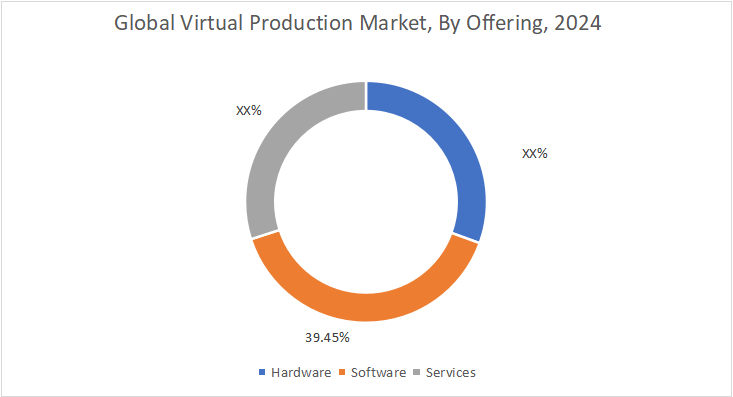
On the basis of offering, this market is segmented into hardware, software, and services.
Trends in the Offering:
- Rising installation of LED stages is increasing demand for integrated hardware systems.
- Growing complexity of real time workflows is supporting demand for specialized services.
The software was responsible for the highest revenue share of 39.45% in 2024.
- Software includes real time rendering engines, virtual environment design tools, and content integration platforms.
- Production teams are adopting game engine based rendering tools to improve workflow efficiency.
- Moreover, demand for real time scene adjustments during filming is supporting adoption.
- Additionally, Integration of AI based tools into rendering platforms is accelerating software demand.
- Therefore, increasing reliance on real time rendering and digital asset management is expected to boost the software segment during the forecast period.
It is anticipated that the services will exhibit the highest compound annual growth rate (CAGR) during the forecast period.
- Services include system integration, stage setup, technical consulting, training, and managed production support.
- There are skilled teams needed for operating and maintaining the complexity of LED and tracking systems.
- In addition, the demand for outsourced expertise is growing for mid-sized studios.
- Further, continuous software updates and system calibration are increasing service contracts.
- Therefore, expanding need for technical expertise and operational support is expected to boost the services segment during the forecast period.
By Type:
On the basis of type, market is segmented into pre-production, production, and post-production.
Trends in the Type:
- Studios are increasing the use of digital previsualization tools before principal photography.
- Real time in camera visual effects are reshaping on set production workflows.
The production was responsible for the highest revenue share in 2024.
- This also includes the live integration of digital backgrounds with physical sets, which is done through the use of LED volumes.
- Real time rendering also reduces the need for green screens and post-production.
- Also, controlled studio environments improve lighting consistency and scene accuracy.
- In addition, streaming platforms require faster turnaround of episodic content.
- Thus, real time content capture during filming is driving dominance of the production segment.
It is anticipated that the pre-production will exhibit the highest compound annual growth rate (CAGR) during the forecast period.
- Pre-production includes virtual scouting, digital set design, and technical visualization.
- Early stage visualization reduces script level uncertainties and budget overruns.
- Moreover, directors use virtual previews to refine camera movements and scene layouts.
- Furthermore, increasing demand for planning accuracy is supporting adoption.
- Therefore, higher use of digital planning tools is expected to boost the pre-production segment during the forecast period.
By End User:
On the basis of end user, this market is divided into movies, TV series, commercial ads, online videos, and others.
Trends in the End User:
- Film studios are adopting virtual production for high budget cinematic projects.
- Advertising agencies are using controlled studio environments for branded content shoots.
Movies accounted for the largest revenue share in the year 2024.
- Large scale films require complex visual environments and extended shooting schedules.
- Virtual production reduces outdoor location dependency and travel costs.
- Also, high resolution LED stages support cinematic quality output.
- Moreover, global film franchises are investing in permanent virtual production infrastructure.
- Thus, as per this market analysis, demand for controlled large scale film production is driving dominance of the movies segment.
TV series is anticipated to register the fastest CAGR during the forecast period.
- Streaming platforms are commissioning multi season content with tight timelines.
- Episodic production requires repeatable digital environments.
- Additionally, the virtual stages also allow for quick scene changes between episodes.
- Further, the optimization of budgets for the extended production cycles also helps the adoption.
- For example, in December 2025, Korea has opened its largest virtual production studio, which is located at the Studio Cube facility in Daejeon, Korea, and was opened in December 2025. This studio has a 60m x 8m LED screen that combines live-action filming with real-time 3D graphics for dynamic and immersive scenes.
- Therefore, rising demand for high volume episodic content is expected to boost the TV series segment during the forecast period.
Regional Analysis:
North America, Europe, Asia Pacific, the Middle East and Africa, and Latin America are the regions of coverage.
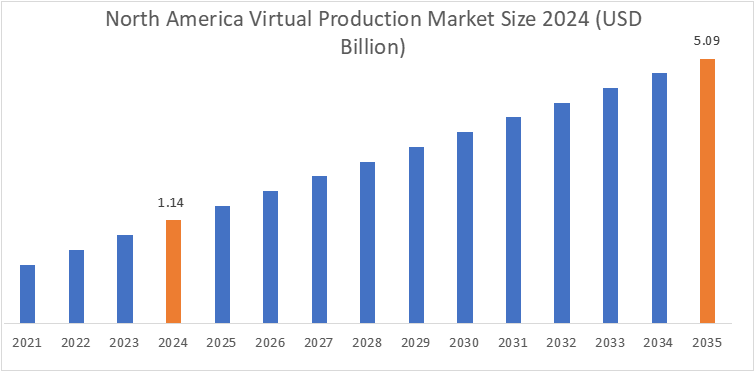
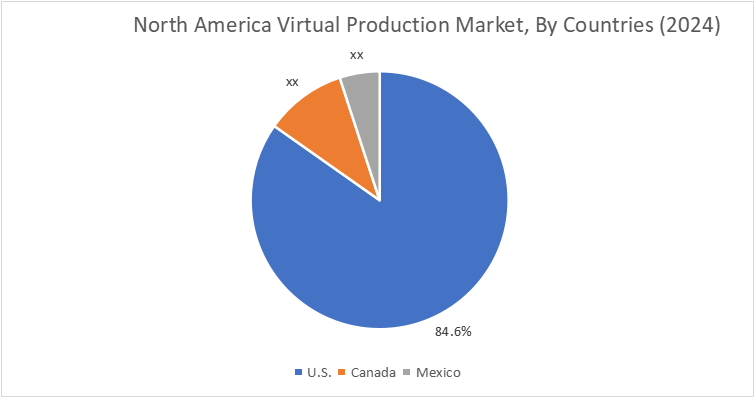
In 2024, North America accounted for the highest market share at 41.8% and was valued at USD 1.14 Billion, and is expected to reach USD 5.09 Billion by 2035. In North America, the U.S. accounted for the highest market share of 84.6% during the base year of 2024. The growth of the market is facilitated by the presence of key film studios, streaming services, and developed infrastructure for LED stages. High content production budgets and early adoption of real time rendering tools are increasing virtual production deployment across movies and episodic series. In addition, Canada is increasing studio space with government-backed incentives for local productions.
- For example, in February 2025, LG launched its first Virtual Production Studio in North America in February 2025. It includes double-wall 1.5-pixel pitches of MAGNIT Micro LED displays for faster and cost-effective content creation, reducing the time to build content from days to hours. The studio boosts LG's marketing efficiency using real-time rendering and partner tech like Megapixel HELIOS.
Asia Pacific is expected to witness the fastest growth during the forecast period. China is investing heavily in high-tech digital film studios and large-scale LED volumes to address the growing need for local content production. India is increasing OTT-based original content production, which is fueling the adoption of controlled studio environments. South Korea and Japan are integrating virtual production into television and commercial advertising productions. The growth in regional streaming subscriptions is aiding the expansion of infrastructure.
- In July 2025, Absen and Versatile introduced the world's largest LED virtual production volume in Deqing, China. This is a 270° curved 50m-diameter, 12m-high screen covering 1,700m² (four basketball courts) that redefines immersive content creation scale.
Europe market growth is supported by film production incentives and cross border content collaborations in the UK, Germany, and France. Rise in demand for high quality visual effects in regional series and films is increasing investment in rendering software and technical services.
Latin America market growth is supported by expansion of local streaming content in Brazil and Mexico. Production houses are opting for compact LED solutions to minimize costs and risks associated with shooting outdoors.
The growth of the Middle East & Africa region for driven by diversification initiatives for the media sector in the UAE and Saudi Arabia. Large scale studio infrastructure development projects are attracting international film production companies. Virtual production technology is being integrated into the South African market for enhancing local film and advertising production.
Top Key Players & Market Share Insights:
The market is moderately consolidated with technology providers, LED manufacturers, rendering engine providers, and studios competing with each other. Companies are forming partnerships with film studios and streaming services, and investing in advanced software, LED, and camera tracking technology. The development of dedicated virtual production facilities and services is enhancing the competitive landscape for companies. Key participants in the market for virtual production include:
- Sony Group Corporation– Japan
- NVIDIA Corporation– US
- Epic Games, Inc.– US
- Autodesk, Inc. – US
- ROE Visual Co., Ltd. – China
- Disguise Systems Limited – UK
- Pixomondo – Germany
- Brompton Technology Ltd. – UK
- ARRI AG – Germany
- NEP Group, Inc. – US
Recent Industry Developments:
Product Launches
- In October 2025, SWR launched a three-month virtual production trial with Sony in Baden-Baden, using a 10x4m VERONA LED wall and OCELLUS tracking for live multi-camera broadcasts like the interactive Twitch show "Fehler im System." This partnership tests efficiency gains and creative possibilities for future TV programming.
- In April 2025, Samsung and Vu announced a partnership to showcase the company’s virtual production technology at NAB Show 2025. It includes the company’s high-end LED displays along with real-time rendering capabilities to help create an efficient filmmaking process.
Virtual Production Market Report Insights:
| Report Attributes | Report Details |
|---|---|
| Study Timeline | 2019-2035 |
| Market Size in 2035 (USD Trillion) | USD 12.22 Billion |
| CAGR (2025-2035) | 14.60% |
| By Offering |
|
| By Type |
|
| By End User |
|
| By Region |
|
| Key Players |
|
| Report Coverage |
|
Key Questions Answered in the Report
How big is the virtual production market? −
The virtual production market sizeis estimated to reach over USD 12.22 Billion by 2035 from a value of USD 2.73 Billion in 2024 and is projected to grow by USD 3.13 Billion in 2025, growing at a CAGR of 14.60% from 2025 to 2035.
Which segmentation details are covered in the virtual production report? +
The virtual production report includes specific segmentation details for offering, type, end user, and regions.
Which is the fastest segment anticipated to impact the market growth? +
Services is the fastest growing segment, driven by rising demand for system integration, technical consulting, and managed support.
Who are the major players in the virtual production market? +
The key participants in the virtual production marketare Sony Group Corporation (Japan), NVIDIA Corporation (US), Epic Games, Inc. (US), Autodesk, Inc. (US), ROE Visual Co., Ltd. (China), Disguise Systems Limited (UK), Pixomondo (Germany), Brompton Technology Ltd. (UK), ARRI AG (Germany), NEP Group, Inc. (US), and others.
What are the key trends in the virtual production market? +
The virtual production market is shaped by increasing adoption of real time rendering engines, expansion of LED volume stages, and growing OTT commissioned content.
Overview
Reputation & Certifications


Our Services
- Market Intelligence & Forecasting
- Custom Research Solutions
- Market Entry Strategy
- Competitive Intelligence
- Customer Insights
- Industry Innovation Analysis
- Investment Advisory