Jump to Content
Vision Processing Unit Market Size & Industry Share - Growth Trends & Forecasts (2026 - 2034)
Vision Processing Unit Market Size:
Vision Processing Unit Market size is estimated to reach over 15,427.77 (US$M) by 2034 from a value of 3,697.89 (US$M) in 2025 and is projected to grow by 4,333.93 (US$M) in 2026, growing at a CAGR of 17.2% from 2026 to 2034, according to a recent report from Consegic Business Intelligence.
Vision Processing Unit Market Scope & Overview:
Vision Processing Unit (VPU) is a chip-based processor designed to specifically accelerate artificial intelligence and machine learning workloads on devices. The processor has the ability to improve system responsiveness, improve efficiency, and enhance AI computer performance. Moreover, the key role of a vision processor is to enable devices to quickly process, analyze, and make decisions based on visual inputs. Additionally, the advantages include enhanced computer vision performance, improved power efficiency, enhanced real-time processing capabilities, improved scalability &flexibility as well as compatibility with AI frameworks among others. Further, the rising demand to manage computer vision and edge AI workloads efficiently is propelling the vision processing unit market growth.

Vision Processing Unit Market Dynamics - (DRO) :
Key Drivers:
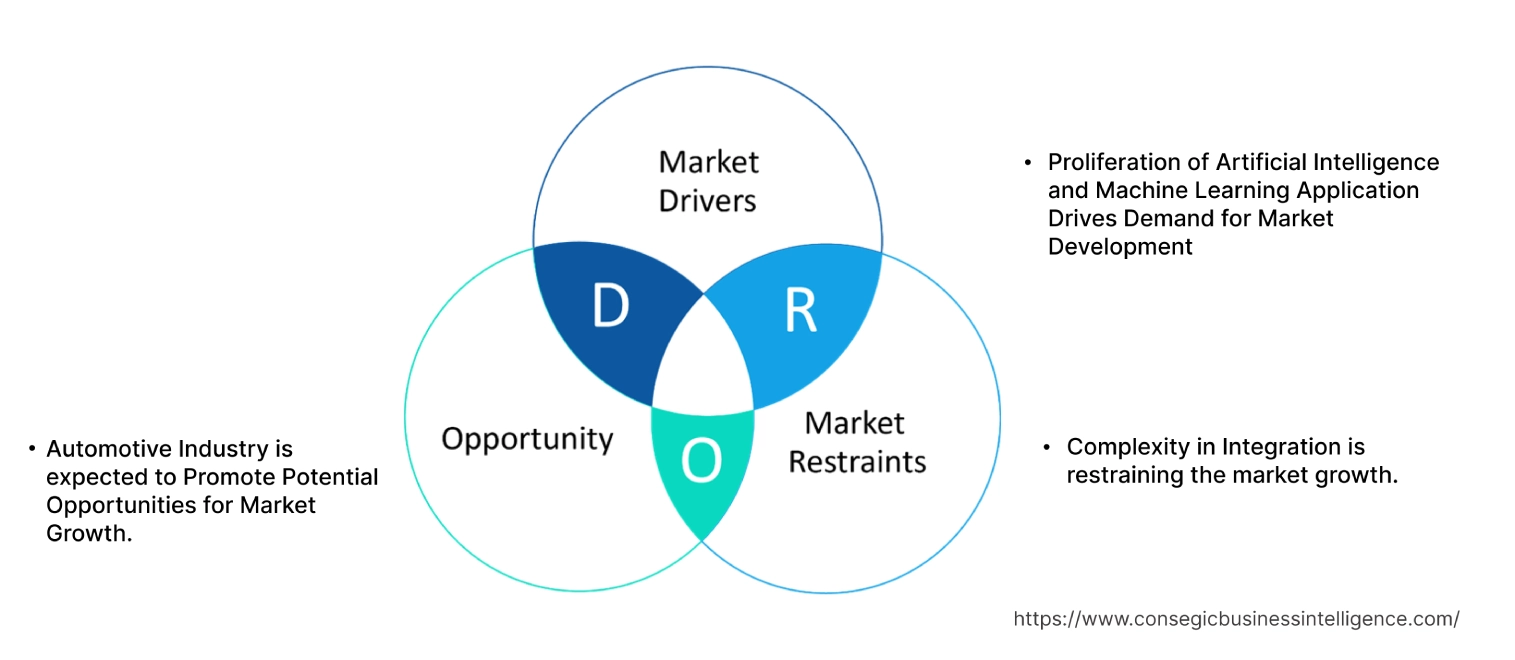
Proliferation of Artificial Intelligence and Machine Learning Application Drives Demand for Market Development
The rising demand for boosting AI and ML capabilities is driving the vision processing unit market. Moreover, the primary role of vision processors in artificial intelligence and machine learning is to optimize the workload related to object detection, people counting, facial recognition, and real-time video analytics. Further, the integration of vision processors into AI and ML-embedded devices amplifies the need for high-performance, energy-efficient VPUs which in turn drives the vision processing unit market growth.
- For instance, in December 2020, Lenovo launched the ThinkSmart Cam and ThinkSmart Bar with built-in VPU to enhance the AI conference meeting with advanced features such as autozoom, auto framing, people counting, and others.
Thus, the rising demand for boosting AI and ML capabilities and integration of vision processors into AI and ML-embedded devices is driving the growth of the market.
Key Restraints :
Complexity in Integration is restraining the market growth.
The integration of VPUs into existing hardware and software peripherals embedded with AI requires significant modifications that hamper market expansion. Moreover, increasing complexity requires specialized knowledge and skills restraining the vision processing unit market expansion. Additionally, adjustments require calibration also increasing the complexity of integration. Furthermore, the integration of vision processors in existing infrastructure inherits complex tasks hindering market development.
Thus, the complexity of integration into existing systems and the need for knowledge and skills hinder the development of the market.
Future Opportunities :
Automotive Industry is expected to Promote Potential Opportunities for Market Growth.
The automotive industry for vision processors is growing rapidly due to the integration of ADAS features into vehicles promoting the market. Further, the emergence of Industry 4.0 which automates all the production processes while adhering to the high quality standards is driving the demand for vision processor units to make decisions based on visual inputs. Additionally, the vision processor unit enhances the component inspection process in the manufacture of cars driving the vision processing unit market opportunity. Further, the advanced driver-assistance system is integrated with a vision processor unit to enhance the vision capabilities in the car with advanced features such as lane departure warnings, pedestrian detection, and others.
- For instance, in April 2023, MediaTek launched Dimensity Auto, which is a cutting-edge technology designed for the automotive sector to enhance the always-connected vehicle's capabilities. Additionally, the Dimensity Auto Cockpit features include a deep learning accelerator, and vision processing unit, and others.
Thus, the integration of the processing unit into an advanced driver-assistance system as well as the need to enhance the inspection process is propelling the vision processing unit market opportunity.
Vision Processing Unit Market Segmental Analysis :
By Fabrication Process:
Based on the fabrication process, the market is bifurcated into ≤16 nm and 16–28 nm.
Trends in the fabrication process:
- The trend towards miniaturization of chipsets for enhancing performance and efficiency is driving the need for a ≤16 nm fabrication process.
- The trends towards the growing semiconductor sector which is propelling the advancement in the fabrication process for applications in AR and VR technologies.
The ≤16 nm segment accounted for the largest revenue share in the year 2024.
- ≤16 nm fabrication process has a major advantage of improved performance and less power consumption driving the adoption of ≤16 nm fabrication process.
- Additionally, the ≤16 nm fabrication process is majorly used in high-end mobile computing, automotive electronic applications, and others propelling the progress of the vision processing unit industry.
- For instance, Samsung has developed an Exynos 8895 processor for improved performance and power efficiency. The processor is embedded with a vision processing unit with advanced 10nm FinFET process technology.
- Thus, as per the analysis, the rising need for various applications and aforementioned advantages is driving the evolution of ≤16 nm fabrication process in turn propelling the vision processing unit market trends.
The 16–28 nm is anticipated to register the fastest CAGR during the forecast period.
- The 16-28 nm fabrication process features high performance and low power consumption capabilities driving the progress of the vision processing unit market.
- Further, the rising adoption in various applications including 5G RF transceivers, Internet of Things (IoT), and automotive radar among others propelling the vision processing unit market expansion.
- For instance, the Intel Movidius Myriad 2 Vision Processing Unit utilizes a 28nm fabrication process designed for enhancing performance and energy efficiency.
- Therefore, as per the analysis, the aforementioned features and a wide range of applications are anticipated to boost the market during the forecast period.
By Application:
Based on the application, the market is segmented into ADAS, Smart Phones, Cameras, Surveillance Systems, Medical Imaging Technologies, HVAC Systems, Smart Homes, and Others.
Trends in the Application:
- The trend toward smart city initiative is fueling the growth of the vision processing unit market in smart home applications.
- The growing healthcare sector is increasingly leveraging vision-based processing units for enhancing medical imaging and diagnostic capabilities propelling the market trend.
Smart Phones accounted for the largest revenue share in the year 2024 and are anticipated to register the fastest CAGR during the forecast period.
- The primary role of the vision processing unit in smartphones is to enhance the capabilities of various advanced features such as image processing, object detection, AR & VR, among others driving the vision processing unit market demand.
- Further, the increasing shift towards the user experience is propelling the development of smartphone applications.
- For instance, in December 2021, HiSilicon launched HiSilicon AI ISP`, which is a smart image signal processor for Internet of Things (IoT) smart devices. The Processor is a combination of the neural network processing unit and a vision processing unit for seamless hardware-software collaboration.
- Thus, as per the analysis, the shift towards enhancing user experience and the need to enhance the capability is driving the smartphone application of the market.
By End-User:
Based on the end-user, the market is segmented into Automotive, Security and Surveillance, Healthcare, Consumer Electronics and Others.
Trends in the End-User:
- The need for tracking patient movements and behaviors as well as improving patient care and safety is propelling the healthcare segment.
- The trend towards understanding customer buying patterns and preferences which helps in enhancing customer experiences is driving the market in the retail sector.
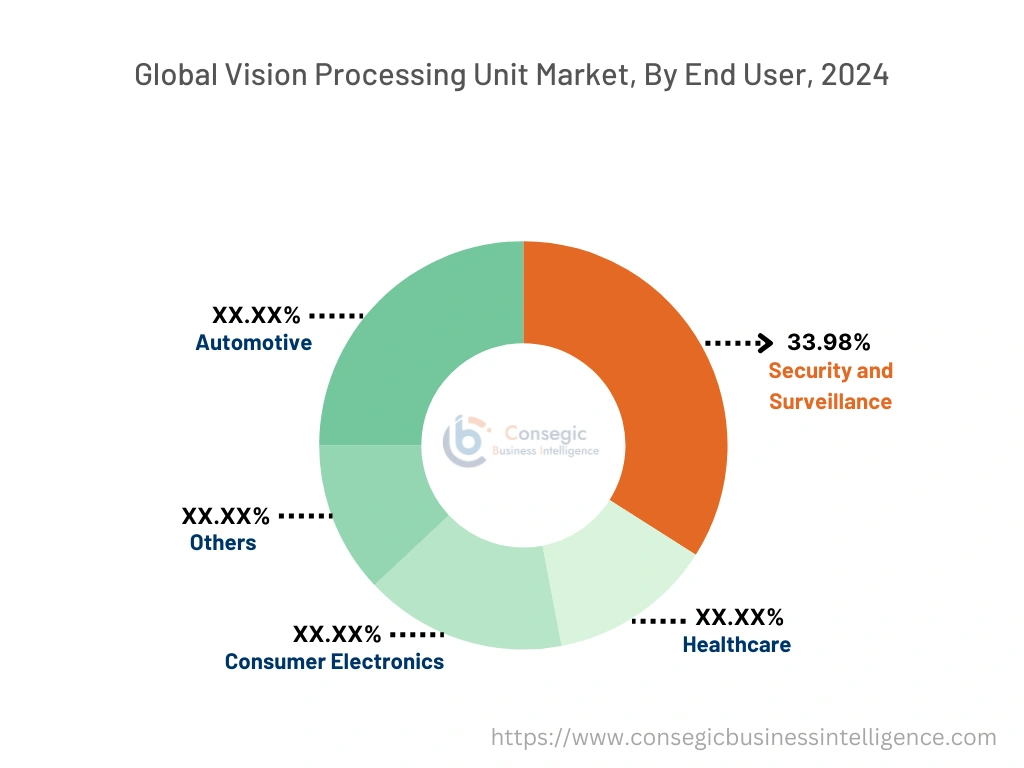
Security and Surveillance accounted for the largest revenue share of 33.98% in the year 2024.
- Vision processor unit in the security and surveillance segment utilizes smart image processing capabilities in the system to process, compress, and store digital images.
- Further, the rapidly advancing digital age is propelling the need for integrating computer vision into CCTV systems to improve security, public safety, and data analysis driving the progress of security and surveillance.
- For instance, in February 2023, Dahua launched the IPC WizMind S Series surveillance system. The system utilizes AI technology to improve image performance and intelligent functions and supports flexible environment adaptability.
- Thus, as per the analysis, the rapidly advancing digital age is driving the vision processing unit market demand for the security and surveillance segment.
The Automotive is anticipated to register the fastest CAGR during the forecast period.
- The vision processor unit plays a key role in enhancing various automotive features such as parking assistance, lane departure warnings, collision avoidance systems and other boosting the automotive segment.
- Further, the VPU has the ability to handle large amounts of data by providing a high level of functionality with low power consumption is driving the market.
- For instance, NXP Semiconductors have Automotive Vision Systems to enhance the advanced driver assistance systems and achieve fully autonomous L5 vehicles.
- Therefore, according to the vision processing unit market analysis, the ability to handle large amounts of data is anticipated to boost the evolution of the vision processing unit market size during the forecast period.
Regional Analysis:
The regions covered are North America, Europe, Asia Pacific, the Middle East and Africa, and Latin America.
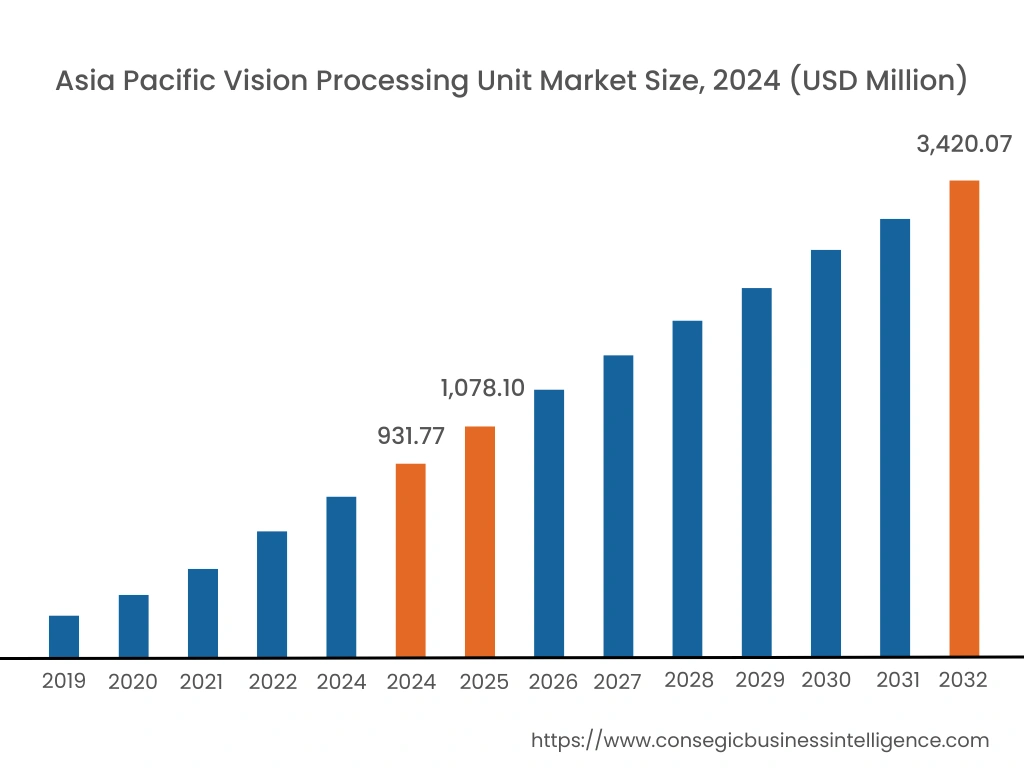
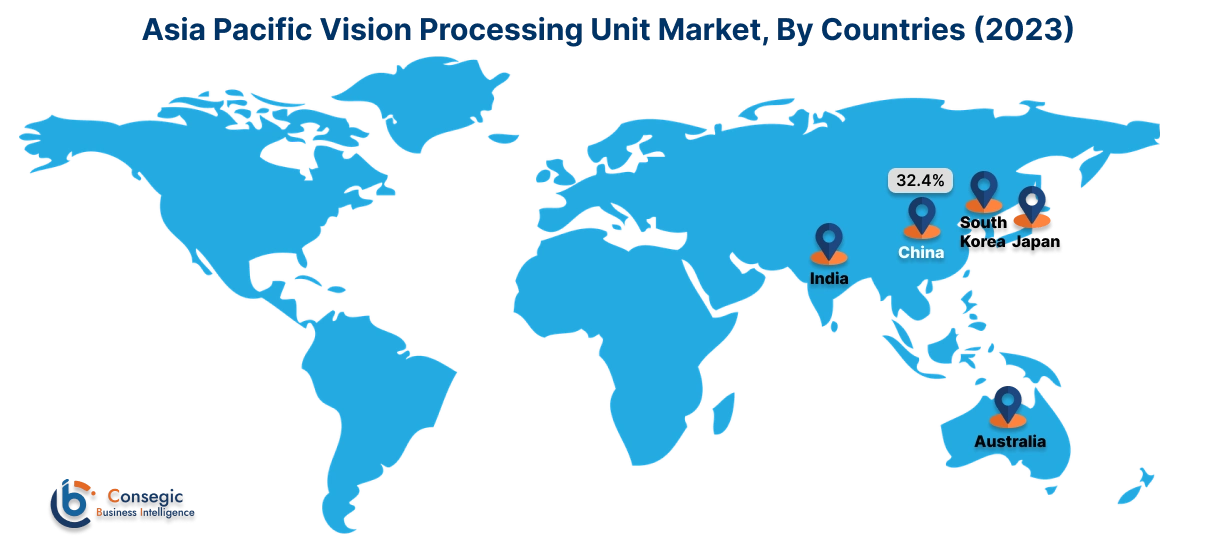
Asia Pacific region was valued at USD 931.77 Million in 2024. Moreover, it is projected to grow by USD 1,078.10 Million in 2025 and reach over USD 3,420.07 Million by 2032. Out of this, China accounted for the maximum revenue share of 32.4%. The Asia Pacific region's growing consumer electronics sector offers lucrative growth prospects for the market. Additionally, the growing smart city initiative is projected to drive the vision processing unit market share during the forecast period.
- For instance, in September 2020, Advantech based out in Taiwan, launched the TREK-60 Modular In-Vehicle AI Platform. The platform aims to enhance fleet management and surveillance applications. Additionally, the TREK-60 features a built-in Intel Movidius Myriad X from Intel.
North America is estimated to reach over USD 3,640.21 Million by 2032 from a value of USD 1,049.47 Million in 2024 and is projected to grow by USD 1,208.54 Million in 2025. The vision processing unit market share is mainly driven by its deployment in AR and VR applications as well as in the automotive sector and other industries.
- For instance, in October 2020, Intel partnered with ESA and Ubotica for the launch of PhiSat-1 satellite. The satellite uses Intel's Movidius Myriad 2 chip which is a vision processor designed for disaster mitigation.
Furthermore, factors including the growing healthcare sector which is enhancing medical imaging and diagnostic capabilities driving the market growth in the North American region.
The regional vision processing unit market analysis depicts that the rising need for enhancing security and the government shifting focus towards safety and security in Europe is driving the vision processing unit market size. Additionally, the primary factor driving the market in the Middle East and African region is rising investment in smart city projects. Further, the evolution of the automotive sector with the increasing adoption of ADAS features and increasing adoption of drones in the agriculture sector is paving the way for the progress of the vision processing unit market trend in the Latin America region.
Top Key Players & Market Share Insights:
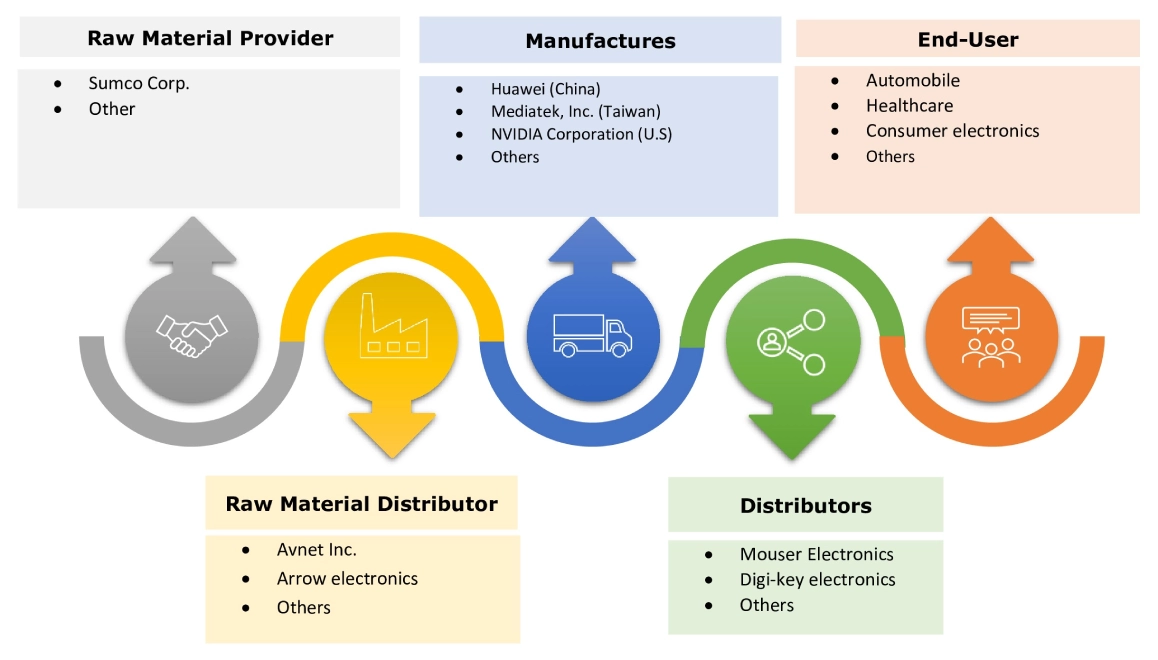
The global vision processing unit market is highly competitive with major players providing processors to the national and international markets. Key players are adopting several strategies in research and development (R&D), product innovation, and end-user launches to hold a strong position in the vision processing unit market. Key players in the vision processing unit industry include-
- Intel (U.S)
- Active Silicon Ltd (U.S)
- Qualcomm Technologies, Inc. (U.S)
- Advanced Micro Devices, Inc. (AMD) (U.S)
- Ambarella, Inc. (U.S)
- Samsung (South Korea)
- Google (U.S)
- Huawei (China)
- Mediatek, Inc. (Taiwan)
- NVIDIA Corporation (U.S)
Recent Industry Developments :
Partnerships & Collaborations:
- In April 2024, Avnet partnered with Qualcomm Technologies, Inc. for the launch of two new ARM-based Systems on Modules. The MSC SM2S-QCS6490 SMARC 2.1.1 module family and MSC SM2S-QCS5430 SMARC 2.1.1 module family are embedded with Qualcomm Adreno 633 VPU.
Vision Processing Unit Market Report Insights :
| Report Attributes | Report Details |
| Study Timeline | 2021-2034 |
| Market Size in 2034 | USD 15,427.77 Million |
| CAGR (2026-2034) | 17.20% |
| Base Year | 2025 |
| By Fabrication Process |
|
| By Application |
|
| By End-User |
|
| By Region |
|
| Key Players |
|
| North America | U.S. Canada Mexico |
| Europe | U.K. Germany France Spain Italy Russia Benelux Rest of Europe |
| APAC | China South Korea Japan India Australia ASEAN Rest of Asia-Pacific |
| Middle East and Africa | GCC Turkey South Africa Rest of MEA |
| LATAM | Brazil Argentina Chile Rest of LATAM |
| Report Coverage |
|
Key Questions Answered in the Report
How big is the Vision Processing Unit market? −
Vision Processing Unit Market size is estimated to reach over USD 11,231.76 Million by 2032 from a value of USD 3,163.83 Million in 2024 and is projected to grow by USD 3,650.36 Million in 2025, growing at a CAGR of 17.2% from 2025 to 2032.
What specific segmentation details are covered in the Vision Processing Unit report? +
The Vision Processing Unit report includes specific segmentation details for the fabrication process, application, end use, and regions.
Which is the fastest segment anticipated to impact the market growth? +
In the Vision Processing Unit market, the smartphone segment is the fastest-growing segment during the forecast period due to rising demand for enhancing the capabilities of various advanced features such as image processing, object detection, AR & VR, among other
Who are the major players in the Vision Processing Unit market? +
The key participants in the Vision Processing Unit market are Intel (U.S), Active Silicon Ltd (U.S), Samsung (South Korea), Google (U.S), Huawei (China), Mediatek, Inc. (Taiwan), NVIDIA Corporation (U.S), Qualcomm Technologies, Inc. (U.S), Advanced Micro Devices, Inc. (AMD) (U.S), Ambarella, Inc. (U.S) and others.
What are the key trends in the Vision Processing Unit Market? +
The Vision Processing Unit market is being shaped by several key trends including increasing utilization in the automotive and healthcare industry for tracking movements and behaviors as well as the trend towards enhancing customer experiences are the key trends driving the market.
Overview
Reputation & Certifications


Our Services
- Market Intelligence & Forecasting
- Custom Research Solutions
- Market Entry Strategy
- Competitive Intelligence
- Customer Insights
- Industry Innovation Analysis
- Investment Advisory