Jump to Content
Waste Oil Market - Size, Share, Industry Trends, and Forecasts (2025-2032)
Waste Oil Market Size:
Waste Oil Market size is growing with a CAGR of 5.1% during the forecast period (2025-2032), and the market is projected to be valued at USD 82.29 Billion by 2032 from USD 55.32 Billion in 2024. Additionally, the market value for the 2025 attributes to USD 57.97 Billion.
Waste Oil Market Scope & Overview:
Waste oil is any petroleum-based or synthetic oil that, through contamination or loss of original properties, is no longer suitable for its original purpose. These include various types such as engine oils, transmission oils, refrigeration and compressor oils, metalworking oils, and a wide range of lubricating oils. The collection typically occurs from automotive service centers, industrial facilities, power plants, and other sources generating oils. This oil is processed through technologies such as vacuum distillation and hydrogen treatment (hydrotreating), which are employed to remove contaminants and recover valuable base oils. These processed oils find applications in re-refining to produce new lubricants, biodiesel production as a feedstock, direct use in waste oil heaters and special space heaters, and even as a component in asphalt plants, contributing to resource recovery and environmental sustainability.

Waste Oil Market Dynamics - (DRO) :
Key Drivers:
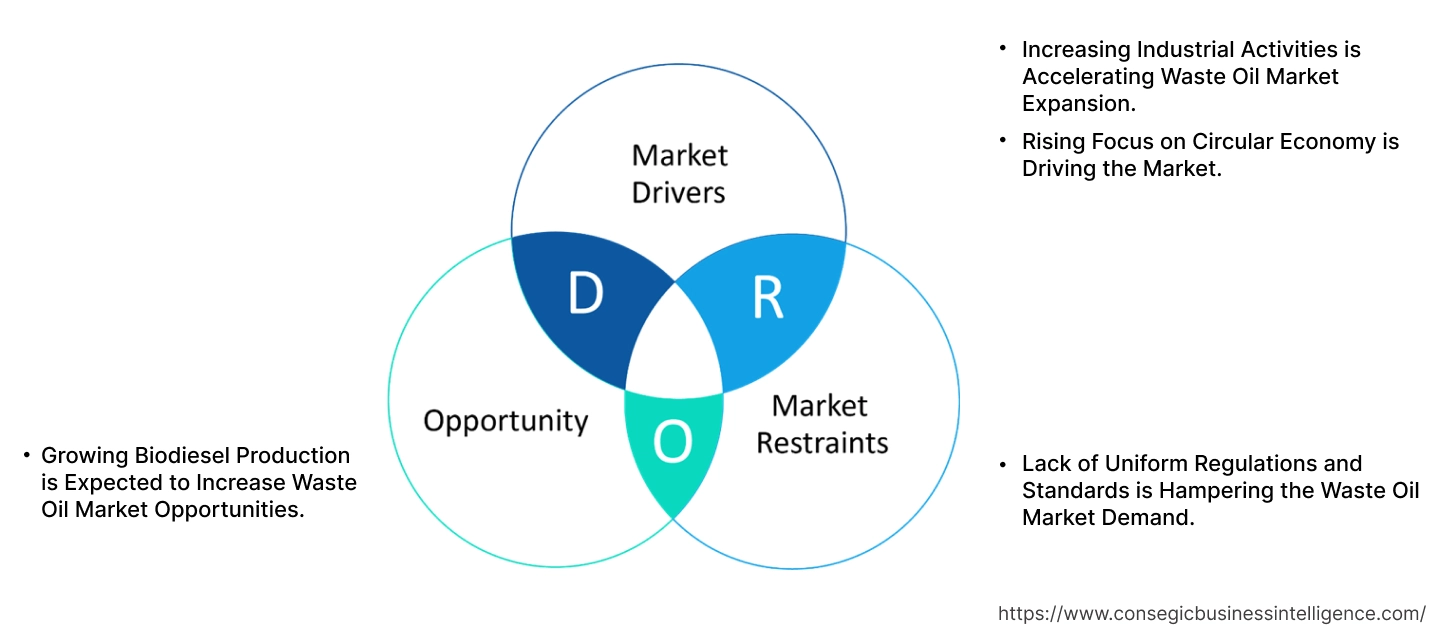
Increasing Industrial Activities is Accelerating Waste Oil Market Expansion.
There has been expansion in automotive, marine, power generation, and other sectors, boosting lubricant consumption. Moreover, there is also an increase in transportation fleets, encompassing land, air, and sea travel, rising requirements for engine oils, transmission fluids, and hydraulic oils. The growing consumption of these oils has led to an increase in the generation of waste oil as well, thus requiring services to manage it.
For instance,
- According to an article published by Biofabrik, in 2023, the United States alone generates over 18 billion barrels of waste oil annually from various industrial activities.
Overall, the increasing industrial activities are significantly boosting the waste oil market expansion.
Rising Focus on Circular Economy is Driving the Market.
The circular economy is a production and consumption model focused on maximizing resource use, value extraction, and product recovery and regeneration at end-of-life. Governments and companies are focusing on the circular economy by launching new waste oil services, which are crucial for the circular economy, as they prevent pollution and enable the recycling of used oil into valuable products such as biodiesel. This process reduces reliance on new resources and generates economic value from waste.
For instance,
- In 2022, Shell launched a "used oil management service" in India to formalize the country's waste oil disposal system and increase the re-refining rate. This initiative aims to achieve circular economy goals while reducing waste, thus positively influencing waste oil market trends.
Thus, the rising focus on the circular economy is accelerating the global waste oil market growth.
Key Restraints:
Lack of Uniform Regulations and Standards is Hampering the Waste Oil Market Demand.
The absence of consistent definitions for "waste oil," varying levels of acceptable contaminants, and disparate quality specifications for re-refined products create complexities for international trade. This patchwork of regulations hinders the cross-border movement of waste oil for processing and the sale of re-refined oils, as companies face different compliance requirements in each jurisdiction. Furthermore, the uncertainty surrounding varying standards deters international investment in waste oil processing infrastructure. Companies are hesitant to invest in facilities that do not meet the regulatory requirements of potential export markets or that face inconsistent quality demands. This lack of harmonization ultimately fragments the market, limits economies of scale, and impedes the development of a truly global and efficient waste oil recycling industry. Hence, the lack of uniform regulations and standards is hampering the waste oil market demand.
Future Opportunities :
Growing Biodiesel Production is Expected to Increase Waste Oil Market Opportunities
Biodiesel is a renewable and biodegradable fuel. Oils which are considered waste, play a significant role in biodiesel production as they serve as a cost-effective and sustainable feedstock. Instead of being discarded, waste oil from various sources such as restaurants and industrial processes undergo a chemical process called transesterification to be converted into biodiesel. This process reduces waste and lowers the demand for virgin vegetable oils which acts as one of the key feedstocks for biodiesel feedstock. Growing global preference for environmentally friendly alternatives to traditional petroleum-based diesel fuel will increase biodiesel production, thus positively influencing the need for waste oil as a feedstock.
For instance,
- According to a study published in Springer, in 2025, global biodiesel production is expected to grow at a CAGR between 8% and 10% from 2022 to 2032. This creates potential for the market.
Overall, growing biodiesel production is expected to increase waste oil market opportunities.
Waste Oil Market Segmental Analysis :
By Type:
Based on type, the market is categorized into engine oils, transmission oils, refrigeration & compressor oils, metalworking fluids & oils, lubricating oils, and others.
Trends in Type:
- Increasing focus on sustainability and stricter environmental regulations are driving higher rates of engine oil collection and re-refining into new base oils.
- Improved collection infrastructure and awareness are leading to a greater volume of used transmission fluids being directed toward processing and potential reuse.
The lubricating oils segment accounted for the largest market share in 2024.
- Waste lubricating oils are generated when lubricating oils, typically derived from crude oil or synthetically manufactured, become contaminated by various physical and chemical impurities.
- They are processed into fuel oils, and they are used as raw materials in the refining and petrochemical industries. Moreover, these oils are also recycled for their scrap metal Additionally, they are re-refined into base oils, which are then used to produce new lubricants.
- Manufacturers are increasing the production of re-refined base oil due to growing environmental awareness, promoting waste oil recycling, thus influencing the demand for waste lubricating oils for production purposes.
- For instance, in 2024, ExxonMobil announced a significant initiative at its Gravenchon Refinery to begin the production of re-refined base oils (RRBO) derived from used oils.
- Overall, as per the market analysis, the increased re-refined base oil manufacturing is driving a segment in waste oil market growth.
The refrigeration & compressor oils segment is expected to grow at the fastest CAGR over the forecast period.
- These are specialized oils used in refrigeration and air conditioning systems, as well as in various types of air and gas compressors.
- Over time, the oil breaks down due to thermal stress, oxidation, and chemical reactions within the system.
- Waste refrigeration & compressor oils are reprocessed to produce new base oils suitable for formulating fresh refrigeration and compressor lubricants, thus closing the material loop.
- Moreover, depending on the level of contamination and processing, they are used as a fuel source in industrial boilers or specialized heating systems.
- Increased shipping and power generation are driving higher fuel oil production, thus driving the demand for waste refrigeration & compressor oils for production processes.
- According to market analysis, the rising fuel oil production will drive the segment in the market trends for the upcoming years.
By Application:
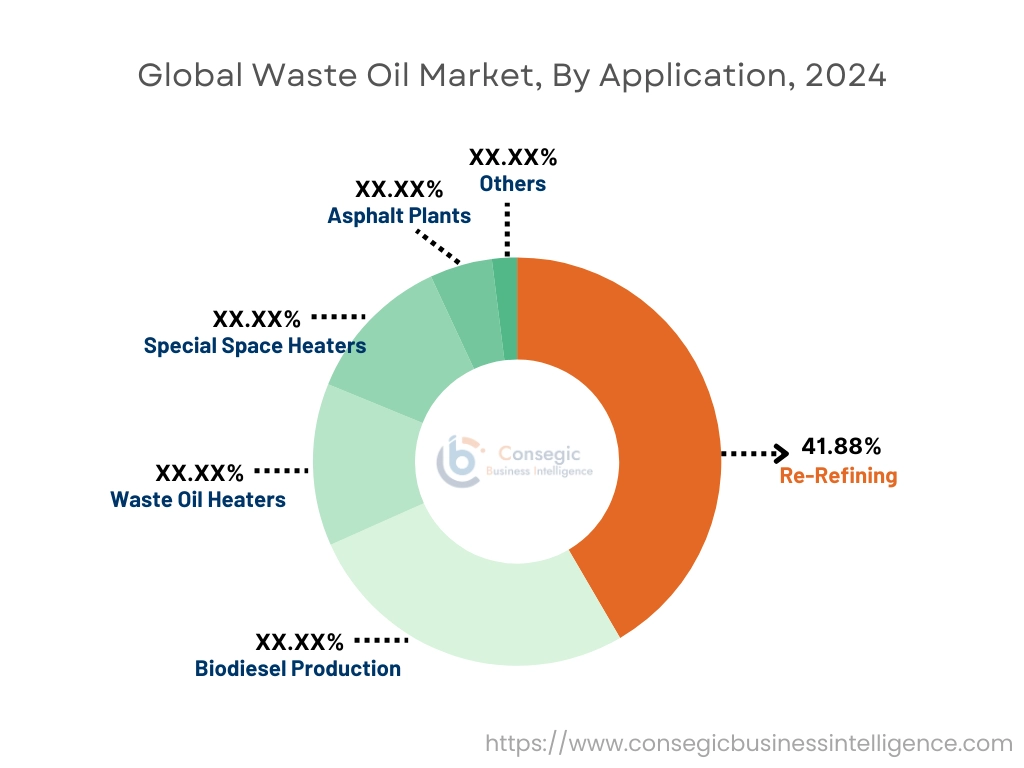
Based on application, the market is categorized into re-refining, biodiesel production, waste oil heaters, special space heaters, asphalt plants, and others.
Trends in the Application
- Waste oil is being processed into specialized fuel oils for niche applications such as marine fuels and as a substitute in certain industrial burners.
- Ongoing Research is being conducted to explore the potential of converting certain components of waste oil into bioplasticizers and other bio-based polymers.
The re-refining segment accounted for the largest market share of 41.88% in 2024.
- Re-refining is a significant application, where waste oil undergoes a series of processes to remove contaminants, water, and degraded additives, restoring the base oil to a quality comparable to virgin base oil.
- The re-refined base oils produced are then used to manufacture a variety of products, most notably new lubricating oils for automotive (engine oil, transmission fluid) and industrial applications (hydraulic fluids, gear oils).
- Increasing environmental regulations and the economic viability of using a cheaper feedstock has led manufacturers to expand their re-refining capabilities.
- For instance, in 2024, TotalEnergies acquired Tecoil, which uses optimized "re-refining" process to produce high-quality base oils. The company will increase the re-refining process, positively impacting the segment.
- Overall, as per the waste oil market analysis, manufacturers expanding their capabilities is driving segment in the waste oil industry.
The biodiesel production segment is expected to grow at the fastest CAGR over the forecast period.
- Instead of being discarded, waste oil from various sources, including cooking oil and industrial lubricants, undergo a chemical process called transesterification.
- This reaction converts the triglycerides in the waste oil into biodiesel and glycerin, a byproduct.
- It provides a cost-effective alternative to virgin vegetable oils, reduces the environmental burden of waste oil disposal, and contributes to a more sustainable fuel cycle.
- This application aligns perfectly with the principles of a circular economy by repurposing a discarded material into a renewable energy source, lessening reliance on fossil fuels and minimizing environmental impact.
- Rising environmental awareness, and the potential benefits of biodiesel as a fuel will drive its increased production, creating potential for the market.
- Thus, as per the market analysis, the growing biodiesel production will drive segmental share for the forecasted years.
Regional Analysis:
The regional segment includes North America, Europe, Asia Pacific, the Middle East and Africa, and Latin America.
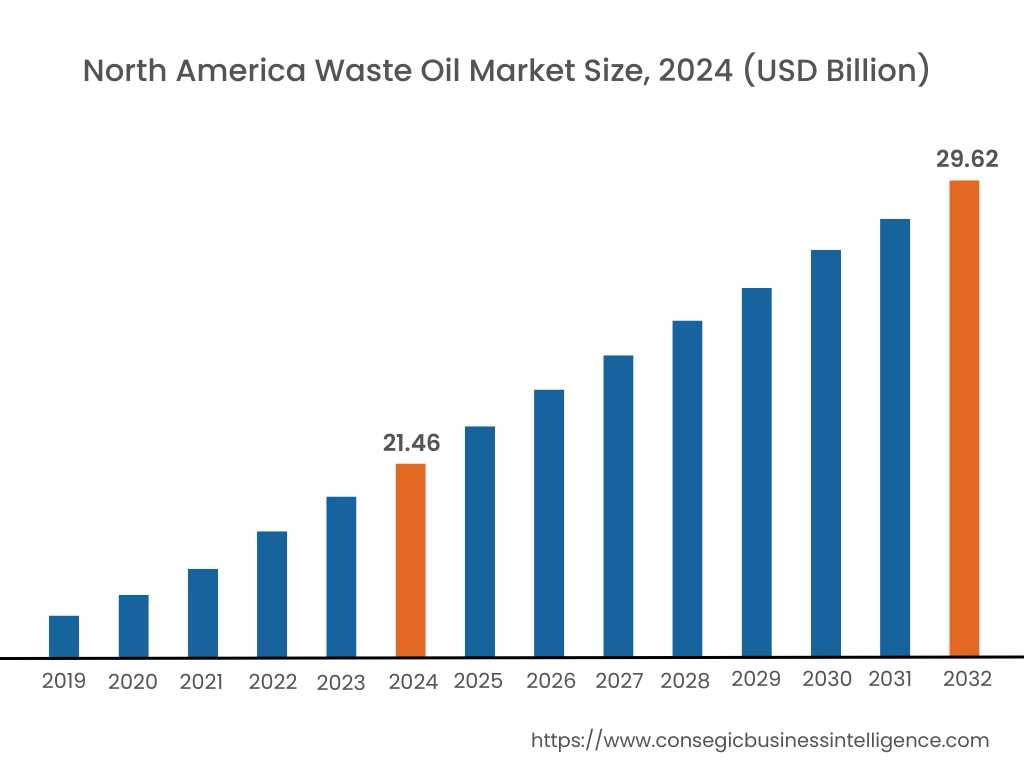
In 2024, North America accounted for the highest waste oil market share at 38.79% and was valued at USD 21.46 Billion and is expected to reach USD 29.62 Billion in 2032. In North America, the U.S. accounted for the waste oil market share of 71.13% during the base year of 2024. Manufacturing across various industries, from automotive and aerospace to heavy machinery, relies heavily on lubricants, inevitably leading to a substantial amount of waste oil. This is driving the services for its effective management. Moreover, companies are contributing to circular economy, further boosting market in the region.
For instance,
- In 2024, Castrol and Safety-Kleen partnered to launch the "Castrol MoreCircular" program in the U.S. This program aims to reduce the carbon footprint of business lubricants by collecting, re-refining, and integrating used oil into premium lubricant formulations.
Thus, growing waste oil volumes and circular economy initiatives trends are driving the market in the region.

In Asia Pacific, the waste oil market is experiencing the fastest growth with a CAGR of 5.1% over the forecast period. The integration of waste oil into biodiesel production is a significant growth drive fueled by increasing environmental consciousness and government initiatives promoting renewable energy. The abundance of used cooking oil from densely populated urban centers and the expanding food processing industry provides a readily available and cost-effective feedstock for biodiesel production. Several APAC countries are actively encouraging the use of waste oil for biodiesel to reduce reliance on fossil fuels and manage waste sustainably.
Europe's waste oil market analysis indicates that several key trends are contributing to its growth in the region. The stringent and continuously evolving environmental regulations regarding waste management are significant factors in the waste oil market trends. The European Union's Waste Framework Directive and specific regulations on waste oil mandate the proper collection, treatment, and prioritization of regeneration (re-refining) over other disposal methods. These regulations impose strict controls on handling, storage, and transportation, pushing industries and waste management companies towards compliant and environmentally sound practices.
The Middle East and Africa (MEA) region is experiencing a growing awareness of the detrimental environmental consequences of improper waste oil disposal and is fostering increased support for recycling initiatives among the public and corporations. Market analysis also indicates that many countries in the MEA region are implementing financial incentives, tax benefits, and subsidies to encourage the collection and re-processing of used oil. These measures aim to conserve resources and mitigate the environmental risks associated with improper disposal, thereby fueling the growth of the market in the region.
Latin America's region creates potential for the market growth. The development of more robust infrastructure for the collection and transportation of waste oil is a key driver, enabling a greater volume of used oil to reach processing facilities. Simultaneously, continuous technological advancements are another trend in oil processing, such as improved hydrotreating and solvent extraction techniques, are enhancing the quality and yield of recovered base oils. These dual advancements are making waste oil recycling more efficient and economically viable across countries, thus driving the market in region.
Top Key Players and Market Share Insights:
The Waste Oil market is highly competitive with major players providing products to the national and international markets. Key players are adopting several strategies in research and development (R&D) and product innovation to hold a strong position in the global Waste Oil market. Key players in The Waste Oil industry include-
- J. Richards & Sons Pty Ltd (Australia)
- Solvents & Petroleum Service, Inc. (United States)
- Solway Recycling (United Kingdom)
- Sun Coast Resources, LLC (United States)
- Slicker Recycling (United Kingdom)
- Safety-Kleen, Inc. (United States)
- All Waste Matters (United Kingdom)
- Enva (Ireland)
- GFL Environmental Inc. (Canada)
- Valicor (United States)
Recent Industry Developments :
Acquisition:
- In January 2023, Neste expanded its renewable feedstock capabilities by acquiring Crimson Renewable Energy Holdings, LLC’s used cooking oil (UCO) collection and aggregation business, along with related properties on the U.S. West Coast. This acquisition provided Neste with a substantial UCO collection, logistics, and storage network across California, Oregon, and Washington.
Service Launch:
- In June 2022, Shell introduced a waste oil management service in India to enhance the country's waste disposal infrastructure and boost re-refining rates, aligning with circular economy principles and its broader goal of achieving net-zero emissions by 2050. Shell collaborated with entities handling used oil for this initiative.
Waste Oil Market Report Insights:
| Report Attributes | Report Details |
| Study Timeline | 2019-2032 |
| Market Size in 2032 | USD 82.29 Billion |
| CAGR (2025-2032) | 5.1% |
| By Type |
|
| By Application |
|
| By Region |
|
| Key Players |
|
| North America | U.S. Canada Mexico |
| Europe | U.K. Germany France Spain Italy Russia Benelux Rest of Europe |
| APAC | China South Korea Japan India Australia ASEAN Rest of Asia-Pacific |
| Middle East and Africa | GCC Turkey South Africa Rest of MEA |
| LATAM | Brazil Argentina Chile Rest of LATAM |
| Report Coverage |
|
Key Questions Answered in the Report
How big is the Waste Oil market? −
In 2024, the Waste Oil market is USD 55.32 Billion.
Which is the fastest-growing region in the Waste Oil market? +
Asia Pacific is the fastest-growing region in the Waste Oil market.
What specific segmentation details are covered in the Waste Oil market? +
Type and Application segmentation details are covered in the Waste Oil market.
Who are the major players in the Waste Oil market? +
J.J. Richards & Sons Pty Ltd (Australia), Goins Waste Oil Company Inc (United States), Safety-Kleen, Inc. (United States), All Waste Matters (United Kingdom), and Enva (Ireland) are some major players in the market.
Overview
Reputation & Certifications


Our Services
- Market Intelligence & Forecasting
- Custom Research Solutions
- Market Entry Strategy
- Competitive Intelligence
- Customer Insights
- Industry Innovation Analysis
- Investment Advisory