Jump to Content
Water-Based Coatings Market - Size, Share, Industry Trends, and Forecasts (2025-2032)
Water-Based Coatings Market Size:
Water-Based Coatings Market size is estimated to reach over USD 121.58 Billion by 2032 from a value of USD 90.22 Billion in 2024 and is projected to grow by USD 92.05 Billion in 2025, growing at a CAGR of 3.8% from 2025 to 2032.
Water-Based Coatings Market Scope & Overview:
The water-based coatings are formulated with water as the primary solvent, offering reduced volatile organic compound (VOC) emissions compared to solvent-based alternatives. These coatings are widely used across industries for their superior adhesion, durability, and aesthetic properties. Key characteristics include quick drying, excellent corrosion resistance, and compatibility with various substrates such as metals, plastics, and wood. The benefits of water-based coatings include enhanced environmental compliance, improved worker safety, and reduced fire hazards due to their non-flammable nature. Applications span architectural coatings, automotive refinishes, industrial coatings, and packaging, where superior performance and eco-friendliness are essential. The primary end-use industries include construction, automotive, aerospace, and consumer goods, driven by stringent environmental regulations, increasing demand for sustainable products, and advancements in waterborne coating technologies.
How is AI Transforming the Water-Based Coatings Market?
AI uses machine learning algorithms to predict coating performance under various conditions, allowing for faster development of tailored products. Also, AI can monitor real-time raw material prices and suggest alternative, more affordable components without sacrificing product quality. Further, AI helps formulate coatings that reduce volatile organic compound (VOC) emissions to meet environmental regulations. Furthermore, the Key AI applications include predicting performance, suggesting cost-effective raw materials, simulating chemical interactions, and monitoring environmental compliance. Thus, AI integration leads to increased efficiency, consistency, and sustainability.

Water-Based Coatings Market Dynamics - (DRO) :
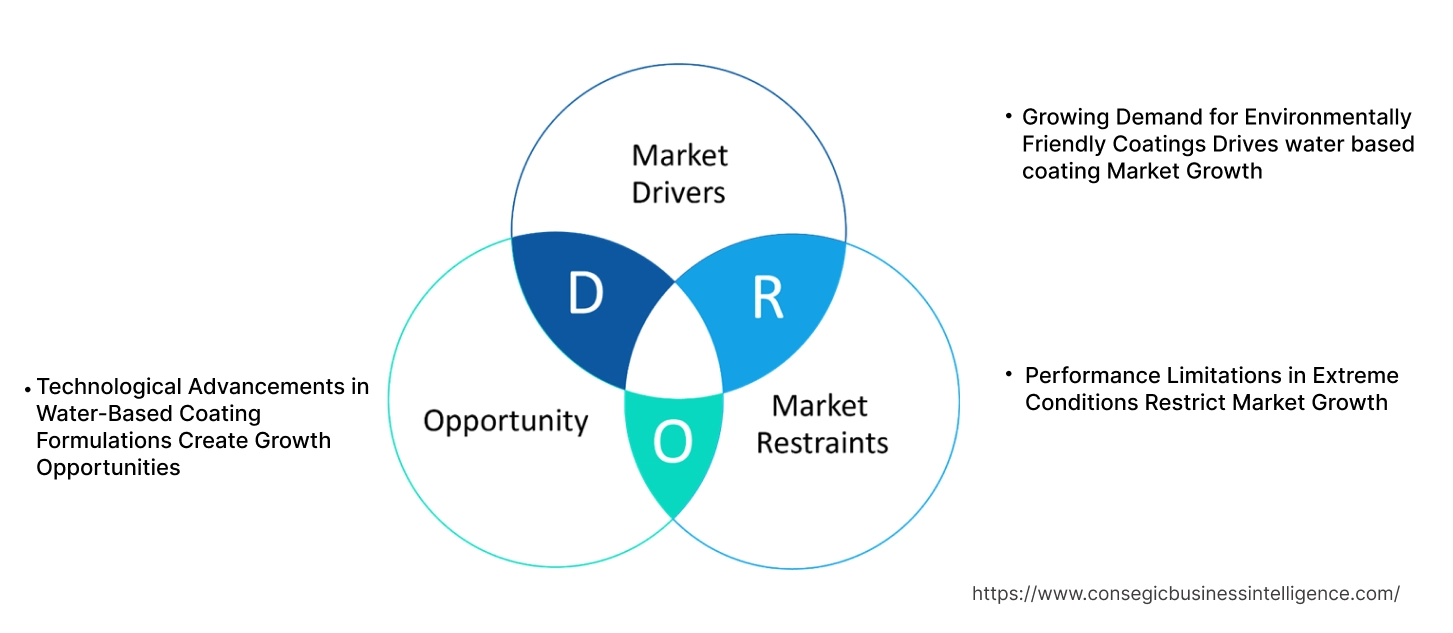
Key Drivers:
Growing Demand for Environmentally Friendly Coatings Drives water based coating Market Growth
The increasing global focus on sustainability is significantly driving the adoption of environmentally friendly water-based coatings. These coatings emit significantly lower volatile organic compounds (VOCs) compared to solvent-based alternatives, aligning with stringent environmental regulations such as the U.S. Clean Air Act and the European Union’s REACH. The push for green manufacturing practices trends across fields like automotive, construction, and furniture is accelerating this transition to minimize air pollution and reduce worker exposure to harmful chemicals.
In addition to regulatory compliance, the growing awareness among consumers and manufacturers about the environmental impact of solvent-based products is fueling the development for eco-friendly coatings. Companies are adopting water-based formulations for applications such as protective finishes, industrial coatings, and architectural paints to meet sustainability goals. Advancements in waterborne technology, such as improved adhesion, durability, and gloss retention, have further enhanced the water-based coatings market growth.
Key Restraints:
Performance Limitations in Extreme Conditions Restrict Market Growth
Despite their environmental benefits, water-based coatings face performance challenges in extreme conditions, such as high humidity, low temperatures, or heavy industrial exposure. The curing process of water-based coatings is highly dependent on environmental factors, with prolonged drying times in humid or cold environments. This limitation reduces their efficiency in outdoor or industrial settings, where solvent-based coatings typically offer better performance.
Additionally, water-based coatings may lack the same level of abrasion resistance and chemical durability as solvent-based systems in harsh conditions, such as those encountered in marine or heavy-duty industrial applications. These performance constraints require manufacturers to incorporate additives or apply additional layers, which increases the overall cost and complexity of application. These factors deter some industries from fully transitioning to water-based coatings, restraining water-based coatings market expansion.
Future Opportunities:
Technological Advancements in Water-Based Coating Formulations Create Growth Opportunities
Recent technological advancements in coating formulations are unlocking new opportunities for water based coating market growth. Innovative trends such as hybrid resin systems, improved pigment dispersion techniques, and self-crosslinking polymers have significantly enhanced the performance characteristics of water-based coatings, including their adhesion, chemical resistance, and weatherability. These advancements address traditional performance limitations, enabling the coatings to compete more effectively with solvent-based products in demanding applications.
For instance, new waterborne epoxy and polyurethane formulations provide high durability and abrasion resistance, making them suitable for industrial flooring, automotive components, and marine applications. Additionally, advancements in quick-dry and low-temperature curing technologies have expanded the use of water-based coatings market opportunities in environments previously considered unsuitable. As industries increasingly adopt them for their sustainability and improved performance, these technological breakthroughs are expected to drive market expansion, particularly in high-growth sectors like automotive, construction, and packaging.
Water-Based Coatings Market Segmental Analysis :
By Product Type:
Based on product type, the water-based coatings market is segmented into water-soluble paints, emulsion paints, and water-based alkyds.
The emulsion paints segment accounted for the largest water-based coatings market share in 2024.
- Emulsion paints dominate the market due to their versatile applications, durability, and superior performance in both interior and exterior coatings.
- These paints provide excellent adhesion, resistance to water, and a smooth finish, making them the preferred choice for building and construction applications.
- The increasing water-based coatings market demand for low-VOC and eco-friendly coatings in compliance with stringent environmental regulations is further driving the adoption of emulsion paints.
- Advancements in formulations, including enhanced water resistance and faster drying times, have also contributed to their market leadership.
- Therefore, emulsion paints analysis leads the water-based coatings market trends, driven by their superior performance, eco-friendly characteristics, and widespread application in the construction sectors.
The water-based alkyds segment is anticipated to register the fastest CAGR during the forecast period.
- Water-based alkyd coatings are gaining traction as an alternative to solvent-based alkyds, offering similar durability and gloss with significantly lower VOC emissions.
- These coatings are widely used in wood finishes, metal protection, and industrial applications due to their excellent adhesion and corrosion resistance.
- The growing shift towards sustainable and environmentally friendly coatings solutions, combined with innovations in water-based alkyd formulations for improved drying times and application properties, is driving rapid advancement in this segmental trend.
- Thus, water-based alkyds as per the analysis expected to grow rapidly, supported by their sustainable attributes and increasing use in industrial and wood protection applications.
By Resin Type:
Based on resin type, the market is segmented into acrylic and polyurethane.
The acrylic segment accounted for the largest revenue share in 2024.
- Acrylic resins are widely used in water-based coatings due to their excellent weather resistance, UV stability, and color retention properties.
- These resins are commonly applied in architectural coatings, automotive refinishes, and industrial paints, providing long-lasting protection and aesthetic appeal.
- The increasing demand for water-based acrylic coatings in the construction sectors, driven by urbanization and infrastructure development, is a key factor supporting their market dominance.
- Additionally, innovations in acrylic emulsions that enhance performance and reduce environmental impact are further boosting their adoption.
- Thus, acrylic resins dominate the water-based coatings market trends, driven by their superior weather resistance and analysis portrays extensive use in construction and automotive applications.
The polyurethane segment is anticipated to register the fastest CAGR during the forecast period.
- Polyurethane resins are valued for their high durability, chemical resistance, and flexibility, making them ideal for high-performance coatings in automotive, electronics, and industrial applications.
- The rising water-based coatings market demand for protective coatings that withstand harsh conditions, coupled with the growing use of water-based polyurethane formulations for reduced VOC emissions, is driving this segment.
- Advances in waterborne polyurethane technologies, such as hybrid systems and self-healing coatings, are further expanding their market potential.
- Thus, polyurethane resins analysis is expected to grow rapidly, driving trends says their high-performance characteristics and increasing adoption in industrial and automotive protective coatings.
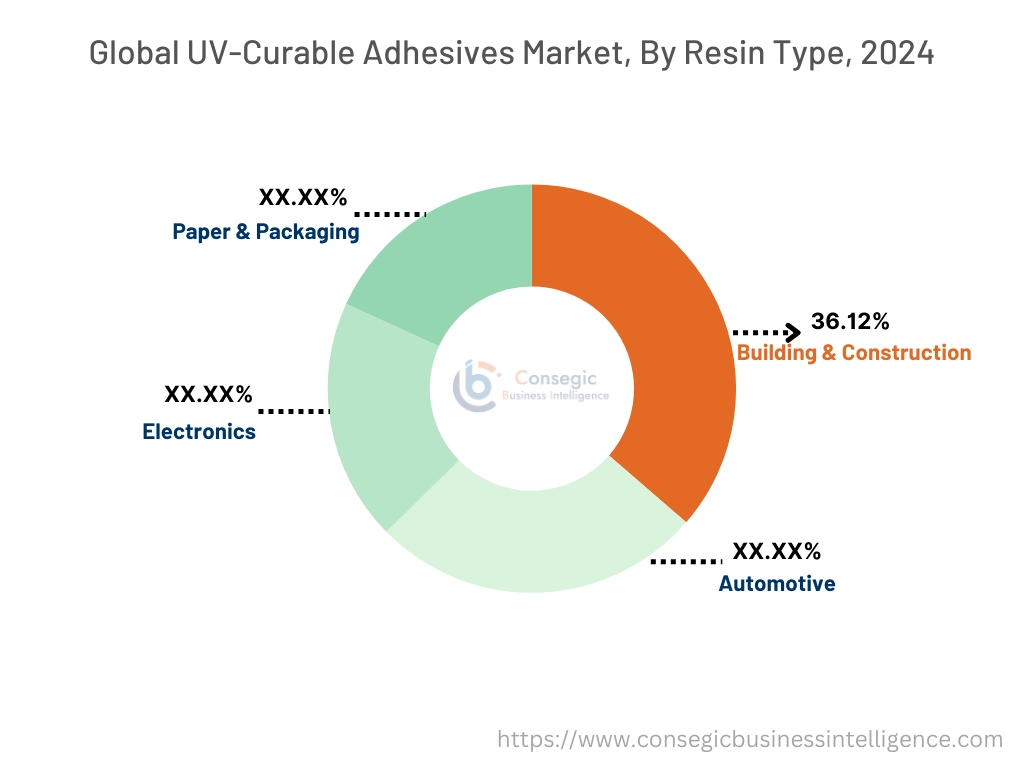
By End-User Industry:
Based on end-user industry, the market is segmented into building & construction, automotive, electronics, and paper & packaging.
The building & construction segment accounted for the largest water-based coatings market share of 36.12% in 2024.
- The building and construction industry is the largest consumer of water-based coatings, primarily for architectural and decorative applications.
- These coatings are used for interior and exterior wall paints, wood finishes, and metal coatings, providing durability and aesthetic appeal.
- The increasing focus on green building initiatives and sustainable construction practices is driving its adoption due to their low VOC content and environmental compliance.
- The ongoing urbanization and infrastructure development projects worldwide further fuel rise in this segment.
- Hence, building & construction trends analysis leads the water-based coatings market analysis, supported by the growing applications for sustainable and high-performance coatings in architectural and infrastructure applications.
The automotive segment is anticipated to register the fastest CAGR during the forecast period.
- In the automotive industry, water-based coatings are increasingly replacing solvent-based systems for surface finishing, corrosion protection, and aesthetic enhancement.
- These coatings provide excellent adhesion, scratch resistance, and UV protection while meeting stringent environmental regulations.
- The shift towards lightweight materials in electric vehicles (EVs) and advancements in waterborne coating technologies, including basecoats and clearcoats, are driving growth in this segment.
- Additionally, the rising adoption in automotive refinishing is contributing to the rapid water-based coatings market expansion.
- The automotive segment trends analysis is expected to grow rapidly, driven by the transition to eco-friendly coatings and the increasing focus on lightweight materials in vehicle manufacturing.
Regional Analysis:
The regions covered are North America, Europe, Asia Pacific, the Middle East and Africa, and Latin America.
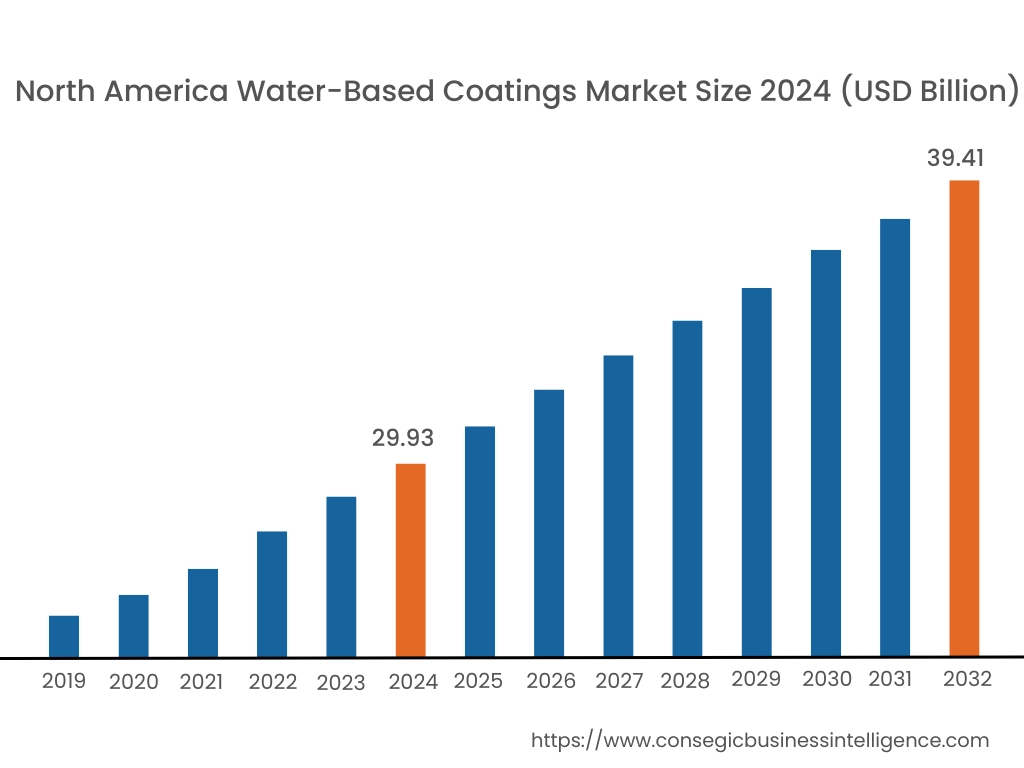
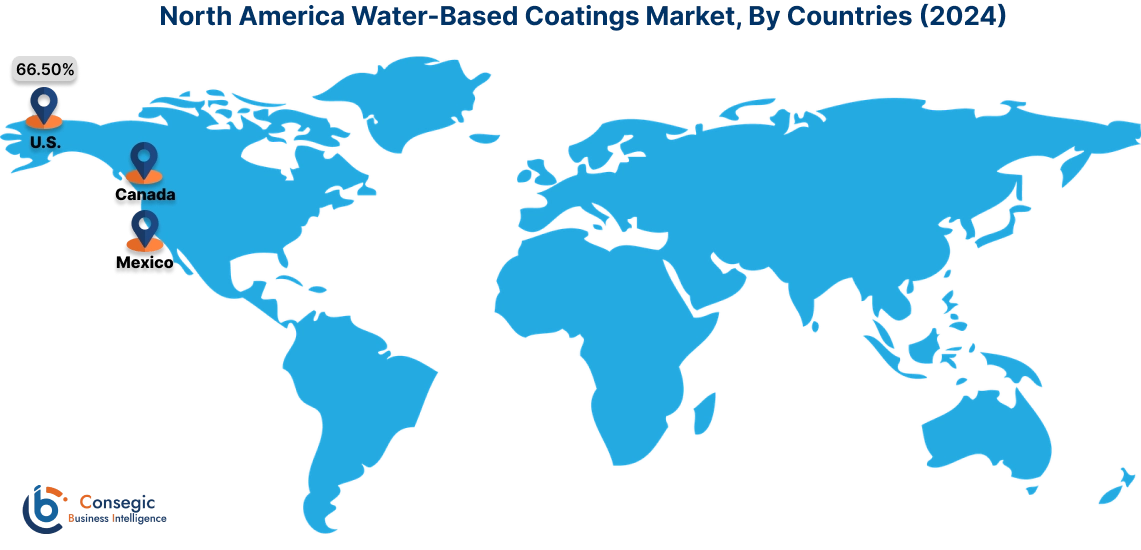
In 2024, North America was valued at USD 29.93 Billion and is expected to reach USD 39.41 Billion in 2032. In North America, the U.S. accounted for the highest share of 66.50% during the base year of 2024. North America dominates the water-based coatings industry, driven by stringent environmental regulations promoting low-VOC and eco-friendly coatings. The U.S. leads the region with significant demand from the construction, automotive, and industrial sectors. The push for sustainable building materials and green building certifications has increased the adoption of water-based coatings in architectural applications. Canada’s market is growing steadily due to the rising applications for protective coatings in infrastructure projects. However, challenges such as the higher initial cost of water-based coatings compared to solvent-based alternatives and performance limitations in extreme weather conditions persist in the region.
In Asia Pacific, the market is experiencing the fastest growth with a CAGR of 4.2% over the forecast period. Asia-Pacific experiences the fastest water-based coatings market growth, driven by rapid industrialization, urbanization, and increasing construction activities in China, India, and Southeast Asia. China is the largest consumer of water-based coatings due to its booming construction and automotive industries, coupled with stricter environmental regulations. India’s expanding infrastructure projects and rising awareness of green building practices are driving the market for water-based architectural coatings. In Japan and South Korea, the focus is on advanced coatings for automotive and electronics applications, where water-based formulations are increasingly replacing solvent-based products. However, challenges such as cost sensitivity and the need for advanced curing technologies in some sectors limit applications in the region.
Europe is a key market for water-based coatings, fueled by strict environmental policies such as the EU Directive on VOC emissions. Countries like Germany, the UK, and France are leading the adoption of water-based coatings in fields such as automotive, construction, and packaging. Germany’s robust automotive sector relies heavily on water-based coatings for high-performance finishes, while the UK is witnessing increasing applications in residential and commercial building projects. The growing preference for sustainable packaging solutions is driving advancement for water-based coatings in the food and beverage industry. However, the region faces challenges in balancing eco-friendliness with cost-effectiveness and performance.
The Middle East & Africa region is witnessing steady development in the water-based coatings market analysis, particularly in the UAE, Saudi Arabia, and South Africa. The UAE and Saudi Arabia are investing heavily in infrastructure and real estate projects, increasing the rise for water-based architectural and protective coatings. These coatings are preferred due to their low environmental impact and ability to withstand harsh climates. In Africa, South Africa’s construction and automotive sectors are driving the adoption of water-based coatings. However, limited local production capabilities and dependency on imports pose challenges, affecting the market's advancement potential.
Latin America is witnessing emerging water-based coatings market opportunities, with Brazil and Mexico leading the region. The construction and automotive industries in Brazil are key drivers, with rising appeals for environmentally friendly and durable coatings. Mexico’s growing manufacturing sector, especially in automotive and consumer goods, is contributing to increased adoption of water-based coatings. The region is also seeing a rise in the use of water-based coatings in decorative and protective applications for infrastructure development. However, economic fluctuations and inadequate awareness about the benefits of water-based coatings in some countries hinder widespread adoption.
Top Key Players and Market Share Insights:
The Water-Based Coatings market is highly competitive with major players providing products and services to the national and international markets. Key players are adopting several strategies in research and development (R&D), product innovation, and end-user launches to hold a strong position in the global Water-Based Coatings market. Key players in the Water-Based Coatings industry include -
- AkzoNobel N.V. (Netherlands)
- Axalta Coating Systems (United States)
- BASF SE (Germany)
- Berger Paints India Limited (India)
- Kansai Paint Co., Ltd. (Japan)
- Nippon Paint Company Limited (Japan)
- PPG Industries Inc. (United States)
- RPM International Inc. (United States)
- The Sherwin-Williams Company (United States)
- Asian Paints (India)
Water-Based Coatings Market Report Insights :
| Report Attributes | Report Details |
| Study Timeline | 2019-2032 |
| Market Size in 2032 | USD 121.58 Billion |
| CAGR (2025-2032) | 3.8% |
| By Type |
|
| By Resin Type |
|
| By End-User Industry |
|
| By Region |
|
| Key Players |
|
| North America | U.S. Canada Mexico |
| Europe | U.K. Germany France Spain Italy Russia Benelux Rest of Europe |
| APAC | China South Korea Japan India Australia ASEAN Rest of Asia-Pacific |
| Middle East and Africa | GCC Turkey South Africa Rest of MEA |
| LATAM | Brazil Argentina Chile Rest of LATAM |
| Report Coverage |
|
Key Questions Answered in the Report
What is the current size of the water-based coating market? −
Water-Based Coatings Market size is estimated to reach over USD 121.58 Billion by 2032 from a value of USD 90.22 Billion in 2024 and is projected to grow by USD 92.05 Billion in 2025, growing at a CAGR of 3.8% from 2025 to 2032.
What is driving the growth of the water-based coating market? +
Increasing demand for eco-friendly and low-VOC coatings in construction, automotive, and packaging industries.
Which regions dominate the water-based coating market? +
North America leads the market, driven by stringent environmental regulations promoting low-VOC and eco-friendly coatings.
What is the projected growth rate for the market? +
The market is anticipated to grow at a CAGR of 3.8% over the next five years.
What are the key developments in the water-based coating market? +
Innovations include the introduction of advanced resin formulations and improved durability for industrial applications.
Overview
Reputation & Certifications


Our Services
- Market Intelligence & Forecasting
- Custom Research Solutions
- Market Entry Strategy
- Competitive Intelligence
- Customer Insights
- Industry Innovation Analysis
- Investment Advisory