Jump to Content
Wearable Camera Market - Size, Share, Industry Trends, and Forecasts (2025-2032)
Wearable Camera Market Size:
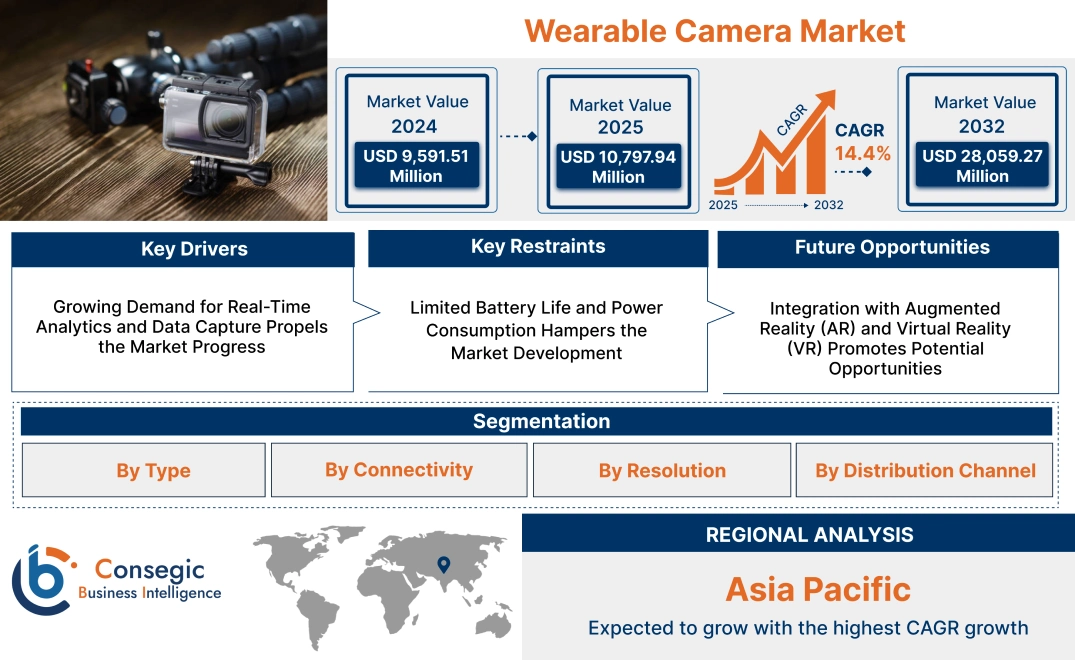
Wearable Camera Market size is estimated to reach over USD 28,059.27 Million by 2032 from a value of USD 9,591.51 Million in 2024 and is projected to grow by USD 10,797.94 Million in 2025, growing at a CAGR of 14.4% from 2025 to 2032.
Wearable Camera Market Scope & Overview:
A wearable camera is a compact, body-mounted device designed to capture photos and videos hands-free, enabling users to document their surroundings or activities seamlessly. These cameras are widely used in applications such as sports and adventure activities, law enforcement, healthcare, and personal documentation, providing convenience and portability for users.
These cameras are equipped with features such as high-definition recording, image stabilization, waterproofing, and wireless connectivity for real-time sharing or storage. They come in various forms, including body-worn, clip-on, and head-mounted designs, catering to different user needs and environments. Advanced models also integrate GPS, motion sensors, and night vision capabilities, enhancing their functionality in diverse conditions.
End-users include athletes, outdoor enthusiasts, security personnel, and professionals in industries requiring documentation or surveillance capabilities. These cameras play an essential role in capturing and preserving real-time experiences across both personal and professional applications.
Wearable Camera Market Dynamics - (DRO) :
Key Drivers:
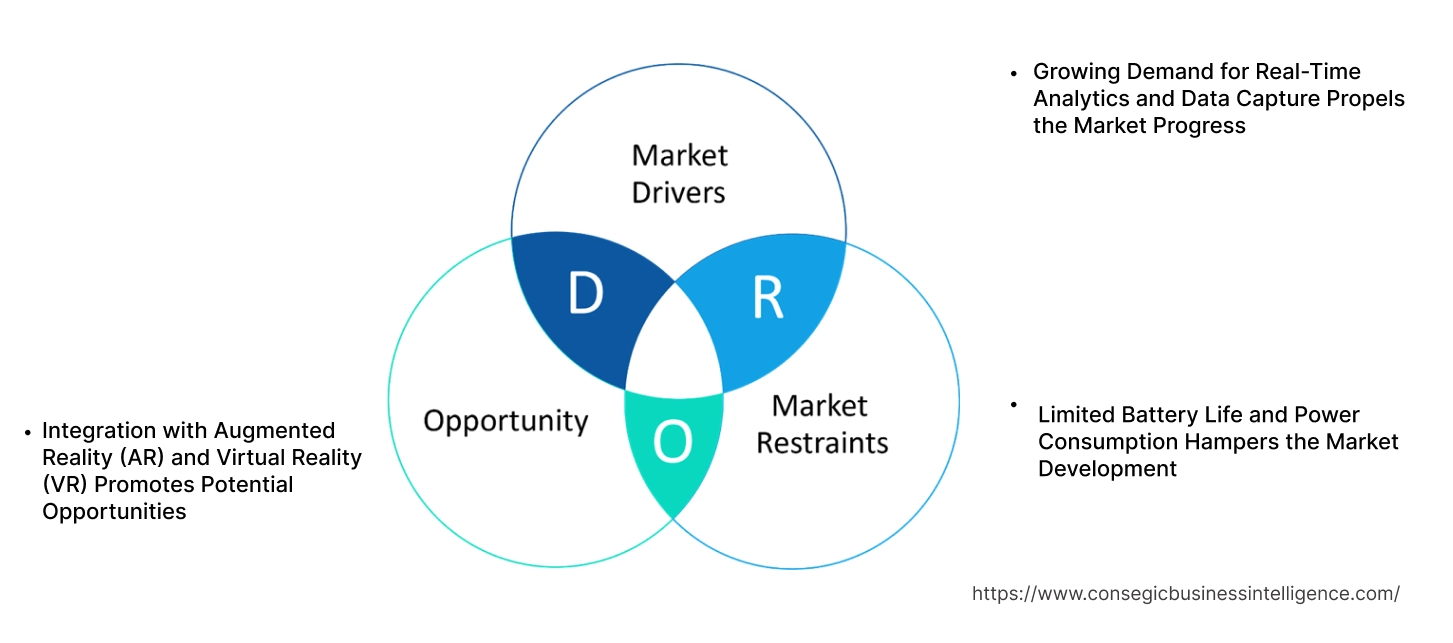
Growing Demand for Real-Time Analytics and Data Capture Propels the Market Progress
The growing demand for real-time analytics and data capture across industries like sports, healthcare, and logistics is driving the adoption of wearable cameras. In sports, coaches and analysts use these cameras to track players' movements, analyze techniques, and enhance training efficiency, providing immediate feedback and improving performance. In healthcare, these cameras play a crucial role in patient monitoring by capturing real-time activity data, enabling healthcare providers to assess patients' conditions remotely, ensure compliance with treatment plans, and improve overall care management. Similarly, in logistics, these cameras help track inventory, monitor processes, and optimize supply chain operations by providing visual data for better decision-making. These real-time insights enhance operational efficiency, improve safety, and enable more informed decisions, making wearable cameras an essential tool in various sectors that rely on immediate data capture and analysis. The ability to capture visual data seamlessly enhances performance across these industries, driving wearable camera market demand.
Key Restraints:
Limited Battery Life and Power Consumption Hampers the Market Development
Limited battery life and high power consumption are significant restraints for wearable cameras, particularly during prolonged use, such as recording high-definition video. These cameras often require frequent recharging due to their energy-intensive nature, especially when capturing high-resolution footage or using features like Wi-Fi or Bluetooth connectivity. This limitation affects the convenience and functionality of these cameras, especially for users in outdoor or remote environments, where access to charging stations is limited. For activities such as long hikes, sports events, or fieldwork, users experience interruptions in their recording sessions, reducing the overall effectiveness of the device. Additionally, battery degradation over time further shortens operational periods, increasing the need for maintenance or replacement. Thus, the aforementioned factors are limiting the wearable camera market growth.
Future Opportunities :
Integration with Augmented Reality (AR) and Virtual Reality (VR) Promotes Potential Opportunities
The integration of wearable cameras with augmented reality (AR) and virtual reality (VR) technologies offers a significant growth opportunity by enhancing immersive experiences across various sectors. In gaming, these devices provide players with a more interactive and engaging experience by blending the real world with virtual elements, allowing for real-time interaction with both physical and digital environments. In training and simulations, these cameras equipped with AR and VR help create realistic, hands-on learning environments, improving skills acquisition in industries such as healthcare, defense, and manufacturing. These technologies allow users to capture real-time video while simultaneously overlaying virtual information, enabling more dynamic and practical experiences. By combining these cameras with AR and VR, industries will offer innovative solutions for education, entertainment, and remote assistance, creating new ways for users to capture, interact with, and share content in more immersive and engaging ways. Therefore, the above mentioned factors create substantial wearable camera market opportunities.
Wearable Camera Market Segmental Analysis :
By Type:
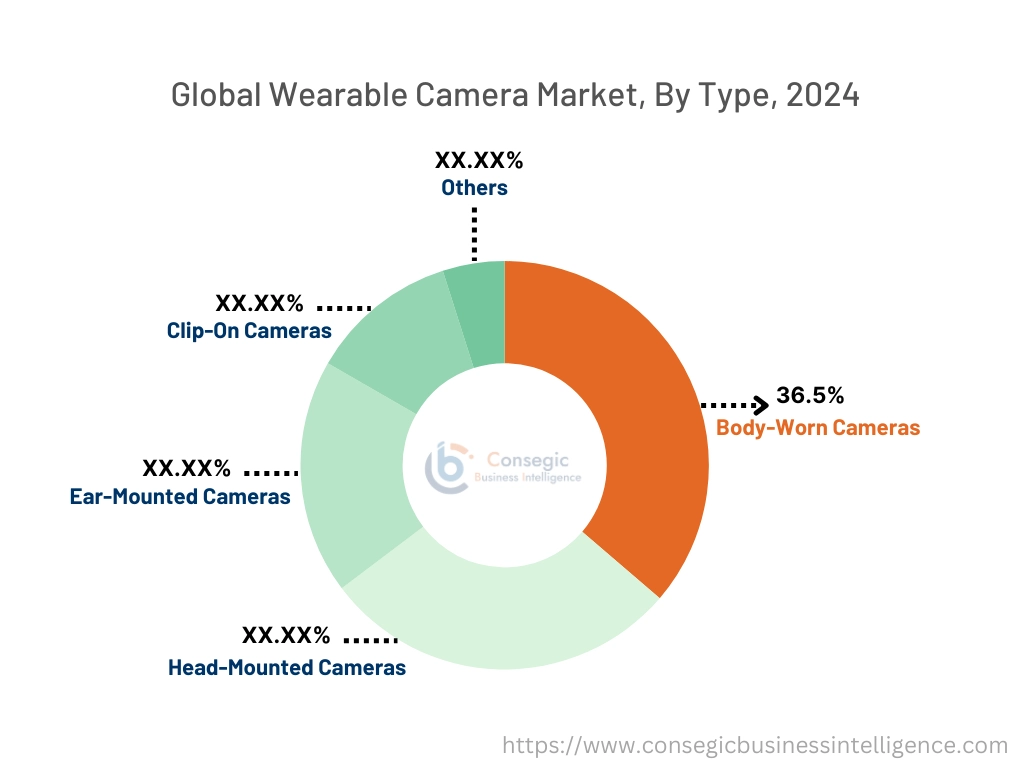
Based on type, the market is segmented into body-worn cameras, head-mounted cameras, ear-mounted cameras, clip-on cameras, and others.
The body-worn cameras segment accounted for the largest revenue of 36.5% of the total wearable camera market share in 2024.
- Body-worn cameras are widely used in law enforcement, providing real-time video evidence and improving accountability.
- The segment benefits from increasing adoption in healthcare and industrial applications for monitoring and safety purposes.
- Enhanced durability, compact designs, and integration with advanced technologies like AI and facial recognition drive segment growth.
- The increasing focus on security and surveillance across various sectors supports the dominance of body-worn cameras, contributing to the wearable camera market expansion.
The head-mounted cameras segment is projected to grow at the fastest CAGR during the forecast period.
- Head-mounted cameras are gaining popularity in sports and adventure activities, providing hands-free operation and immersive recording experiences.
- These cameras are increasingly used in industrial and healthcare industry for training, inspections, and surgeries.
- Lightweight designs and integration with augmented reality (AR) technologies enhance their adoption across diverse applications.
- As per the wearable camera market analysis, the demand for real-time data streaming and high-definition recording capabilities is driving growth in this segment.
By Connectivity:
Based on connectivity, the market is segmented into Wi-Fi, Bluetooth, GPS, cellular, and others.
The Wi-Fi segment held the largest revenue of the total wearable camera market share in 2024.
- Wi-Fi-enabled wearable cameras are preferred for their seamless data transfer capabilities to cloud storage and connected devices.
- The integration of Wi-Fi with advanced features such as live streaming and remote monitoring drives adoption in sports, law enforcement, and healthcare.
- The segment benefits from the increasing demand for smart devices with enhanced connectivity features.
- As per the wearable camera market trends, Wi-Fi-enabled cameras are widely used in professional applications requiring real-time video access and analysis.
The Bluetooth segment is expected to witness the fastest CAGR during the forecast period.
- Bluetooth connectivity offers low-power consumption, making it ideal for lightweight and compact wearable cameras.
- The growing use of Bluetooth in personal and consumer applications, such as fitness tracking and lifestyle blogging, boosts segment growth.
- Advancements in Bluetooth technology enable seamless pairing with multiple devices, enhancing user convenience.
- The segment’s growth is supported by the increasing popularity of these cameras in casual and everyday scenarios, further driving the wearable camera market demand.
By Resolution:
Based on resolution, the market is segmented into standard definition (SD), high definition (HD), ultra-high definition (UHD), 4K, and others.
The HD segment accounted for the largest revenue share in 2024.
- HD cameras are widely adopted for their balance between video quality and affordability, catering to both professional and personal users.
- The segment benefits from increasing need in applications such as law enforcement, sports, and industrial monitoring.
- HD cameras are widely preferred in situations requiring reliable image clarity and moderate storage requirements.
- As per the wearable camera market analysis, the segment's dominance is further supported by advancements in HD camera technology, offering better image stabilization and low-light performance.
The 4K segment is projected to grow at the fastest CAGR during the forecast period.
- 4K cameras offer superior image quality, making them ideal for professional applications in filmmaking, sports, and surveillance.
- Increasing consumer preference for high-resolution content drives the demand for 4K wearable cameras in personal and recreational use.
- The segment benefits from declining prices of 4K technology and improvements in storage and processing capabilities.
- Integration of 4K cameras with advanced features like slow-motion recording and AI-based enhancements supports wearable camera market expansion.
By Distribution Channel:
Based on distribution channel, the market is segmented into online retail and offline retail.
The online retail segment held the largest market share in 2024.
- Online platforms provide a convenient shopping experience with detailed product descriptions, reviews, and competitive pricing.
- The segment benefits from the increasing popularity of e-commerce and the growing adoption of digital payment systems.
- Discounts, promotions, and the availability of exclusive online models drive higher sales through online channels.
- As per the wearable camera market trends, the dominance of this segment is supported by the rise in online platforms catering specifically to consumer electronics.
The offline retail segment is projected to grow at the fastest CAGR during the forecast period.
- Offline stores provide hands-on experience and personalized assistance, encouraging consumers to make informed purchase decisions.
- Specialty electronics stores and supermarkets are key contributors to offline sales, catering to a diverse customer base.
- The segment benefits from partnerships between manufacturers and brick-and-mortar retailers to enhance product visibility.
- The growing focus on premium retail experiences and live demonstrations further supports the relevance of offline retail, fueling the wearable camera market opportunities.
Regional Analysis:
The regions covered are North America, Europe, Asia Pacific, the Middle East and Africa, and Latin America.
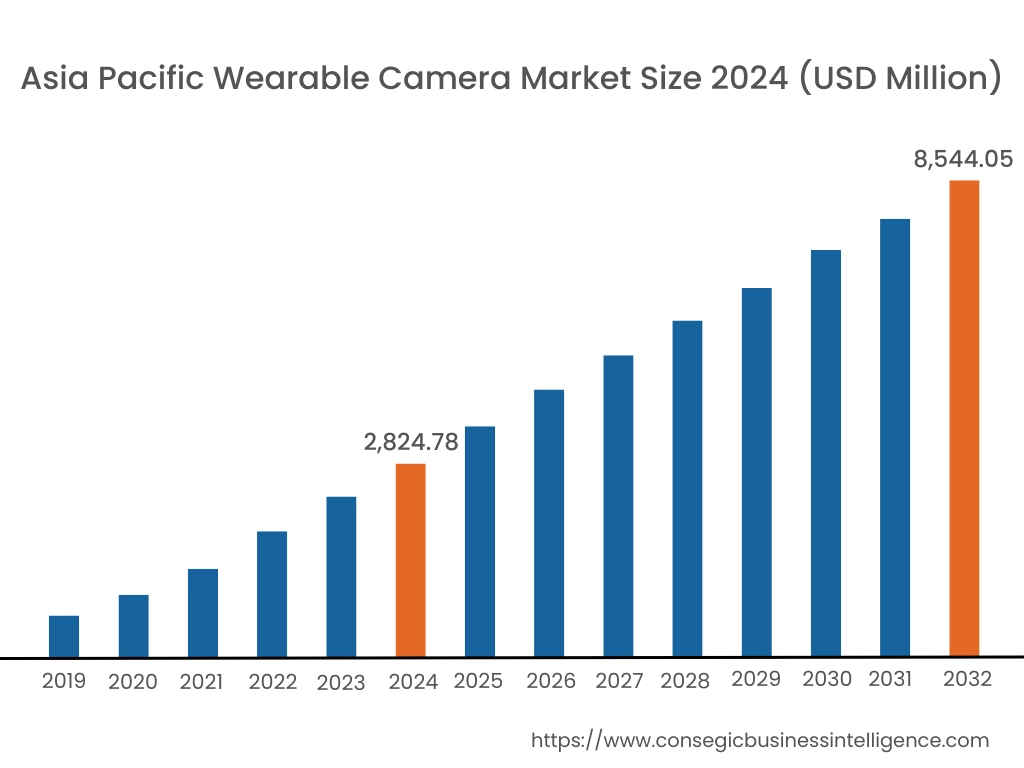
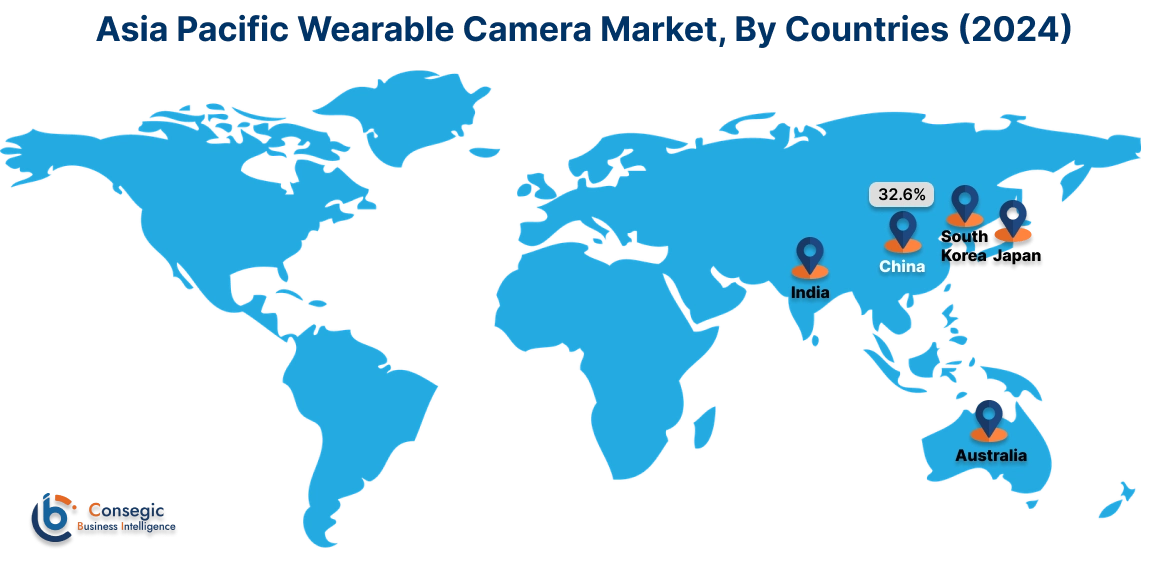
Asia Pacific region was valued at USD 2,824.78 Million in 2024. Moreover, it is projected to grow by USD 3,189.08 Million in 2025 and reach over USD 8,544.05 Million by 2032. Out of this, China accounted for the maximum revenue share of 32.6%. The Asia-Pacific region is witnessing rapid advancements in the wearable camera market, attributed to technological innovations and increasing consumer electronics adoption. A prominent trend is the incorporation of these cameras in healthcare settings for patient monitoring and telemedicine. The market trends also indicates that the expanding healthcare infrastructure and rising awareness of wearable technology are contributing to wearable camera market growth in this region.
North America is estimated to reach over USD 9,094.01 Million by 2032 from a value of USD 3,181.58 Million in 2024 and is projected to grow by USD 3,574.92 Million in 2025. This region holds a substantial share of the wearable camera market, driven by the increasing adoption of body-mounted cameras in law enforcement and security sectors. A notable trend is the integration of advanced features such as real-time video streaming and cloud storage, enhancing operational efficiency. Analysis indicates that the emphasis on transparency and accountability in public safety is propelling the need for these cameras in North America.
European countries are key players in the wearable camera market, with a strong emphasis on applications in sports and adventure activities. A significant trend is the use of head-mounted cameras by athletes and outdoor enthusiasts to capture immersive experiences. The market trends also suggests that the growing popularity of adventure tourism and extreme sports is influencing the market dynamics in this region.
In the Middle East and Africa, the market is influenced by the adoption of advanced surveillance technologies in security and defense industry. The focus is on deploying body-mounted cameras to enhance situational awareness and evidence collection. Analysis suggests that investments in security infrastructure and modernization initiatives are pivotal in shaping the market landscape in these regions.
Latin American countries are increasingly recognizing the importance of wearable cameras in industrial applications, such as mining and construction, to ensure safety and compliance. A notable trend is the use of such cameras for real-time monitoring and remote assistance. Analysis indicates that economic development and the implementation of stringent safety regulations are key factors influencing the market in this region.
Top Key Players and Market Share Insights:
The wearable camera market is highly competitive with major players providing products and services to the national and international markets. Key players are adopting several strategies in research and development (R&D), product innovation, and end-user launches to hold a strong position in the global wearable camera market. Key players in the wearable camera industry include -
- GoPro Inc. (USA)
- Garmin Ltd. (USA)
- Vievu LLC (USA)
- Drift Innovation Ltd. (UK)
- Sony Corporation (Japan)
- Xiaomi Corporation (China)
- Axon Enterprise Inc. (USA)
- Pinnacle Response Ltd. (UK)
Recent Industry Developments :
Product Launches:
- In November 2024, Insta360 launched the X4, its most advanced 360° action camera, featuring 8K30fps video, 5.7K60fps, and 4K100fps slow-motion recording. A powerful AI chip, 135-minute battery life, and advanced stabilization ensure top-tier performance. The X4 doubles as an action cam with a 4K60fps Single-Lens Mode. Waterproof up to 33ft and featuring removable lens guards, it’s built for extreme conditions.
- In October 2024, Iveda introduced the upgraded VEMO Body Cam, the first wearable body camera to integrate with AI-driven real-time video analytics. The new VEMO Command Center enables live streaming, GPS tracking, and SOS alerts, enhancing situational awareness. With 15-hour battery life, 4G, Wi-Fi, and IR capabilities, it ensures clear, real-time evidence capture. Available at $450 MSRP, VEMO offers AI-powered security for law enforcement and private agencies.
Wearable Camera Market Report Insights :
| Report Attributes | Report Details |
| Study Timeline | 2019-2032 |
| Market Size in 2032 | USD 28,059.27 Million |
| CAGR (2025-2032) | 14.4% |
| By Type |
|
| By Connectivity |
|
| By Resolution |
|
| By Distribution Channel |
|
| By Region |
|
| Key Players |
|
| North America | U.S. Canada Mexico |
| Europe | U.K. Germany France Spain Italy Russia Benelux Rest of Europe |
| APAC | China South Korea Japan India Australia ASEAN Rest of Asia-Pacific |
| Middle East and Africa | GCC Turkey South Africa Rest of MEA |
| LATAM | Brazil Argentina Chile Rest of LATAM |
| Report Coverage |
|
Key Questions Answered in the Report
What is the size of the Wearable Camera Market? −
The Wearable Camera Market size is estimated to reach over USD 28,059.27 Million by 2032 from a value of USD 9,591.51 Million in 2024 and is projected to grow by USD 10,797.94 Million in 2025, growing at a CAGR of 14.4% from 2025 to 2032.
What are the key segments in the Wearable Camera Market? +
The market is segmented by type (body-worn cameras, head-mounted cameras, ear-mounted cameras, clip-on cameras, others), connectivity (Wi-Fi, Bluetooth, GPS, cellular, others), resolution (SD, HD, UHD, 4K, others), and distribution channel (online retail, offline retail).
Which segment is expected to grow the fastest in the Wearable Camera Market? +
The Bluetooth connectivity segment is expected to grow at the fastest CAGR during the forecast period, driven by the growing use of Bluetooth in personal and consumer applications like fitness tracking and lifestyle blogging.
Who are the major players in the Wearable Camera Market? +
Key players in the Wearable Camera market include GoPro Inc. (USA), Garmin Ltd. (USA), Sony Corporation (Japan), Xiaomi Corporation (China), Axon Enterprise Inc. (USA), Pinnacle Response Ltd. (UK), Vievu LLC (USA), Drift Innovation Ltd. (UK).
Overview
Reputation & Certifications


Our Services
- Market Intelligence & Forecasting
- Custom Research Solutions
- Market Entry Strategy
- Competitive Intelligence
- Customer Insights
- Industry Innovation Analysis
- Investment Advisory