Jump to Content
AdBlue oil Market - Size, Share, Industry Trends, and Forecasts (2025 - 2032)
AdBlue oil Market Size:
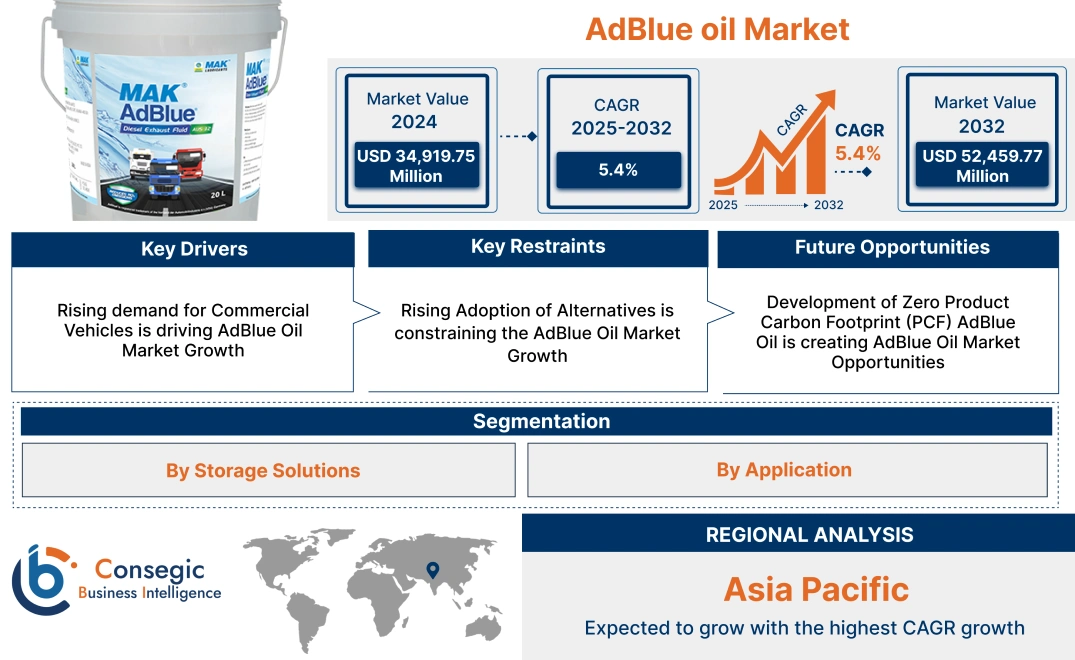
AdBlue oil market size is estimated to reach over USD 52,459.77 Million by 2032 from a value of USD 34,919.75 Million in 2024, growing at a CAGR of 5.4% from 2025 to 2032.
AdBlue oil Market Scope & Overview:
AdBlue oil, also known as Diesel Exhaust Fluid (DEF), is a fluid made with 32.5% urea and 67.5% deionized water. It is used in selective catalytic reduction (SCR) systems to reduce harmful emissions from diesel engines. It works to convert nitrogen oxide emissions in the exhaust gas of diesel engines, into nitrogen and water. It is stored in various options including bulk storage tanks, dispensers, portable containers, and others. It is used in various applications such as in commercial vehicles, passenger vehicles, industrial machinery, and others. Governments in countries like Germany, India, and others are implementing stringent emission standards like 6d, 6a, Via, and others, which is driving the market.
AdBlue oil Market Dynamics - (DRO) :
Key Drivers:
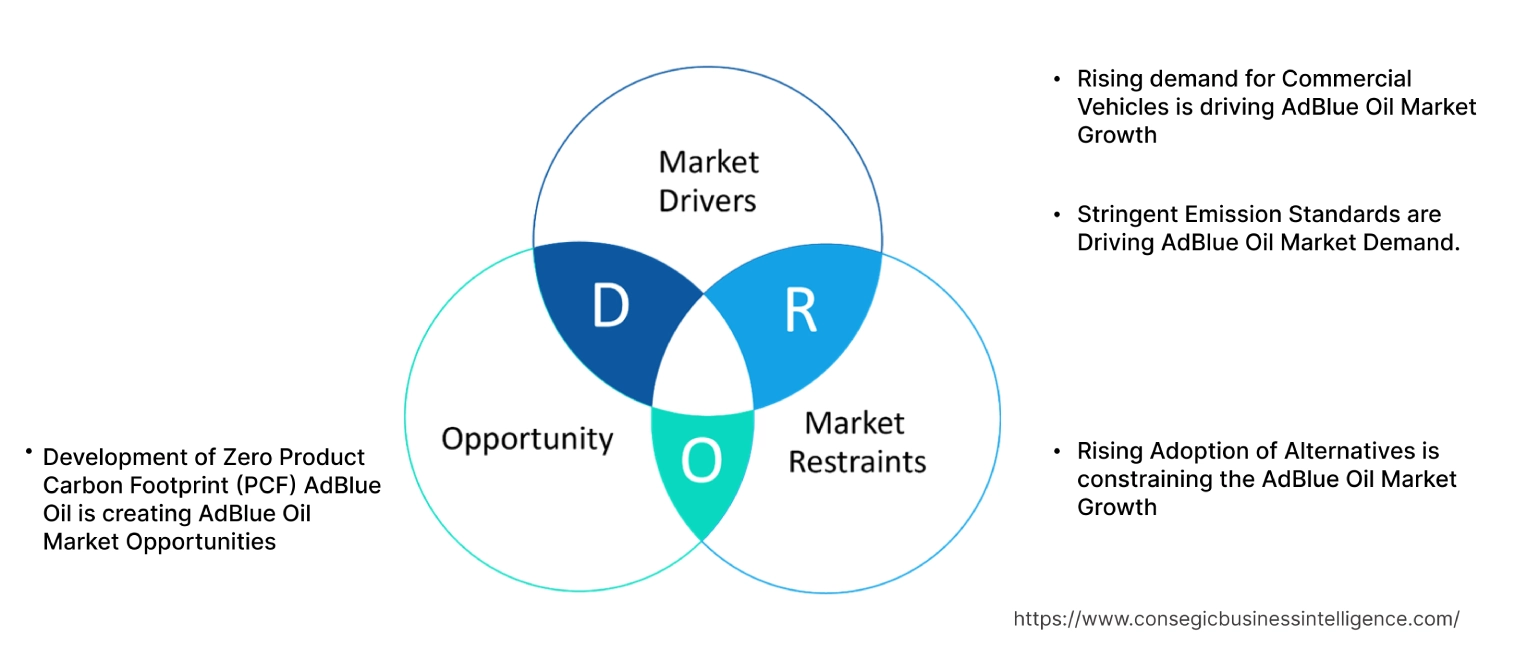
Rising demand for Commercial Vehicles is driving AdBlue Oil Market Growth
Commercial vehicles, such as trucks, buses, and heavy-duty vehicles, are vital for industries like logistics, transportation, and others, which have been expanding globally. With the enforcement of stringent emission standards such as BS-VI, Euro 6, and others, these vehicles are increasingly adopting SCR systems that use AdBlue oil to reduce nitrogen oxide (NOx) emissions. Factors such as the rise in e-commerce, increased infrastructural projects and others result in the growing proliferation of commercial vehicles, further driving the market.
- In 2023, according to the Society of Indian Automobile Manufacturers, the overall commercial vehicle sales increased from 7,16,566 units in 2022 to 9,62,468 units in the year 2023 in India. AdBlue oil is used in commercial vehicles equipped with SCR systems to reduce nitrogen oxide emissions in turn driving the market
Thus, the growing use of commercial vehicles is driving the AdBlue oil market expansion, supported by the reduction in harmful emissions and eco-friendly transportation.
Stringent Emission Standards are Driving AdBlue Oil Market Demand.
Stringent emission standards like Euro 6d, 6a, Via, and others enforce reductions in the harmful nitrogen oxide emissions from diesel vehicles. These regulations compel the government to adopt systems like selective catalytic reduction, where AdBlue oil is used in SCR to reduce harmful emissions from diesel engines. Countries like China, India, and others implemented emission standards like Euro 6d, 6a, Via, and others to reduce nitrogen oxide (NOx) emissions in the atmosphere.
- In 2023, according to the International Trade Administration, China’s Ministry of Ecology and Environment (MEE) implemented 6a and Via emission standards for vehicles including light-duty trucks, passenger vehicles, and others. These emission standards mandate diesel vehicles to reduce nitrogen oxide emissions in the atmosphere. It is driving the market, as AdBlue oil is used in diesel vehicles to reduce harmful NOx emissions released into the atmosphere through Selective Catalytic Reduction (SCR) systems.
Thus, stringent emission standards like Euro 6d, 6a, Via, and others are driving the AdBlue oil market expansion, by forcing diesel vehicles to adopt selective catalytic reduction systems.
Key Restraints :
Rising Adoption of Alternatives is constraining the AdBlue Oil Market Growth
Alternative fuels offer a promising path toward sustainable transportation. These fuels, derived from sources other than petroleum, include biofuels like ethanol and biodiesel, natural gas, hydrogen, and electricity. Biofuels, produced from plant materials or waste products, reduce greenhouse gas emissions. Natural gas, a cleaner-burning fossil fuel, emits fewer pollutants than gasoline or diesel. Hydrogen fuel cell vehicles produce zero tailpipe emissions, but their infrastructure is still developing. Electric vehicles, powered by batteries, offer zero-emission mobility but face challenges related to charging infrastructure and battery technology. While each alternative fuel has its advantages and limitations, a diverse energy mix, including a combination of these fuels, helps reduce reliance on fossil fuels and mitigate climate change.
Thus, the growing adoption of alternatives is constraining the AdBlue oil market demand, by reducing the dependence on diesel-powered engines.
Future Opportunities :
Development of Zero Product Carbon Footprint (PCF) AdBlue Oil is creating AdBlue Oil Market Opportunities
Production of AdBlue oil is mainly dependent on fossil fuels which results in carbon dioxide emission in the atmosphere. Further, during the packaging of AdBlue, mainly plastic is used which also contributes to the carbon dioxide emission. Zero PCF AdBlue oil minimizes plastic packaging with the help of renewable energies and raw materials like vegetable oil, plant seeds, and more. It is enhancing the market by incorporating sustainability in the production and packaging process.
- In 2024, BASF launched zero PCF AdBlue oil with reduced carbon dioxide emissions. It is available with a certified product carbon footprint of <0.05 based on a mass balance approach. This will result in the proliferation of the market, reducing carbon dioxide emissions.
Thus, the zero PCF AdBlue oil is creating market opportunities, by incorporating sustainability and eco-friendly practices.
AdBlue oil Market Segmental Analysis :
By Storage Solutions:
By storage solutions, the market is divided into bulk storage tanks, dispensers, portable containers, and others.
Trends in Storage Solutions:
- As per AdBlue oil market trends, bulk storage containers are used for the storage of AdBlue, ensuring bulk and consistent supply.
- Mobile dispensers are emerging rapidly for the storage of AdBlue oil, reducing wastage and precise dispensing as per the latest trends.
The bulk storage tanks accounted for the largest market share in the year 2024.
- Bulk storage tanks are typically used for the storage of AdBlue oil for industries with high consumption such as logistics, transportation, and others.
- These tanks are designed to store large volumes of AdBlue, typically ranging from several hundred liters to thousands of liters, ensuring consistent and uninterrupted supply
- These tanks are made from durable materials like stainless steel or high-density polyethylene (HDPE) to prevent contaminations and maintain the quality of the product.
- Bulk storage tanks are automated with automated dispensing systems, allowing for easy and precise fueling of vehicles that are equipped with Selective Catalytic Reduction systems.
- These bulk storage tanks are highly cost-effective for large-scale operators, as they allow them to purchase AdBlue in bulk, reducing overall cost per unit.
- Thus, bulk storage tanks are widely used for the storage of AdBlue oil ensuring cost-effectiveness and easy fueling of vehicles.
The dispensers are expected to grow at the fastest CAGR over the forecast period.
- Dispensers as a storage solution for AdBlue oil are emerging rapidly for convenient and efficient fueling of vehicles with SCR systems.
- These dispensers are designed to provide precise and controlled dispensing, reducing wastage and ensuring the proper functioning of SCR systems.
- They are commonly integrated at fuel stations, fleet depots, and industrial sites, allowing businesses to maintain uninterrupted supply.
- For instance, in 2024, Bharat Petroleum Corporation Ltd (BPCL) launched the first mobile MAK AdBlue oil dispenser for eco-friendly access. It features a battery-powered operation, with a Weight and Measure certified metering unit, providing printed bills and SMS messaging to customers. It will enhance the supply of AdBlue, thereby driving the market by providing a customized service experience.
- Thus, the use of dispensers in the storage of AdBlue oil is rising as per the latest trends, providing a controlled and uninterrupted supply.
By Application:
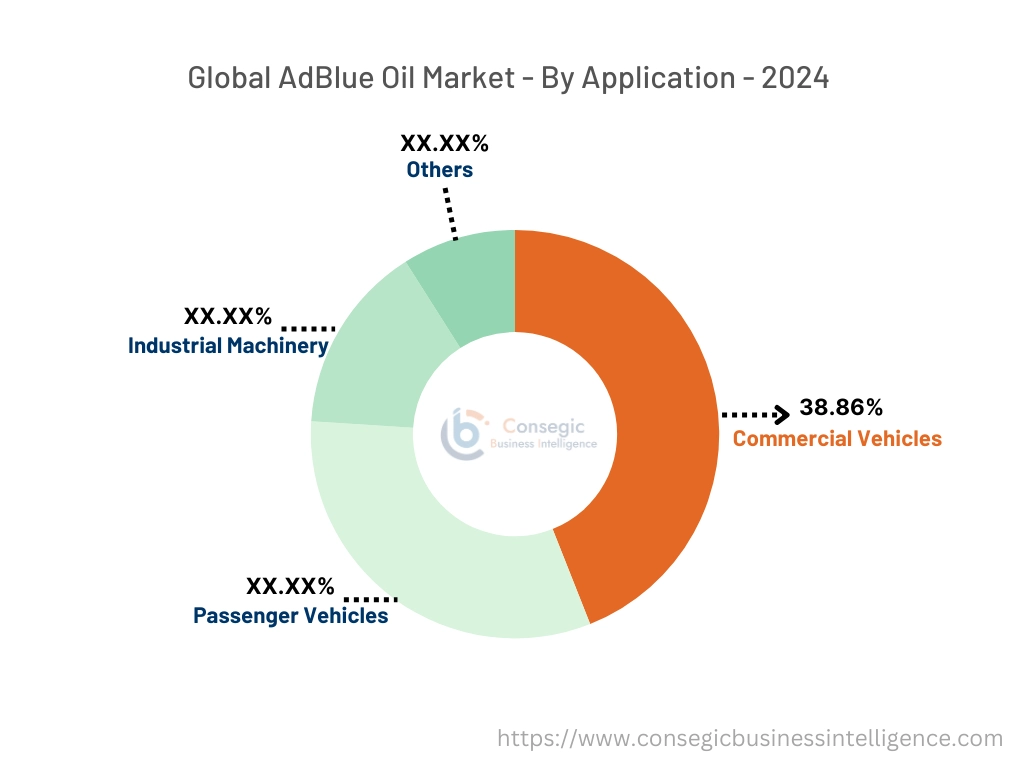
By application, the market is divided into commercial vehicles, passenger vehicles, industrial machinery, and others.
Trends in Application:
- According to AdBlue oil market trends, AdBlue is widely used in commercial vehicles due to its high engine capacity and emissions.
- Application of AdBlue oil is rising in passenger vehicles to reduce harmful emissions in the atmosphere and promote sustainability as per latest trends.
Commercial vehicles accounted for the largest market share of 38.86% in the year 2024.
- AdBlue oil is widely used in commercial vehicles driven by the widespread adoption of SCR systems to meet stringent emission standards like BS-VI and Euro 6.
- This category includes heavy-duty buses, trucks, and other large vehicles that require substantial amounts of AdBlue due to their high engine capacity and emissions.
- The logistics and transportation sectors are major contributors, as a fleet of commercial vehicles operates for extended hours and long distances, necessitating frequent refueling with AdBlue.
- Additionally, expanding e-commerce and infrastructure development are driving the growth of logistics fleets, strengthening the dominance of commercial vehicles in the market.
- Thus, commercial vehicles remain dominant in the application of AdBlue oil due to their wide consumption and frequent refueling.
Passenger vehicles are expected to grow at the fastest CAGR over the forecast period.
- AdBlue oil in passenger vehicles is emerging rapidly, due to widespread adoption of SCR systems to meet stringent emission standards like BS-VI and Euro 6.
- This category includes passenger cars, minivans, and others that incorporate compact AdBlue tanks in diesel engines.
- Rising consumer awareness about environmental sustainability and urban air quality is also contributing to the incorporation of AdBluein cars.
- Automakers are increasingly equipping diesel passenger cars with SCR systems that require AdBlue to reduce harmful nitrogen oxide emissions.
- For instance, in 2024, Toyota launched the Toyota LandCruiser Prado 250 Series in Australia which requires AdBlue oil for its operation. It is the passenger car that will travel up to 8000km, with a 17.4L AdBlue oil tank, further showcasing the incorporation of Adlue oil in passenger cars, thus driving the market.
- Thus, the application of AdBlue oil is rising in passenger vehicles, supported by rising consumer awareness about urban air quality and environmental sustainability as per current trends.
Regional Analysis:
The regional segment includes North America, Europe, Asia Pacific, the Middle East and Africa, and Latin America.

In 2024, North America accounted for the highest market share at 40.56% and was valued at USD 14,163.45 Million and is expected to reach USD 21,309.16 Million in 2032. In North America, the United States accounted for the highest market share of 73.21% during the base year of 2024. According to market analysis, North America’s AdBlue oil market share is driven by the well-established automotive and transportation sectors. The region is a hub of many industries including logistics, construction, automotive, and others, which depend on diesel vehicles requiring AdBlue oil to reduce harmful emissions in the atmosphere. The region is also experiencing rapid construction and industrial developments, which further drives the demand for AdBlue in diesel-powered engines.
- In 2024, US-DEF launched a new brand of AdBlue oil for the American retail market. It meets the International Organization for Standardization (ISO) 22241 standards, and its delivery options include 55-gallon drums and 330-gallon totes further strengthening the market in North America.
Thus, North America is dominating the market, driven by the expanding construction sector and industrial developments.

Asia-Pacific is expected to witness the fastest CAGR over the forecast period of 5.9% during 2024-2031. As per market analysis, the AdBlue oil market share of the Asia-Pacific region is experiencing rapid proliferation in the market due to rapid urbanization and industrial developments. AdBlue oil is used in diesel engines of bulldozers, cranes, and others which are crucial in the construction industry. The rising production of commercial and passenger vehicles is further driving the market. Countries like China, India, and Japan are major contributors, due to growing production and export of AdBlue oil, further propelling the market. The government in this region is implementing stringent emission standards like 6d, 6a, Via, and others enforcing reductions in the harmful nitrogen oxide emissions from diesel vehicles, further enhancing the market. Thus, the Asia-Pacific region is experiencing growth in the market supported by large-scale production and rapid urbanization.
According to AdBlue oil market analysis, the European region is growing significantly in the market due to well-established automotive and manufacturing sectors. The European countries are leading in the manufacturing of diesel-powered vehicles such as trucks, containers, and others, further fueling the market growth. Countries like France, the United Kingdom, and Russia are key contributors due to the major production and export of AdBlue oil to other networks. The region is also growing in advanced farming practices which are dependent on diesel engines used in tractors, mini harvesters, pumps, and others, further driving the market. Governments in this region are implementing stringent emission standards for vehicles including Euro 6, Euro 6d, and others, further driving the market.
According to AdBlue oil market analysis, the market is expanding in the Middle East and Africa region driven by rapid construction and the growing automotive sector. In countries like Dubai, UAE, and South Africa the market is propelling due to the rapid proliferation of industrial projects and the expanding manufacturing sector. It is fueling the adoption of AdBlue oil in diesel-powered engines along with the SCR system. Also, the region is growing in terms of mining and transportation, which heavily depend on diesel vehicles, further driving the market. Also, the government in this region is implementing stringent emission standards regarding diesel-powered vehicles, driving the adoption of SCR systems, which incorporate AdBlue oil to reduce harmful emissions.
According to market analysis, Latin America is witnessing moderate growth in the market, driven by expanding industrial activities, rising vehicle ownership, and infrastructure development. Key countries like Brazil, Mexico, and Argentina lead the market due to their strong automotive and industrial sectors. Further in Brazil, there are many production plants of AdBlue oil, producing large amounts. The growing industrial market is a significant contributor, with increasing demand for AdBlue oil in diesel vehicles, for the reduction of harmful emissions. Government regulations are encouraging the adoption of AdBlue oil in the region, driving AdBlue oil market opportunities. However, challenges such as supply chain complexities, rising raw material costs, and advanced machinery impact the growth of the market in the region as per market analysis.
Top Key Players and Market Share Insights:
The AdBlue oil industry is highly competitive with major players providing precise measurements between objects to the national and international markets. Key players are adopting several strategies in research and development (R&D) and product innovation to hold a strong position in the global AdBlue oil market. Key players in the AdBlue oil industry include-
- BASF (Germany)
- Bosch Limited. (Germany)
- BP plc (United Kingdom)
- CF Industries Holdings, Inc. (United States)
- GreenChem Holding B.V. (Netherlands)
- Mitsui Chemicals, Inc. (Japan)
- Nissan Chemical Corporation (Japan)
- Yara (Norway)
- Shell Global(Netherlands)
- TotalEnergies SE (France)
Recent Industry Developments :
Business Expansion:
- In 2024, OCI Global added AdBlue oil to its European production portfolio. They have started the production of AdBlue in Europe with a capacity to produce up to 300,000 tonnes a year, further propelling the market.
Investment:
- In 2022, OMV Petrom invested USD 0.8 million in the AdBlue oil production plant. In the first phase, AdBlue will sold in OMV Petrom filling stations and in the year 2023, it will sold in other European regions like Romania, Austria, and others, further driving the market.
AdBlue oil Market Report Insights :
| Report Attributes | Report Details |
| Study Timeline | 2019-2032 |
| Market Size in 2032 | USD 52,459.77 Million |
| CAGR (2025-2032) | 5.4% |
| By Storage Solutions |
|
| By Application |
|
| By Region |
|
| Key Players |
|
| North America | U.S. Canada Mexico |
| Europe | U.K. Germany France Spain Italy Russia Benelux Rest of Europe |
| APAC | China South Korea Japan India Australia ASEAN Rest of Asia-Pacific |
| Middle East and Africa | GCC Turkey South Africa Rest of MEA |
| LATAM | Brazil Argentina Chile Rest of LATAM |
| Report Coverage |
|
Key Questions Answered in the Report
How big is the AdBlue Oil market? −
In 2024, the AdBlue Oil market is USD 34,919.75 Million.
Which is the fastest-growing region in the AdBlue Oil market? +
Asia-Pacific is the fastest-growing region in the AdBlue Oil market.
What specific segmentation details are covered in the AdBlue Oil market? +
Storage solutions and applications are covered in the AdBlue Oil market.
Who are the major players in the AdBlue Oil market? +
BASF (Germany), Bosch Limited. (Germany) and Mitsui Chemicals, Inc. (Japan)are some of the major players in the market.
Overview
Reputation & Certifications


Our Services
- Market Intelligence & Forecasting
- Custom Research Solutions
- Market Entry Strategy
- Competitive Intelligence
- Customer Insights
- Industry Innovation Analysis
- Investment Advisory