Jump to Content
Agri Natural Enemy Pest Control Market - Size, Share, Industry Trends, and Forecasts (2025-2032)
Agri Natural Enemy Pest Control Market Size:
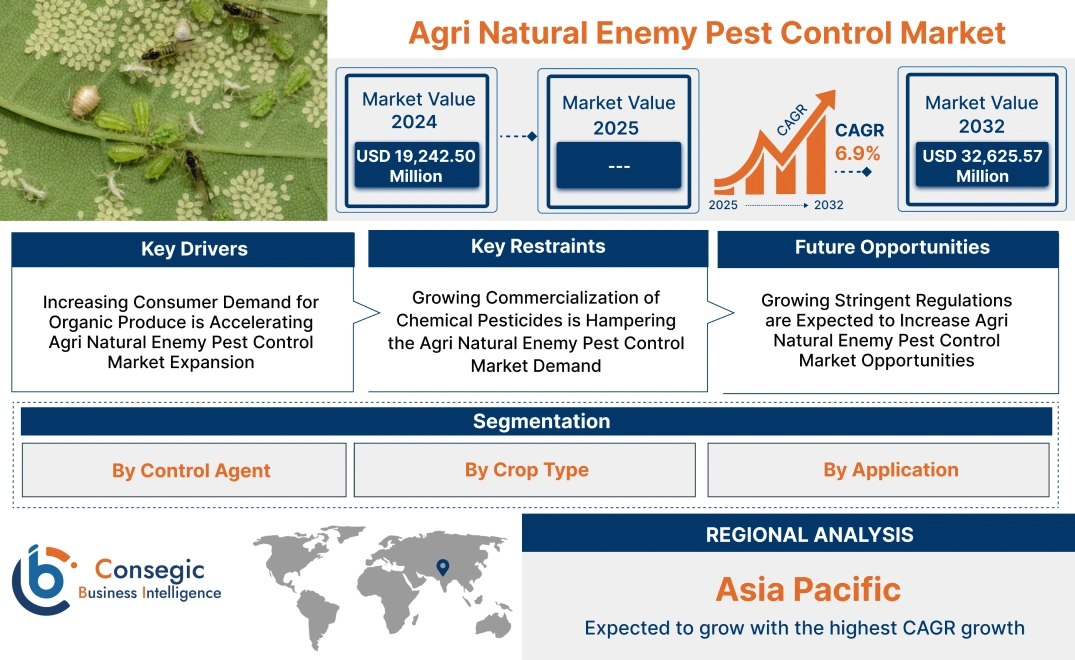
Agri Natural Enemy Pest Control Market size is growing with a CAGR of 6.9% during the forecast period (2025-2032), and the market is projected to be valued at USD 32,625.57 Million by 2032 from USD 19,242.50 Million in 2024.
Agri Natural Enemy Pest Control Market Scope & Overview:
Agri natural enemy pest control is a natural method to manage pests in farming. In this method, different beneficial organisms are introduced to plants to kill harmful organisms. It includes predators such as ladybugs and lacewings. Parasitoids such as tiny wasps and praying mantids. Pathogens such as bacteria, viruses, and fungi. Farmers are preferring it as an important part of integrated pest management (IPM). This IPM focuses on protecting crops in an eco-friendly manner.
It reduces the need for synthetic chemical-based pesticides, which have harmful effects on the environment. However, natural pest control is environmentally safe. It also helps in preventing pests from becoming resistant to treatment. This method is effectively used against various pests. This includes thrips, mealybugs, and whiteflies amongst others. This method protects crops. It is also beneficial for greenhouses and ornamental plants.
Agri Natural Enemy Pest Control Market Dynamics - (DRO) :
Key Drivers:
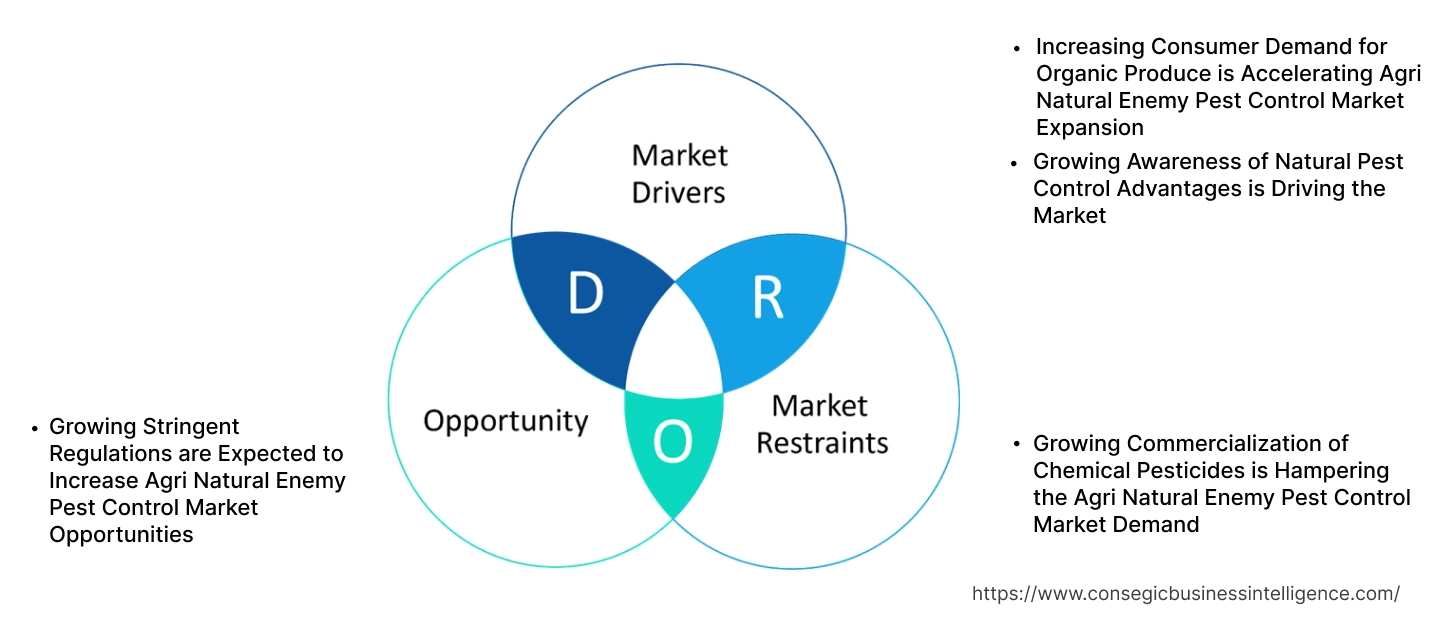
Increasing Consumer Demand for Organic Produce is Accelerating Agri Natural Enemy Pest Control Market Expansion
Organic produce is the growing of fruits, vegetables, grains, and other crops without using synthetic pesticides. Agri natural enemy pest control method introduces beneficial organisms to crops. By this farmer kill pests without relying on chemical-based pesticides. This reduces crop damage effectively. It also maintains healthy yields of crops. More people are becoming aware of risks to health with chemical-based pesticides. This is making consumers ask for safer food options.
For instance,
- According to Organic Trade Association, the sales of organic fruits and vegetables in year 2023 grew by 2.6%. The increased need for organic produce has pushed farmers to use natural methods to prevent pests.
Overall, the increasing consumer demand for organic produce is significantly boosting the agri natural enemy pest control market expansion.
Growing Awareness of Natural Pest Control Advantages is Driving the Market
From many years farmers are using chemical-based pesticide for pest control. However, now many farmers are becoming aware of its negative impact on the environment. They are becoming aware that these synthetic pesticide impact human health also. This awareness is due to information given by advocacy groups and non-profits organizations. Moreover, this has also been possible through information provided by different communication platforms.
For instance,
- The Xerces Society for Invertebrate Conservation published an article in 2024 stating what are helpful predators. They provided knowledge on how natural enemies benefit garden protection. They also provided some examples of natural enemies individuals can use. This growing awareness is making farmers and consumers to adopt natural enemies more.
Thus, growing awareness of natural pest control advantages is accelerating the global agri natural enemy pest control market growth.
Key Restraints:
Growing Commercialization of Chemical Pesticides is Hampering the Agri Natural Enemy Pest Control Market Demand
The market growth faces hurdles from chemical pesticides. Synthetic pesticides are cost effective when compared to natural. Owing to this, farmers choose synthetic options as they purchase it in bulk volume for whole agriculture farm. Moreover, natural agents take more time to kill microorganism compared to synthetic. This increases the risk of damage to crops. Also, this proves as disadvantage to farmers who want quick mechanism to protect their plants. Additionally, these natural control agents have limited shelf life. This discourages its use for longer period of time. Furthermore, these natural pest controls are supposed to be stored at specific conditions. This requires more investment and infrastructure setup, which increases financial costs. Hence, growing commercialization of chemical pesticides is hampering the agri natural enemy pest control market demand.
Future Opportunities :
Growing Stringent Regulations are Expected to Increase Agri Natural Enemy Pest Control Market Opportunities
Synthetic pesticides contaminate water sources. They also harm beneficial insects and pollinators. Also, its residues in food chain pose risk to human health. It is responsible for causing cancer and some neurological diseases. Governments worldwide are understanding these dangers related to synthetic pesticides. This has led them to release various regulations to reduce the use of synthetic pesticides.
For instance,
- Bussels banned the usage of synthetic pesticides for companies and individuals as of 2025. They have allowed only farmers to use them in limited amounts. Also, they have announced that no synthetic pesticide will be used as of 2030. This creates potential for manufacturers to develop natural pest control.
Overall, growing stringent regulations are expected to increase agri natural enemy pest control market opportunities.
Agri Natural Enemy Pest Control Market Segmental Analysis :
By Control Agent:
Based on control agents, the market is categorized into predators, parasitoids, pathogens, and others.
Trends in Control Agent:
- Emphasis on conserving existing natural enemy populations within agroecosystems.
- Growing refinement of mass rearing and release methods for improved efficacy.
The predators segment accounted for the largest market share in 2024.
- Predators dominated the agri natural enemy pest control market trends. It is becoming a popular choice for farmers. This is because of their superior effectiveness when compared to all others.
- These are creatures that feed harmful pests. An example includes ladybugs. It eats aphids and mites. This helps farmers in controlling spider mites.
- They reproduce continuously. This helps in controlling pests over time. This makes them a sustainable method.
- Governments are granting incentives to organizations to adopt the integrated pest management (IPM) approach in farming.
- For instance, in 2022, the Environmental Protection Agency granted USD 700 thousand to six organization who are using IPM strategy. This IPM strategy is framed to reduce the use of synthetic pesticides. This has increased the need for predators to control pests naturally.
- Overall, as per the market analysis, the government granting is driving a segment in agri natural enemy pest control market growth.
The parasitoids segment is expected to grow at the fastest CAGR over the forecast period.
- Parasitoids are an emerging segment in the market. These creatures are small insects. They are also used to control pests in a more effective way.
- It includes wasps. These wasps lay their eggs on or inside harmful pests. Then, when the eggs are hatched, the larvae feed on the pests. This led to eventually killing them.
- For example, the Trichogramma wasps are used to control caterpillars and Encarsia Formosa are used to control whiteflies.
- According to market analysis, the growing need for food which is free from synthetic pesticides will drive the segment for the upcoming years. Moreover, rising awareness of their benefits in controlling pests naturally will further support the growth.
By Crop Type:
Based on crop type, the market is categorized into cereals & grains, fruits & vegetables, ornamentals, and others.
Trends in the Crop Type
- Growing use in ornamentals due to its increased need as focus on aesthetics and environmentally friendly practices.
- Utilizing natural enemies on cotton to control pests such as bollworms and reduce reliance on chemical insecticides.
The fruits & vegetables segment accounted for the largest market share in 2024.
- Fruits and vegetables dominated the agri natural enemy pest control market trends. They are easily exposed to pests. Also, these crops are sensitive to chemicals. This leaves harmful residues in them.
- Moreover, these fruits and vegetables are grown by farmers in various environments. They are grown in open fields to control greenhouses. This makes them a proper choice for biological pest control methods.
- Governments are banning the use of synthetic pesticides for these crops. As they negatively impact environment and health. This is driving the segment.
- Moreover, there are advancements in biotechnology methods. This is helping manufacturers to develop natural pest control with enhanced properties. This is supporting the market growth more strongly.
- Overall, as per the market analysis, stringent government regulations for synthetic pesticides and technological advancements are driving segmental growth in the agri natural enemy pest control industry.
The cereals & grains segment is expected to grow at the fastest CAGR over the forecast period.
- Cereals and grains are an emerging segment in the market. It is because of their importance in global food production.
- Crops such as wheat, corn, and rice serve as staples in many regions and countries. This requires a constant number of agents to keep pests under control.
- According to market analysis, consumers are understanding the benefits of sustainable farming. They are seeking cleaner food options. This has increased the need for pesticide-free food, including cereals and grains.
- For instance, according to Organic Boosting, organic cereal market is expected to grow at CAGR of 6.30% from 2021 to 2026. This will require natural pest control methods to kill harmful organisms.
By Application:
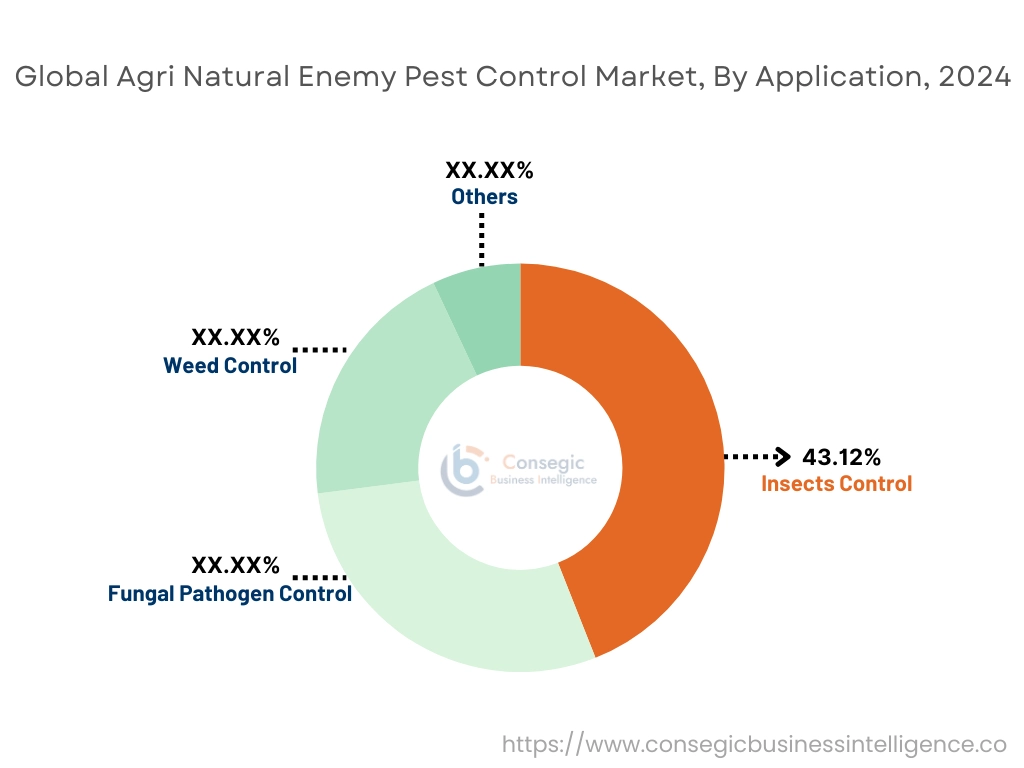
Based on application, the market is categorized into insects control, fungal pathogen control, weed control, and others.
Trends in the Application
- Expansion of natural pest control in greenhouse and protected agriculture industry.
- Development of user-friendly tools and resources for farmers to implement natural pest control.
The insects control segment accounted for the largest market share of 43.12% in 2024.
- Insects control is further categorized into aphids, beetles, caterpillars, flies, and others.
- Insects control dominated the market. Insects are a serious threat to crop yields. They infect plants with disease on various parts. This includes leaves, stems and roots.
- It reduces the growth and development of plants. This leads to weakening of plants, while decreasing crop yields. They cause substantial economic losses to farmers doing farming worldwide.
- Governments are banning synthetic insecticides due to their negative impact on the environment, human and animal health.
- For instance, in 2021, the Environmental Protection Agency banned chlorpyrifos for all food. Chlorpyrifos is a harmful insecticide impacting brain of humans. This has promoted the use of agri natural enemy pest control.
The fungal pathogen control segment is expected to grow at the fastest CAGR over the forecast period.
- Fungal pathogen control is an emerging segment. Its demand is growing because of the serious fungal diseases growing in plants. This includes diseases such as powdery mildew, rust, and blight.
- They are damaging crops. It also leads to significant yield losses. This puts farmers under financial strain.
- Chemical fungicides are widely used to tackle these issues. But they create problems such as resistance, environmental harm, and leftover residues on crops.
- Biological solutions, such as beneficial microorganisms and fungal antagonists, offer an environmentally friendly way to manage infections. They protect plants without harming the crops or leaving harmful residues.
- As per market analysis, growing plant fungal diseases requiring effective pest control will drive the segment for the forecasted period.
Regional Analysis:
The regional segment includes North America, Europe, Asia Pacific, the Middle East and Africa, and Latin America.
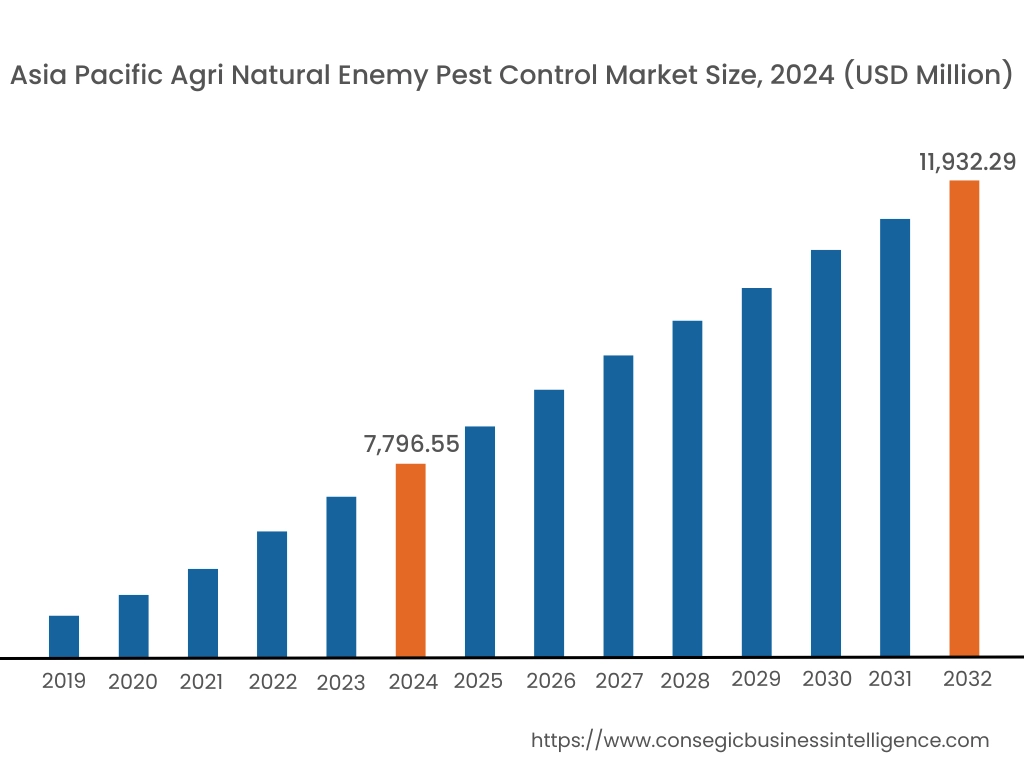
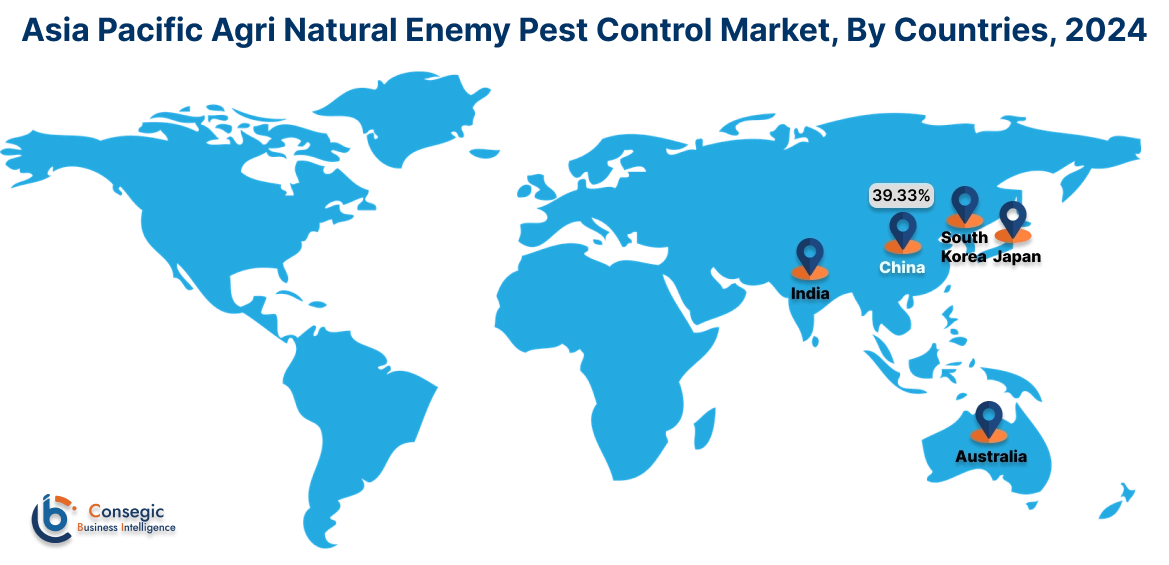
In 2024, Asia Pacific accounted for the highest agri natural enemy pest control market share at 40.52% and was valued at USD 7,796.55 Million and is expected to reach USD 11,932.29 Million in 2032. In Asia Pacific, the China accounted for the agri natural enemy pest control market share of 39.33% during the base year of 2024. Countries such as China, India, and Japan are leading the market. They are investing in research and development activities. These activities are making biological pest control more practical and effective. Moreover, farmers are also adopting precision farming technologies. This is allowing for better integration of agri natural enemy pest control into their crops. Additionally, pests have developed resistance to many chemical pesticides, making them less effective, and increased annual loss.
For instance,
- According to a study published by National Center for Biotechnology Information, in 2024, insect pests resistance causes around USD 36 billion of crop loss annually in India. This has required effective while natural solutions control it, driving the market in region.
Overall, robust R&D, adoption of precision farming, and inefficacy of chemical pesticides due to pest resistance are driving the market in the region.
In North America, the agri natural enemy pest control market is experiencing the fastest growth with a CAGR of 9.3% over the forecast period. More people are focusing on healthier eating habits. They are choosing food that is free from synthetic chemicals and pesticides. This shift has pushed farmers to adopt more sustainable practices. This includes using biological pest control to meet the growing demand for organic produce. Natural predators, parasitoids, and pathogens offer an effective way to control pests without harming the organic quality of the crops. Moreover, awareness about the risks of chemical pesticides is increasing. Farmers are more informed about the environmental damage associated with traditional pest control. This includes water contamination or harm to beneficial insects. They are recognizing the long-term benefits of natural control agents. This includes healthier soil and reduced reliance on chemicals. This is also driving a broader adoption of biological pest control across North America.
Europe's agri natural enemy pest control market analysis states that several trends are responsible for the progress of the market in the region. The European Union has implemented tough laws to reduce the use of harmful pesticides. They are focusing on protecting the environment and human health. This has left farmers with limited chemical options. It has also encouraged them to explore safer, more sustainable alternatives. This includes biological pest control. Moreover, the growing adoption of integrated pest management is another important trend driving this market in Europe. IPM promotes a holistic approach to pest control. Natural enemies such as predators and parasitoids play a vital role in IPM. It effectively targets pests without harming beneficial species or the environment.
The Middle East and Africa (MEA) agri natural enemy pest control market analysis states that the region is also witnessing several trends for notable surge. Many governments in the region are focused on promoting sustainable agricultural practices. These practices are to improve food security and reduce environmental damage. They are offering incentives such as subsidies for organic farming. This support is making it easier for farmers to adopt biological pest control methods. It is also making them less rely on chemicals which harm the soil and water. Moreover, there is growing investment in the agricultural industry across MEA. Both governments and private organizations are investing in the development of innovative natural pest control solutions driving the market in region.
Latin America's agri natural enemy pest control market size is also emerging and limited retail penetration in rural areas poses challenges. Governments in the region are increasingly collaborating with universities and agricultural businesses. This is to create more sustainable farming methods. These partnerships are focused on advancing biological pest control solutions such as natural predators, parasitoids, and pathogens. By sharing resources and knowledge, these collaborations are helping farmers to speed up the adoption of eco-friendly pest management practices. Moreover, with a growing demand for sustainably produced food, countries such as Brazil and Mexico are aligning their farming practices with global sustainability standards. By turning to natural pest control, farmers are building more resilient agricultural systems that benefit both the environment and their crops.
Top Key Players and Market Share Insights:
The Agri Natural Enemy Pest Control market is highly competitive with major players providing products to the national and international markets. Key players are adopting several strategies in research and development (R&D) and product innovation to hold a strong position in the global Agri Natural Enemy Pest Control market. Key players in The Agri Natural Enemy Pest Control industry include-
- Koppert (Netherlands)
- Andermatt Group AG (Switzerland)
- FMC Corporation (U.S.)
- Novozymes A/S (Denmark)
- Marrone Bio Innovations (U.S.)
- Biobest Group NV (Belgium)
- BASF SE (Germany)
- Certis L.L.C. (U.S.)
- BioWorks, Inc. (U.S.)
- Corteva Agriscience (U.S.)
Agri Natural Enemy Pest Control Market Report Insights :
| Report Attributes | Report Details |
| Study Timeline | 2019-2032 |
| Market Size in 2032 | USD 32,625.57 Million |
| CAGR (2025-2032) | 6.9% |
| By Control Agent |
|
| By Crop Type |
|
| By Application |
|
| By Region |
|
| Key Players |
|
| North America | U.S. Canada Mexico |
| Europe | U.K. Germany France Spain Italy Russia Benelux Rest of Europe |
| APAC | China South Korea Japan India Australia ASEAN Rest of Asia-Pacific |
| Middle East and Africa | GCC Turkey South Africa Rest of MEA |
| LATAM | Brazil Argentina Chile Rest of LATAM |
| Report Coverage |
|
Key Questions Answered in the Report
How big is the Agri Natural Enemy Pest Control market? −
In 2024, the Agri Natural Enemy Pest Control market is USD 19,242.50 Million.
Which is the fastest-growing region in the Agri Natural Enemy Pest Control market? +
North America is the fastest-growing region in the Agri Natural Enemy Pest Control market.
What specific segmentation details are covered in the Agri Natural Enemy Pest Control market? +
Control Agent, Crop Type and Application segmentation details are covered in the Agri Natural Enemy Pest Control market
Who are the major players in the Agri Natural Enemy Pest Control market? +
Koppert (Netherlands), Andermatt Group AG (Switzerland), Biobest Group NV (Belgium), BASF SE (Germany), and Certis L.L.C. (U.S.) are the some of the major players in the market.
Overview
Reputation & Certifications


Our Services
- Market Intelligence & Forecasting
- Custom Research Solutions
- Market Entry Strategy
- Competitive Intelligence
- Customer Insights
- Industry Innovation Analysis
- Investment Advisory