Jump to Content
Agricultural Inoculants Market - Size, Share, Industry Trends, and Forecasts (2025-2032)
Agricultural Inoculants Market Size:
Agricultural Inoculants Market size is growing with a CAGR of 6.9% during the forecast period (2025-2032), and the market is projected to be valued at USD 962.29 Million by 2032 from USD 567.13 Million in 2024.
Agricultural Inoculants Market Scope & Overview:
Agricultural inoculants are natural products. They are made from beneficial microorganisms. It includes bacteria, fungi, and others. They are used by farmers to improve soil health. They also help in boosting plant growth. They work with plants to help them increase their nutrient uptake. They also fight various diseases. Moreover, they support healthier yields. By using these inoculants, farmers are reducing their reliance on chemical fertilizers and pesticides. This promotes more sustainable farming practices. Farmers choose inoculants in forms such as liquids, and solids. These products are commonly used on various crops. It includes corn, wheat, rice, soybeans, peanuts, lentils, and vegetables.
How is AI Transforming the Agricultural Inoculants Market?
There is a rising adoption of AI in agricultural inoculants market, specifically for facilitating the development, application, and effectiveness of agricultural inoculants. Moreover, AI-powered systems are primarily used for enhancing the effectiveness of beneficial microbes by optimizing their application and predicting their impact on crops.
Additionally, AI-powered systems can analyze various factors such as soil conditions, weather patterns, and crop needs to recommend the ideal type and amount of inoculant to use, further leading to improved nutrient uptake, disease resistance, and overall plant health. Consequently, the above factors are expected to propel the market growth during the forecast period.

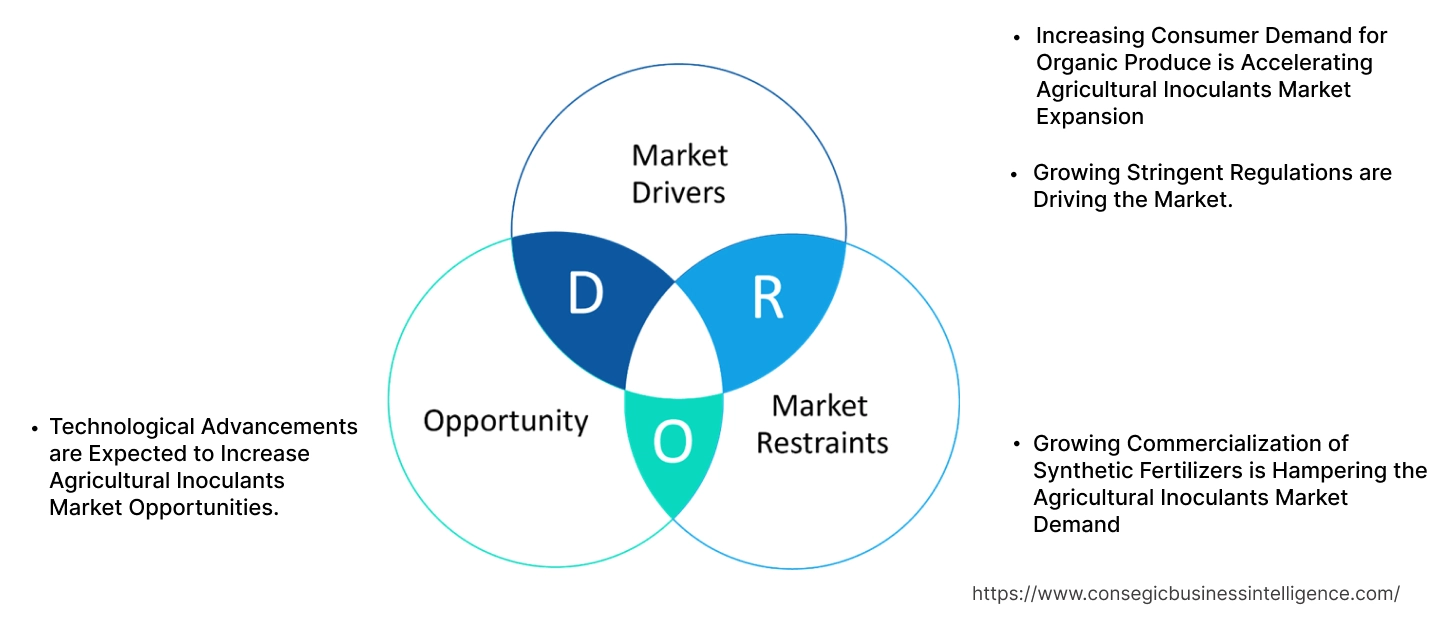
Agricultural Inoculants Market Dynamics - (DRO) :
Key Drivers:
Increasing Consumer Demand for Organic Produce is Accelerating Agricultural Inoculants Market Expansion
Organic produce is grown by farmers without the use of synthetic fertilizers. It includes fruits, vegetables, grains, and other crops. Inoculants are made from beneficial organisms. They have become an important option for farmers. It is because they help them to grow healthy crops, without using chemical fertilizers. More people are becoming aware that synthetic fertilizers decrease the nutritional value of produce. This is making consumers ask for more safe and healthy food options.
For instance,
- According to the Organic Trade Association, in the year 2023, the U.S. saw a 2.6% increase in sales of organic fruits and vegetables. The increased need for organic produce has pushed farmers to use natural methods to grow healthy crops.
Overall, the increasing consumer demand for organic produce is significantly boosting the agricultural inoculants market expansion.
Growing Stringent Regulations are Driving the Market.
Synthetic fertilizers increase yields in a short period, but they degrade soil health. They also pollute water sources through runoff. Moreover, they release gases such as nitrous oxide. This contributes to climate change. However, there is growing awareness among farmers and regulatory bodies of the harm these fertilizers cause to the environment. Owing to this, governments worldwide are releasing stringent regulations to decrease the use of synthetic fertilizers.
For instance,
- According to the World Bank, in May 2021, Sri Lanka’s government banned all imports related to chemical fertilizers. This has increased the sales of agricultural inoculants to grow healthy plants in a natural way.
Thus, growing stringent regulations are accelerating the global agricultural inoculants market growth.
Key Restraints:
Growing Commercialization of Synthetic Fertilizers is Hampering the Agricultural Inoculants Market Demand
The market growth faces challenges from synthetic fertilizers. These fertilizers are widely adopted by farmers as they provide quick results. They increase crop yields in very short periods. On the other hand, inoculants take time to give results. This is a disadvantage for farmers looking to have immediate results on crops. Moreover, inoculants have shorter shelf life. This discourages its use for a longer period of time. Additionally, the result of inoculants varies on different factors. It includes soil types, climate, and specific crops being grown. This variability makes them less reliable in comparison to synthetic fertilizers. Furthermore, these inoculants are supposed to be stored under specific conditions. This requires more investment and infrastructure setup, which increases financial costs. Hence, the growing commercialization of synthetic fertilizers is hampering the agricultural inoculants market demand.
Future Opportunities :
Technological Advancements are Expected to Increase Agricultural Inoculants Market Opportunities.
There are increased research and development activities. It has allowed manufacturers to identify specific species of bacteria and fungi which work best for particular crops. Moreover, genetic engineering techniques are used to improve the performance of microorganisms. This has enhanced their stress tolerance. It has also increased their production of beneficial compounds. Additionally, advanced formulation techniques and novel delivery methods are proving beneficial.
For instance,
- Springer Nature published an article in 2024, stating that next-generation inoculants are being developed with increased shelf life. They also stated that new method encapsulation has led to the development of inoculants containing multiple strains simultaneously. This gives manufacturers chances to develop more innovative inoculants.
Overall, technological advancements improving inoculant properties are expected to increase agricultural inoculants market opportunities.
Agricultural Inoculants Market Segmental Analysis :
By Microbe Type:
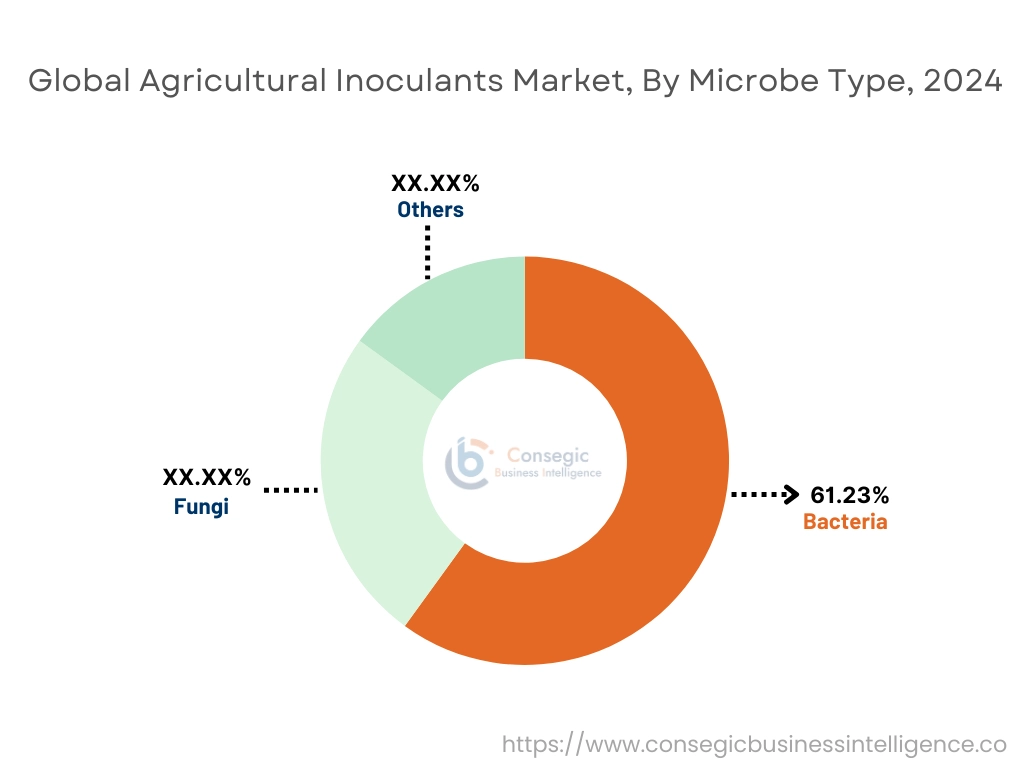
Based on microbe type, the market is categorized into bacteria, fungi, and others.
Trends in Microbe Type:
- Growing focuses on the development of mycorrhizal inoculants with improved shelf life and stability.
- Development of genetically modified microorganisms with enhanced plant growth-promoting traits.
The bacteria segment accounted for the largest market share of 61.23% in 2024.
- Bacteria dominate the agricultural inoculants market trends. These inoculants have been used for many years.
- They are used to improve crop nutrition and improve plant development. They also suppress plant diseases.
- They have a successful track of application in the agriculture industry. Also, they are cost-effective for producing and applying.
- An example is azotobacter. They promote plant development by fixing atmospheric nitrogen and producing plant growth hormones.
- Research efforts have led to the development of inoculants with new strains with improved properties.
For instance, in 2024, Asfertglobal launched an inoculant with a unique strain of Bacillus Velezensis. These new innovations have increased their reach and application in the agriculture industry, driving segment.
- Overall, as per the market analysis, the new product innovations are driving a segment in agricultural inoculants market growth.
The fungi segment is expected to grow at the fastest CAGR over the forecast period.
- Fungal inoculants are an emerging segment of the market. They offer sustainable solutions to improve crop productivity.
- They also stimulate root development. This leads to increased plant vigor.
- Mycorrhizal fungi form symbiotic relationships with roots. It forms this with most plant species. This enhances nutrient and water uptake.
- Trichoderma and other beneficial fungi exhibit strong biocontrol properties. They suppress a wide range of plant diseases caused by fungi, and some nematodes.
- According to market analysis, there is ongoing research that is leading to a better understanding of the mechanisms of action of beneficial fungi.
- This has led to the development of more effective and efficient inoculants, driving segments.
- Also, the government banned synthetic fertilizers with further support for the market.
By Form:
Based on form, the market is categorized into solid and liquid.
Trends in the Form:
- There is a growing exploration of novel carrier materials for solid formulations to improve efficacy.
- Increased usage of nanotechnology in both forms for targeted delivery of microorganisms
The solid segment accounted for the largest market share in 2024.
- Solid dominates the agricultural inoculants market trends. These formulations incorporate carrier materials such as pets, vermiculite, or charcoal. They offer significantly improved stability during storage and transportation.
- They are compatible with traditional farming methods. They are easily applied by coating seeds or mixing directly into the soil.
- Governments are granting incentives to organizations to adopt sustainable approaches to farming.
- For instance, in 2023, the UK government launched the Sustainable Farming Incentive. This is designed to pay farmers to adopt sustainable farming. This has increased the need for solid inoculants to improve plant productivity in a natural way.
- Overall, as per the market analysis, government granting is driving segmental growth in the agricultural inoculants industry.
The liquid segment is expected to grow at the fastest CAGR over the forecast period.
- Liquid inoculants are quickly gaining popularity. This is because of their unique benefits and flexibility. This form is ready to use.
- They have active microbes that start working as soon as they’re applied. This makes them a faster-acting option for improving plant development. This is an advantage for time-sensitive farming operations.
- Moreover, liquid inoculants are applied through irrigation systems. This ensures even distribution across fields.
- This precision is valuable for farmers using advanced techniques such as precision agriculture.
- As per the market analysis, farming practices are evolving. The movement towards efficient and sustainable methods will drive the segment for the upcoming years.
By Crop Type:
Based on crop type, the market is categorized into fruits & vegetables, cereals & grains, oilseeds & pulses, and others.
Trends in the Crop Type:
- Increased focus on developing inoculants for specific oilseeds such as soybeans and canola.
- Growing research activities on inoculants for high-value fruit and vegetable crops.
The cereals & grains segment accounted for the largest market share in 2024.
- Cereals and grains, such as wheat, rice, and corn, are staples in many regions and countries worldwide.
- These staple crops have sheer cultivation scales requiring high yields. Farmers turn to inoculants to address nutrient deficiencies in the soil, especially nitrogen.
- Nitrogen-fixing bacteria are found in many inoculants. They help these crops access the nutrients they need to develop. This reduces the dependence on synthetic fertilizers.
- Agriculture organizations and communication platforms are increasingly making farmers aware of the inoculant’s benefits.
- For instance, the Agriculture and Horticulture Development Board published an article in 2024, providing information on different types of beneficial microorganisms for cereal growers and how to select specific strains. This awareness has led to an increase in sales of it for cereals, driving segment.
- Overall, as per the market analysis, the growing awareness amongst farmers is driving the segment.
The fruit & vegetables segment is expected to grow at the fastest CAGR over the forecast period.
- Fruits and vegetables are an emerging segment of the market. It is becoming an important area for agricultural inoculants.
- Consumers are requiring fresh produce that is free from chemical-based fertilizers.
- Unlike staple crops, fruits and vegetables require high levels of nutrients and consistent care. Inoculants enhance nutrient availability.
- An example includes phosphate-solubilizing microbes. This helps plants access important nutrients naturally.
- This leads to better development of plants with higher yields and improved resistance to pests and diseases.
- The shift toward organic farming will drive the adoption of inoculants in fruit and vegetable farming driving segment for the forecasted period.
Regional Analysis:
The regional segment includes North America, Europe, Asia Pacific, the Middle East and Africa, and Latin America.
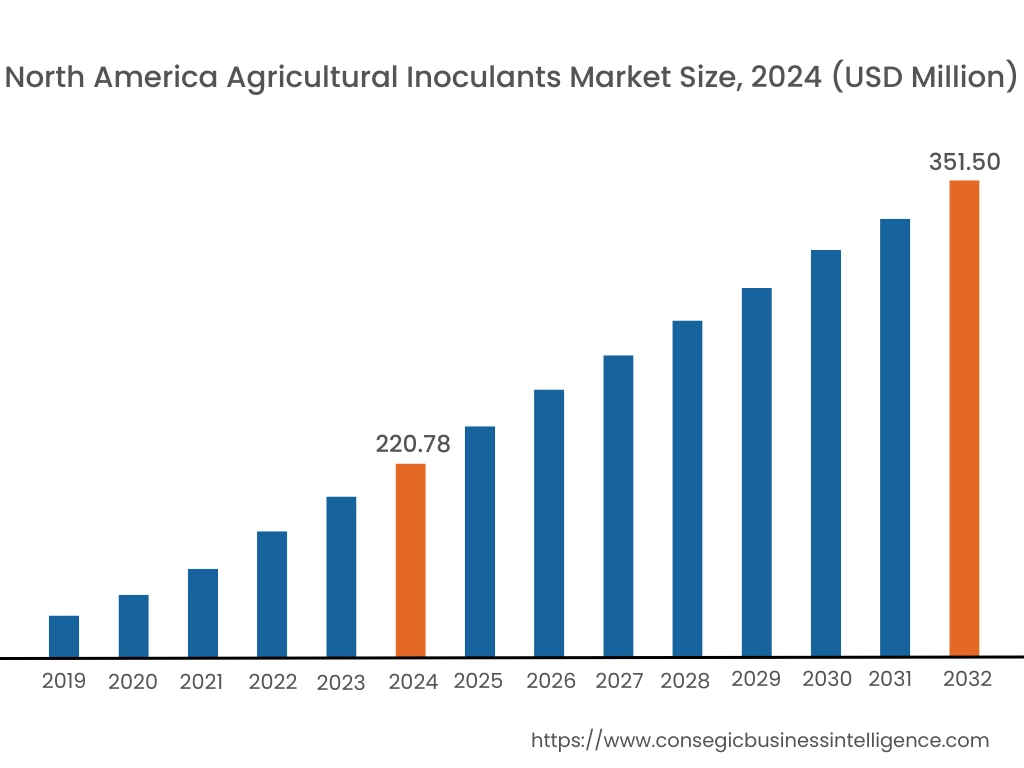
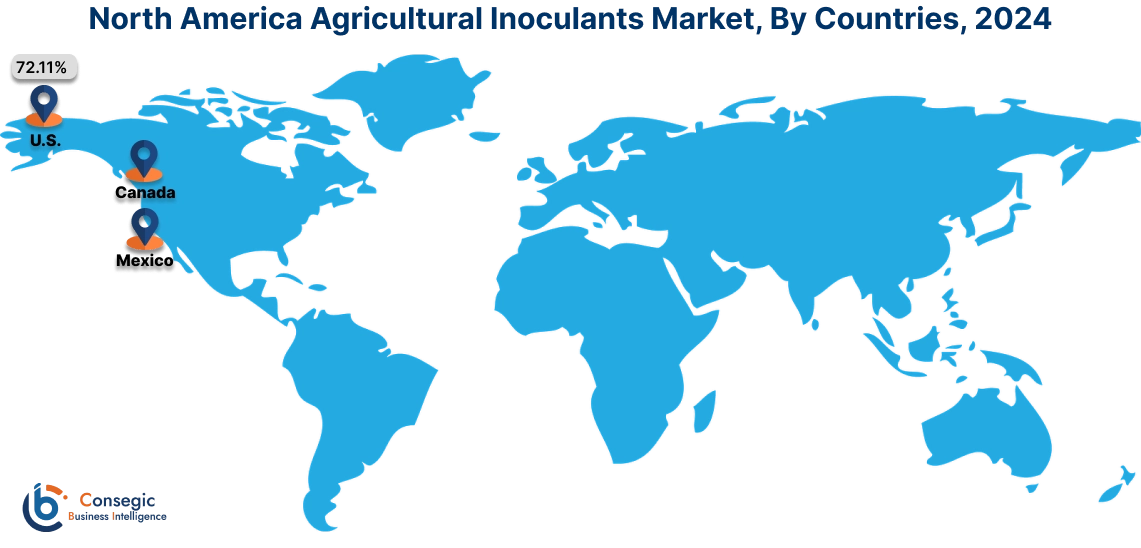
In 2024, North America accounted for the highest agricultural inoculants market share at 38.93% and was valued at USD 220.78 Million and is expected to reach USD 351.50 Million in 2032. In North America, the U.S. accounted for the agricultural inoculants market share of 72.11% during the base year of 2024. Farmers in the region are adopting precision agriculture industry tools. This includes soil sensors to optimize crop productivity. These innovations are making it easier to apply inoculants accurately. Additionally, there are advancements in biotechnology. These are helping to develop more effective and stable inoculant strains tailored to specific crops. This boosts overall efficiency.
For instance,
- In 2022, Performance Nutrition launched NutriWise inoculant in two forms, granules and powder. It contains three species of microorganisms, namely Bacillus, Trichoderma, and Saccharomyces.
Moreover, the rising demand for organic food is a major driver in the region. Consumers are becoming more health-conscious and environmentally aware. They are seeking food produced without chemical fertilizers. Inoculants are a natural fit for organic farming. They improve soil fertility and promote plant development without harming the environment. Overall, technological advancements, along with rising demand for organic food are driving the market in the region.
In Asia Pacific, the agricultural inoculants market is experiencing the fastest growth with a CAGR of 8.5% over the forecast period. Farmers and governments are recognizing the environmental and economic benefits of inoculants. They help in reducing dependency on synthetic fertilizers. There is also a growing understanding of how inoculants restore soil health naturally. Educational campaigns by agricultural organizations are spreading knowledge about the long-term advantages of using inoculants. Moreover, precision agriculture is another significant trend contributing to the market in APAC. Farmers in countries such as China, India, and Japan are accepting precision agriculture tools. These technologies enable the targeted application of inoculants. This ensures optimal interaction between the microbes and crops. By introducing inoculants into precision systems, farmers are achieving better nutrient efficiency. They are also helping to reduce waste while boosting productivity.
Europe's agricultural inoculants market analysis states that several trends are responsible for the progress of the market in the region. The region has some of the toughest environmental laws. When it comes to the use of synthetic fertilizer, the regulatory body in Europe is becoming more strict. These regulations are pushing farmers to reduce their chemical input and use inoculants. Inoculants offer a natural alternative to enhance soil health. They also improve crop productivity without violating these rules. Moreover, governments and organizations across Europe are offering incentives for sustainable farming practices. This is further fueling the demand for inoculants. Financial subsidies and tax breaks are encouraging farmers to shift towards more environmentally friendly methods. These incentives are especially attractive to those involved in organic farming. Inoculants align perfectly with these goals, as they help reduce the reliance on chemical treatments.
The Middle East and Africa (MEA) agricultural inoculants market analysis states that the region is also witnessing several trends for a notable surge. Governments and private investors in the region are recognizing the importance of modernizing agricultural practices. This is important to ensure food security and economic stability. They are investing in improving infrastructure. They also aim to adopt advanced technologies that promote higher yields and better resource management. Agricultural inoculants are gaining attention as a key component in these efforts. They help improve soil fertility and optimize nutrient uptake. Moreover, there are growing concerns about water scarcity and land degradation. Owing to this, there is investment in the agricultural sector. This has increased the access of farmers to biological solutions that enhance crop productivity.
Latin America's agricultural inoculants market size is also emerging and limited retail penetration in rural areas poses challenges. In the region, there are collaborations between governments and agricultural organizations. They are promoting the use of inoculants. These partnerships help bring innovative farming solutions to farmers. This includes those in rural areas. Through joint efforts, there is a push to provide better access to education on the benefits of using inoculants. This helps farmers to understand that they improve soil health and boost crop yields. Moreover, many countries in Latin America face issues such as soil erosion, nutrient depletion, and reduced soil fertility. This impacts on agricultural productivity. Inoculants are becoming a viable solution to restore and maintain soil health. These microbes help break down organic matter and improve soil structure.
Top Key Players and Market Share Insights:
The Agricultural Inoculants market is highly competitive with major players providing products to the national and international markets. Key players are adopting several strategies in research and development (R&D) and product innovation to hold a strong position in the global Agricultural Inoculants market. Key players in The Agricultural Inoculants industry include-
- Koppert (Netherlands)
- Asfertglobal (Portugal)
- Lallemand, Inc. (Germany)
- EnviroKure (U.S.)
- Bionema Group Limited (UK)
- Novozymes A/S (Denmark)
- BASF SE (Germany)
- Corteva Agriscience (U.S.)
- Dora Agri-Tech (China)
- Biofilm (Sri Lanka)
Agricultural Inoculants Market Report Insights :
| Report Attributes | Report Details |
| Study Timeline | 2019-2032 |
| Market Size in 2032 | USD 962.29 Million |
| CAGR (2025-2032) | 6.9% |
| By Microbe Type |
|
| By Form |
|
| By Crop Type |
|
| By Region |
|
| Key Players |
|
| North America | U.S. Canada Mexico |
| Europe | U.K. Germany France Spain Italy Russia Benelux Rest of Europe |
| APAC | China South Korea Japan India Australia ASEAN Rest of Asia-Pacific |
| Middle East and Africa | GCC Turkey South Africa Rest of MEA |
| LATAM | Brazil Argentina Chile Rest of LATAM |
| Report Coverage |
|
Key Questions Answered in the Report
How big is the Agricultural Inoculants market? −
In 2024, the Agricultural Inoculants market is USD 567.13 Million.
Which is the fastest-growing region in the Agricultural Inoculants market? +
Asia Pacific is the fastest-growing region in the Agricultural Inoculants market.
What specific segmentation details are covered in the Agricultural Inoculants market? +
Microbe Type, Form and Crop Type details are covered in the Agricultural Inoculants market
Who are the major players in the Agricultural Inoculants market? +
Koppert (Netherlands), Asfertglobal (Portugal), Novozymes A/S (Denmark), BASF SE (Germany), and Corteva Agriscience (U.S.) are some of the major players.
Overview
Reputation & Certifications


Our Services
- Market Intelligence & Forecasting
- Custom Research Solutions
- Market Entry Strategy
- Competitive Intelligence
- Customer Insights
- Industry Innovation Analysis
- Investment Advisory