Jump to Content
Phosphine Fumigation Market - Size, Share, Industry Trends, and Forecasts (2025-2032)
Phosphine Fumigation Market Size:
Phosphine Fumigation Market size is estimated to reach over USD 1,027.53 Million by 2032 from a value of USD 664.51 Million in 2024 and is projected to grow by USD 689.88 Million in 2025, growing at a CAGR of 5.6% from 2025 to 2032.
Phosphine Fumigation Market Scope & Overview:
Phosphine fumigation is a pest control method using phosphine gas to eliminate insects, rodents, and other pests in stored agricultural products and structures. This method is highly effective due to its gaseous nature, which allows uniform penetration across treated areas. This method offers quick action, minimal residue, and compatibility with various storage environments, making it a preferred choice for pest management.
Key benefits include protecting food quality, extending product shelf life, and maintaining hygiene standards. It is widely used for grains, nuts, processed foods, and packaged goods. Additionally, phosphine fumigation is essential for preventing cross-contamination in storage and transportation.
Industries relying on this method include agriculture, food processing, logistics, and warehousing. The increasing need for effective pest control and compliance with regulatory requirements supports its widespread adoption across diverse sectors.
How is AI Transforming the Phosphine Fumigation Market?
There is a rising adoption of AI in the phosphine fumigation market, mainly for enhancing precision, safety, and efficiency through real-time monitoring, predictive analytics, and autonomous systems. AI-powered sensors can track gas, temperature, and humidity to optimize dosage and minimize chemical use. Moreover, automated equipment and remote monitoring solutions can improve worker safety by reducing exposure to dangerous phosphine gas. Additionally, AI solutions help with compliance, report generation, and overall process streamlining, making fumigation smarter and more sustainable. Consequently, the above factors are expected to propel the market growth during the forecast period.

Phosphine Fumigation Market Dynamics - (DRO) :
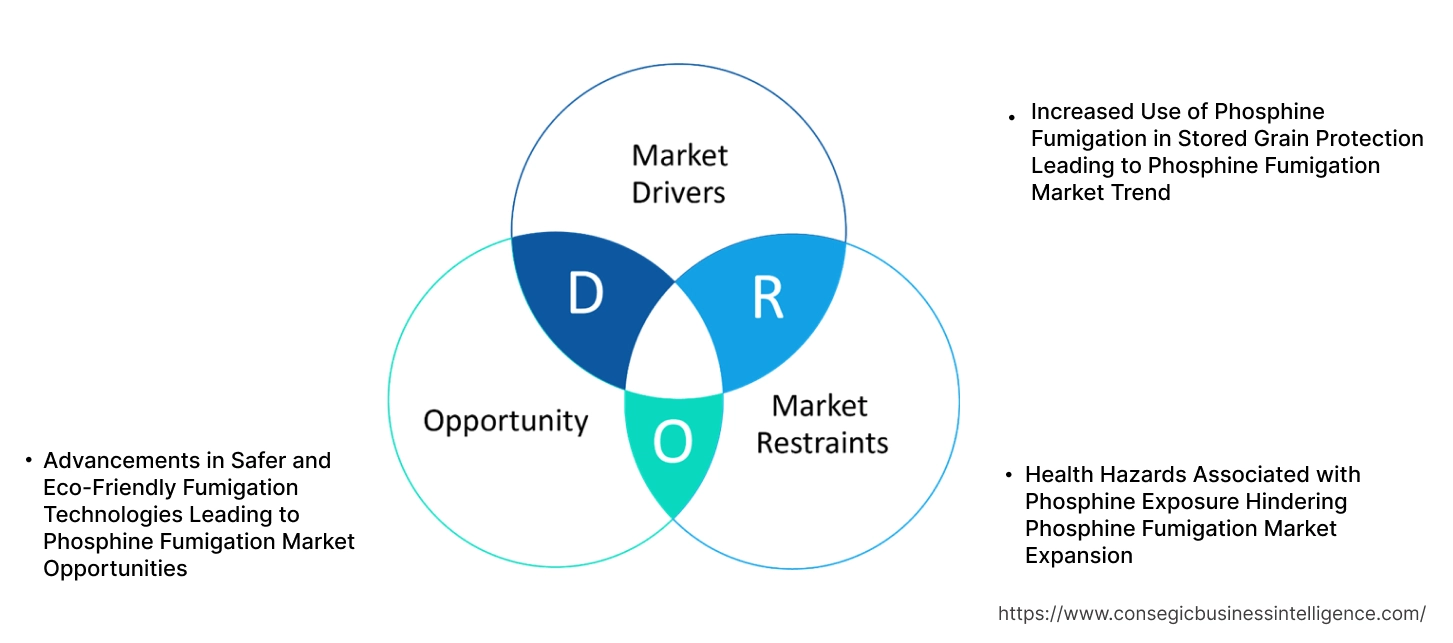
Key Drivers:
Increased Use of Phosphine Fumigation in Stored Grain Protection Leading to Phosphine Fumigation Market Trend
Phosphine fumigation effectively controls pests and insects in stored grains, ensuring quality preservation. This method is widely preferred in the agriculture sector due to its efficacy in penetrating grain storage units and eliminating infestations without leaving harmful residues. For example, large-scale grain storage facilities use phosphine to prevent losses caused by pests like weevils and beetles, safeguarding food supply chains.
Thus, the role of phosphine fumigation in maintaining grain quality supports its expanding use in the market.
Key Restraints:
Health Hazards Associated with Phosphine Exposure Hindering Phosphine Fumigation Market Expansion
Phosphine gas poses significant health risks during improper handling, including respiratory issues and toxicity. This challenge limits its adoption, especially among small-scale operators who lack proper safety training and equipment. For instance, workers exposed to high phosphine concentrations in confined spaces may face severe health repercussions, leading to stringent regulatory controls.
Therefore, health concerns related to phosphine use hinder its broader acceptance in the fumigation market.
Future Opportunities :
Advancements in Safer and Eco-Friendly Fumigation Technologies Leading to Phosphine Fumigation Market Opportunities
Future technologies will focus on controlled-release formulations, minimizing risks while improving pest control efficiency. For example, developments in encapsulated phosphine products will reduce human exposure and environmental impact.
As these advancements gain adoption, they will create a promising pathway for expanding the phosphine fumigation market.
Phosphine Fumigation Market Segmental Analysis :
By Type:
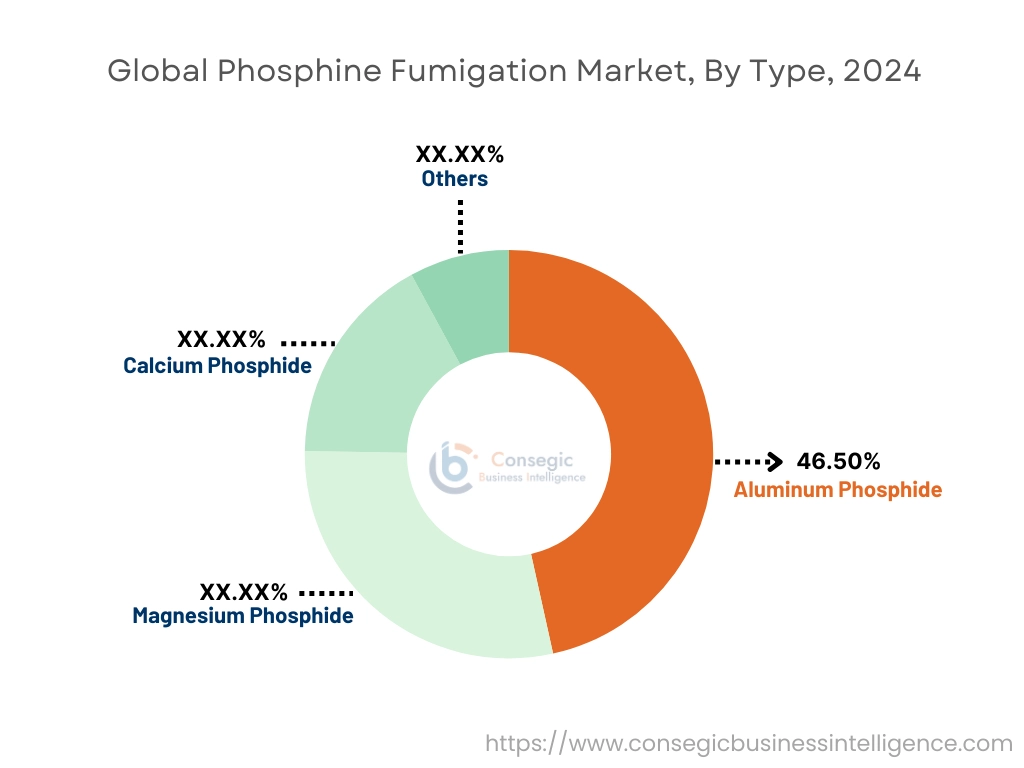
Based on type, the market is segmented into aluminum phosphide, magnesium phosphide, calcium phosphide, and others.
The aluminum phosphide sector accounted for the largest revenue in phosphine fumigation market share by 46.50% in 2024.
- Aluminium phosphide is a widely used fumigant for the control of pests in various agricultural and storage applications.
- It is highly effective due to its low toxicity to humans and animals, making it the preferred choice in the fumigation industry.
- Aluminum phosphide releases phosphine gas when it reacts with moisture, which is toxic to pests, ensuring effective pest control.
- Its versatility in treating a range of pests and its widespread availability have contributed to its dominance in the market.
- The phosphine fumigation market trend for aluminium phosphide is bolstered by its cost-effectiveness and ease of application, especially in raw agricultural commodities and stored food products.
- Therefore, according to phosphine fumigation market analysis, the aluminum phosphide segment is expected to maintain its leading position in the market due to its cost-effectiveness and wide range of applications.
The magnesium phosphide sector is anticipated to register the fastest CAGR during the forecast period.
- Magnesium phosphide, although used less frequently than aluminium phosphide, is gaining traction due to its rapid action and the ability to release higher concentrations of phosphine gas.
- It is especially effective for controlling insect pests in bulk grain storage and other commodities.
- Magnesium phosphide is favoured in situations requiring fast and efficient fumigation, particularly where aluminium phosphide's slower action may be a drawback.
- Increased research into enhancing its effectiveness and minimizing potential hazards is expected to boost its phosphine fumigation market share during the forecast period.
- Thus, according to phosphine fumigation market analysis, the magnesium phosphide segment is set to grow rapidly due to its quick fumigation results and evolving formulations.
By Form:
Based on form, the phosphine fumigation market is segmented into solid and liquid forms.
The solid form sector accounted for the largest revenue share in 2024.
- Solid phosphine fumigants are typically in the form of tablets or pellets, which are placed directly into storage areas.
- These forms are widely used due to their ease of handling, transportation, and application.
- The solid form is particularly useful in bulk grain storage, warehouses, and containers, where it gradually releases phosphine gas to control pests.
- Solid phosphine fumigants are also cost-effective, making them popular among various end-users in agriculture and food storage.
- Their widespread use and well-established application techniques ensure their continued dominance in the market.
- Therefore, according to market analysis, the solid form is expected to remain the dominant market segment due to its practicality, low cost, and widespread adoption in pest control.
The liquid form sector is anticipated to register the fastest CAGR during the forecast period.
- Liquid phosphine fumigants are gaining popularity due to their higher concentration of active ingredients and ability to produce more consistent results compared to solid forms.
- Liquid phosphine is typically applied in controlled environments, such as warehouses, and is more effective for certain applications, such as those involving sensitive goods.
- The growing preference for liquid fumigants in specialized industrial applications, where precision and rapid action are required, is driving the phosphine fumigation market
- As innovations in liquid fumigation technologies continue to improve, this segment is expected to witness substantial growth.
- Thus, according to market analysis, the liquid form segment is poised for significant growth, driven by technological advancements and the trend for precision in fumigation.
By Application:
Based on application, the market is segmented into raw agricultural commodities, stored processed food, warehouse, and others.
The raw agricultural commodities sector accounted for the largest revenue share in 2024.
- Phosphine fumigation is widely used in the agricultural sector for pest control during the storage of raw commodities such as grains, seeds, and pulses.
- The raw agricultural commodities segment is the largest due to the high phosphine fumigation market trend for fumigation in maintaining the quality and safety of these products during transport and storage.
- Phosphine’s ability to effectively control pests without compromising the integrity of the commodities makes it an essential tool for agricultural producers and distributors.
- As global food demand increases, the need for efficient pest control in the agricultural sector is expected to grow, thereby boosting the trend in the market.
- Therefore, according to market analysis, the raw agricultural commodities segment is expected to remain dominant due to its critical role in the agricultural supply chain and global food security.
The stored processed food sector is anticipated to register the fastest CAGR during the forecast period.
- As the trend for processed food grows worldwide, the need for effective pest control in storage facilities for processed foods is rising.
- Phosphine fumigation is used in the storage of processed food products like cereals, nuts, and dried fruits to prevent contamination by pests.
- The increased awareness about food safety and the growing export of processed foods are driving the trend for fumigation solutions in this sector.
- Moreover, advancements in fumigation methods, such as controlled release systems, are enhancing the appeal of phosphine fumigation in processed food storage.
- Thus, according to market analysis, the stored processed food sector is expected to experience rapid growth due to increasing food safety concerns and the expanding global food trade.
Regional Analysis:
The regional segment includes North America, Europe, Asia Pacific, Middle East and Africa, and Latin America.
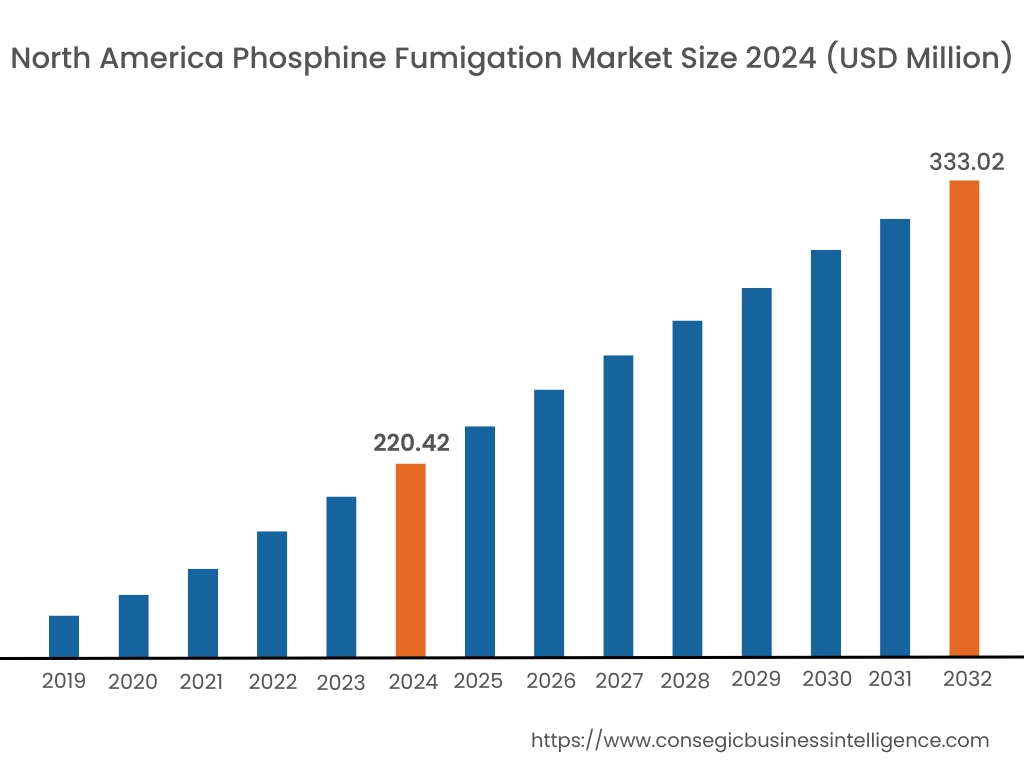
In 2024, North America was valued at USD 220.42 Million and is expected to reach USD 333.02 Million in 2032. In North America, the U.S. accounted for the highest share of 72.30% during the base year of 2024.
North America holds a significant share of the phosphine fumigation market. The United States and Canada are key players in agricultural fumigation, particularly in the grain storage and transportation sectors. Stringent regulations around pesticide use, combined with advancements in fumigation technologies, support the trend for phosphine fumigation. The market is also influenced by increasing awareness of pest control in the food and agriculture industries.

In Asia Pacific, the market is experiencing the fastest growth with a CAGR of 6.0% over the forecast period.
Asia-Pacific presents substantial phosphine fumigation market growth opportunities for phosphine fumigation. Countries like India, China, and Australia are major contributors due to their extensive agricultural sectors. Increasing demand for grain exports, along with efforts to reduce post-harvest losses, drives the need for effective fumigation solutions. The rising focus on food security and improved pest control methods in this region further supports phosphine fumigation market expansion.
Europe remains a mature market for phosphine fumigation. Countries such as Germany, France, and the United Kingdom have well-established agricultural systems that rely on effective pest control methods. Regulatory frameworks around chemical usage in agriculture are stringent, which promotes the adoption of safer and more efficient fumigation methods. The market in Europe is also influenced by the growing phosphine fumigation market demand for organic produce, driving the need for sustainable fumigation solutions.
The Middle East and Africa region shows a varied market performance in phosphine fumigation. Countries with strong agricultural activities, such as South Africa and Egypt, are major users of fumigation methods to ensure the quality of grains and stored products. However, inconsistent regulatory enforcement and limited access to modern fumigation technologies in some regions challenge widespread market adoption. Increasing investment in agricultural infrastructure is expected to improve market conditions in the long term.
Latin America, with key players like Brazil and Argentina, has a growing phosphine fumigation market demand for phosphine fumigation, particularly in the grain and agriculture sectors. The region's large-scale farming operations and export-driven agricultural industry require effective pest management solutions. Although challenges such as regulatory compliance and the need for more efficient fumigation practices persist, the demand for phosphine fumigation remains strong due to its cost-effectiveness and effectiveness in protecting stored crops.
Top Key Players & Market Share Insights:
The Global Phosphine Fumigation Market is highly competitive with major players providing products and services to the national and international markets. Key players are adopting several strategies in research and development (R&D), product innovation, and end-user launches to hold a strong position in the Global Phosphine Fumigation Market. Key players in the Phosphine Fumigation industry include-
- BASF SE (Germany)
- Degesch America, Inc. (United States)
- Vapor Technologies, Inc. (United States)
- Shenzhen Xinhongda Fumigation Co., Ltd. (China)
- Pest Control India (India)
- Rentokil Initial plc (United Kingdom)
- Fumigation Service & Supply, Inc. (United States)
- Ecolab Inc. (United States)
- Industrial Fumigant Company (United States)
- China National Chemical Corporation (ChemChina) (China)
Recent Industry Developments :
Product Launches:
- In January 2024, Degesch America introduced U-Phos® Phosphine Fumigant to the U.S. market. This cylinderized fumigant has received approval from the U.S. Environmental Protection Agency (EPA) and is currently undergoing approval procedures in multiple states. U-Phos® is recognized for its cost-effectiveness and is utilized in conjunction with CO₂ or forced air through specialized equipment to create a non-flammable mixture suitable for fumigation purposes.
Phosphine Fumigation Market Report Insights:
| Report Attributes | Report Details |
| Study Timeline | 2019-2032 |
| Market Size in 2032 | USD 1,027.53 Million |
| CAGR (2025-2032) | 5.6% |
| By Type |
|
| By Form |
|
| By Application |
|
| By Region |
|
| Key Players |
|
| North America | U.S. Canada Mexico |
| Europe | U.K. Germany France Spain Italy Russia Benelux Rest of Europe |
| APAC | China South Korea Japan India Australia ASEAN Rest of Asia-Pacific |
| Middle East and Africa | GCC Turkey South Africa Rest of MEA |
| LATAM | Brazil Argentina Chile Rest of LATAM |
| Report Coverage |
|
Key Questions Answered in the Report
How big is the Phosphine Fumigation Market? −
In 2024, the Phosphine Fumigation Market was USD 664.51 million.
What will be the potential market valuation for the Phosphine Fumigation Market by 2032? +
In 2032, the market size of Phosphine Fumigation Market is expected to reach USD 1,027.53 million.
What are the segments covered in the Phosphine Fumigation Market report? +
The type, form, and applications are the segments covered in this report.
Who are the major players in the Phosphine Fumigation Market? +
BASF SE (Germany), Degesch America, Inc. (United States), Rentokil Initial plc (United Kingdom), Fumigation Service & Supply, Inc. (United States), Ecolab Inc. (United States), Industrial Fumigant Company (United States), China National Chemical Corporation (ChemChina) (China), Vapor Technologies, Inc. (United States), Shenzhen Xinhongda Fumigation Co., Ltd. (China), Pest Control India (India) are the major players in the Phosphine Fumigation market.
Overview
Reputation & Certifications


Our Services
- Market Intelligence & Forecasting
- Custom Research Solutions
- Market Entry Strategy
- Competitive Intelligence
- Customer Insights
- Industry Innovation Analysis
- Investment Advisory