Jump to Content
Agricultural Pheromones Market - Size, Share, Industry Trends, and Forecasts (2024 - 2031)
Agricultural Pheromones Market Size:
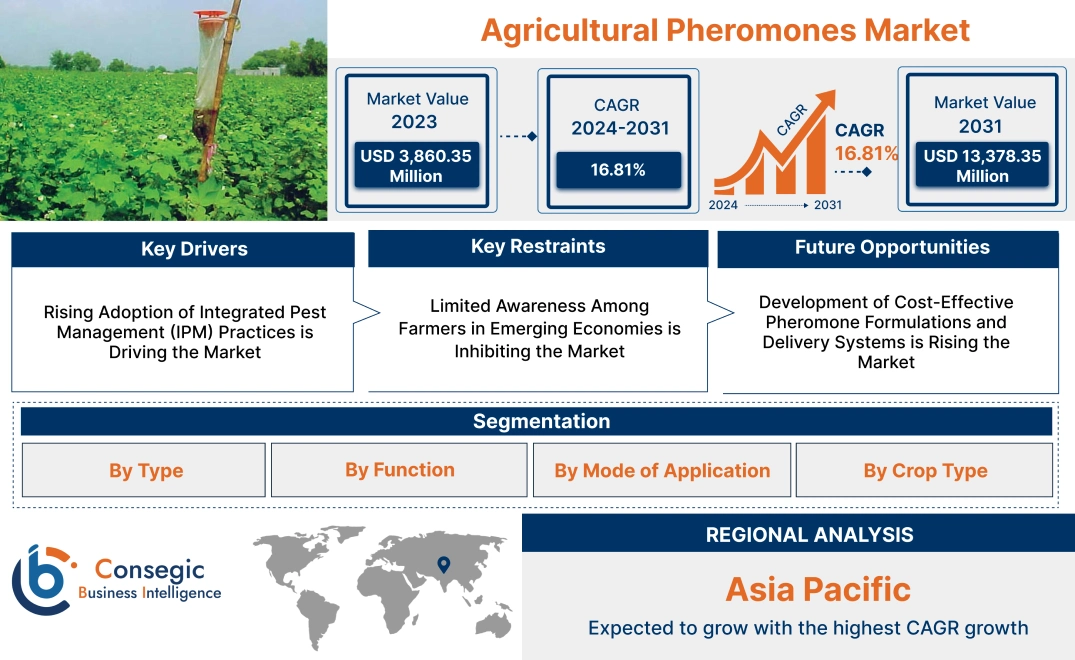
Agricultural Pheromones Market size is estimated to reach over USD 13,378.35 Million by 2031 from a value of USD 3,860.35 Million in 2023 and is projected to grow by USD 4,440.41 Million in 2024, growing at a CAGR of 16.81% from 2024 to 2031.
Agricultural Pheromones Market Scope & Overview:
Agricultural pheromones are chemical substances used in integrated pest management (IPM) to control pest populations and enhance crop protection through environmentally sustainable methods. These pheromones, including sex, aggregation, and alarm pheromones, are used to disrupt pest mating cycles, attract pests to traps, or alter pest behavior, minimizing the reliance on chemical pesticides. Key characteristics of agricultural pheromones include species-specificity, non-toxic nature, and compatibility with organic farming practices. The benefits include improved crop yields, reduced environmental impact, and sustainable pest control solutions. Applications span orchard crops, field crops, and horticulture for managing pests like moths, beetles, and flies. End-users include farmers, agricultural cooperatives, and pest management companies, driven by increasing opportunities for sustainable agricultural practices, rising awareness of pesticide-related environmental issues, and advancements in pheromone formulation and delivery technologies.
Agricultural Pheromones Market Dynamics - (DRO) :
Key Drivers:
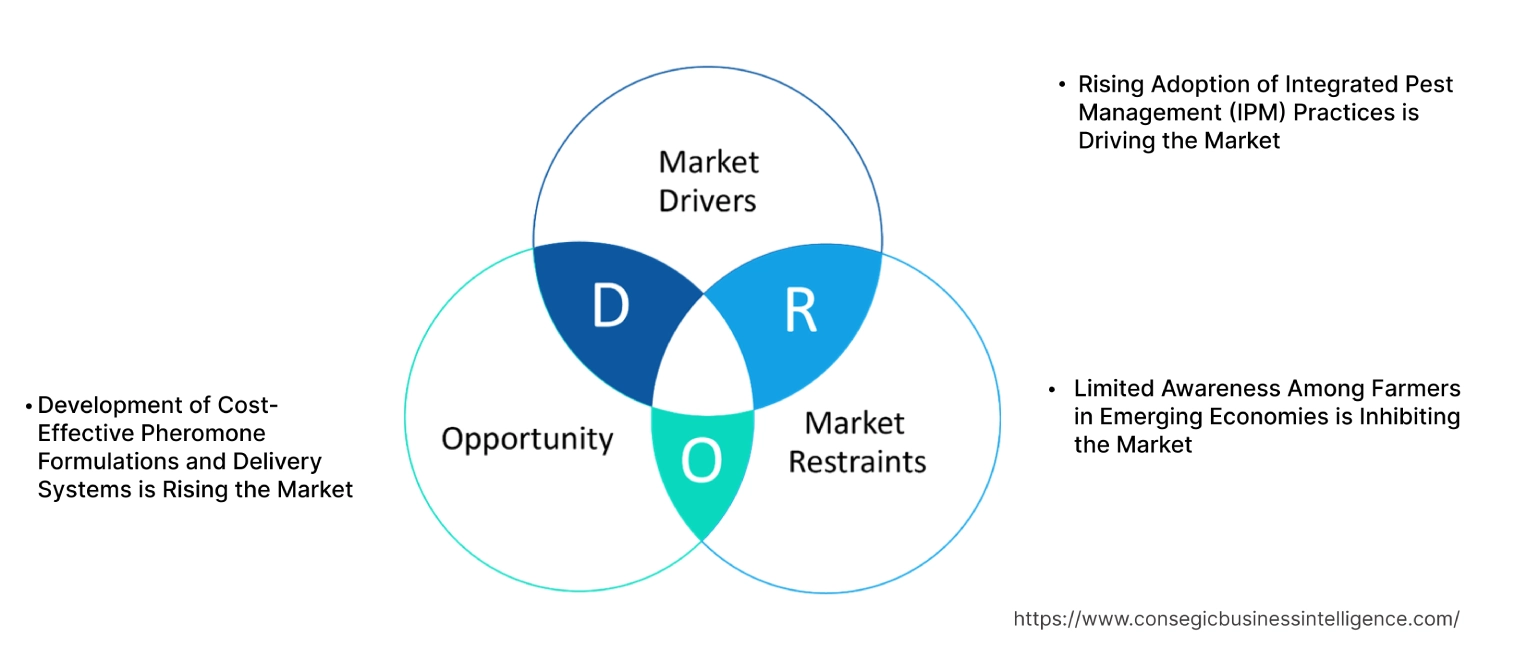
Rising Adoption of Integrated Pest Management (IPM) Practices is Driving the Market
Integrated Pest Management (IPM) practices are gaining traction as a sustainable and eco-friendly approach to controlling pest populations in agriculture. Agricultural pheromones play a pivotal role in IPM by disrupting pest mating cycles and reducing their populations without relying on chemical pesticides. Unlike conventional pest control methods, pheromone-based solutions target specific species, preserving beneficial insects and maintaining ecological balance.
This trend is particularly important in reducing chemical residues in food products and meeting consumer preferences for safer, healthier produce. Regulatory frameworks favoring non-toxic pest control methods also support the adoption of pheromones in IPM. As farmers and agricultural organizations increasingly prioritize sustainable practices, the role of pheromones in improving crop yields and minimizing environmental impact is becoming indispensable.
Key Restraints :
Limited Awareness Among Farmers in Emerging Economies is Inhibiting the Market
Despite the proven benefits of agricultural pheromones, their adoption in emerging economies is limited by a lack of awareness and knowledge among farmers. Many small and medium-scale farmers are unfamiliar with pheromone technology, its application methods, and its long-term benefits for pest management. This knowledge gap is compounded by limited access to training programs and technical support, which discourages farmers from exploring pheromone-based solutions.
Additionally, misconceptions about the effectiveness of pheromones compared to chemical pesticides further impede their adoption. Bridging this awareness gap requires collaborative efforts from manufacturers, agricultural extension services, and government bodies to educate farmers through workshops, demonstrations, and accessible informational resources. Expanding awareness in these regions is critical to unlocking the full potential of agricultural pheromones in global farming practices.
Future Opportunities :
Development of Cost-Effective Pheromone Formulations and Delivery Systems is Rising the Market
The development of cost-effective pheromone formulations and delivery systems offers significant opportunities for expanding the use of agricultural pheromones. Innovations such as microencapsulation and slow-release technologies improve the efficiency and longevity of pheromone applications, reducing the need for frequent reapplication. These advancements not only lower costs but also make pheromone-based solutions more practical for small and large-scale farming operations.
Trends in precision agriculture are further enhancing the scope of pheromone delivery, with automated dispensers and drone-based application systems gaining popularity. These technologies enable targeted and uniform pheromone dispersion, optimizing pest control while minimizing wastage. By focusing on scalable and affordable solutions, manufacturers can address cost barriers and expand the adoption of pheromones across diverse agricultural landscapes, aligning with the growing emphasis on sustainable farming.
Agricultural Pheromones Market Segmental Analysis :
By Type:
Based on type, the Agricultural Pheromones Market is segmented into sex pheromones, aggregation pheromones, alarm pheromones, and others.
The sex pheromones segment accounted for the largest revenue in the agricultural pheromones market share in 2023.
- Sex pheromones are primarily used for mating disruption, effectively preventing reproduction and population growth of pests such as moths, beetles, and weevils.
- They are widely adopted in high-value crops, including fruits, nuts, and vegetables, where pest damage can cause significant economic losses.
- Increasing awareness about the environmental impact of chemical pesticides and stringent regulations promoting sustainable pest control methods further drive the adoption of sex pheromones.
- Sex pheromones dominate the market analysis due to their efficacy in pest control, their role in integrated pest management (IPM), and their environmental sustainability.
The aggregation pheromones segment is anticipated to register the fastest CAGR during the forecast period.
- Aggregation pheromones attract both male and female pests, making them highly effective for mass trapping and monitoring pest populations.
- They are particularly effective in managing pests in stored grain, food processing, and agriculture.
- With advancements in pheromone delivery systems, such as improved trap designs and slow-release formulations, the trends for aggregation pheromones are expected to grow significantly.
- Aggregation pheromones analysis is expected to grow rapidly due to their role in effective mass trapping and increasing agricultural pheromones market opportunities for cost-effective pest control solutions.
By Function:
Based on function, the market is segmented into mating disruption, mass trapping, and monitoring and detection.
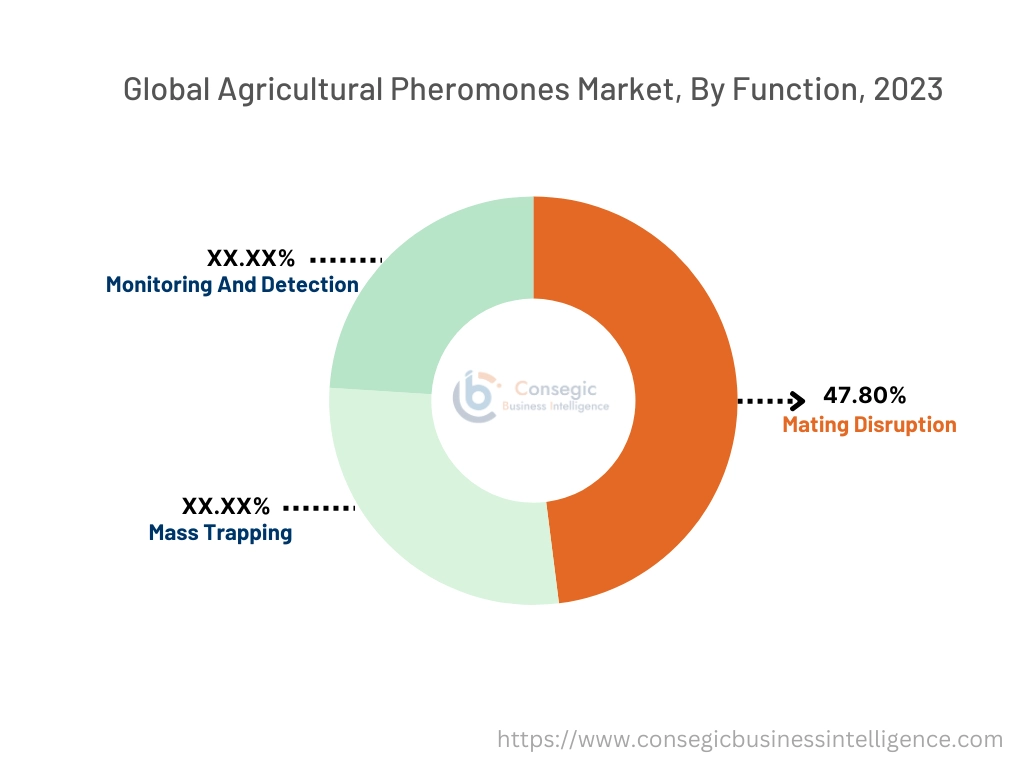
The mating disruption segment accounted for the largest revenue of 47.80% share in 2023.
- Mating disruption prevents pests from reproducing by interfering with their natural mating signals.
- This method is especially effective for long-term pest control in orchards, vineyards, and nut plantations.
- Its success in reducing dependency on chemical pesticides aligns with the rising agricultural pheromones market demand for organic and residue-free produce.
- Moreover, advancements in slow-release dispensers and microencapsulation technologies enhance the efficacy of mating disruption systems.
- Mating disruption leads the market due to its long-term effectiveness, environmental safety, and compatibility with sustainable farming practices.
The mass trapping segment is anticipated to register the fastest CAGR during the forecast period.
- Mass trapping is increasingly popular in agriculture and storage facilities due to its ability to capture large pest populations efficiently.
- This method minimizes the use of chemicals while effectively controlling pest outbreaks.
- With the development of highly specific pheromone blends and innovative trap designs, mass trapping is becoming a preferred solution for farmers and warehouse operators.
- Mass trapping is expected to grow rapidly, driven by advancements in pheromone delivery systems and the rising demand for sustainable pest management solutions.
By Mode of Application:
Based on the mode of application, the market is segmented into dispensers, traps, sprays, and others.
The dispenser segment accounted for the largest revenue share in 2023.
- Dispensers provide a controlled and sustained release of pheromones, making them ideal for mating disruption and monitoring.
- They are widely used in perennial crops such as vineyards, orchards, and nut plantations.
- Innovations such as biodegradable dispensers and microencapsulation technologies are improving their adoption, particularly in regions with stringent environmental regulations.
- Dispensers dominate the market due to their efficiency in sustained pheromone release and their growing adoption in high-value crop management.
The traps segment is anticipated to register the fastest CAGR during the forecast period.
- Pheromone-based traps are cost-effective, easy to deploy, and efficient in capturing pests.
- They are widely used in mass trapping and monitoring pest populations in both open-field agriculture and storage facilities.
- The increasing focus on residue-free farming and advancements in trap designs, including digital monitoring capabilities, are driving agricultural pheromones market growth in this segment.
- Traps are expected to grow rapidly due to their trends and their affordability, effectiveness, and advancements in trap technologies.
By Crop Type:
Based on crop type, the market is segmented into fruits & nuts, vegetables, field crops, and others.
The fruits & nuts segment accounted for the largest revenue in agricultural pheromones market share in 2023.
- Fruits and nuts are among the highest-value crops, making pest control critical to prevent significant economic losses.
- Pheromones are extensively used in managing pests like codling moths, fruit flies, and borers in apples, grapes, almonds, and citrus crops.
- The increasing adoption of pheromone-based pest control to ensure residue-free produce, particularly in export-oriented farming, supports the dominance of this segment.
- Fruits and nuts dominate the market trends due to their high economic value, vulnerability to pests, and widespread use of pheromone-based pest control solutions.
The vegetables segment is anticipated to register the fastest CAGR during the forecast period.
- Vegetables, including tomatoes, cucumbers, and peppers, are highly susceptible to pest infestations, particularly in organic farming.
- Pheromone solutions help reduce the reliance on chemical pesticides, ensuring compliance with food safety standards.
- Growing consumer demand for organic and sustainable produce is driving the adoption of pheromones in vegetable farming.
- Vegetables are expected to grow rapidly, driven by the increasing agricultural pheromones market trends for organic produce and advancements in pest control technologies.
By End-Use:
Based on end-use, the market is segmented into horticulture, agriculture, storage facilities, and others.
The horticulture segment accounted for the largest revenue share in 2023.
- Horticulture, encompassing fruits, vegetables, and ornamental crops, relies heavily on pheromone-based pest control to maintain crop quality and yield.
- The adoption of IPM practices and increasing investment in high-value crop production are driving demand in this segment.
- The shift toward sustainable farming practices further supports growth in the horticulture sector.
- Horticulture leads the market trends due to its high economic value and increasing adoption of sustainable pest management practices.
The storage facilities segment is anticipated to register the fastest CAGR during the forecast period.
- Pheromones are widely used in storage facilities to control pests like grain beetles and moths that infest stored crops.
- The focus on reducing post-harvest losses, coupled with the growing agricultural pheromones market demand for chemical-free storage solutions, is driving growth in this segment.
- Advancements in pheromone delivery systems, such as smart traps with digital monitoring, are further boosting adoption.
- Storage facilities are expected to grow rapidly due to the rising agricultural pheromones market trends that focus on minimizing post-harvest losses and ensuring the safety of stored produce.
Regional Analysis:
The regions covered are North America, Europe, Asia Pacific, the Middle East and Africa, and Latin America.
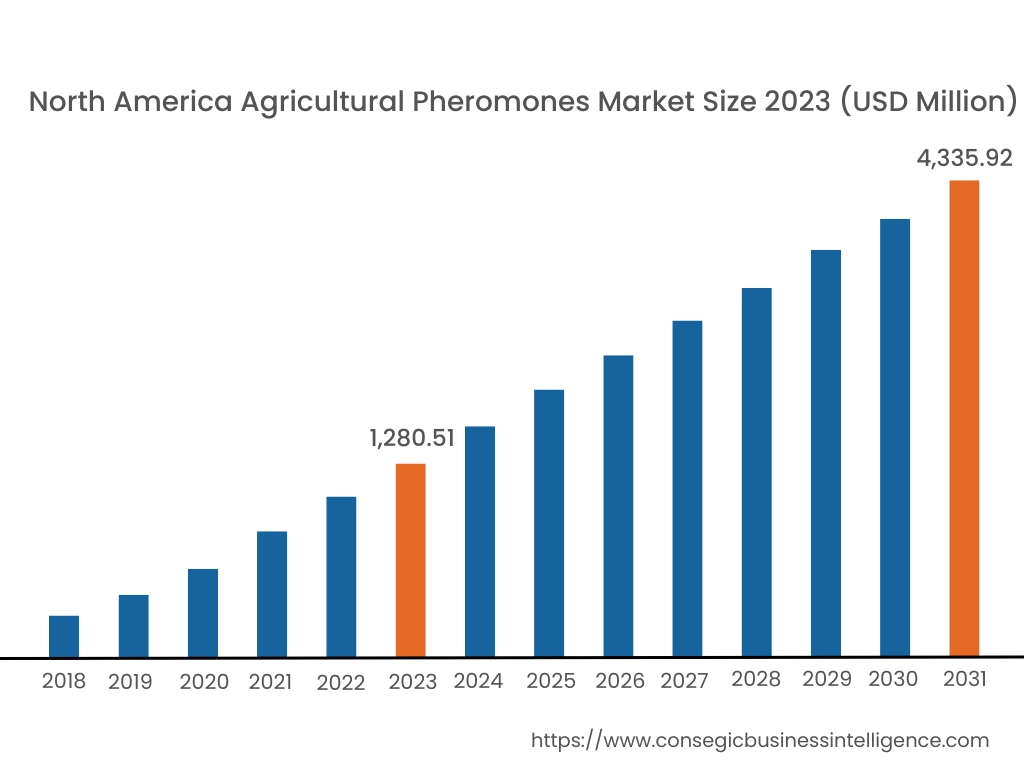
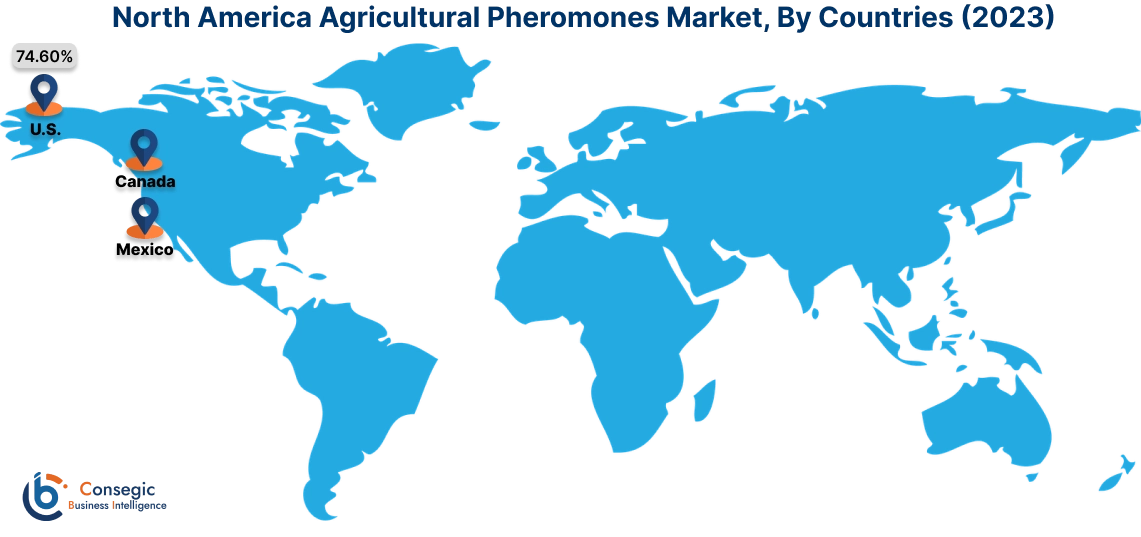
In 2023, North America was valued at USD 1,280.51 Million and is expected to reach USD 4,335.92 Million in 2031. In North America, the U.S. accounted for the highest share of 74.60% during the base year of 2023. North America holds a significant stake in the agricultural pheromones market analysis, driven by advanced farming practices and increasing adoption of integrated pest management (IPM) techniques. The U.S. dominates the region with a strong demand for pheromone-based products to manage pests in high-value crops such as fruits, nuts, and vegetables. The rising focus on sustainable and organic farming further supports the adoption of pheromones as a non-toxic alternative to chemical pesticides. Canada contributes through its growing use of pheromone traps and mating disruption methods, particularly in greenhouse cultivation. However, the high cost of pheromone-based solutions compared to conventional pesticides may limit widespread adoption.
In Asia Pacific, the market is experiencing the fastest growth with a CAGR of 17.3% over the forecast period. Asia-Pacific is the fastest-growing region in the agricultural pheromones market analysis, driven by increasing trends for high-quality crops and the need to reduce chemical pesticide usage in China, India, and Japan. China leads the market with the growing adoption of pheromones in large-scale farming operations, supported by government initiatives promoting sustainable agriculture. India’s expanding horticulture industry drives the use of pheromone traps and lures to control pests in fruits and vegetables. Japan, with its advanced agricultural technologies, focuses on precision farming and the integration of pheromone-based methods for pest control. However, limited access to affordable pheromone products and a lack of awareness in rural areas may hinder market growth in certain parts of the region.
Europe is a prominent market for agricultural pheromones, supported by stringent regulations on pesticide usage and the region’s strong emphasis on sustainable agriculture. Countries like Spain, Italy, and France are key contributors. Spain, a leading producer of fruits and vegetables, extensively uses pheromone traps and dispensers to control pests in high-value crops. Italy focuses on pheromone-based solutions for vineyard pest management, while France emphasizes the use of pheromones in organic farming and protected cultivation systems. However, limited awareness among small-scale farmers and the high initial investment in pheromone technology may pose challenges in some parts of the region.
The Middle East & Africa region is witnessing a steady surge in the agricultural pheromones market growth, driven by the analysis of increasing investments in sustainable farming practices and the rising importance of crop protection. Countries like Saudi Arabia and the UAE are adopting pheromone-based pest control methods in protected agriculture and greenhouse cultivation. In Africa, South Africa is emerging as a key market, leveraging pheromones to manage pests in export-oriented crops like fruits and flowers. However, limited local manufacturing capabilities and dependence on imports for pheromone products may restrict agricultural pheromones market expansion development in the region.
Latin America is an emerging market for agricultural pheromones expansion, with Brazil and Mexico leading the region. As per the analysis, Brazil’s extensive agriculture industry uses pheromones to protect crops such as soybeans, sugarcane, and fruits from pest infestations, aligning with the increasing focus on sustainable farming practices. Mexico’s horticulture sector relies on pheromone traps and dispensers for effective pest management in high-value crops like avocados and berries. The region also benefits from growing export opportunities for organic produce, which necessitates reduced pesticide usage. However, economic instability and limited access to advanced technologies may pose challenges for broader adoption in the region.
Top Key Players and Market Share Insights:
The Agricultural Pheromones market is highly competitive with major players providing products and services to the national and international markets. Key players are adopting several strategies in research and development (R&D), product innovation, and end-user launches to hold a strong position in the global Agricultural Pheromones market. Key players in the Agricultural Pheromones industry include -
- Russell IPM (U.K.)
- Shin-Etsu Chemical Company (Japan)
- Provivi, Inc. (U.S.)
- Koppert Biological Systems (Netherlands)
- Pacific Biocontrol Corporation (U.S.)
- Isagro S.p.A. (Italy)
- Biobest Group (Belgium)
- SEDQ Healthy Crops SL (Spain)
- ISCA Global (U.S.)
- Suterra LLC (U.S.)
Agricultural Pheromones Market Report Insights :
| Report Attributes | Report Details |
| Study Timeline | 2018-2031 |
| Market Size in 2031 | USD 13,378.35 Million |
| CAGR (2024-2031) | 16.81% |
| By Type |
|
| By Function |
|
| By Mode of Application |
|
| By Crop Type |
|
| By Region |
|
| Key Players |
|
| North America | U.S. Canada Mexico |
| Europe | U.K. Germany France Spain Italy Russia Benelux Rest of Europe |
| APAC | China South Korea Japan India Australia ASEAN Rest of Asia-Pacific |
| Middle East and Africa | GCC Turkey South Africa Rest of MEA |
| LATAM | Brazil Argentina Chile Rest of LATAM |
| Report Coverage |
|
Key Questions Answered in the Report
What is the projected size of the Agricultural Pheromones Market by 2031? −
Agricultural Pheromones Market size is estimated to reach over USD 13,378.35 Million by 2031 from a value of USD 3,860.35 Million in 2023 and is projected to grow by USD 4,440.41 Million in 2024, growing at a CAGR of 16.81% from 2024 to 2031.
Which type of pheromone dominates the market? +
Sex pheromones hold the largest market share, driven by their effectiveness in mating disruption and pest population control in high-value crops.
What are the key growth drivers for the market? +
The rising adoption of integrated pest management (IPM) practices, increasing demand for sustainable farming methods, and growing awareness of pesticide-related environmental impacts are major drivers for the market.
What challenges does the market face? +
Limited awareness among farmers in emerging economies and the high initial cost of pheromone-based solutions compared to conventional pesticides are key restraints.
What future opportunities exist in the market? +
The development of cost-effective pheromone formulations and delivery systems, including slow-release and precision application technologies, presents significant growth opportunities.
Overview
Reputation & Certifications


Our Services
- Market Intelligence & Forecasting
- Custom Research Solutions
- Market Entry Strategy
- Competitive Intelligence
- Customer Insights
- Industry Innovation Analysis
- Investment Advisory