Jump to Content
Agrochemical Active Ingredients Market - Size, Share, Industry Trends, and Forecasts (2025-2032)
Agrochemical Active Ingredients Market Size:
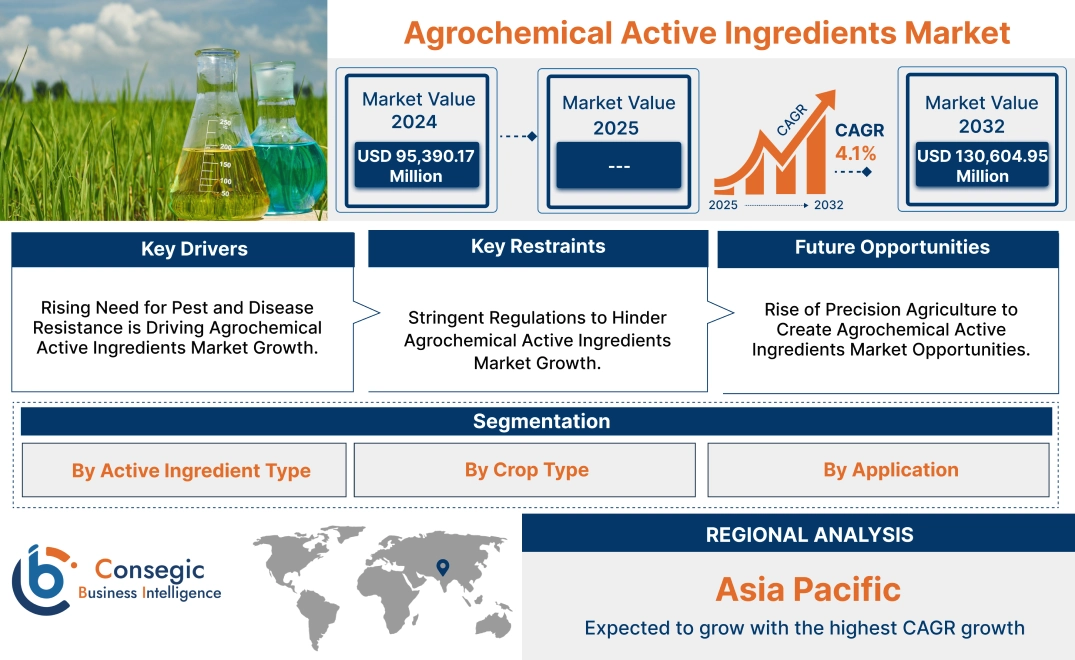
Agrochemical Active Ingredients Market size is growing with a CAGR of 4.1% during the forecast period (2025-2032), and the market is projected to be valued at USD 130,604.95 Million by 2032 from USD 95,390.17 Million in 2024.
Agrochemical Active Ingredients Market Scope & Overview:
Agrochemical active ingredients (AII) are the core chemical that controls pests. These core chemicals are herbicides, insecticides, and others. These substances are designed specifically in order to eliminate the paste. This is done simultaneously while minimizing the harm occurred to the environment and the organisms. Each active ingredient has a distinct mode of action. A few of these distinct modes of action are the interference with the growth of the pest amongst others. To improve their applicability, these AII are used alone in very rare cases. They are formulated into various product forms. A few of these product forms are sprays and granules amongst others. These are combined with other substances known as inert ingredients. Agrochemical active ingredients play a crucial role in modern agriculture. This enables farmers to protect their crops from pests and diseases. This in-turn leads to increasing yields and ensuring food security for a growing global population.
Agrochemical Active Ingredients Market Dynamics - (DRO) :
Key Drivers:
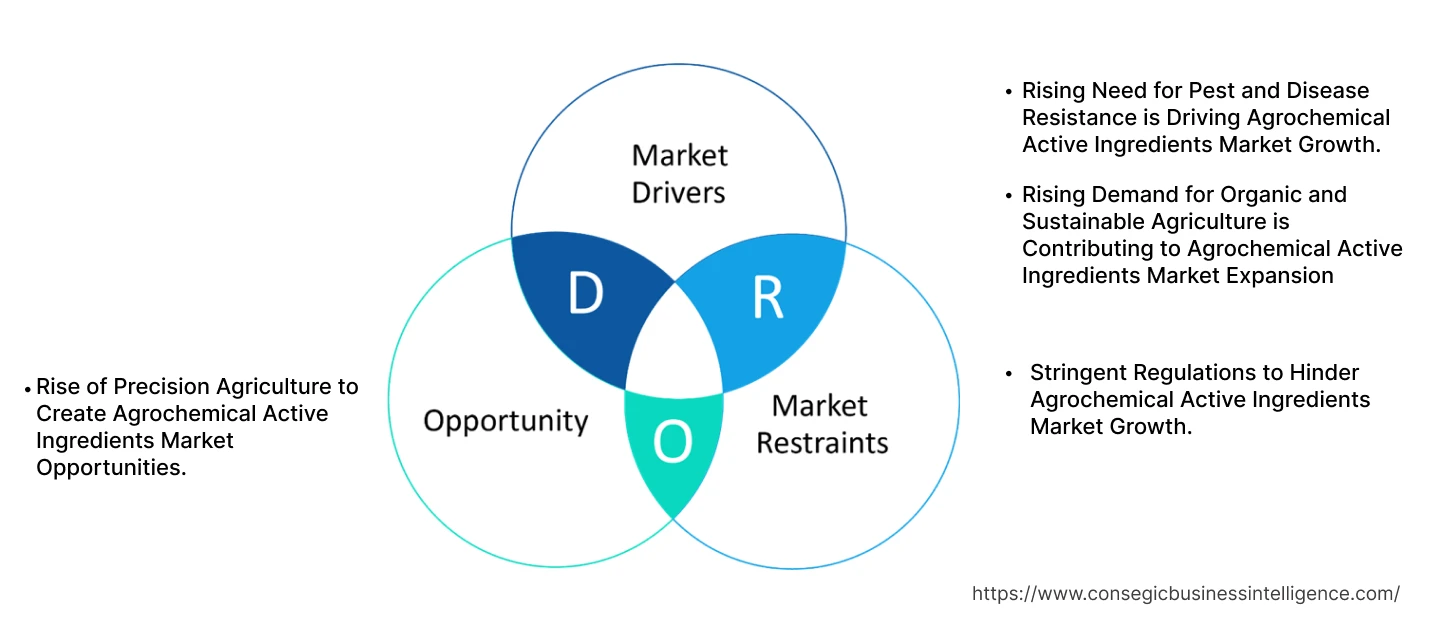
Rising Need for Pest and Disease Resistance is Driving Agrochemical Active Ingredients Market Growth.
The active agrochemical ingredients market is experiencing growth driven by the need for development of chemicals that cater to the several disadvantages posed by the pest and diseases.
- For instance, according to FAO, roughly 40% of the overall production of crops is lost each year due to the pests and diseases.
As the population of pests develops resistance and adapts to the existing pesticides, there is an increase in the development of new active ingredients that cater to this specific type of pests and diseases. Additionally, the rise of new diseases, due to the factors such as climate change and increased global trade, required the development of new active ingredients for crop protection solutions. This growing requirement is driving the focus of key players into investment for research and development in the agrochemical industry.
Rising Demand for Organic and Sustainable Agriculture is Contributing to Agrochemical Active Ingredients Market Expansion
One of the key factors impacting the market development of agricultural active ingredients is the requirement for sustainable and organic agriculture practices. This demand is due to one of several factors. One of the primary factors is the increasing consumer inclination towards food products that are produced sustainably.
- For instance, according to Saudi Journal of Economics and Finance, there was 1.71 million ha of land that was registered for organic certification process in 2023-2024.
Additionally, the increase in concerns related to the environment are driving the need for sustainable agricultural practices. Therefore, the shift in consumer preference and the growing consciousness towards eco-friendly solutions combined are driving agrochemical active ingredients market demand.
Key Restraints:
Stringent Regulations to Hinder Agrochemical Active Ingredients Market Growth.
The increase in the number of assessments related to human health and environmental health has a significant impact on these chemicals. This led to the incorporation of stringent regulatory frameworks across the globe. These regulations include several factors such as the inclusion of usage restrictions, registration, residue limits amongst others. The thorough regulatory processes required in order to obtain registration for new active ingredients are often lengthy and expensive. This increases the costs associated with the development and launch of the product for agrochemical companies. Furthermore, the growing focus on protection of environment and human health has developed in the implementation of stricter restrictions. These restrictions limit the application and effectiveness of certain active ingredients.
Future Opportunities :
Rise of Precision Agriculture to Create Agrochemical Active Ingredients Market Opportunities.
The rise of precision agriculture has created new opportunities for AII by taking advantage of technologies such as sensors, drones, GPS. These technologies are incorporated into precision agriculture that facilitates in target application of these agrochemicals. This is expected to lead to minimization of the impact on the environment. This approach allows for specific applications where agrochemicals are actually required.
- For instance, in 2024, John Deere introduced a new business unit. The job of this business unit is to include several thousand producers in precision agriculture in the Americas.
In addition to this, precision agriculture showcases a shift towards more sustainable farming practices. These advancements create a strong need for agrochemical active ingredients that are not only highly effective and environmentally friendly but also compatible with precision agriculture technologies. Overall, the above-mentioned analysis together hold potential to create active agrochemical ingredients market opportunities over the forecast period.
Agrochemical Active Ingredients Market Segmental Analysis :
By Active Ingredient Type:
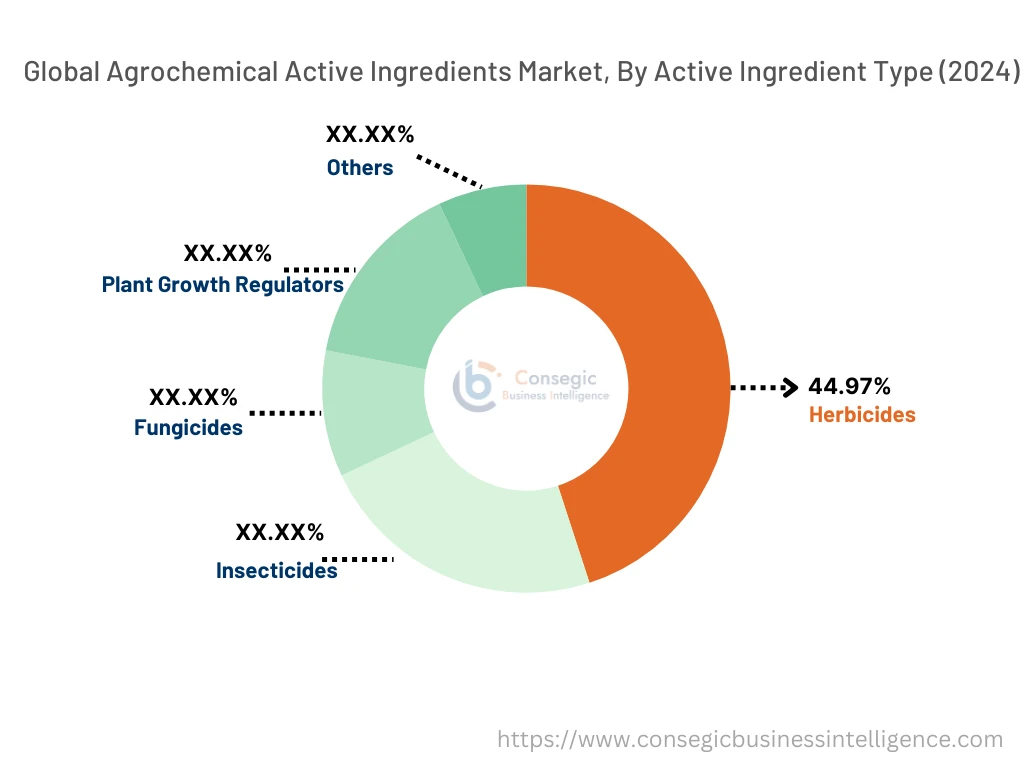
Based on Active Ingredient Type, the market is categorized into herbicides, insecticides, fungicides, plant growth regulators, and others
Trends in the Active Ingredient Type:
- Increasing focus on developing herbicides that target specific weeds and simultaneously minimize the damage to crops.
- The growing requirement for systemic fungicides that are absorbed by the plant and provide long-lasting protection.
The Herbicides segment accounted for the largest market share of 44.97% in 2024.
- Herbicides attribute to the largest segment within the agrochemical active ingredients market analysis. A key factor is the growing focus on development of selective herbicides that are to target specific weeds.
- This focus on selection of herbicide is vital for reducing environmental impact as well as adhering to the sustainable agricultural practices.
- For instance, in 2022, according to the USDA, atrazine, an herbicide was used most widely as an active ingredient in the U.S. It was used on roughly 65% of the acres that were planted
- Additionally, the key players are also engaged in developing new strategies for weed management. One such strategy is the incorporation of crop varieties that are herbicide resistant.
- Furthermore, due to an increase in environmental concerns, there's a rising need for bioherbicides, which are derived from natural sources. They offer more environmentally friendly options to conventional synthetic herbicides.
The Insecticide segment is expected to be the fastest growing segment over the forecast period.
- The increase in incidence of pests due to climate change, and the introduction of new and more resistant strains are contributing to the need for development of new insecticides.
- In addition to this, as there is a rise in the global population, the requirement for food has also been increased. Simultaneously, insect control is mandatory in order to protect the crops from yield losses.
- Moreover, key players are aiming towards the development of biopesticides. These biopesticides are derived from natural sources such as bacteria and fungi. These biopesticides offer an eco-friendlier option.
- These factors and trends combined are expected to create potential within the insecticide segment of the agrochemical active ingredients market demand.
By Crop Type:
The crop type segment is categorized into cereals & grains, oilseeds & pulses, fruits & vegetables, and others
Trends in the Crop Type
- The incorporation of Agrochemical active ingredients in enhancing yields and quality of these cereal and grains.
- The growing need for specialty crops is leading to the development of specialized agrochemical solutions.
Cereals & Grains accounted for the largest market share in 2024.
- The cereals and grains segment dominates due to the high cultivation of crops across the globe. Most cultivated crops are wheat, rice, corn, and barley.
- In addition to this, the increase in global population requires a increase in the production of these staple food crops. Agrochemical active ingredients contribute by protecting the crops from pests, weeds and others.
- For Instance, in 2022, according to the Official Statistics Portal, a large usage of herbicides attributing to approximately 73% were used on cereals.
- Therefore, due to the afore-mentioned analysis and trends, agrochemical active ingredients contribute significantly to enhancing crop yields amongst others.
The Insecticide segment is expected to be the fastest growing segment over the forecast period.
- The insecticide segment expected to grow at the fastest CAGR due to the growing prevalence and severity of insect pest infestations. These are enhanced due to climate change and the rise of new and more resistant strains.
- Similarly, the need for effective insect control in safeguarding crops from yield losses and ensuring adequate food supply for a increasing global population are factors contributing to the segment trajectory.
- In addition to this, there is a consumer shift towards more sustainable agricultural practices. This has led to an increased requirement for biopesticides derived from natural sources such as bacteria and fungi.
- Thus, due to the above-mentioned is expected to grow in insecticides segments over the forecast period in the agrochemical active ingredients market analysis.
By Application:
Based on applications, the market is categorized into crop protection, seed treatment, and others.
Trends in the Application:
- The growing need of agrochemicals to control pests, diseases, and weeds in order to protect the crop.
The crop protection segment accounted for the largest market share in 2024.
- Crop protection occupies the dominant position within the agrochemical active ingredients market expansion due to the direct application of agrochemicals onto crops.
- It includes various methods such as spraying, dusting, or soil application. These agrochemicals include a diverse range of substances, including herbicides, insecticides, and fungicides. They are each specifically designed to combat a particular target.
- Herbicides are utilized to control weeds that compete with crops for essential resources like water, sunlight, and nutrients. Insecticides are employed to effectively manage and eliminate insect pests that inflict significant damage to crops. Fungicides are crucial in preventing and controlling fungal diseases that can devastate crop yields.
- For instance, according to FAO, the fruit and vegetable production across the globe reached 2.1 billion tons in 2023. This is attributed to roughly around 1% increase from the previous year.
- By effectively controlling these threats, crop protection measures play a pivotal role in protecting the crop, making sure that optimal yields are observed, amongst others. These factors and trends contribute to the significant potential of the crop protection segment within the agrochemical active ingredients market trend.
The seed treatment segment is expected to grow at the fastest CAGR over the forecast period.
- The seed treatment segment is expected to grow at the fastest CAGR as it offers an efficient and targeted approach, minimizing the overall use of agrochemicals when compared to traditional foliar applications.
- Seed treatments play a crucial role in improving crop production by protecting seeds from soil-borne diseases and pests during germination and early growth stages. This makes sure that the plant development is healthy in turn leading to higher yields.
- Furthermore, the increasing adoption of precision agriculture technologies facilitates more precise and efficient seed treatment applications.
- As per analysis, these factors collectively contribute to the significant potential of the seed treatment segment within the agrochemical active ingredients market trend.
Regional Analysis:
The regions covered are North America, Europe, Asia Pacific, the Middle East and Africa, and Latin America.
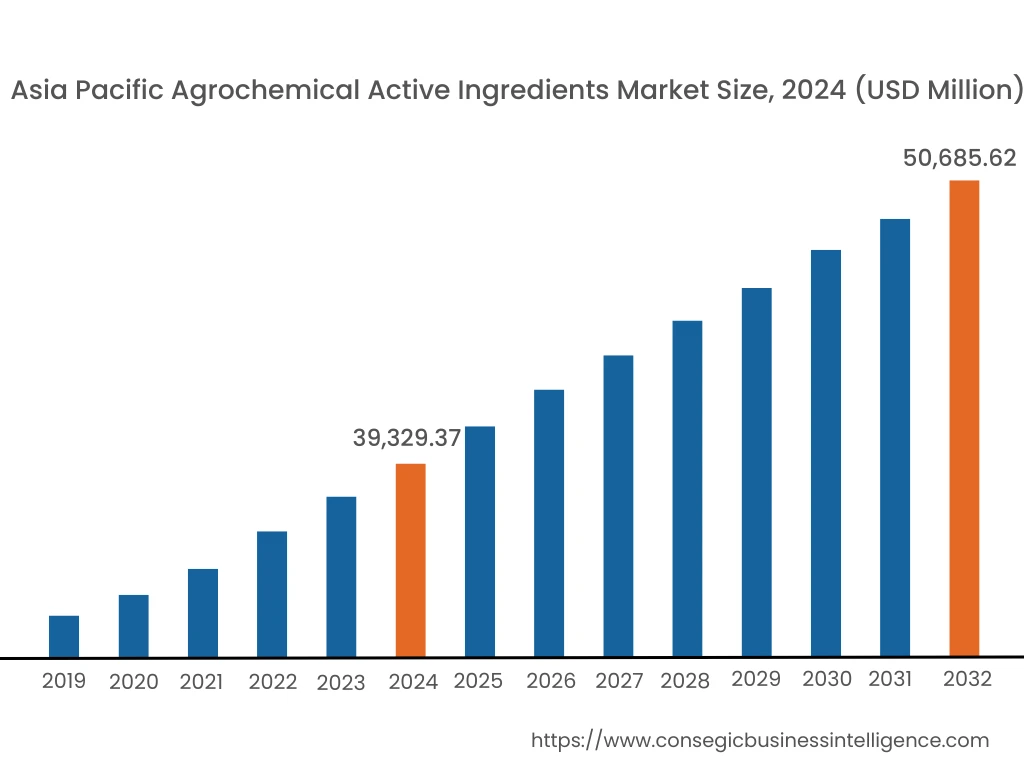
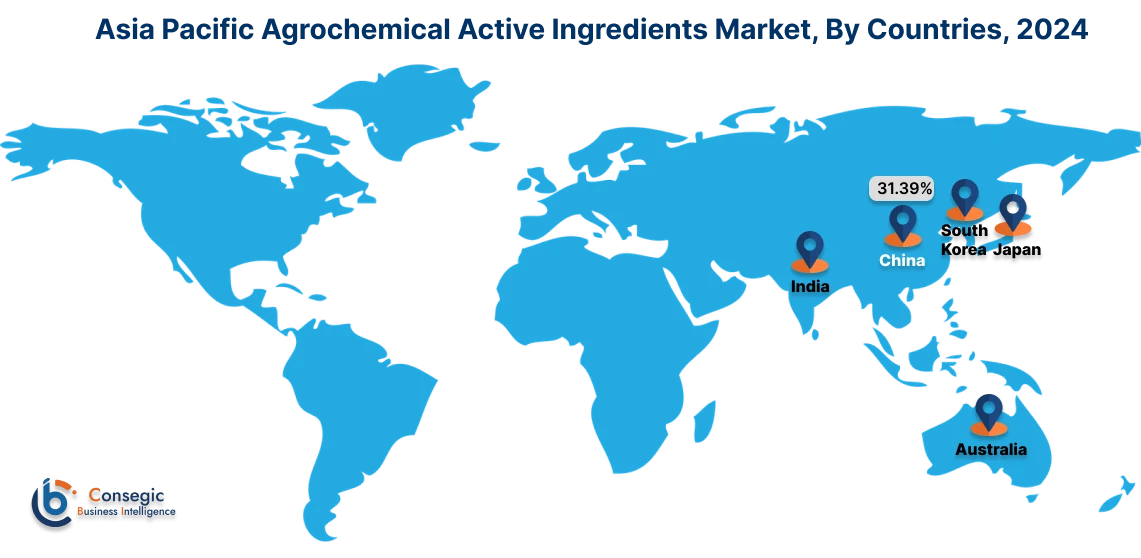
In 2024, Asia Pacific accounted for the highest agrochemical active ingredients market share at 41.23% and was valued at USD 39,329.37 Million and is expected to reach USD 50,685.62 Million in 2032. In Asia Pacific, China accounted for the agrochemical active ingredients market share of 31.39% during the base year of 2024.
The rise of pest and disease resistance is the key factors that is leading to the market trajectory of agrochemical active ingredient in Asia Pacific. The frequent exposure to the same class of pesticides leads to the evolution of resistant strains. This requires the constant development of new active ingredients to overcome resistance and maintain effective crop protection.
- For instance, according to the Government of India, roughly around 18% of the yield attributing to roughly USD 10.5 billion on a yearly basis across the country due to pests.
Therefore, as per market analysis, the development of new agrochemicals with improved resistance management strategies helps in order to provide long-term sustainability of agricultural production in the Asia Pacific region.
In Europe, the active agrochemical ingredients market is experiencing the fastest growth with a CAGR of 5.77% over the forecast period. Government support plays a crucial role in the European agrochemical active ingredients market. The European Union has implemented a stringent regulatory framework for plant protection products. Additionally, government funding for research and development of new active ingredients is leading to innovation in the market. A few of the new active ingredients are biopesticides amongst others. All these factors are contributing towards eco-friendly and sustainable agricultural practices. Furthermore, government policies promote integrated pest management (IPM) strategies. These strategies focus on a combination of cultural, biological, and chemical control methods. These as well contribute to the sustainable use of agrochemicals and minimize environmental impact.
The consumer inclination towards high-value crops in the North American market is a significant driver of trajectory. As consumer requirement for high-quality fruits, vegetables, and specialty crops increases, farmers are increasingly focusing on cultivating these crops. This has caused a requirement in the development of specialized agrochemical solutions. These solutions are tailored to the specific needs of these high-value crops. These solutions are highly effective in controlling pests and diseases ensuring the safety and quality of the produce. This focus on high-value crops drives the demand for innovative and specialized agrochemical-active ingredients.
The rise of precision agriculture presents a significant potential for the Middle East and African agrochemical active ingredient industry. The region is expected to integrate technologies such as GPS, sensors, and drones. Farmers optimize the application of agrochemicals by incorporating these technologies. This helps in the reduction of input costs. Precision agriculture enables site-specific application of agrochemicals, ensuring that the right amount of the right product is applied at the right time and in the right location. This approach enhances the efficacy of agrochemicals. As precision agriculture technologies become more accessible and affordable in the region, the demand for active agrochemical ingredients that are compatible with these technologies will continue to grow.
The Latin American agrochemical active ingredients market is experiencing a shift towards sustainable agriculture. Growing environmental consciousness among consumers is driving a demand for organic and sustainably produced food. This has led to an increase in organic farming practices. Additionally, it has also led to a grown emphasis on minimizing the environmental impact of agricultural activities. Furthermore, stringent environmental regulations and increasing pressure from regulatory bodies are convincing farmers and agrochemical industry companies to adopt more sustainable approaches. These sustainable alternatives offer reduced environmental impact while effectively controlling pests and diseases. Therefore, due to the above-mentioned factors, the market in Latin America is growing.
Top Key Players and Market Share Insights:
The Global Agrochemical Active Ingredients Market is highly competitive with major players providing products to the national and international markets. Key players are adopting several strategies in research and development (R&D) and product innovation to hold a strong position in the global Agrochemical Active Ingredients market. Key players in the Agrochemical Active Ingredients industry include-
- Bayer AG (Germany)
- Syngenta (Switzerland)
- BASF SE (Germany)
- Corteva, Inc. (U.S.)
- Nufarm Limited (UK)
- Monsanto Company (U.S.)
- Solvay S.A. (Belgium)
- Sumitomo Chemical (Japan)
- Helm AG (Germany)
- DuPont (U.S.)
- UPL Limited (India)
- The Dow Chemical Company (U.S.)
Agrochemical Active Ingredients Market Report Insights :
| Report Attributes | Report Details |
| Study Timeline | 2018-2032 |
| Market Size in 2032 | USD 130,604.95 Million |
| CAGR (2025-2032) | 4.1% |
| By Active Ingredient Type |
|
| By Crop Type |
|
| By Application |
|
| By Region |
|
| Key Players |
|
| North America | U.S. Canada Mexico |
| Europe | U.K. Germany France Spain Italy Russia Benelux Rest of Europe |
| APAC | China South Korea Japan India Australia ASEAN Rest of Asia-Pacific |
| Middle East and Africa | GCC Turkey South Africa Rest of MEA |
| LATAM | Brazil Argentina Chile Rest of LATAM |
| Report Coverage |
|
Key Questions Answered in the Report
How big is the Agrochemical Active Ingredients market? −
In 2024, the Agrochemical Active Ingredients market is USD 95,390.17 Million.
Which is the fastest-growing region in the Agrochemical Active Ingredients market? +
Europe is the fastest-growing region in the Agrochemical Active Ingredients market.
What specific segmentation details are covered in the Agrochemical Active Ingredients market? +
By Active Ingredient Type, Crop Type and Application segmentation details are covered in the Agrochemical Active Ingredients market.
Who are the major players in the Agrochemical Active Ingredients market? +
Bayer AG (Germany), Syngenta (Switzerland), BASF SE (Germany), Corteva, Inc. (U.S.), Nufarm Limited (UK) are some of the major players in the market.
Overview
Reputation & Certifications


Our Services
- Market Intelligence & Forecasting
- Custom Research Solutions
- Market Entry Strategy
- Competitive Intelligence
- Customer Insights
- Industry Innovation Analysis
- Investment Advisory