Jump to Content
Air Separation Plant Market Size & Industry Share - Growth Trends & Forecasts (2026 - 2034)
Air Separation Plant Market Size:
Air Separation Plant Market size is estimated to reach over 12,468.24 (US$M) by 2034 from a value of 7,635.37 (US$M) in 2025 and is projected to grow by 8,062.95 (US$M) in 2026, growing at a CAGR of 5.6% from 2026 to 2034, according to a recent report from Consegic Business Intelligence.
Air Separation Plant Market Scope & Overview:
The air separation plant focuses on facilities designed to extract and separate atmospheric air into its primary components, including oxygen, nitrogen, and argon, through cryogenic distillation or non-cryogenic methods. These plants are integral to industries requiring high-purity gases for applications such as welding, chemical processing, and medical oxygen supply. Key characteristics of air separation plants include scalability, energy efficiency, and the ability to produce high-purity gases tailored to specific industrial requirements. The benefits of these plants include consistent gas supply, reduced operational costs, and enhanced production efficiency for end-users. Applications span sectors such as healthcare, manufacturing, energy, and food and beverages. End-users include industries such as steel production, chemical manufacturing, electronics, and healthcare facilities, driven by rising industrialization, advancements in gas separation technologies, increasing air separation plant market opportunities, surge for industrial gases across diverse applications.
How is AI Impacting the Air Separation Plant Market?
AI is impacting the air separation plant market by driving operational efficiency and optimizing production. AI-powered systems enable real-time monitoring and analysis of plant performance, allowing for predictive maintenance that minimizes downtime and reduces operational costs. This includes anticipating equipment failures and optimizing energy consumption, a major expense for ASUs. AI also enhances process control, leading to improved purity and yield of industrial gases like oxygen, nitrogen, and argon. Furthermore, AI facilitates the development of "digital twins" for ASUs, enabling simulations for process optimization and new design development, ultimately making air separation more sustainable and cost-effective.

Air Separation Plant Market Dynamics - (DRO) :
Key Drivers:
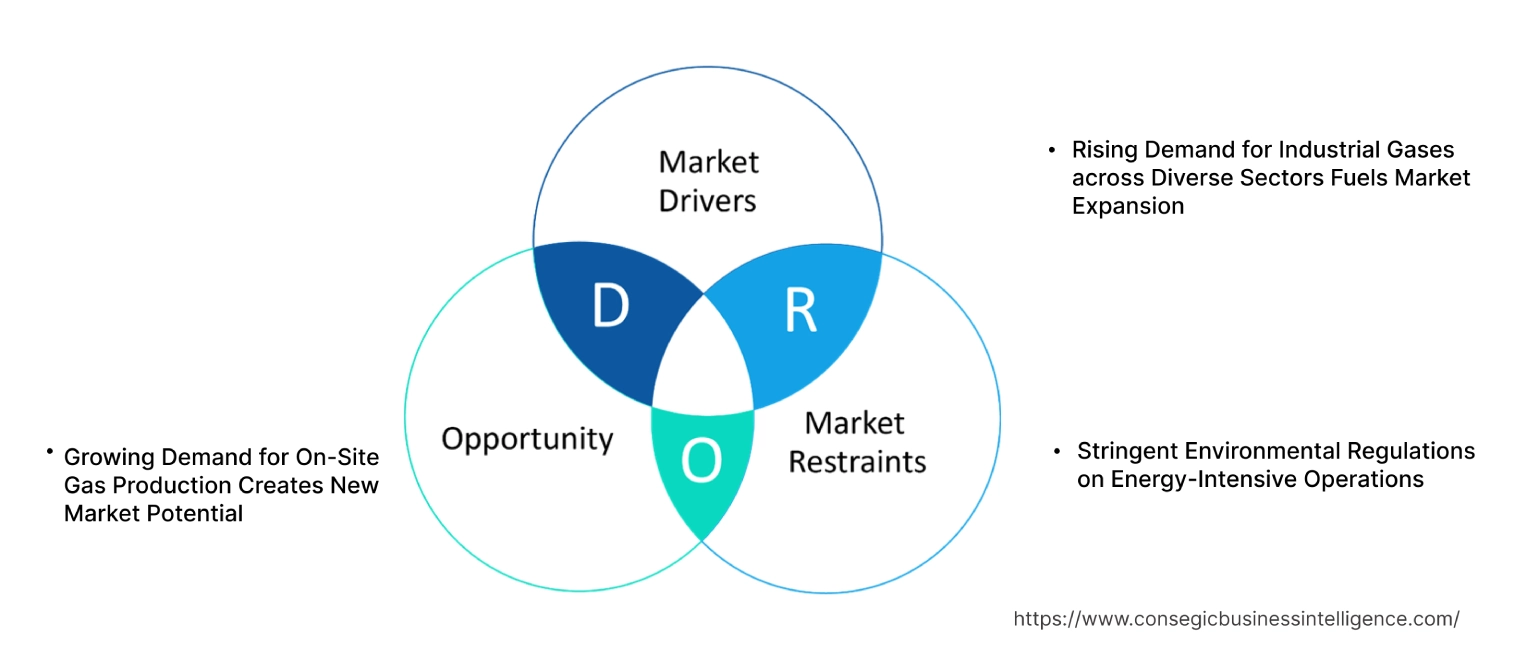
Rising Demand for Industrial Gases across Diverse Sectors Fuels Market Expansion
The increasing utilization of industrial gases, including oxygen, nitrogen, and argon, across a wide range of sectors is driving the significant rise in the air separation plant market. In the healthcare sector, oxygen is critical for medical treatments, especially in life-support systems and respiratory therapies. Similarly, the manufacturing sector relies on nitrogen for creating inert environments in welding, metal production, and chemical processing. Argon plays a vital role in electronics manufacturing and high-precision welding applications.
The rising need for high-purity gases to support industrial processes and innovations is fueling the growth of air separation plants globally. Additionally, the rapid expansion of the food and beverage sector, where nitrogen is extensively used for packaging and preservation, is further contributing to the market's upward trend. The increasing adoption of advanced air separation technologies to meet the growing advancement for high-quality gases is shaping the market’s future.
Key Restraints :
Stringent Environmental Regulations on Energy-Intensive Operations.
The air separation plant market is experiencing challenges due to strict environmental regulations targeting energy-intensive operations. Cryogenic air separation plants, which are widely used for large-scale gas production, consume substantial amounts of energy and are associated with significant greenhouse gas emissions. Governments worldwide are implementing stringent policies to limit the carbon footprint of industrial operations, compelling manufacturers to adopt energy-efficient systems and comply with emission standards.
The need for costly upgrades and sustainable technologies to align with these regulations is creating operational and financial constraints for manufacturers, particularly in regions with aggressive climate policies. This trend toward stricter environmental compliance is reshaping the market, encouraging investments in green energy solutions but also restraining appeals in regions with limited resources.
Future Opportunities :
Growing Demand for On-Site Gas Production Creates New Market Potential
The increasing air separation plant market opportunities trend toward on-site gas production is emerging as a significant opportunity in the air separation plant market. On-site gas generation systems provide industries with a reliable and cost-effective supply of industrial gases, eliminating logistical challenges associated with transportation and storage. This approach is particularly advantageous for healthcare facilities that require uninterrupted oxygen supplies and manufacturing plants that depend on a consistent flow of nitrogen and oxygen for their operations.
Compact and modular air separation plants tailored to meet the specific requirements of individual industries are gaining popularity, driving air separation plant market trends in decentralized gas production. The adoption of on-site systems is further supported by the rising focus on operational efficiency and sustainability. As industries prioritize reducing costs and minimizing environmental impact, the rise for on-site gas production solutions is expected to grow, creating new avenues for market expansion.
Air Separation Plant Market Segmental Analysis :
By Process:
Based on the process, the air separation plant market is segmented into cryogenic and non-cryogenic processes.
The cryogenic segment accounted for the largest revenue in the air separation plant market share in 2023.
- Cryogenic air separation is the most widely used process for producing high-purity gases such as nitrogen, oxygen, and argon.
- This process is preferred in large-scale industrial applications, including steel manufacturing, chemical processing, and healthcare.
- The rising trend of expanding industrial infrastructure in developing economies has significantly boosted the adoption of cryogenic plants.
- Additionally, advancements in energy-efficient cryogenic systems are gaining traction, aligning with the global shift toward sustainable industrial operations.
- The cryogenic analysis depicts it the process dominates the market due to its efficiency in producing high-purity gases and its critical role in large-scale industrial applications.
The non-cryogenic segment is anticipated to register the fastest CAGR during the forecast period.
- Non-cryogenic processes, including Pressure Swing Adsorption (PSA) and Vacuum Pressure Swing Adsorption (VPSA), are increasingly being adopted for small to medium-scale applications.
- These processes are cost-effective and provide sufficient purity levels for industries such as food & beverage, electronics, and healthcare.
- The growing trends of decentralizing industrial gas production, coupled with advancements in PSA and VPSA technologies, are driving the surge for non-cryogenic systems.
- The non-cryogenic segment is expected to grow rapidly, driven by its cost-effectiveness and suitability for small to medium-scale industrial applications.
By Gas Type:
Based on gas type, the market is segmented into nitrogen, oxygen, argon, and others.
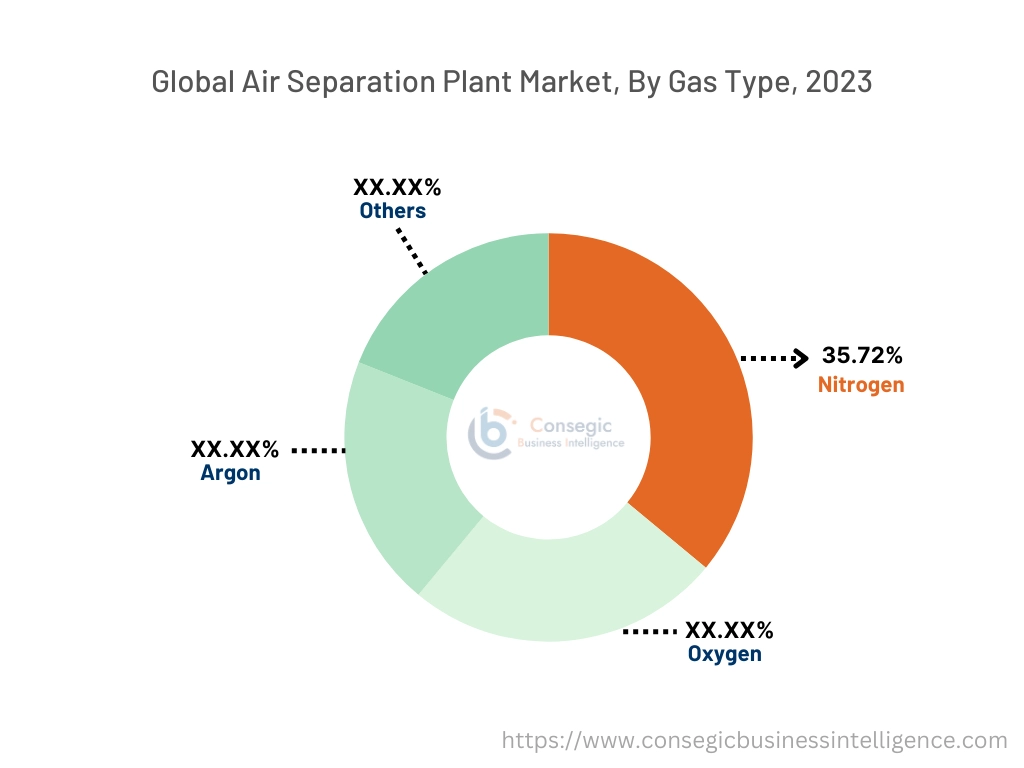
The nitrogen segment accounted for the largest revenue share of 35.72% in 2023.
- Nitrogen is widely used across multiple industries, including food preservation, electronics manufacturing, and chemical processing.
- Its role as an inert gas makes it indispensable for applications such as blanketing, purging, and cooling.
- The increasing trends of using nitrogen in advanced electronics manufacturing processes and the rising development of packaged food products are key factors driving the segment.
- Moreover, the focus on energy-efficient nitrogen production systems is shaping the adoption of modern air separation technologies.
- Nitrogen analysis depicts it leads the market due to its versatile applications across industries and its growing use in electronics manufacturing and food preservation.
The oxygen segment is anticipated to register the fastest CAGR during the forecast period.
- Oxygen plays a critical role in industries such as healthcare, metallurgy, and chemical processing.
- The growing surge for medical-grade oxygen, particularly in emerging economies, and the trend of adopting oxygen-enriched combustion systems in the steel companies are propelling this segment’s advancement.
- Additionally, advancements in portable oxygen concentrators and large-scale production technologies are enhancing the availability of oxygen for industrial and medical applications.
- The oxygen segmental analysis is expected to grow rapidly, driven by its increasing applications in healthcare and the adoption of oxygen-enriched systems in industrial applications.
By End-Use Industry:
Based on the end-use industry, the air separation plant market is segmented into materials, oil & gas, chemicals, healthcare, and others.
The materials segment accounted for the largest revenue in the air separation plant market share in 2023.
- The materials industry, particularly steel and glass manufacturing, is a significant consumer of industrial gases such as oxygen and nitrogen.
- Oxygen is essential for blast furnaces, while nitrogen is used for purging and cooling processes.
- The trend of adopting advanced gas separation technologies to optimize production efficiency and meet stringent environmental standards is driving the segment.
- Additionally, the rising demand for high-strength steel in the construction and automotive industries is further contributing to the adoption of air separation plants.
- The materials segment dominates the market due to the critical role of industrial gases in steel and glass production and the growing focus on production efficiency.
The healthcare segment is anticipated to register the fastest CAGR during the forecast period.
- The healthcare sector relies heavily on medical-grade oxygen for treating respiratory conditions and other critical care applications.
- The increasing focus on improving healthcare infrastructure, particularly in developing regions, and the rising air separation plant market trend of home-based oxygen therapy are driving this segment.
- Furthermore, the appeal for portable oxygen solutions and the need for continuous oxygen supply in hospitals during pandemics or emergencies have significantly boosted the adoption of air separation technologies in healthcare.
- The healthcare segment is expected to grow rapidly, driven by the rising need for medical-grade oxygen and advancements in portable oxygen solutions.
Regional Analysis:
The regions covered are North America, Europe, Asia Pacific, the Middle East and Africa, and Latin America.
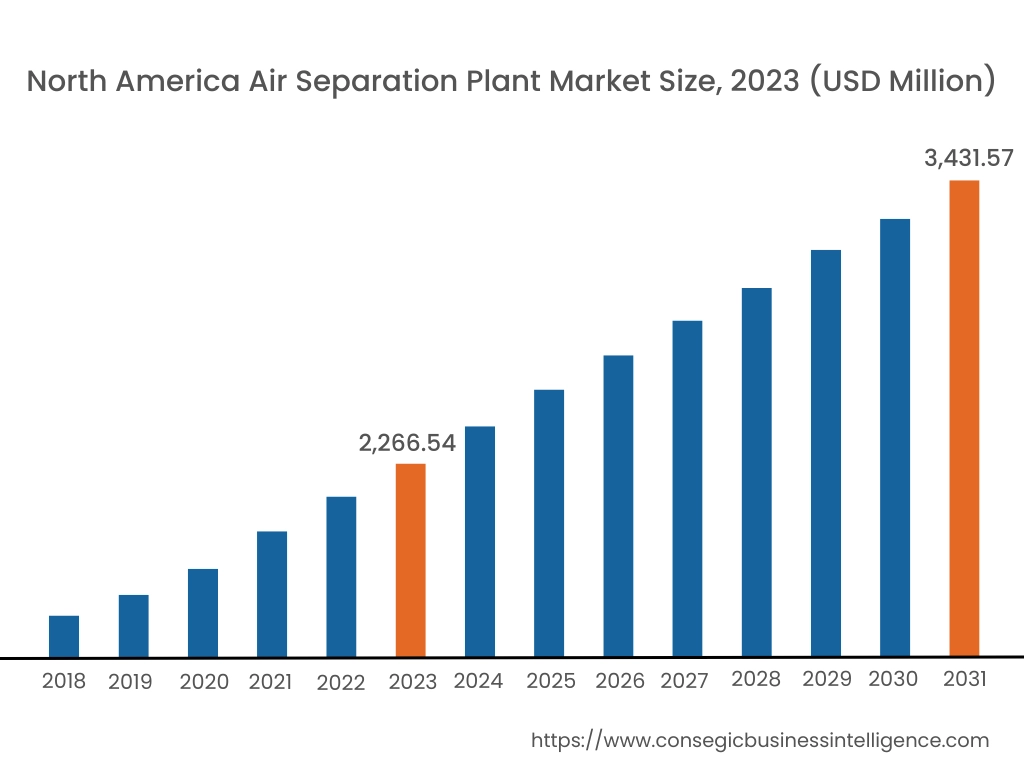
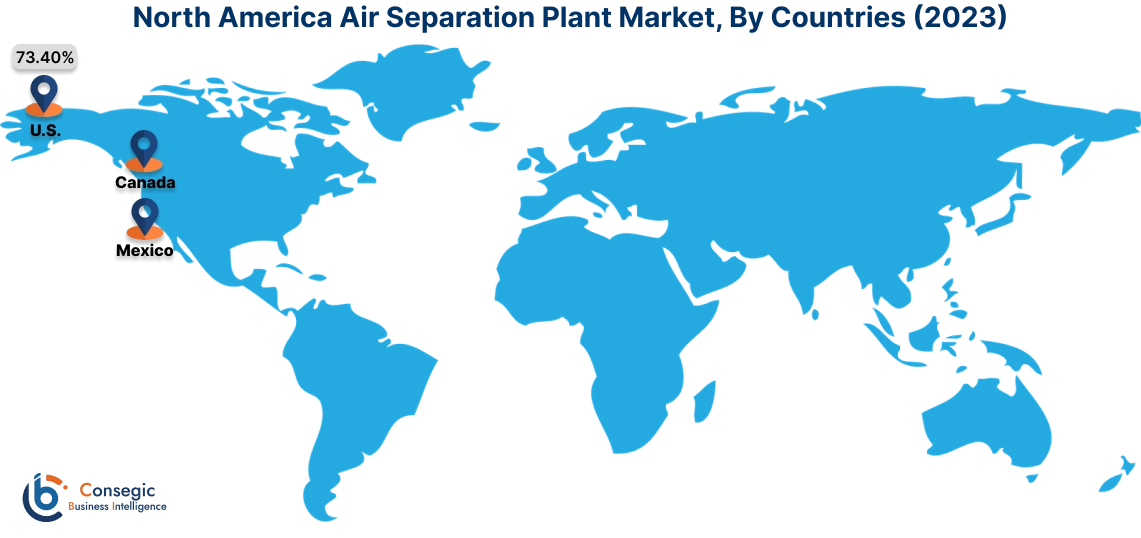
In 2023, North America was valued at USD 2,266.54 Million and is expected to reach USD 3,431.57 Million in 2031. In North America, the U.S. accounted for the highest share of 73.40% during the base year of 2023. North America is a leading market for air separation plants, driven by a strong surge from industries such as healthcare, chemicals, and energy. The U.S. dominates the region, with increasing applications in oxygen production for medical use and nitrogen for industrial processes. The rise of clean energy initiatives, including hydrogen production and carbon capture projects, is further boosting air separation plant market demand for air separation technologies. Canada contributes to market expansion with its expanding oil sands sectors, which require significant amounts of oxygen and nitrogen for refining processes. However, high energy consumption and operational costs of air separation plants pose challenges in the region.
In Asia Pacific, the market is experiencing the fastest growth with a CAGR of 6.1% over the forecast period. Asia-Pacific is the largest and fastest-growing region in the air separation plant market, driven by rapid industrialization, urbanization, and the growing demand for industrial gases in China, India, and Japan. China dominates the region due to its extensive steel and chemical production industries, which heavily rely on oxygen and nitrogen. India is experiencing strong growth, fueled by rising healthcare applications for medical oxygen and increased investments in steel manufacturing and infrastructure development. Japan’s focus on hydrogen economy initiatives and advanced manufacturing processes supports the adoption of air separation technologies. However, challenges such as fluctuating raw material prices and high capital investment requirements hinder the market in certain areas.
Europe is a significant market for air separation plants, supported by the region’s focus on sustainability and decarbonization efforts. Countries like Germany, the UK, and France analysis lead the market with a high surge for industrial gases in steel manufacturing, chemical processing, and healthcare applications. Germany’s emphasis on green hydrogen production as part of its energy transition strategy is driving the adoption of large-scale air separation units. The UK and France are witnessing growth in medical oxygen production due to increasing healthcare needs. However, stringent environmental regulations and rising energy costs challenge the enlargement of air separation plant operations in the region.
The Middle East & Africa region is witnessing steady growth in the air separation plant market analysis, driven by the expanding oil and gas, petrochemical, and healthcare industries. Saudi Arabia and the UAE are key markets, with increasing investments in industrial gas production to support their growing refining and petrochemical sectors. The region’s focus on green hydrogen projects, particularly in Saudi Arabia’s NEOM City, is boosting applications for advanced air separation units. In Africa, South Africa’s demand for industrial gases in mining and healthcare applications supports air separation plant market growth. However, challenges such as limited infrastructure and dependency on imports for plant components impact market expansion in the region.
Latin America is emerging for air separation plants market analysis, with Brazil and Mexico leading the region. Brazil’s growing industrial sector, particularly in steel and chemicals, drives appeal for oxygen and nitrogen production. The country’s increasing focus on improving healthcare infrastructure and providing medical oxygen is further supporting air separation plant market growth. Mexico’s expanding manufacturing sector, particularly in automotive and electronics, is boosting air separation plant market demand for industrial gases. However, economic instability and limited access to advanced air separation technologies pose challenges for the market’s growth in the region.
Top Key Players & Market Share Insights:
The Air Separation Plant market is highly competitive with major players providing products and services to the national and international markets. Key players are adopting several strategies in research and development (R&D), product innovation, and end-user launches to hold a strong position in the global Air Separation Plant market. Key players in the Air Separation Plant industry include -
- Air Liquide S.A. (France)
- Linde AG (Germany)
- Messer Group GmbH (Germany)
- Air Products and Chemicals, Inc. (United States)
- Taiyo Nippon Sanso Corporation (Japan)
- Praxair, Inc. (United States)
- Oxyplants (India)
- AMCS Corporation (United States)
- Enerflex Ltd. (Canada)
- Technex Ltd. (United Kingdom)
Recent Industry Developments :
Innovations:
- In 2024, Air Products developed a patent-pending process cycle that minimizes steam consumption while maintaining operational flexibility. Additionally, advancements in radial flow temperature swing adsorption have been integrated to purify air before it enters the cryogenic process, reducing energy consumption and minimizing the plant's footprint.
Air Separation Plant Market Report Insights :
| Report Attributes | Report Details |
| Study Timeline | 2021-2034 |
| Market Size in 2034 | USD 12,468.24 Million |
| CAGR (2026-2034) | 5.60% |
| Base Year | 2025 |
| By Process |
|
| By Gas Type |
|
| By End-Use Industry |
|
| By Region |
|
| Key Players |
|
| North America | U.S. Canada Mexico |
| Europe | U.K. Germany France Spain Italy Russia Benelux Rest of Europe |
| APAC | China South Korea Japan India Australia ASEAN Rest of Asia-Pacific |
| Middle East and Africa | GCC Turkey South Africa Rest of MEA |
| LATAM | Brazil Argentina Chile Rest of LATAM |
| Report Coverage |
|
Key Questions Answered in the Report
What is the projected size of the Air Separation Plant Market by 2031? −
Air Separation Plant Market size is estimated to reach over USD 10,587.99 Million by 2031 from a value of USD 6,832.92 Million in 2023 and is projected to grow by USD 7,095.71 Million in 2024, growing at a CAGR of 5.6% from 2024 to 2031.
Which process dominates the market? +
The cryogenic process holds the largest share due to its efficiency in producing high-purity gases for large-scale industrial applications.
Which process is expected to grow the fastest? +
The non-cryogenic process, including PSA and VPSA, is anticipated to grow rapidly due to its cost-effectiveness and suitability for small to medium-scale applications.
Which gas type leads the market? +
Nitrogen dominates the market due to its versatile applications in industries like food preservation, electronics, and chemical processing.
Which gas type is projected to grow the fastest? +
Oxygen is expected to grow rapidly, driven by increasing medical oxygen demand and its use in oxygen-enriched systems for industrial applications.
Overview
Reputation & Certifications


Our Services
- Market Intelligence & Forecasting
- Custom Research Solutions
- Market Entry Strategy
- Competitive Intelligence
- Customer Insights
- Industry Innovation Analysis
- Investment Advisory