Jump to Content
Alcohol Dehydrogenase Market Size & Industry Share - Growth Trends & Forecasts (2026 - 2034)
Alcohol Dehydrogenase Market Size:
Alcohol Dehydrogenase Market size is estimated to reach over 3,716.03 (US$M) by 2034 from a value of 2,220.16 (US$M) in 2025 and is projected to grow by 2,350.93 (US$M) in 2026, growing at a CAGR of 5.9% from 2026 to 2034, according to a recent report from Consegic Business Intelligence.
Alcohol Dehydrogenase Market Scope & Overview:
The alcohol dehydrogenase focuses on the production and application of alcohol dehydrogenase enzymes, which catalyze the oxidation and reduction of alcohols in biochemical and industrial processes. These enzymes are widely used in industries such as pharmaceuticals, food and beverages, and biofuels for their role in chemical synthesis, metabolic research, and fermentation processes. Key characteristics of alcohol dehydrogenase include high specificity, efficiency in catalysis, and compatibility with diverse substrates. The benefits include enhanced reaction rates, cost-effective production processes, and applications in green chemistry for sustainable industrial practices. Applications span drug development, alcohol production, diagnostics, and research in metabolic pathways. End-users include pharmaceutical companies, food and beverage manufacturers, and research laboratories, driven by increasing demand for enzymatic processes, advancements in biotechnology, and the growing emphasis on sustainable and efficient manufacturing techniques.

Alcohol Dehydrogenase Market Dynamics - (DRO) :
Key Drivers:
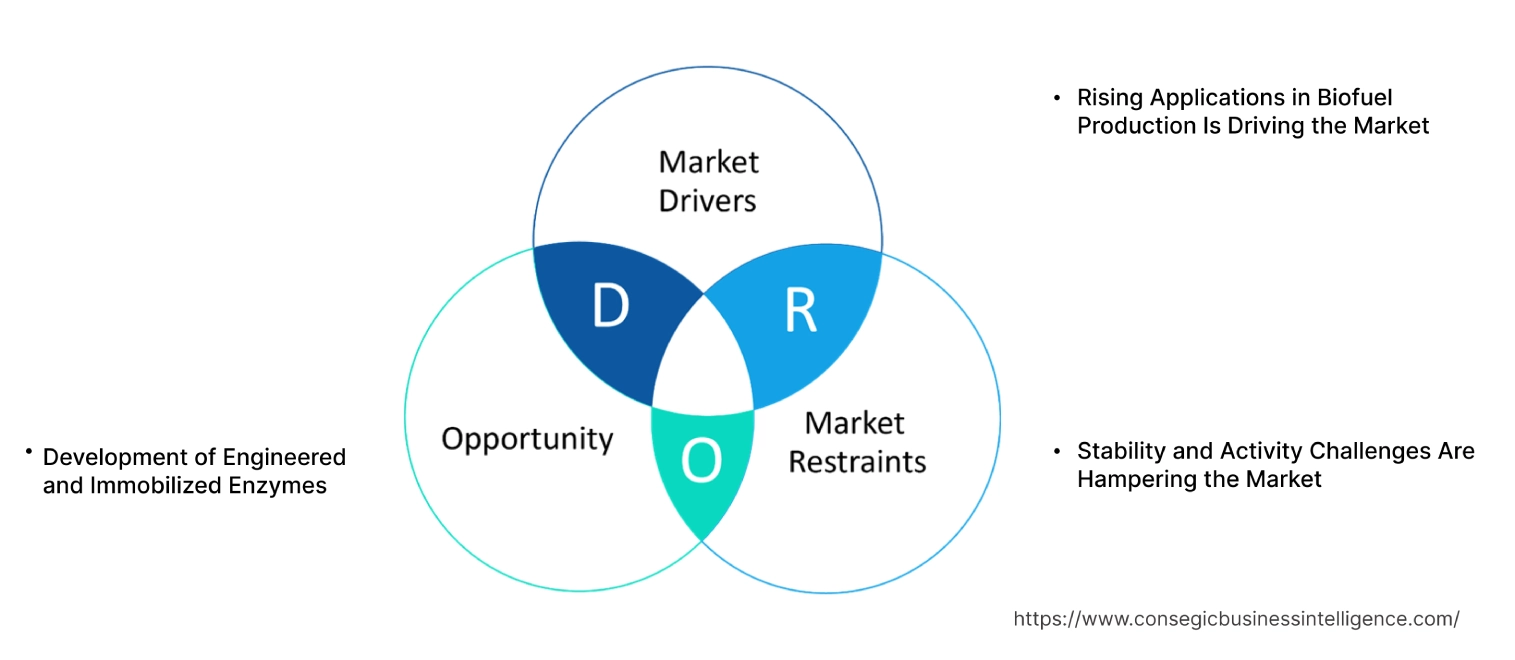
Rising Applications in Biofuel Production Is Driving the Market
Alcohol dehydrogenase plays a pivotal role in biofuel production by facilitating the conversion of biomass into ethanol and other alcohol-based fuels. The enzyme is integral to fermentation processes, where it catalyzes the transformation of sugars into ethanol, enhancing production efficiency and yield. This application aligns with global trends emphasizing renewable energy sources and carbon footprint reduction, particularly as industries transition from fossil fuels to sustainable alternatives.
Bioethanol, produced with the aid of alcohol dehydrogenase, is widely used as a cleaner-burning fuel additive, contributing to reduced greenhouse gas emissions. Innovations in second-generation biofuels, derived from non-food biomass like agricultural residues and waste, further highlight the enzyme’s importance in supporting sustainable energy solutions. As the analysis of renewable energy markets indicates a growing focus on decarbonization, alcohol dehydrogenase is poised to remain a critical component in advancing biofuel technologies.
Key Restraints :
Stability and Activity Challenges Are Hampering the Market
Alcohol dehydrogenase enzymes face significant challenges related to their stability and activity under varying industrial conditions. Factors such as temperature fluctuations, pH variability, and the presence of inhibitors can impact the enzyme’s efficiency, limiting its effectiveness in large-scale applications. These challenges increase the complexity of industrial processes, necessitating careful optimization of reaction conditions to maintain consistent catalytic performance.
Furthermore, the limited shelf life and sensitivity of these enzymes require specialized storage and handling protocols, adding to operational costs. For industries relying on alcohol dehydrogenase, addressing these stability issues is essential to achieving reliable and cost-effective outcomes. Advancements in enzyme engineering and formulation techniques are critical to overcoming these challenges and ensuring the broader applicability of alcohol dehydrogenase across diverse sectors.
Future Opportunities :
Development of Engineered and Immobilized Enzymes
The development of engineered and immobilized alcohol dehydrogenase enzymes presents a transformative opportunity for the market. Engineered enzymes with enhanced stability, activity, and substrate specificity can address traditional limitations, enabling their use in more complex and demanding industrial processes. These advancements align with trends in biocatalysis, which prioritize efficiency, sustainability, and reduced environmental impact.
Immobilized enzymes, which are fixed onto solid supports, offer additional advantages, such as reusability, easier recovery, and improved operational stability. This approach minimizes enzyme loss during reactions and reduces production costs over multiple use cycles. As industries explore cost-effective and eco-friendly production methods, the adoption of engineered and immobilized alcohol dehydrogenase is expected to expand, driving innovation and efficiency in biofuels, pharmaceuticals, and food processing applications.
Alcohol Dehydrogenase Market Segmental Analysis :
By Source:
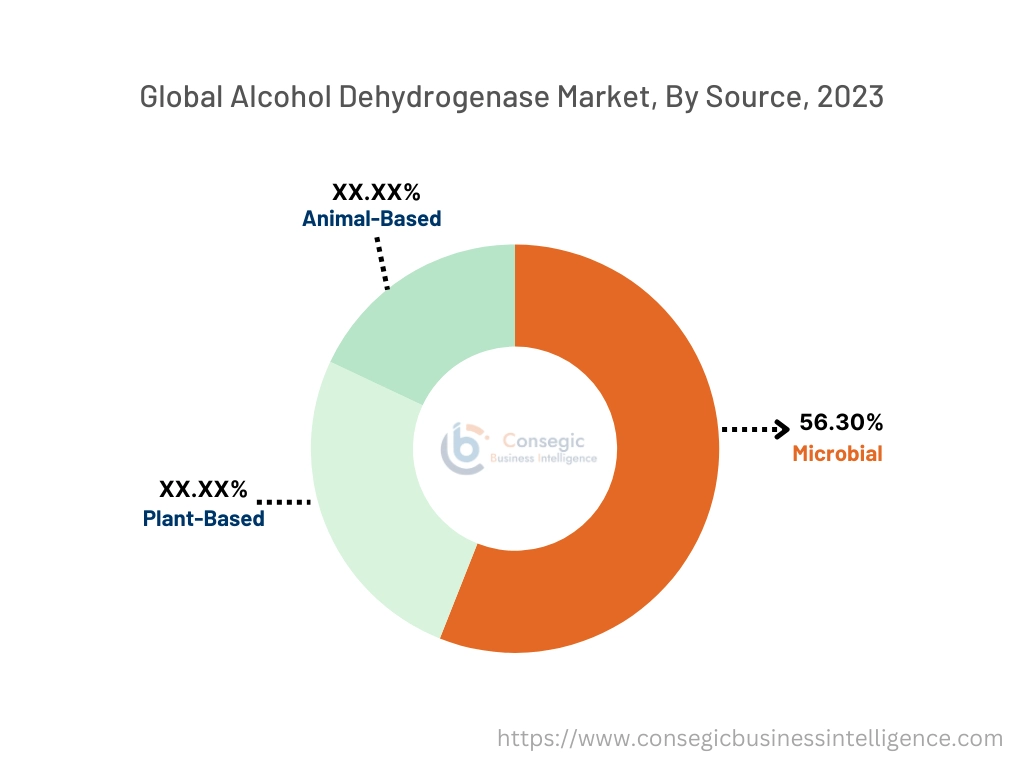
Based on source, the market is segmented into microbial, plant-based, and animal-based.
The microbial segment accounted for the largest revenue of 56.30% share in 2023.
- Microbial-derived alcohol dehydrogenase is extensively used due to its ease of production, cost-effectiveness, and scalability.
- It is widely adopted in industrial applications, including biofuel production, disease diagnostics, and alcohol concentration detection.
- The rising demand for sustainable and efficient enzyme production techniques further supports the dominance of the microbial segment.
- Microbial sources analysis dominates the market trends due to their scalability, cost-efficiency, and extensive application across industrial sectors.
The plant-based segment is anticipated to register the fastest CAGR during the forecast period.
- Plant-based alcohol dehydrogenase is gaining attention for its natural origin and reduced allergenicity.
- It is increasingly used in food and beverage applications, as well as in pharmaceutical and research activities, driven by the growing consumer preference for plant-based solutions.
- Advancements in enzyme extraction technologies are further fueling development in this segment.
- Plant-based sources are expected to grow rapidly, driven by their natural origin and increasing adoption in food, pharmaceuticals, and research industries.
By Product:
Based on product, the market is segmented into recombinant and native alcohol dehydrogenase.
The recombinant segment accounted for the largest revenue share in 2023.
- Recombinant alcohol dehydrogenase offers high purity, reliability, and batch-to-batch consistency, making it a preferred choice in pharmaceuticals, biotechnology, and research applications.
- Its ability to be tailored for specific industrial needs through genetic engineering is driving its adoption.
- The rising demand for customized enzymes for diagnostics and catalysis further supports this segment's trends.
- Recombinant alcohol dehydrogenase leads the market due to its high reliability, customization capabilities, and extensive use in pharmaceutical and research applications.
The native segment is anticipated to register steady growth during the forecast period.
- Native alcohol dehydrogenase, derived from natural sources, is widely used in traditional applications such as alcohol concentration detection and biofuel production.
- The increasing focus on sustainable enzyme production methods and advancements in extraction processes are driving advancement in this segment.
- Native products continue to grow steadily, supported by their use in traditional applications and advancements in sustainable production methods.
By Type:
Based on type, the market is segmented into 7.5 KU, 15 KU, 30 KU, 75 KU, and others.
The 15 KU segment accounted for the largest revenue in the alcohol dehydrogenase market share in 2023.
- The 15 KU alcohol dehydrogenase type is widely utilized in industrial-scale applications, including biofuel production, alcohol detection, and biocatalysis.
- Its balance between activity levels and cost-effectiveness makes it highly suitable for large-scale manufacturing processes.
- The increasing demand for high-activity enzymes in the pharmaceutical and biotechnology industries further drives the growth of this segment.
- The 15 KU segment dominates the market due to its suitability for large-scale industrial applications and cost-efficiency.
The 30 KU segment is anticipated to register the fastest CAGR during the forecast period.
- The 30 KU type offers superior enzymatic activity and is increasingly used in high-performance applications such as disease diagnosis and advanced research studies.
- The growing trends for high-efficiency enzymes in diagnostics and pharmaceutical production are driving the adoption of this segment.
- The 30 KU segment is expected to grow rapidly, driven by its high efficiency and increasing alcohol dehydrogenase market opportunities in advanced diagnostic and pharmaceutical applications.
By Application:
Based on application, the market is segmented into alcohol concentration detection, disease diagnosis, catalyst, and others.
The alcohol concentration detection segment accounted for the largest revenue in alcohol dehydrogenase market share in 2023.
- Alcohol dehydrogenase is extensively used for alcohol concentration detection in industries such as beverages, pharmaceuticals, and clinical diagnostics.
- Its role in accurately determining alcohol levels in products and biological samples makes it indispensable in these industries.
- The increasing alcohol dehydrogenase market opportunities for quality control in beverages and growing applications in forensic testing are key drivers for this segment.
- Alcohol concentration detection dominates the market due to its critical role in quality control, clinical diagnostics, and forensic testing.
The disease diagnosis segment is anticipated to register the fastest CAGR during the forecast period.
- Alcohol dehydrogenase is increasingly used in diagnostics for alcohol-related liver disorders and metabolic diseases.
- The enzyme's application in understanding alcohol metabolism and its role in biomarker identification are driving growth in this segment.
- Additionally, advancements in diagnostic technologies and the rising prevalence of alcohol-related diseases support the expansion of this segment.
- Disease diagnosis is expected to grow rapidly, driven by advancements in diagnostic technologies and rising alcohol dehydrogenase market demand for metabolic disorder research.
By End-User:
Based on end-users, the market is segmented into pharmaceutical companies, research institutes, biotechnology companies, food & beverage manufacturers, and others.
The pharmaceutical companies segment accounted for the largest revenue share in 2023.
- Pharmaceutical companies are the largest consumers of alcohol dehydrogenase due to its critical role in drug synthesis, enzymatic research, and disease diagnostics.
- The increasing focus on biocatalysis and green chemistry in pharmaceutical manufacturing is driving alcohol dehydrogenase market trends for alcohol dehydrogenase.
- Additionally, its application in studying alcohol metabolism and liver diseases further supports alcohol dehydrogenase market growth in this segment.
- Pharmaceutical companies dominate the market due to their extensive use of alcohol dehydrogenase in drug synthesis, diagnostics, and metabolic research.
The biotechnology companies segment is anticipated to register the fastest CAGR during the forecast period.
- Biotechnology companies utilize alcohol dehydrogenase in applications such as enzyme engineering, biofuel production, and synthetic biology.
- The rising focus on sustainable industrial processes and advancements in enzyme technology are driving trends from this segment.
- Additionally, its application in genetic engineering and renewable energy production further propels alcohol dehydrogenase market growth.
- Biotechnology companies are expected to grow rapidly, driven by advancements in enzyme technology and increasing adoption of sustainable industrial processes.
Regional Analysis:
The regions covered are North America, Europe, Asia Pacific, the Middle East and Africa, and Latin America.
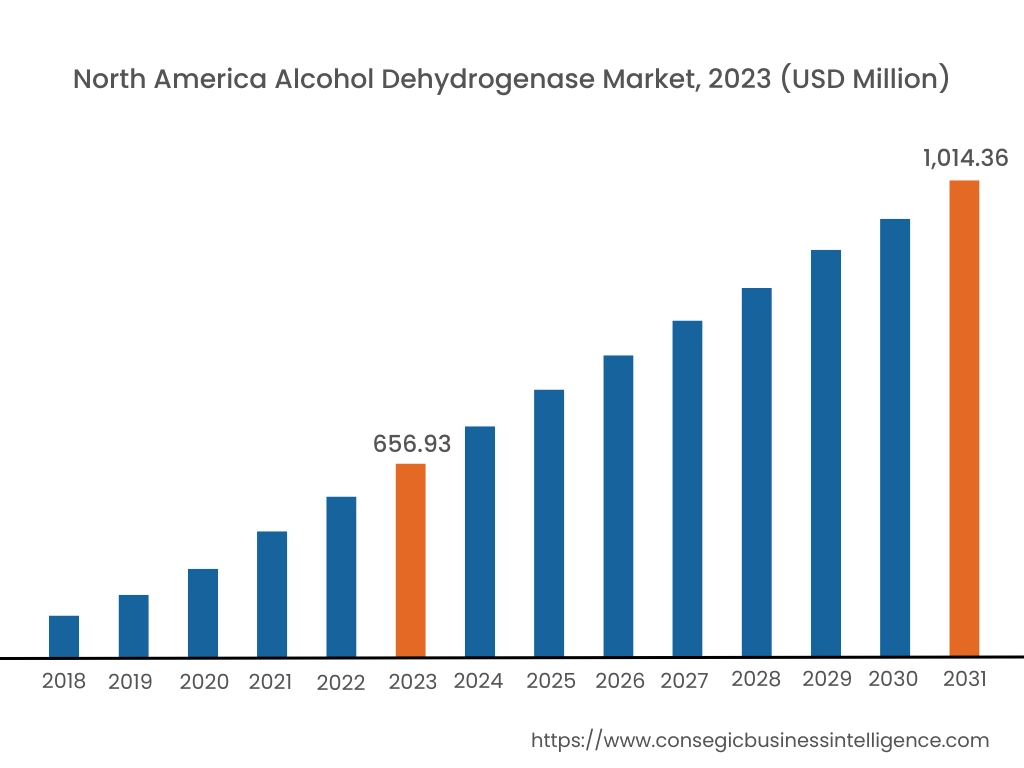
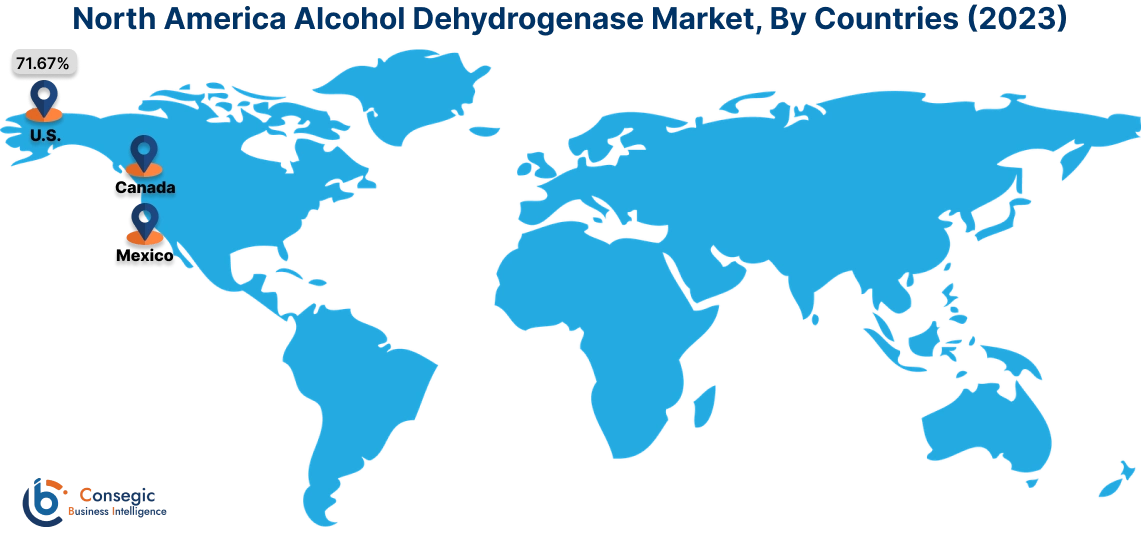
In 2023, North America was valued at USD 656.93 Million and is expected to reach USD 1,014.36 Million in 2031. In North America, the U.S. accounted for the highest share of 71.67% during the base year of 2023. North America holds a significant stake in the alcohol dehydrogenase market analysis, driven by the growing demand for enzymes in pharmaceutical and biotechnology applications. The U.S. leads the region with extensive use of alcohol dehydrogenase in drug synthesis, particularly in the production of chiral intermediates for pharmaceuticals. The growing emphasis on green chemistry and biocatalysis in industrial applications further supports alcohol dehydrogenase market trends. Canada contributes to the market through the increasing adoption of alcohol dehydrogenase in academic and industrial research. However, high costs associated with enzyme purification and production may pose challenges in the region.
In Asia Pacific, the market is experiencing the fastest growth with a CAGR of 6.3% over the forecast period. Asia-Pacific is the fastest-growing region in the alcohol dehydrogenase market analysis, fueled by rapid industrialization and expansion of the pharmaceutical and biotechnology industries in China, India, and Japan. China dominates the market with large-scale production of pharmaceuticals and increasing use of enzymes in green manufacturing processes. India’s growing biopharmaceutical industry and focus on cost-effective production support the adoption of alcohol dehydrogenase in drug synthesis. Japan emphasizes high-precision enzyme applications in advanced research and bioprocessing technologies. However, limited technical expertise and inconsistent quality standards in some parts of the region may pose challenges.
Europe is a prominent market for alcohol dehydrogenase, supported by a strong biotechnology and pharmaceutical sector. Countries analysis like Germany, France, and the UK are major contributors. Germany’s advanced chemical and pharmaceutical industries leverage alcohol dehydrogenase for biocatalytic processes in drug development and specialty chemical production. France emphasizes enzyme applications in biofuel production and food processing, while the UK focuses on academic and industrial research using alcohol dehydrogenase in green chemistry. However, stringent EU regulations on enzyme usage and production can create compliance challenges for manufacturers.
The Middle East & Africa region is witnessing steady growth in the alcohol dehydrogenase market, driven by analysis of increasing investments in biotechnology and industrial processes. Countries like Saudi Arabia and the UAE are adopting alcohol dehydrogenase in the production of biofuels and fine chemicals, aligning with their focus on sustainable energy solutions. In Africa, South Africa is emerging as a market with growing adoption in academic research and industrial bioprocessing applications. However, limited local enzyme production capabilities and reliance on imports may restrict broader market expansion in the region.
Latin America is an emerging market for alcohol dehydrogenase, with Brazil and Mexico leading the region. Brazil’s strong biofuel industry drives the demand for alcohol dehydrogenase in ethanol production, while Mexico leverages the enzyme in pharmaceutical and chemical manufacturing. The region also shows increasing interest in green chemistry and sustainable manufacturing processes, further boosting the market. However, economic instability and limited infrastructure for enzyme production may hinder alcohol dehydrogenase market expansion in certain countries.
Top Key Players and Market Share Insights:
The Alcohol Dehydrogenase market is highly competitive with major players providing products and services to the national and international markets. Key players are adopting several strategies in research and development (R&D), product innovation, and end-user launches to hold a strong position in the global Alcohol Dehydrogenase market. Key players in the Alcohol Dehydrogenase industry include -
- Sigma-Aldrich (U.S.)
- ProSpec-Tany Technogene Ltd. (Israel)
- Roche Diagnostics (Switzerland)
- Worthington Biochemical Corp. (U.S.)
- Sekisui Diagnostics (U.S.)
- Thermo Fisher Scientific (U.S.)
- Creative Enzymes (U.S.)
- MP Biomedicals (U.S.)
- Randox Laboratories (U.K.)
Alcohol Dehydrogenase Market Report Insights :
| Report Attributes | Report Details |
| Study Timeline | 2021-2034 |
| Market Size in 2034 | USD 3,716.03 Million |
| CAGR (2026-2034) | 5.89% |
| Base Year | 2025 |
| By Source |
|
| By Product |
|
| By Type |
|
| By Application |
|
| By End-User |
|
| By Region |
|
| Key Players |
|
| North America | U.S. Canada Mexico |
| Europe | U.K. Germany France Spain Italy Russia Benelux Rest of Europe |
| APAC | China South Korea Japan India Australia ASEAN Rest of Asia-Pacific |
| Middle East and Africa | GCC Turkey South Africa Rest of MEA |
| LATAM | Brazil Argentina Chile Rest of LATAM |
| Report Coverage |
|
Key Questions Answered in the Report
What is the projected market size of the Alcohol Dehydrogenase Market by 2031? −
Alcohol Dehydrogenase Market size is estimated to reach over USD 3,129.78 Million by 2031 from a value of USD 1,980.45 Million in 2023 and is projected to grow by USD 2,061.77 Million in 2024, growing at a CAGR of 5.89% from 2024 to 2031.
What drives the demand for alcohol dehydrogenase in biofuel production? +
Alcohol dehydrogenase catalyzes the conversion of biomass into ethanol, playing a crucial role in biofuel production. It enhances efficiency in fermentation processes and supports the global transition toward renewable energy sources.
Which source segment dominates the Alcohol Dehydrogenase Market? +
The microbial segment holds the largest revenue share due to its cost-effectiveness, scalability, and extensive industrial applications, including biofuel production and diagnostics.
Which product type is expected to grow the fastest? +
The plant-based segment is anticipated to register the fastest growth, driven by consumer preferences for natural and sustainable solutions, especially in the food, pharmaceuticals, and research industries.
Overview
Reputation & Certifications


Our Services
- Market Intelligence & Forecasting
- Custom Research Solutions
- Market Entry Strategy
- Competitive Intelligence
- Customer Insights
- Industry Innovation Analysis
- Investment Advisory