Jump to Content
Alfalfa Hay Market - Size, Share, Industry Trends, and Forecasts (2025-2032)
Alfalfa Hay Market Size:
Alfalfa Hay Market size is growing with a CAGR of 6.4% during the forecast period (2025-2032), and the market is projected to be valued at USD 134,293.70 Million by 2032 from USD 81,824.18 Million in 2024.
Alfalfa Hay Market Scope & Overview:
Alfalfa is a type of legume hay. They are a dried form of forage made from the alfalfa plant. They are highly nutritious which fixes the nitrogen present in the air. This results in high content of the protein. It is a good source of nutrients such as vitamins, minerals, and essential amino acids. This type of hay is highly digestible, which easily utilize the nutrients it provides. Additionally, they are palatable and easily consumed, which makes them important for providing high nutritional value, improved animal performance, and offer a sustainable feed source. They are mainly available in the form of bales, pellets, and cubes among others. The end-user for the consumption of these hay includes dairy cattle, beef cattle, horses, sheep & goat, and others. They are distributed for the end-user through different online retailers, pet stores, supermarkets & hypermarkets, and others.
How is AI Impacting the Alfalfa Hay Market?
AI is significantly impacting the alfalfa hay market by improving efficiency, optimizing resource use, and boosting overall yield and quality. Precision agriculture powered by AI is enabling better crop management, reduced input costs, and higher quality hay through optimized irrigation, fertilization, and harvesting. AI also plays a role in post-harvest, with applications in supply chain management, market analysis, and even predicting market prices.

Alfalfa Hay Market Dynamics - (DRO) :
Key Drivers:
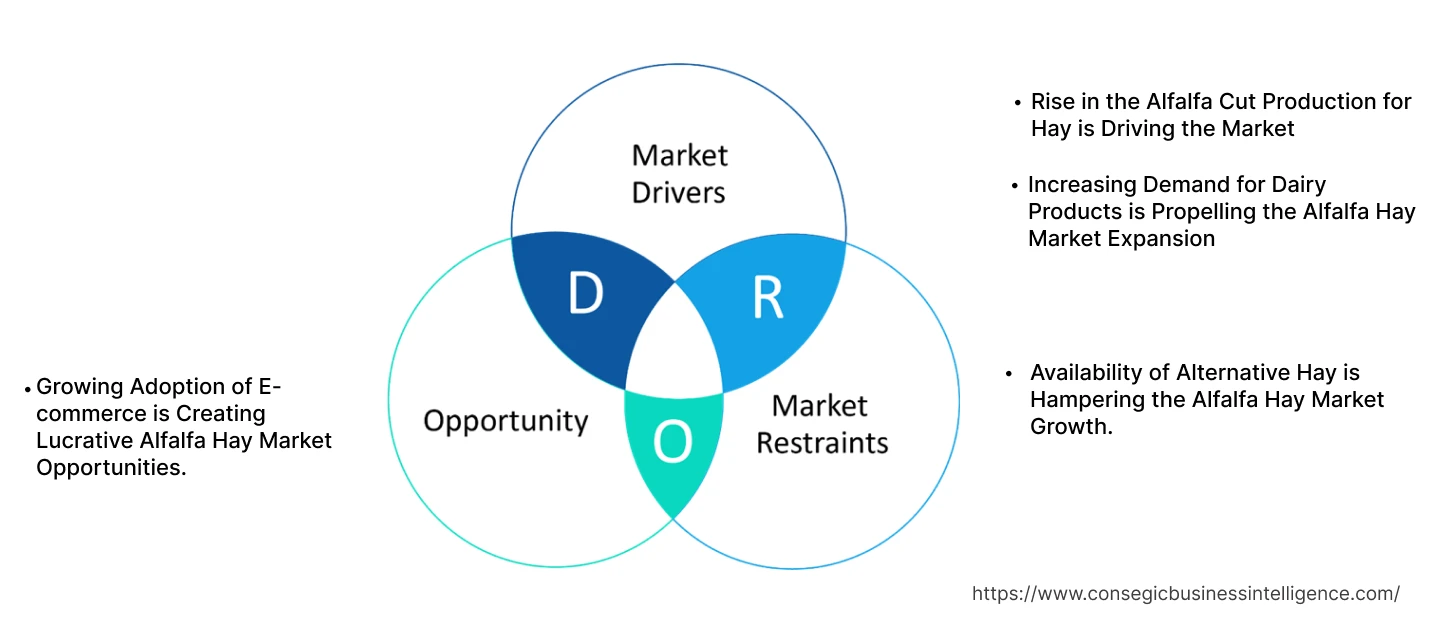
Rise in the Alfalfa Cut Production for Hay is Driving the Market
The increase in the yield of alfalfa is influenced by the development of agricultural practices. They include the utilization of improved varieties of seed, enhanced techniques for irrigation and optimized strategies for the management of pests and diseases. Agricultural practices allow for multiple cutting of alfalfa every season, this maximizes the yield and extends the harvesting.
For instance,
- The data published by the North American Alfalfa Improvement Conference, mentioned, that there are around 16.8 million of acres of alfalfa cut that is developed for hay, with an average yield of 3.45 tons per acre.
Thus, the rise in the production of alfalfa cut for hay is driving the alfalfa hay market growth.
Increasing Demand for Dairy Products is Propelling the Alfalfa Hay Market Expansion
The increase in global population is directly proportional to the increase in the amount of dairy consumed. In addition to this, changes in consumer preference with respect to dietary and nutritional habits are leading to an increase in the dairy products.
For instance,
- The data published in the FAO India, states that the requirement of dairy products reached 180 million tons in 2022. This shows a prominent rise in the requirement compared to previous years.
To cater to this rising requirement, alfalfa players are focusing on developing a wide variety of alfalfa hay which is a prominent feed source in various dairy cattle. In addition to the feed source, alfalfa supports the high production of milk. Thus, these products are expected to have a significant positive impact on the alfalfa hay market demand.
Key Restraints:
Availability of Alternative Hay is Hampering the Alfalfa Hay Market Growth.
There is a wide variety of hay available which serves as an alternative to alfalfa. Hay types such as clover hay, grass hay, and mixed hay are common alternatives. These alternatives are less expensive and easily available in retail and pet stores. Additionally, alternative feed source such as grain by products, protein supplements, and corn silage also affects the requirements of alfalfa. They offer a variety of nutritional portfolio and price points. These factors make them an attractive option for the producers of livestock feeder. This depends on the specific need and economic constraints. Thus, the availability of alternative hay and nutrient sources hinders the market.
Future Opportunities :
Growing Adoption of E-commerce is Creating Lucrative Alfalfa Hay Market Opportunities.
An e-commerce distribution channel is a method of delivering products to consumers through the Internet. It involves selling directly to customers via e-commerce platforms, without the need for physical retail locations or intermediaries. Online distribution channel plays a vital role in the pet feet and nutrition sector, acting as crucial intermediaries between hay producers and consumers. These factors are offering to the rise in the buying of pet required products online.
For instance,
- According to the data published by GlobalPETS, a resource for the international pet industry, in July 2024, it is stated that German pet owners are buying more and more online, showing an increase in online shopping. E-commerce represented sales of USD 1.29 billion in 2022 growing to USD 1.40 billion in 2023.
As a result, e-commerce distribution channels have become a primary factor for the market, offering personalized marketing, subscription models, and a platform for product innovation. The factors all together are creating lucrative alfalfa hay market opportunities.
Alfalfa Hay Market Segmental Analysis :
By Form:
Based on form, the market is categorized into bales, pellets, cubes and others.
Trends in the Form:
- The rise in the trend for easy handling, and storage leads to the use of bales.
- The trend for uniform and processed feed drives the use of pellets.
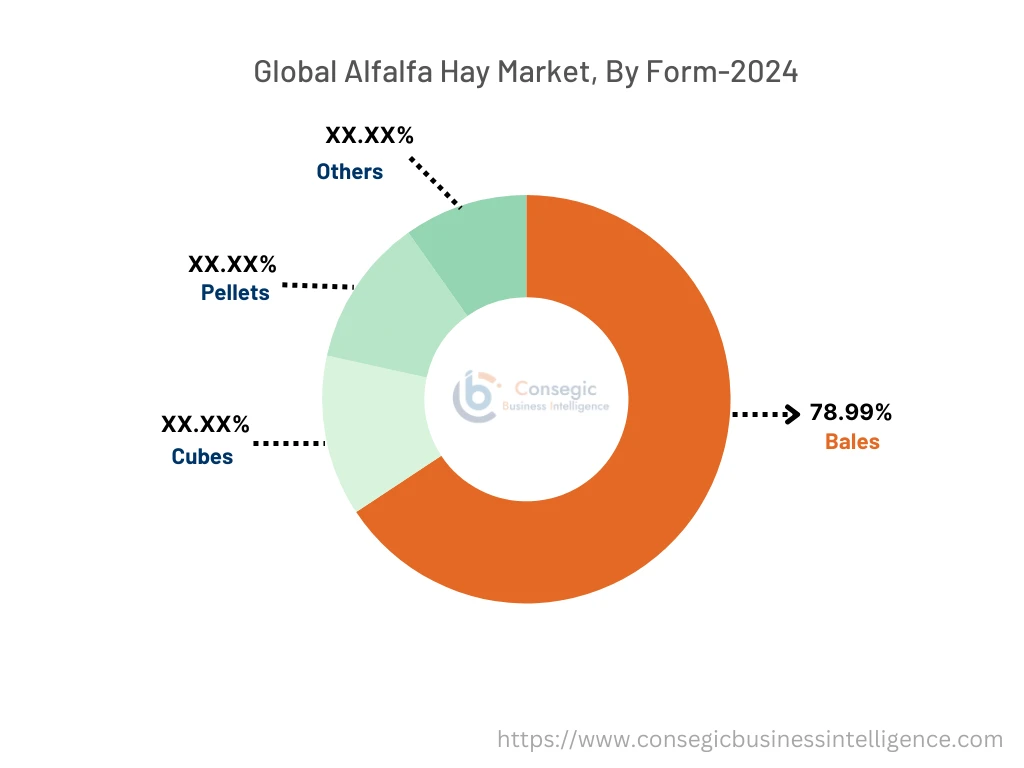
The bales segment accounted for the largest alfalfa hay market share of 78.99% in 2024.
- Alfalfa for hay is widely available in the form of bales. They are available in packages that are compresses
- They offer advantages for the handling, transportation and storage. The bales are available in three types that include, large square bales, small square bales, and round bales.
- The large bales are generally high in density which are wrapped in plastic for weather protection
- Small bales are smaller in size and are easier to handle manually.
- The round bales are round in nature and offer high density.
- These exceptional properties of the bales that minimize the loss of the nutrient values influence the requirement of bales.
- Thus, the rise in the availability and requirement of bales in influencing the alfalfa hay market trends.
The pellets segment is expected to grow at the fastest CAGR over the forecast period.
- The pellet form of hay of alfalfa is generally processed. The dried and chopped hay is compressed into small and dense form of pellets.
- Pellets are known to increase the density of the alfalfa and reduce the storage space. These pellets are easier to handle and transport.
- These properties make them less prone to the spoilage. Additionally, the dense nature allows for efficient and accurate feeding.
- These factors are influencing the requirement of hay pellets
- For instance, Star Milling Co, recently developed an Alfalfa hay pellet for horses. These pellets do not contain any binders, molasses, or vitamins.
- Thus, the rise in the use of pellets for animal feed is influencing the segment.
By End-user:
Based on end-user, the market is categorized into dairy cattle, beef cattle, horses, sheep & goat, and others.
Trends in end-user:
- Growing trend of alfalfa hay as a source of nutrients of livestock is influencing the segment.
- Rise in the use of hay for beef cattle is influencing the segment
The dairy cattle segment accounted for the largest market share in the year 2024.
- Alfalfa is one of the primary components for the nutrition of dairy cattle.
- The hay consists of high protein content, and amino acids which is essential for the production of milk
- The bypassed fraction of protein is easily consumed by cattle for the synthesis of milk.
- It also contributes to the intake of energy by the animals.
- Additionally, hay made from alfalfa contributes to rumen health.
- The protein content present in this hay stimulates the contraction of the rumen, which is essential for the digestion and absorption of nutrients.
- These factors have led to the higher production of milk form dairy cattle such as cows.
- For instance, according to the data published by the FAS USDA, in 2023, states that the milk production from cows is observed to be 207,100 MT.
- Thus, these factors are influencing the alfalfa hay market trends.
The horse segment is expected to grow at the fastest CAGR over the forecast period.
- Alfalfa is a legume that consists of a high amount of protein.
- This protein is essential for the growing horses, lactating mares, and performance horses.
- This hay provides a great source of vitamins and amino acids
- They are essential to contribute to the overall health of the and wellbeing of the horses.
- Hay also provides energy moderately, for supporting the weight and body condition.
- It is highly digestible, which allows digestion of essential nutrients effortlessly.
- Most horses find this type of hay palatable and readily consume it.
- Thus, as per the market analysis, the rise in the consumption of hay made from alfalfa is influencing the growth of the segment.
By Distribution Channel:
Based on a distribution channel, the market is categorized into online retailers, pet stores, supermarkets & hypermarkets, and others.
Trends in the Distribution Channel:
- Rise in the trend for online shopping is influencing the online retailers.
- Rise in the number of supermarkets & hypermarkets is propelling the segment.
The pet stores accounted for the largest market share in the year 2024.
- Pet stores offer easy access to various products that are required by the pets.
- These stores attract active pet owners, mainly those that have horses, and other livestock.
- These stores offer a wide range of hay, that is preferred by pet owners.
- These stores provide convenience, and a one stop shop for all pet necessities that consists of feed and hay products.
- They also promote the sales of hay by displaying them, which attracts a wide range of consumers. This offers a higher profit margin compared to selling through traditional channels.
- Thus, based on the market analysis, the rise in the pet stores that sell hay is driving the growth of the segment.
The online retailer’s segment is expected to grow at the fastest CAGR over the forecast period.
- Online platforms allow farmers to connect end-users such as horse owners, small farms, and backyard livestock keeps.
- Online retailers connect farmers with a wide range of customers.
- They provide access to current information of the market, information that includes, price, and customer review. It is also beneficial for the sellers as they are able to easily track inventory, manage orders, and communicate with customers more effectively.
- The preference for purchasing pet feed and hay from online stores leads to the rise in the sales of e-commerce.
- For instance, the data published by the International Trade Administration, in 2023, stated that Germany has a developing e-commerce market, ranking among the largest in Europe. In 2022, online sales reached an estimated USD 141.2 billion, showcasing an impressive 11% increase from 2021.
- Thus, as per the market analysis, these factors are influencing the growth of the segment.
Regional Analysis:
The regional segment includes North America, Europe, Asia Pacific, the Middle East and Africa, and Latin America.
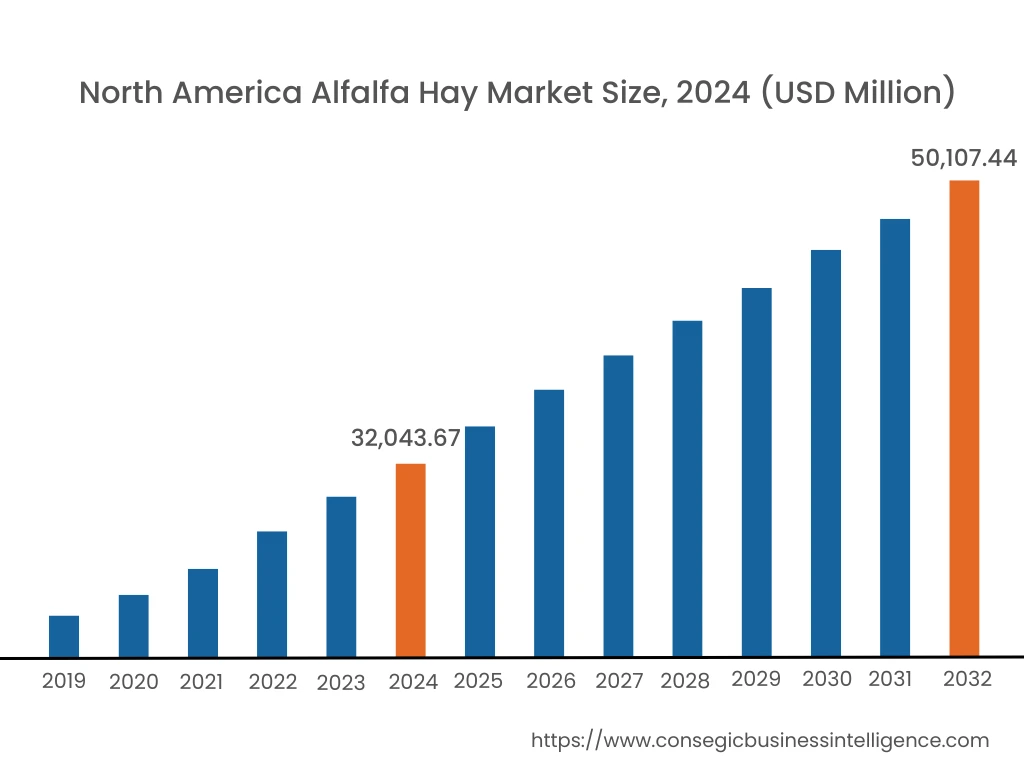
In 2024, North America accounted for the highest market share at 39.17% and was valued at USD 32,043.67 Million and is expected to reach USD 50,107.44 Million in 2032. In North America, U.S. accounted for the highest market share of 71.42% during the base year of 2024.
North America currently holds a dominant position in the alfalfa hay industry, driven by several key factors. The region has a high rate of adoption when precision agriculture technologies are considered. Precision agriculture for alfalfa is essential as they optimize the use of the resources. This has lead to advanced infrastructure along with rising focus on sustainable farming practices.
- For instance, in 2024, Nutrien announced its alliance with Bunge for helping out the U.S. farmers in incorporating sustainable farming practices . This is to reduce useful for reduce the usefulness of reducing the carbon footprint.
Precision agricultural systems are effectively used for the demand of alfalfa. They are known to improve yield, enhance sustainability, and enhance profitability. Hence as per the alfalfa hay market analysis, owing to the above-mentioned factors North America is currently dominating the market.

Asia Pacific is experiencing the fastest growth with a CAGR of 7.45% over the forecast period. The market across the region is attributed to factors such as the rise in the livestock sector. The rise is mainly driven by countries such as China and India. The primary factor that propels the rise of livestock is the growing requirement of animal protein. This includes the rise of dairy cattle, and beef cattle among others. The alfalfa is widely utilized because the livestock producers are focusing on the importance of the high quality of the feed. Alfalfa has a high content of protein. This is very useful for the livestock to maintain overall health. This is preferred for various livestock operations.
Europe presents a significant contribution to the alfalfa hay market analysis. The European diary industry is mature, creating constant requirements for alfalfa. Alfalfa is useful for dairy cattle. The high level of protein offers efficient production of milk. This has led to the rise in the production of premium quality alfalfa. This strong focus on sustainability and quality of the hay is influencing innovations in alfalfa. The innovations focus on the improvement of the production practices, development of new alfalfa varieties, and the implementation of novel and sustainable techniques for farming. Thus, these aforementioned factors are influencing the trends in the region.
The Middle East and Africa (MEA) region is witnessing notable alfalfa hay market demand characterized by significant potential. The rise in the requirement for high quality food is influencing the requirement for alfalfa. Additionally, there is an increase in the farming of livestock in the Middle East and Africa region. It serves as a source of food and also contributes to the cultural practices in the rural areas. These factors influence the development and the use of alfalfa. It is rich in proteins and essential amino acids which are essential for livestock. Thus, these factors are influencing the market demand.
Latin America is an emerging region in the Alfalfa Hay market share, with significant potential for innovation. The Latin American agricultural sector is experiencing a significant trajectory, driven by increasing disposable incomes, government initiative. This has led to a corresponding increase in the requirement of high-quality proteins. The requirement for intensive livestock production system increases the requirement for high quality forages. These factors influence the use of high quality of the feed to support growth. This market analysis presents a substantial opportunity for manufacturers and suppliers to capitalize on this growing market and contribute to the region's alfalfa hay market expansion.
Top Key Players and Market Share Insights:
The Alfalfa Hay market is highly competitive with major players providing precise products to the national and international markets. Key players are adopting several strategies in research and development (R&D) and product innovation to hold a strong position in the global Alfalfa Hay market. Key players in the Alfalfa Hay industry include-
- Andersonhay (United States)
- Al Dahra ACX (UAE)
- Desert Oasis Farms (Saudi Arabia)
- Cubeit Hay (United States)
- Alfalfa King (United States)
- Green Prairie International Inc (Canada)
- Bailey Farms International (United States)
- Standlee Premium Products, LLC (United States)
- Alfalfa Monegros ( Spain)
- Hayden Fresh Farms (United States)
Alfalfa Hay Market Report Insights :
| Report Attributes | Report Details |
| Study Timeline | 2019-2032 |
| Market Size in 2032 | USD 134,293.70 Million |
| CAGR (2025-2032) | 6.4% |
| By Form |
|
| By End-User |
|
| By Distribution Channel |
|
| By Region |
|
| Key Players |
|
| North America | U.S. Canada Mexico |
| Europe | U.K. Germany France Spain Italy Russia Benelux Rest of Europe |
| APAC | China South Korea Japan India Australia ASEAN Rest of Asia-Pacific |
| Middle East and Africa | GCC Turkey South Africa Rest of MEA |
| LATAM | Brazil Argentina Chile Rest of LATAM |
| Report Coverage |
|
Key Questions Answered in the Report
How big is the Alfalfa Hay market? −
In 2024, the Alfalfa Hay market is USD 81,824.18 Million.
Which is the fastest-growing region in the Alfalfa Hay market? +
Asia Pacific is the fastest-growing region in the Alfalfa Hay market.
What specific segmentation details are covered in the Alfalfa Hay market? +
Form, end user, distribution channel segmentation details are covered in the Alfalfa Hay market.
Who are the major players in the Alfalfa Hay market? +
Andersonhay (United States), Al Dahra ACX (UAE), Green Prairie International Inc (Canada) are some of the major players in the market.
Overview
Reputation & Certifications


Our Services
- Market Intelligence & Forecasting
- Custom Research Solutions
- Market Entry Strategy
- Competitive Intelligence
- Customer Insights
- Industry Innovation Analysis
- Investment Advisory