Jump to Content
Ammonium Thiosulfate Market - Size, Share, Industry Trends, and Forecasts (2025 - 2032)
Ammonium Thiosulfate Market Size:
Ammonium Thiosulfate Market size is estimated to reach over USD 663.90 Million by 2032 from a value of USD 410.32 Million in 2024 and is projected to grow by USD 428.45 Million in 2025, growing at a CAGR of 6.2% from 2025 to 2032.
Ammonium Thiosulfate Market Scope & Overview:
The ammonium thiosulfate is a versatile compound widely used as a sulfur and nitrogen-based fertilizer, as well as in industrial and photographic applications. Known for its water solubility and compatibility with other fertilizers, ammonium thiosulfate is a key input in enhancing soil nutrient levels and improving crop yields. Key characteristics include its role as a liquid fertilizer additive, its ability to optimize sulfur availability in soils, and its suitability for various agricultural systems, including drip irrigation. The benefits include increased crop productivity, reduced nitrogen loss, and enhanced nutrient management. Applications span agriculture, industrial water treatment, and photographic processing. End-users include farmers, agrochemical manufacturers, and industrial process operators, driven by increasing demand for high-efficiency fertilizers, rising focus on sustainable farming practices, and growing adoption of sulfur-based nutrients to address soil deficiencies.
How is AI Impacting the Ammonium Thiosulfate Market?
AI is significantly impacting the ammonium thiosulfate market, primarily through its integration into precision agriculture and supply chain optimization. AI-powered systems analyze vast datasets to recommend optimal ATS application rates, enhancing fertilizer efficiency and minimizing environmental impact. Additionally, AI is improving supply chain management by predicting demand fluctuations and optimizing production and inventory.

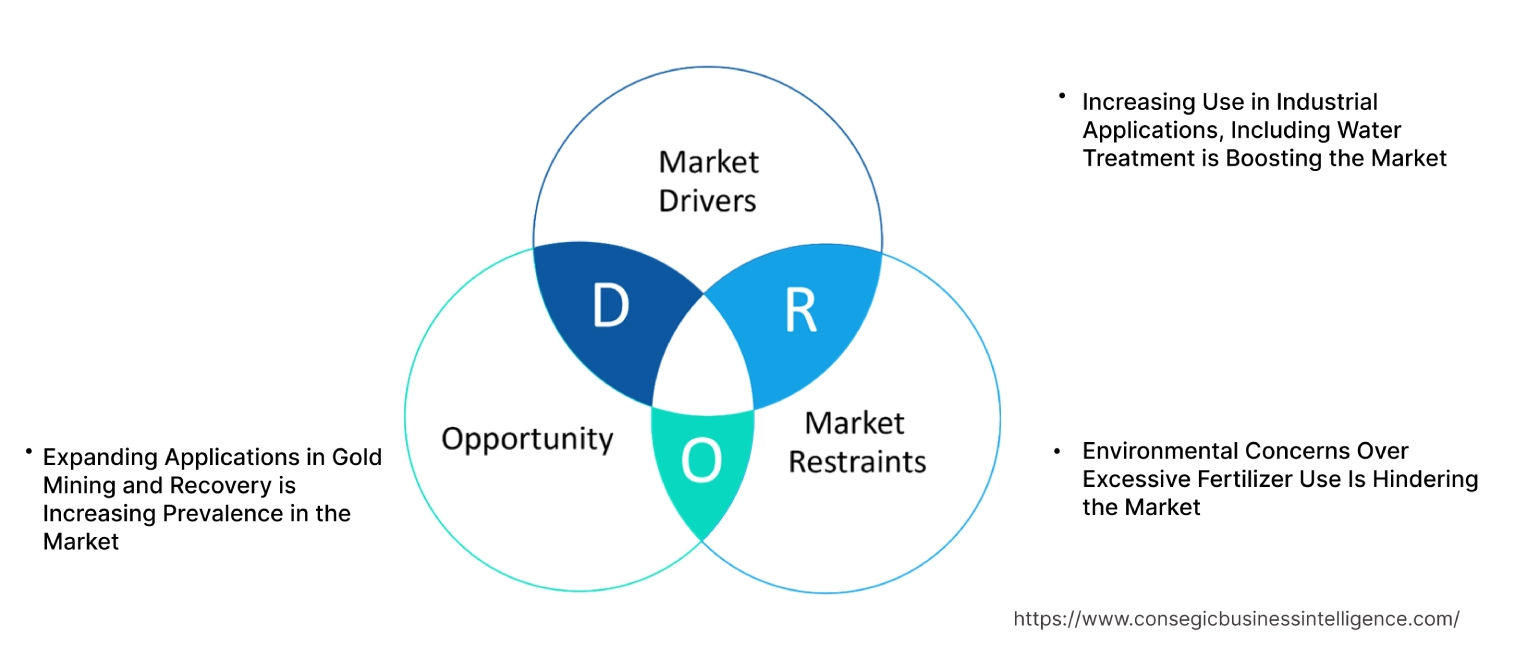
Ammonium Thiosulfate Market Dynamics - (DRO) :
Key Drivers:
Increasing Use in Industrial Applications, Including Water Treatment is Boosting the Market
Ammonium thiosulfate has gained prominence in various industrial applications due to its versatility and environmentally compatible properties. It is widely used as a reducing agent in water treatment processes to remove residual chlorine and other oxidants, making it essential for industries that rely on clean and dechlorinated water. Its non-toxic and efficient chemical properties ensure that it can be safely applied in sensitive processes, such as municipal water treatment and food production facilities.
Trends in industrial sustainability and eco-friendly practices have further underscored its use as a replacement for harsher chemicals. Beyond water treatment, ammonium thiosulfate is also utilized in photographic processing, textile manufacturing, and leather tanning, where it plays a role as a stabilizing and processing agent. The analysis highlights that as industries shift toward greener, safer alternatives, the use of ammonium thiosulfate in industrial processes will continue to expand.
Key Restraints:
Environmental Concerns Over Excessive Fertilizer Use Is Hindering the Market
While ammonium thiosulfate is valued in agriculture for its role in delivering sulfur and nitrogen to crops, excessive or improper use poses environmental challenges. Over-application can lead to nutrient runoff, resulting in water contamination, eutrophication of nearby water bodies, and damage to aquatic ecosystems. In addition, prolonged and unregulated use can cause soil acidification, reducing long-term soil fertility and raising concerns about sustainable agricultural practices.
With increasing global scrutiny on agricultural sustainability, regulations on fertilizer use are becoming more stringent in several regions. Addressing this challenge requires the adoption of precision application techniques, such as controlled-release fertilizers and soil monitoring systems, to minimize environmental risks. Trends in sustainable farming and responsible nutrient management are essential for mitigating these challenges and ensuring the continued use of ammonium thiosulfate in agriculture.
Future Opportunities :
Expanding Applications in Gold Mining and Recovery is Increasing Prevalence in the Market
Ammonium thiosulfate is emerging as a safer and environmentally friendly alternative to cyanide in gold leaching and extraction processes. Its non-toxic and biodegradable properties make it particularly suitable for mining operations that aim to reduce environmental risks and comply with increasingly strict safety regulations. Compared to traditional cyanide-based methods, ammonium thiosulfate offers reduced ecological impact while maintaining effective gold recovery rates, making it ideal for environmentally sensitive mining projects.
Trends in sustainable mining practices and the growing emphasis on reducing chemical hazards are driving the adoption of ammonium thiosulfate in the gold mining sector. The analysis highlights its potential to support the development of cleaner extraction methods, particularly as the mining industry explores greener solutions for resource recovery. This presents significant ammonium thiosulfate market opportunities for manufacturers to supply ammonium thiosulfate as a key component in eco-conscious mining technologies.
Ammonium Thiosulfate Market Segmental Analysis :
By Grade:
Based on grade, the market is segmented into industrial grade and agricultural grade.
The agricultural grade segment accounted for the largest revenue in ammonium thiosulfate market share in 2024.
- Agricultural-grade ammonium sulfate is widely used as a nitrogen and sulfur-based fertilizer to improve crop yields.
- It is particularly effective in enhancing soil quality and providing essential nutrients to crops such as rice, wheat, and corn.
- The growing ammonium thiosulfate market demand for high-yield farming practices and the increasing adoption of ammonium sulfate in regions with sulfur-deficient soils have driven the ammonium thiosulfate market trends of this segment.
- Additionally, agricultural-grade ammonium sulfate is preferred for its cost-effectiveness and compatibility with other fertilizers, making it a key choice for farmers globally.
The industrial grade segment is anticipated to register the fastest CAGR during the forecast period.
- Industrial-grade ammonium sulfate is gaining traction in applications such as water treatment, metal recovery, and chemical manufacturing.
- Its high purity and consistent composition make it suitable for use in industrial processes where precise chemical performance is required.
- The increasing focus on wastewater treatment and the rising demand for ammonium sulfate as a coagulant to remove impurities in industrial effluents have fueled the ammonium thiosulfate market growth of this segment.
- Moreover, advancements in manufacturing processes are enhancing the quality and availability of industrial-grade ammonium sulfate, driving its rapid adoption.
By Application:
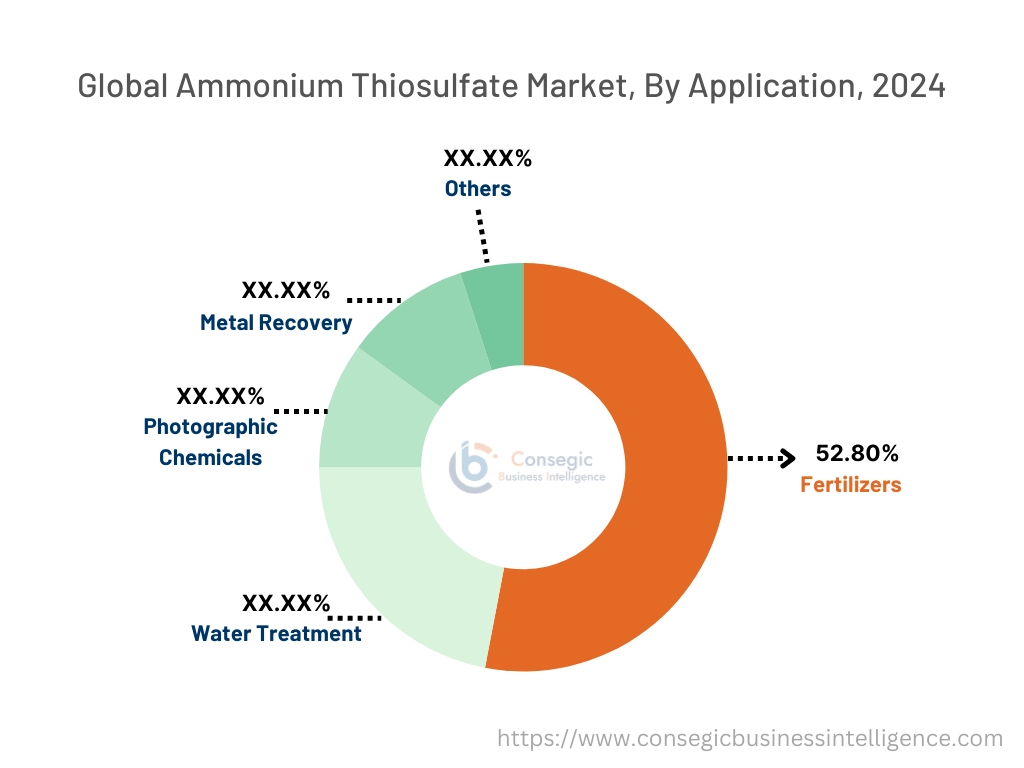
Based on application, the market is segmented into fertilizers, water treatment, photographic chemicals, metal recovery, and others.
The fertilizers segment accounted for the largest revenue of 52.80% in the ammonium thiosulfate market share in 2024.
- Ammonium sulfate is extensively used as a fertilizer to provide crops with a rich source of nitrogen and sulfur, essential for healthy plant growth.
- It is particularly effective for alkaline soils, as it helps lower soil pH while supplying nutrients.
- The increasing trends for high-yield and nutrient-rich crops, driven by the growing global population, have fueled the adoption of ammonium sulfate fertilizers.
- Its widespread use in staple crops such as rice, grains, and vegetables, particularly in Asia-Pacific and Latin America, has solidified the trends of the fertilizers segment in the market.
The water treatment segment is anticipated to register the fastest CAGR during the forecast period.
- Ammonium sulfate is increasingly used as a coagulant in water treatment applications to remove impurities and enhance water quality.
- Its effectiveness in stabilizing pH levels and facilitating the removal of suspended solids makes it a preferred choice in municipal and industrial wastewater treatment plants.
- With the rising concerns about water pollution and stringent environmental regulations, the ammonium thiosulfate market trends for ammonium sulfate in water treatment processes are growing rapidly. Additionally, its cost-effectiveness and availability are further driving adoption in this segment.
Regional Analysis:
The regions covered are North America, Europe, Asia Pacific, the Middle East and Africa, and Latin America.
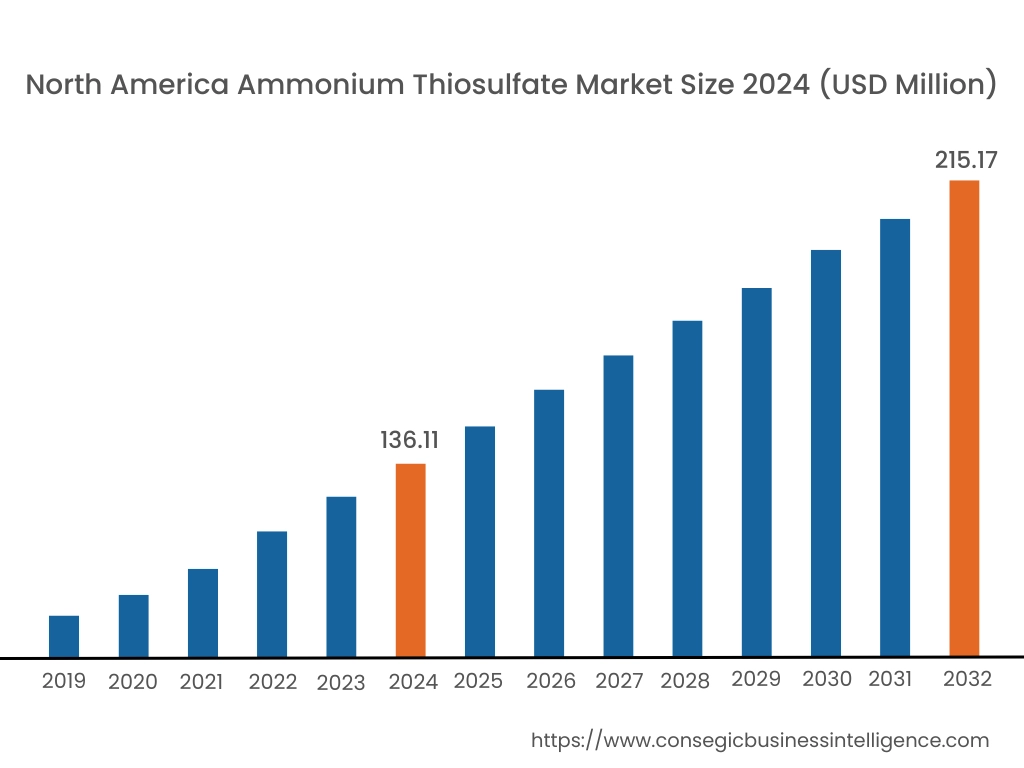
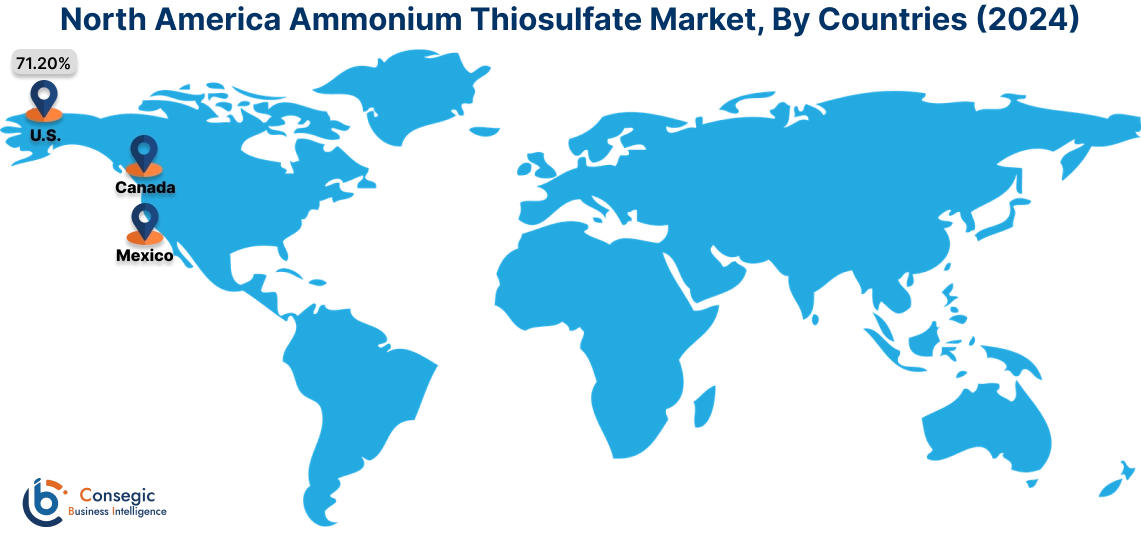
In 2024, North America was valued at USD 136.11 Million and is expected to reach USD 215.17 Million in 2032. In North America, the U.S. accounted for the highest share of 71.20% during the base year of 2024. North America holds a significant share in the ammonium thiosulfate market analysis, primarily driven by its widespread use as a liquid fertilizer in the agricultural sector. The U.S. leads the region due to the adoption of ammonium thiosulfate in large-scale crop production, particularly for corn, wheat, and soybeans, where it is used as a sulfur and nitrogen source to improve crop yields. Additionally, its applications in industrial processes such as water treatment and photography contribute to regional demand. Canada supports the market through its increasing focus on enhancing sulfur-deficient soils in agriculture. However, environmental concerns over excessive fertilizer use may pose regulatory challenges.
In Asia Pacific, the market is experiencing the fastest growth with a CAGR of 6.6% over the forecast period. Asia-Pacific is the fastest-growing region in the ammonium thiosulfate market analysis, driven by increasing agricultural activities and growing trends for high-yield fertilizers in China, India, and Southeast Asia. China leads the market with extensive use of ammonium thiosulfate to improve crop productivity and meet rising food demands. India’s expanding agricultural sector, coupled with government initiatives promoting balanced fertilizer use, drives the adoption of ammonium thiosulfate to address soil sulfur deficiencies. Southeast Asian countries are also witnessing rising opportunities for sulfur-based fertilizers due to their focus on increasing agricultural output. However, limited awareness about the benefits of ammonium thiosulfate in rural areas may hinder market adoption.
Europe is a prominent market for ammonium thiosulfate, driven by its application in sustainable agriculture and stringent environmental regulations on sulfur emissions. Countries like Germany, France, and the UK are key contributors. Germany emphasizes the use of ammonium thiosulfate in precision farming to optimize nutrient management and address sulfur deficiencies in crops. As the regional analysis portrays France’s strong agricultural sector leverages the product for enhancing soil fertility, particularly in rapeseed and cereal production. The UK focuses on its role as a critical nitrogen stabilizer in modern farming practices. However, compliance with strict EU regulations on fertilizer use and environmental sustainability may impact market growth.
The Middle East & Africa region is experiencing steady growth in the ammonium thiosulfate market expansion, supported by increasing agricultural practices and industrial applications. In the Middle East, countries like Saudi Arabia and the UAE are adopting ammonium thiosulfate in advanced farming techniques, particularly in water-scarce areas requiring optimized nutrient delivery systems. In Africa, countries like South Africa are witnessing growing adoption to enhance soil fertility for crops like maize and sugarcane. However, limited infrastructure and affordability challenges may restrict market growth in certain parts of the region.
Latin America is an emerging market for ammonium thiosulfate, with Brazil and Argentina leading the region. Brazil’s large-scale agricultural sector, particularly in soybean, sugarcane, and coffee production, drives ammonium thiosulfate market demand for ammonium thiosulfate to address sulfur depletion in soils. Argentina also leverages the product to boost crop yields in its expanding agricultural lands. The growing focus on precision farming and nutrient management practices further supports regional ammonium thiosulfate market growth. However, economic instability and inconsistent fertilizer policies may limit broader adoption in smaller markets.
Top Key Players and Market Share Insights:
The ammonium thiosulfate market is highly competitive with major players providing products to the national and international markets. Key players are adopting several strategies in research and development (R&D), product innovation, and end-user launches to hold a strong position in the ammonium thiosulfate market. Key players in the ammonium thiosulfate industry include -
- Tessenderlo Group (Belgium)
- Martin Midstream Partners (USA)
- W. Griffin (USA)
- Plant Food (USA)
- Hydrite Chemical Co. (USA)
- PCI Nitrogen (Rentech Nitrogen) (USA)
- Poole Chem (USA)
- Koch Fertilizer (USA)
- Mears Fertilizer (USA)
- Nutrien (Canada)
Recent Industry Developments :
Mergers and Acquisitions:
- In March 2023, Tessenderlo Group signed an agreement to acquire the marketing and sales activities for ammonium thiosulfate (ATS) fertilizers produced by Esseco Srl in Trecate, Italy. This collaboration enhances Tessenderlo’s ATS production capacity and reinforces their commitment to the fertilizer market, aiming for improved customer service and product innovation.
Ammonium Thiosulfate Market Report Insights :
| Report Attributes | Report Details |
| Study Timeline | 2019-2032 |
| Market Size in 2032 | USD 663.90 Million |
| CAGR (2025-2032) | 6.2% |
| By Grade |
|
| By Application |
|
| By Region |
|
| Key Players |
|
| North America | U.S. Canada Mexico |
| Europe | U.K. Germany France Spain Italy Russia Benelux Rest of Europe |
| APAC | China South Korea Japan India Australia ASEAN Rest of Asia-Pacific |
| Middle East and Africa | GCC Turkey South Africa Rest of MEA |
| LATAM | Brazil Argentina Chile Rest of LATAM |
| Report Coverage |
|
Key Questions Answered in the Report
What is the projected size of the Ammonium Thiosulfate Market by 2032? −
Ammonium Thiosulfate Market size is estimated to reach over USD 663.90 Million by 2032 from a value of USD 410.32 Million in 2024 and is projected to grow by USD 428.45 Million in 2025, growing at a CAGR of 6.2% from 2025 to 2032.
What are the main factors driving the growth of the Ammonium Thiosulfate Market? +
The market is driven by the increasing use of ammonium thiosulfate in agriculture as a sulfur and nitrogen-based fertilizer, along with its expanding applications in industrial processes such as water treatment and gold mining.
What are the challenges hindering the market growth? +
The key challenges include environmental concerns related to excessive fertilizer use, nutrient runoff leading to water contamination, and stringent regulations on sustainable agricultural practices.
What future opportunities exist for the Ammonium Thiosulfate Market? +
Opportunities lie in its use as an eco-friendly alternative in gold mining for leaching and recovery processes. Its non-toxic and biodegradable properties make it ideal for sustainable mining operations, replacing hazardous cyanide-based methods.
Which grade segment dominated the market in 2024? +
The agricultural grade segment held the largest market share in 2024, owing to its widespread use as a cost-effective fertilizer to enhance soil quality and crop yields.
Overview
Reputation & Certifications


Our Services
- Market Intelligence & Forecasting
- Custom Research Solutions
- Market Entry Strategy
- Competitive Intelligence
- Customer Insights
- Industry Innovation Analysis
- Investment Advisory