Jump to Content
Aphakia Market - Size, Share, Industry Trends, and Forecasts (2025-2032)
Aphakia Market Size:
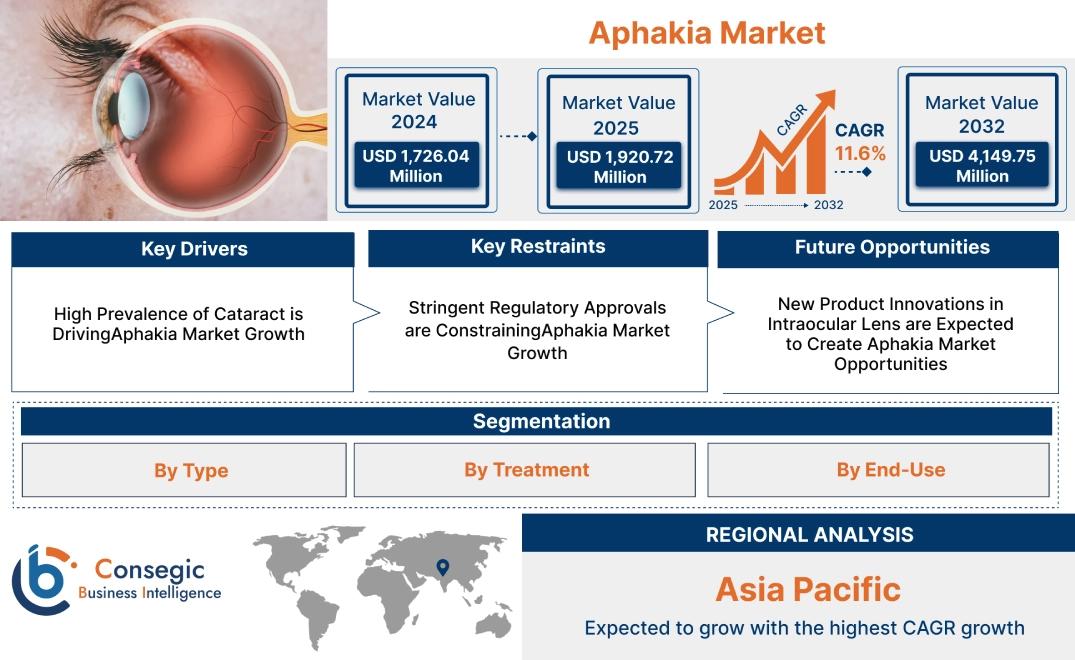
The aphakia market size is growing with a CAGR of 11.6% during the forecast period (2025-2032), and the market is projected to be valued at USD 4,149.75 Million by 2032 from USD 1,726.04 Million in 2024. Additionally, the market value for the 2025 attributes to USD 1,920.72 Million.
Aphakia Market Scope & Overview:
Aphakia is the medical condition referring to absence of the lens of the eye. The symptoms in this condition includes blurred vision, color precipitation, difficulty in focusing, and others. It is mainly of two types, congenital and acquired. Further, congenital aphakia is present at birth while acquired aphakia is caused due to surgical removal, trauma, or other medical conditions. This condition is treated with surgery, contact lenses, spectacles, and others. Healthcare facilities such as hospitals, ophthalmic clinics, and others are providing advanced diagnosis and treatment options for aphakia. Moreover, advancements in treatment options is enhancing the management of this condition among the patients further driving the market expansion.
Aphakia Market Dynamics - (DRO) :
Key Drivers:
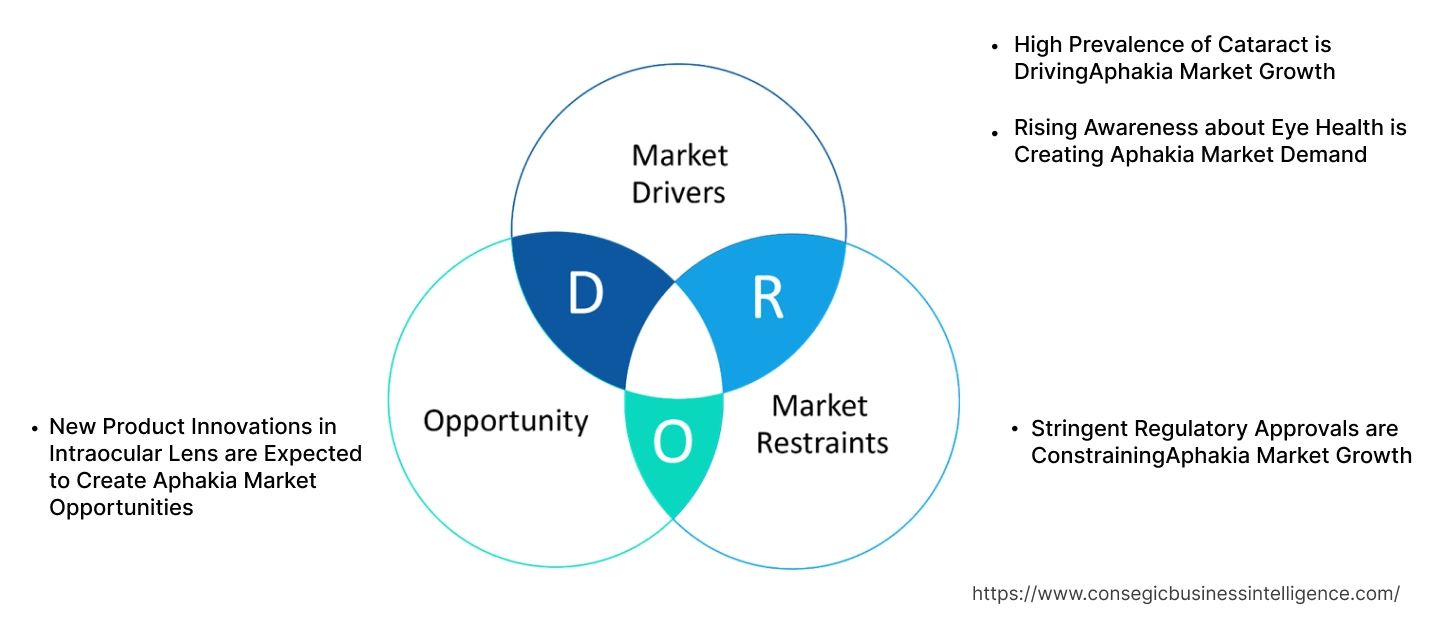
High Prevalence of Cataract is Driving Aphakia Market Growth
The cataract is a medical condition in which the lens of the eye becomes cloudy, resulting in blurred vision. In the treatment of cataract, the natural lens are removed during surgery to treat the clouded lens which leads to aphakia. The prevalence of cataract is high due to diabetes, growing population, smoking and poor nutrition further driving the market.
- In 2023, according to World Health Organization, there are 94 million cases of cataracts worldwide. These high cases of cataract are causing aphakia during surgical treatment through intraoperative lens dislocation and rupturing of natural lens.
Thus, the high prevalence of cataract is leading to aphakia market demand.
Rising Awareness about Eye Health is Creating Aphakia Market Demand
Rising awareness about eye health is a major driver in the market. Private hospitals and eye care centers are launching campaigns to spread awareness about eye-related conditions including aphakia. Moreover, government bodies and medical associations are providing online sources to inform the prospective patients about this condition, its symptoms and diagnostic methods.
- In 2021, article published in American Academy of Ophthalmology explained the aphakia condition, its causes, symptoms, diagnosis along with the treatment options. This has increased the visits to eye care centers and hospitals regarding aphakia diagnosis and treatment, further driving the market.
Hence, rising awareness about eye health is leading to aphakia market expansion.
Key Restraints:
Stringent Regulatory Approvals are Constraining Aphakia Market Growth
Regulatory approvals are significantly restraining the market due to stringent requirements for the approval of intraocular lenses and contact lenses. Authorities such as United States Food and Drug Administration, European Medicines Agency (EMA) impose rigorous testing and documentation requirement for these lenses before it is approved for clinical use. These regulations ensure that the intraocular lenses and contact lenses do not cause harm, function effectively in treatment and meet the required quality standards. The approval process involves multiple stages, including preclinical trials, testing, biocompatibility evaluations and clinical trials, which are time-intensive and costly. It typically causes delays due to lengthy evaluations of additional requirements for compliance. Thus, stringent regulatory approvals are constraining the market demand due to increased cost and limited availability of advanced technology.
Future Opportunities :
New Product Innovations in Intraocular Lens are Expected to Create Aphakia Market Opportunities
An intraocular lens is a lens implanted in the eye through the surgery for the treatment of aphakia. It improves blurred vision and ability to focus in the patients. Innovations in design and haptics are increasing the applicability of intraocular lens. Advanced design provides crisp vision and reduces glare & posterior capsular opacification. Unique haptics provide superior axial and rotational stability in the lens. Moreover, companies are also developing intraocular lenses with advanced material.
- In 2024, Alcon launched Clareon intraocular lenses in India. These lenses are made of glistening-free material that has the lowest levels of haze and consistent clarity. Further, precise implantation and consistent refractive outcomes will boost the adoption of Clareon intraocular lenses.
Thus, new product innovations in intraocular lens are expected to create aphakia market opportunities.
Aphakia Market Segmental Analysis :
By Type:
Based on type, the market is categorized into congenital and acquired.
Trends in Type
- According to aphakia market trends, cataract surgery and eye trauma are resulting in large, acquired cases.
- Diagnosis of heterozygous PXDN variants in genetic analysis is detecting congenital aphakia at early stages as per market trends.
The acquired segment accounted for the largest market share in the year 2024.
- Acquired aphakia is a condition where the lens in the eye is absent, typically resulting from surgical removal, trauma, or medical conditions.
- The natural lens is damaged or lost due to eye trauma or injury resulting in this type of condition.
- Further, cataract surgery typically results in acquired aphakia due to surgical removal of the natural lens.
- Symptoms in this condition include color perception, absence of focus, blurred vision, and others.
- Acquired aphakia is usually diagnosed by ophthalmologists through the complete eye exam.
- Thus, acquired aphakia is dominating segment in the market due to surgery, trauma and confirm diagnosis through complete eye exam.
The congenital segment is expected to grow at the fastest CAGR over the forecast period.
- Congenital aphakia is a condition where there is no lens present in the eyes during the birth.
- It results from a failure of lens induction from the surface ectoderm and aborted lens development.
- Congenital aphakia is mainly caused by variants in the FOXE3 gene and most cases are autosomal recessive.
- Further, diagnosis of novel variants through genetic analysis are improving the detection of congenital aphakia.
- For instance, in 2022, research article published in the ScienceDirect stated that heterozygous PXDN variants are diagnosed in fetal through the genetic analysis. It helps in the detection of congenital aphakia at early stages.
- Thus, advancement in variants diagnosis is detecting congenital aphakia at early stages thereby driving the growth of the segment.
By Treatment :
Based on treatment, the market is categorized into surgery, contact lenses, spectacles, and others.
Trends in Treatment
- As per aphakia market trends, implantation of intraocular lens through surgery improves blurred vision and ability to focus.
- Adoption of contact lenses is growing among the patients due to easy application and less complication rates as per market trends.
The surgery segment accounted for the largest market share in the year 2024.
- Surgery is a widely used treatment for the aphakia in which intraocular lens is placed to replace the damaged, detached or missing lens.
- Intraocular lens improves blurred vision and ability to focus in aphakia. Demand for this lens is rising among the patients for improving visual correction.
- To cater for this demand, companies are developing intraocular lens for aphakia.
- For instance, in 2025, Bausch + Lomb launched enVista Envy full range of vision intraocular lens in the European Union. This lens is used for primary implantation in the capsular bag of the eye for the visual correction of aphakia.
- Thus, surgery segment is dominating in the market due to the availability of advanced intraocular lens.
The contact lenses segment is expected to grow at the fastest CAGR over the forecast period.
- Contact lenses are thin lenses placed directly on the surface of the eyes.
- The use of contact lenses is growing in the treatment for aphakia especially in congenital type where infants and children are not suitable for surgery.
- Contact lenses such as silicone elastomer lens are gas permeable and also improves oxygen transmission to the cornea in the patients.
- Further, contact lenses have low risk, high efficacy and are easily changed or updated once they are damaged.
- Hence, adoption of contact lenses is growing in the treatment due to easy application and improvement in oxygen transmission further driving the growth of the segment.
By End-Use:
Based on end-use, the market is categorized into hospitals, ophthalmic clinics, and others.
Trends in End-Use
- As per market trends, hospitals are adopting advanced diagnostic and specialized treatment options for providing comprehensive care to the patients.
- Preference for ophthalmic clinics is growing among the patients due to cost effectivity and accessibility as per market trends.
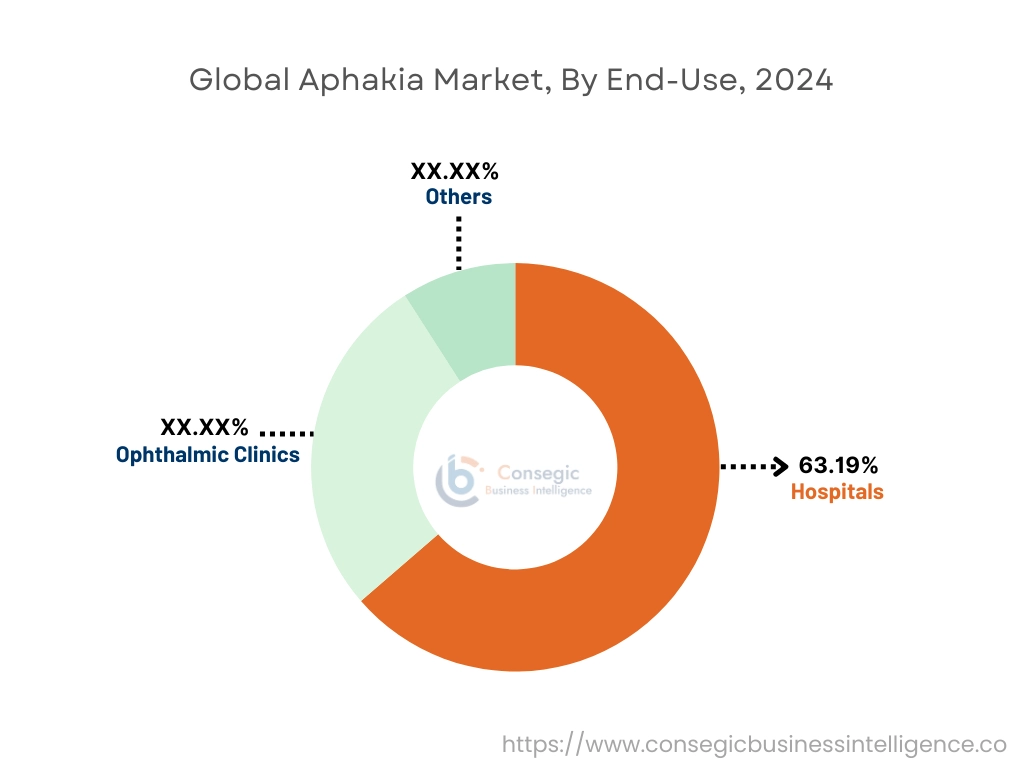
The hospitals segment accounted for the largest market share of 63.19% in the year 2024.
- Hospitals plays major role in the management of aphakia patients through advanced diagnosis methods and treatment options.
- They are widely preferred by the patients due to advanced technology, well-developed infrastructure and skilled healthcare professionals.
- Further, hospitals are providing specialized glasses for the aphakia patients to reduce financial burden.
- For instance, in 2023, The Children’s Hospital in Sydney provided spectacles for babies born with congenital cataracts to treat aphakia. These glasses are used as a part of visual rehabilitation in the patients.
- Thus, hospitals segment is dominating in the market due to advanced infrastructure and specialized treatment option for the congenital cataracts.
The ophthalmic clinics segment is expected to grow at the fastest CAGR over the forecast period.
- Ophthalmic clinics are healthcare facilities which offers diagnostic, therapeutic, or preventive outpatient services related to the eye conditions.
- These clinics offer more accessible, cost-effective options for managing the disease, reducing the need for extended hospital stays.
- As healthcare systems focus on providing more outpatient services, ophthalmic clinics are increasingly being utilized for regular follow-ups, patient management.
- Further, the demand for ophthalmic clinics is rising, supported by growing number of aphakia cases due to cataract surgeries, eye trauma, and congenital defects.
- Thus, adoption of ophthalmic clinics is growing due to increased accessibility and quality of care for the patients, thereby driving the growth of the segment.
Regional Analysis:
The regional segment includes North America, Europe, Asia Pacific, the Middle East and Africa, and Latin America.
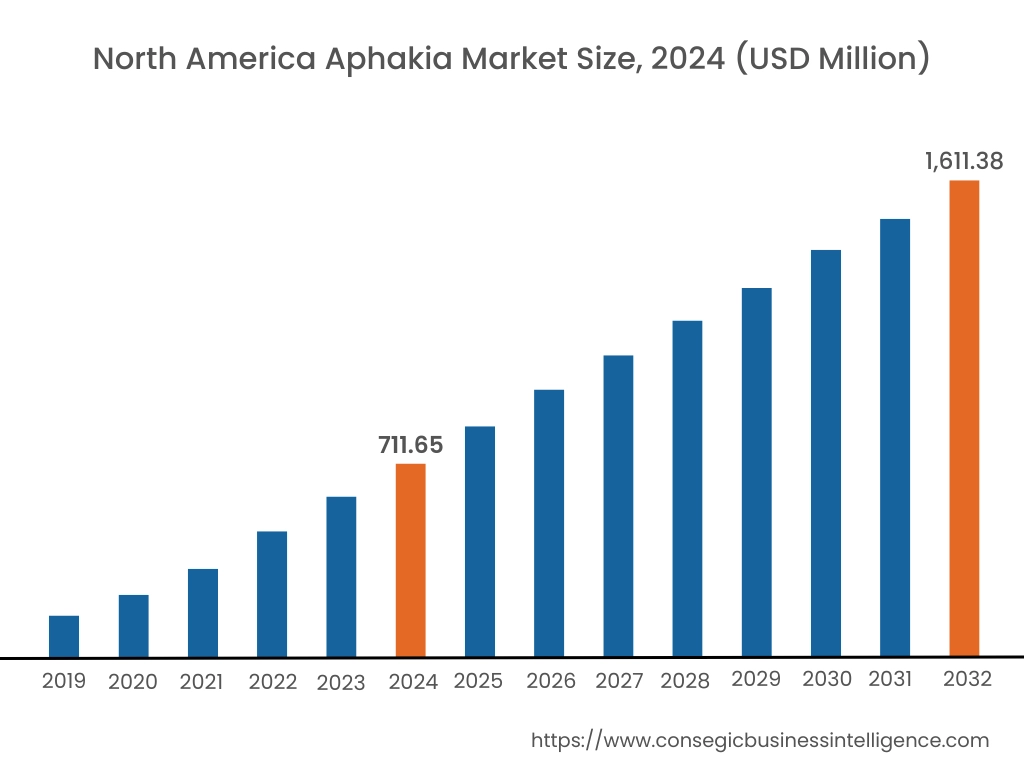
In 2024, North America accounted for the highest market share at 41.23% and was valued at USD 711.65 Million and is expected to reach USD 1,611.38 Million in 2032. In North America, United States accounted for the highest market share of 71.33% during the base year of 2024. The aphakia market share of the North America region is major due to technological advancements. Technological advancements in contact lenses and intraocular lens have enhanced the treatment options for aphakia. Moreover, companies are developing intraocular lens with advanced features for easy implantation further driving the market.
- In 2024, Johnson & Johnson Services, Inc launched TECNIS Odyssey intraocular lens in the United States. It is implanted in the visual correction of aphakia and provides clear vision even in low lightening conditions. Further, this lens also has tolerance to refractive error and high contrast sensitivity.
Thus, North America is leading in the market due to technological advancements and advanced healthcare industry as per analysis.

Asia-pacific is expected to witness the fastest CAGR of 13.2% over the forecast period of 2025-2032. According to aphakia market analysis, the Asia Pacific region is growing rapidly driven by rising prevalence of the ophthalmic diseases. Countries such as China, India, Japan, and South Korea are major contributors in the market due to growing cases of cataracts and glaucoma. The increasing number of hospitals and ophthalmic clinics is further driving the adoption of surgery and spectacles in the treatment of ophthalmic diseases. Hence, the aphakia market share of Asia Pacific is experiencing rapid growth through rising prevalence of ophthalmic diseases and increasing number of hospitals & ophthalmic clinics.
According to aphakia market analysis, Europe region is experiencing steady growth in the market driven by increasing health expenditure. The region is well developed with modern diagnostic technology and skilled ophthalmologists along with digital healthcare infrastructure. The government in the region is also investing in research and development of contact lenses with advanced features for easy applicability. It is further leading to aphakia market expansion in the region.
The Middle East and Africa region is experiencing gradual demand in the market, driven by increasing awareness about eye health and improving healthcare industry. Countries such as Dubai, UAE, and South Arica are major contributors in the market where advanced hospitals and government organizations provide access to advanced treatments for aphakia. Further, the ophthalmic clinics in the region offer diagnostic methods such as genetic testing and complete eye exam as per analysis.
As per analysis, the market in Latin America is driven by rising disposable income and growing population. Countries such as Brazil, Mexico and Argentina are major contributors in the region due to modern healthcare infrastructure. The rise of diagnostic centers and private hospitals has significantly impacted the availability of advanced treatment options for eye-related conditions. Additionally, patients in the region prefer contact lenses due to easy applicability and improved vision.
Top Key Players & Market Share Insights:
The aphakia industry is highly competitive with major players providing products to the national and international markets. Key players are adopting several strategies in research and development (R&D) and product innovation to hold a strong position in the global aphakia market. Key players in aphakia industry include-
- Alcon Inc. (Switzerland)
- Johnson & Johnson Services, Inc. (United States)
- CooperVision, Inc. (United States)
- Rayner Group (United Kingdom)
- Menicon Co., Ltd. (Japan)
- Bausch & Lomb Incorporated. (Canada)
- Aetna Inc. (United States)
- Hoya Corporation (Japan)
- ZEISS International (Germany)
- Ophtec BV (Netherlands)
Aphakia Market Report Insights :
| Report Attributes | Report Details |
| Study Timeline | 2019-2032 |
| Market Size in 2032 | USD 4,149.75 Million |
| CAGR (2025-2032) | 11.6% |
| By Type |
|
| By Treatment |
|
| By End-Use |
|
| By Region |
|
| Key Players |
|
| North America | U.S. Canada Mexico |
| Europe | U.K. Germany France Spain Italy Russia Benelux Rest of Europe |
| APAC | China South Korea Japan India Australia ASEAN Rest of Asia-Pacific |
| Middle East and Africa | GCC Turkey South Africa Rest of MEA |
| LATAM | Brazil Argentina Chile Rest of LATAM |
| Report Coverage |
|
Key Questions Answered in the Report
How big is the aphakia market? −
In 2024, the aphakia market is USD 1,726.04 million.
Which is the fastest-growing region in the aphakia market? +
Asia Pacific is the fastest-growing region in the aphakia market.
What specific segmentation details are covered in the aphakia market? +
Type, Treatment, and End-Use are covered in the aphakia market.
Who are the major players in the aphakia market? +
Alcon Inc. (Switzerland), Johnson & Johnson Services, Inc. (United States), and Bausch & Lomb Incorporated. (Canada) are some of the major players in the market.
Overview
Reputation & Certifications


Our Services
- Market Intelligence & Forecasting
- Custom Research Solutions
- Market Entry Strategy
- Competitive Intelligence
- Customer Insights
- Industry Innovation Analysis
- Investment Advisory