Jump to Content
Apple Juice Concentrate Market - Size, Share, Industry Trends, and Forecasts (2025-2032)
Apple Juice Concentrate Market Size:
Apple Juice Concentrate Market size is growing with a CAGR of 5.0% during the forecast period (2025-2032), and the market is projected to be valued at USD 8,676.77 Million by 2032 from USD 5,912.15 Million in 2024. Additionally, the market value for the 2025 attributes to USD 6,184.26 Million.
Apple Juice Concentrate Market Scope & Overview:
Apple juice concentrate is a versatile and widely used ingredient in the food and beverage industry. It is produced by extracting juice from apples and then evaporating a significant portion of its water content. This process results in a concentrated liquid that retains the characteristic flavor, aroma, and nutritional profile of apples, but in a more compact and shelf-stable form. The concentration process not only reduces volume, making storage and transportation more efficient, but also intensifies the natural sweetness and flavor of the apples. Apple juice concentrate is available in various forms, including cloudy (containing pulp), clarified (filtered to remove solids), and deionized (minerals and acids removed), each offering distinct characteristics suitable for different applications. The applications consists of beverages, bakery & confectionery products, dairy & frozen desserts, baby foods, and others. These products are distributed through business to business and business to consumer channels.
How is AI Transforming the Apple Juice Concentrate Market?
AI is being utilized in the apple juice concentrate market, primarily for optimizing its production, enhancing product quality, and improving production efficiency. AI-powered tools are used for flavor optimization, predicting consumer preferences, and creating new fruit blends. Moreover, AI-powered solutions can assist in flavor formulation and texture optimization, particularly in the development of new products or variations of existing ones.
In addition, AI-powered solutions can also help in optimizing various aspects of the production process, ranging from resource allocation to supply chain management, which contributes to greater efficiency and reduced costs. Thus, the above factors are expected to create lucrative prospects for market growth in upcoming years.

Apple Juice Concentrate Market Dynamics - (DRO) :
Key Drivers:
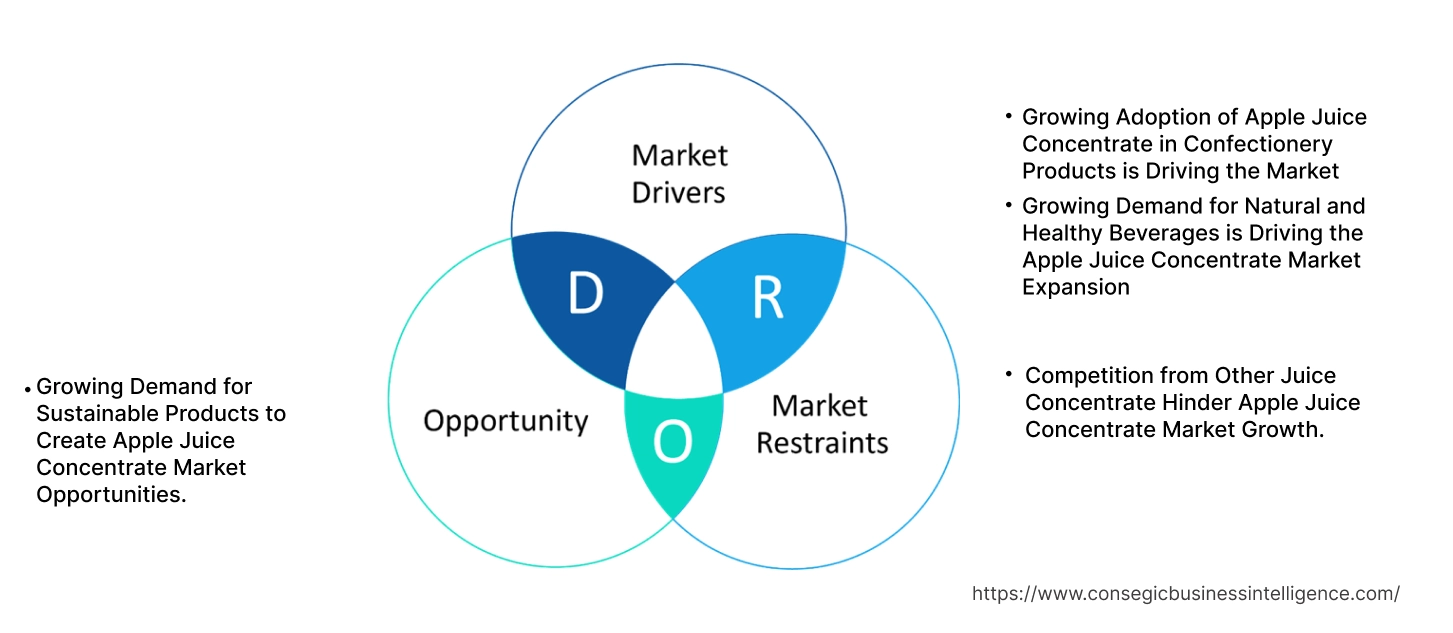
Growing Adoption of Apple Juice Concentrate in Confectionery Products is Driving the Market
The growing adoption of apple juice concentrate in the confectionery sector is a significant driver of market. As consumers increasingly seek natural and fruit-derived ingredients in their foods, confectionery manufacturers are incorporating apple juice concentrate to add sweetness, flavor, and sometimes even texture to their products. Additionally, it contributes a unique flavor profile to candies, gummies, and other sweet treats. Manufacturers are developing confectionery products using concentrates of apple juice.
For instance,
- In February 2025, Lakrids, the Danish confectionery brand introduced fruity licorice collection. The collection consists of licorice that are made using concentrates of apple juice.
Thus, this increasing use of apple juice concentrated in confectionery formulations is thus contributing to the overall growth of the market.
Growing Demand for Natural and Healthy Beverages is Driving the Apple Juice Concentrate Market Expansion.
Consumers are becoming more health-conscious and actively seek beverages perceived as natural, and free from artificial additives. Apple juice, particularly when marketed as 100% juice or made from organic apples, aligns well with this trend. Apple juice concentrate, as the base for many apple juice products, benefits from this positive health. These concentrates act as natural sweeteners that lead to the development of healthy beverages. The rise in awareness about the health concerns associated with the consumption of beverages containing artificial sugar is influencing the consumer requirement for low or no sugar beverages.
For instance,
- According to the data published by the National Library of Medicine, in 2022, the consumers opting for natural drinks is mainly because the drink contains low or no sugar.
Thus, the rise in requirement for natural and healthy beverages is influencing the apple juice concentrate market demand.
Key Restraints:
Competition from Other Juice Concentrate Hinder Apple Juice Concentrate Market Growth.
Consumers generally perceive various fruit juices as interchangeable, especially in blended products or when seeking general nutritional benefits. This allows concentrates like orange, grape, pineapple, and other fruit varieties to compete directly with apple juice concentrate. These alternatives readily substitute apple concentrate in various applications, from blended juices and beverages to food products. Grape, orange, and pineapple juice concentrates offer a range of benefits stemming from the natural properties of the fruits they're derived from.
Grape juice concentrate, particularly from dark-skinned varieties, is rich in antioxidants like resveratrol and flavonoids, which are associated with heart health, improved circulation, and potential anti-cancer properties. Orange juice concentrate is a well-known source of Vitamin C, a crucial nutrient for immune function, collagen production, and antioxidant defense. Pineapple juice concentrate contains bromelain, an enzyme with anti-inflammatory properties that may aid digestion and have other potential health benefits. Thus, these benefits offered by alternative juice concentrate hinders the growth of the market.
Future Opportunities :
Growing Demand for Sustainable Products to Create Apple Juice Concentrate Market Opportunities.
Consumers are becoming more aware of the environmental and social impacts of their purchasing decisions, leading to a surge in requirements for products that are produced in an environmentally responsible and ethical manner. Eco-friendly production practices are contributing towards environmental sustainability goals. These factors allow apple juice to concentrate on the manufacturer to differentiate themselves. They differentiate themselves by building positive brand images and increase in price premiums that consumers are willing to pay.
- For instance, according to PwC, the average spend on sustainably produced products by consumers increased by 9.7% compared to previous year.
As consumer awareness of sustainability and ethical considerations grows, the requirement for this juice concentrate is expected to create lucrative apple juice concentrate market opportunities.
Apple Juice Concentrate Market Segmental Analysis :
By Type:
Based on type, the market is categorized into cloudy, clarified, de-ionized, and others.
Trends in the Type:
- Demand for organic and non-GMO apple juice concentrate is rising due to concerns about pesticides and genetically modified organisms.
- Growing consumer preference for natural and less processed food products is driving requirement for cloudy apple juice concentrate.
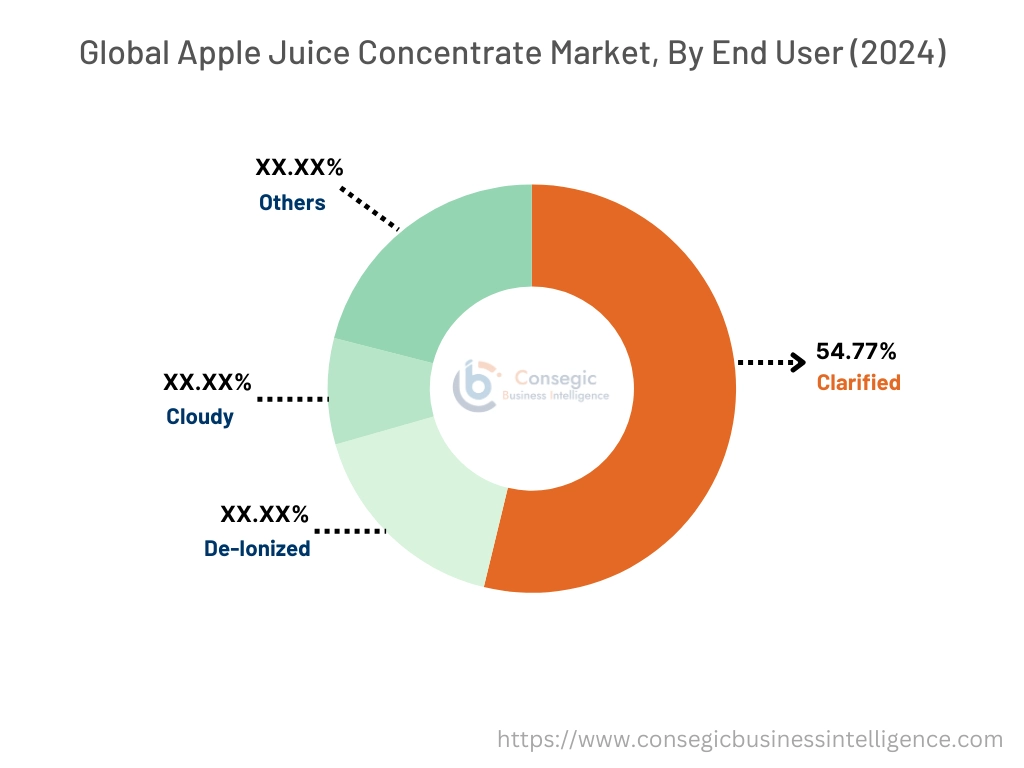
The clarified segment accounted for the largest apple juice concentrate market share of 54.77% in 2024.
- Clarified apple juice concentrate undergoes a filtration process to remove all suspended solids, including pulp and other particulate matter, resulting in a clear, bright appearance.
- This process enhances the visual appeal of the concentrate and the final products, making it a preferred choice for consumers who associate clarity with purity and high quality.
- While the clarification process removes some of the dietary fiber present in cloudy concentrate, it doesn't significantly impact the core flavor profile, which remains sweet and characteristic of apples.
- Clarified concentrate is highly versatile and widely used in the production of premium apple juice, juice blends, ciders, and other beverages.
- Thus, the rise in the use of clarified concentrate of apple juices is driving the apple juice concentrate market trends.
The cloudy segment is expected to grow at the fastest CAGR over the forecast period.
- Cloudy apple juice concentrate distinguishes itself through the retention of apple pulp, a characteristic that significantly influences its appearance, texture, and nutritional profile.
- Unlike clarified apple juice concentrate, where solids are filtered out, cloudy concentrate maintains the natural apple pulp, giving it a less transparent, mainly slightly opaque appearance.
- This pulp contributes to a more intense apple flavor, which is generally fresher and more natural.
- Beyond its sensory qualities, the presence of pulp in cloudy juice concentrate enhances its nutritional value, primarily due to the increased fiber content.
- For instance, Profruit introduced Cloudy Organic Apple Juice Concentrate that is developed using Gala, Pink Lady, Granny Smith, Braeburn, and Fuji. Cloudy Organic Juice Concentrate has been processed to preserve the original quality of the natural fruit.
- Thus, the growing use of cloudy concentrates is influencing the development of the segment.
By Application:
Based on applications, the market is categorized into beverages, bakery & confectionery products, dairy & frozen desserts, baby foods, and others.
Trends in Application:
- The rise in the requirement for naturally flavored beverages is influencing the use of concentrate of apples.
- There is a growing emphasis on sustainable sourcing and production practices in the apple juice concentrate industry.
The beverages segment accounted for the largest market share in the year 2024.
- Apple juice concentrate plays a multifaceted role in the beverage industry, serving as a key ingredient in a diverse range of drinks.
- Its most prominent application is the production of apple juice itself, where it's mixed with water to create the familiar beverage.
- The concentrate of apple juice acts as a crucial component in juice blends, contributing sweetness, apple flavor, and sometimes body to combinations of various fruit juices.
- It is also a popular ingredient in ciders, both hard and soft, where it provides the foundational apple flavor and contributes to the final product's sweetness and tartness balance.
- For instance, in January 2025, Trader Joes introduced organic apple juice beverage. It consists of a blend of organic juice concentrate sweetened with organic natural fruit juices.
- Thus, these factors are influencing the segment need.
The bakery & confectionery products segment is expected to grow at the fastest CAGR over the forecast period.
- Apple juice concentrate are used in the bakery and confectionery industry, offering a natural and versatile ingredient for a variety of treats.
- In baked goods, it acts as a natural sweetener, replacing or reducing the need for refined sugars while also contributing moisture and a subtle apple flavor to cakes, muffins, and cookies.
- It is used in fillings for pies and pastries, adding a concentrated burst of apple.
- In the confectionery world, apple juice concentrate is a key ingredient in candies, gummies, and fruit snacks, providing both sweetness and a natural fruit flavor.
- Its use aligns with the growing consumer preference for products with cleaner labels and natural ingredients.
- Additionally, the concentrate is used to create glazes and coatings, adding a touch of shine and apple flavor to finished baked goods or confections.
- Thus, this versatility makes juice concentrate a valuable ingredient for bakers and confectioners looking to enhance their products with natural apple flavor and sweetness, thus driving the apple juice concentrate market expansion.
By Distribution Channel:
Based on distribution channel, the market is categorized into business to business (B2B), business to consumer (B2C).
Trends in the Distribution Channel:
- The increase in busier and hectic lifestyles has led to the need for convenient purchase of juice concentrates through online channels.
The business to business (B2B) segment accounted for the largest market share in the year 2024.
- The B2B (business to business) segment makes a leading contribution to the market due to the need for the large volume of concentrates of apple juice in the industrial settings.
- This channel involves sales of concentrates from manufacturers to businesses such.
- B2B distribution of products is present large order volumes that characterize significant requirements of these businesses.
- Bulk packaging options like drums, IBCs (Intermediate Bulk Containers), and tankers are commonly used in B2B distribution to efficiently transport large volumes of apple juice concentrate.
- Thus, due to the above-mentioned analysis, the B2B segment is dominating in the overall market trend.
The business to Consumer (B2C) segment is expected to grow at the fastest CAGR over the forecast period.
- The segment is further categorized into online retailers, supermarket & hypermarket and others.
- The business-to-consumer (B2C) channel in the market for bread improver includes direct sales to individual consumers.
- This segment is characterized by smaller package sizes designed for household use, distributed through retail channels such as supermarkets, specialty food stores, and online retailers.
- For instance, the data published by BCG, in 2023, states that e-commerce is seeing a growth by 41% of global retail sales by 2027.
- Thus, as per the market analysis, these factors are influencing the development of the segment.
Regional Analysis:
The regions covered are North America, Europe, Asia Pacific, the Middle East and Africa, and Latin America.
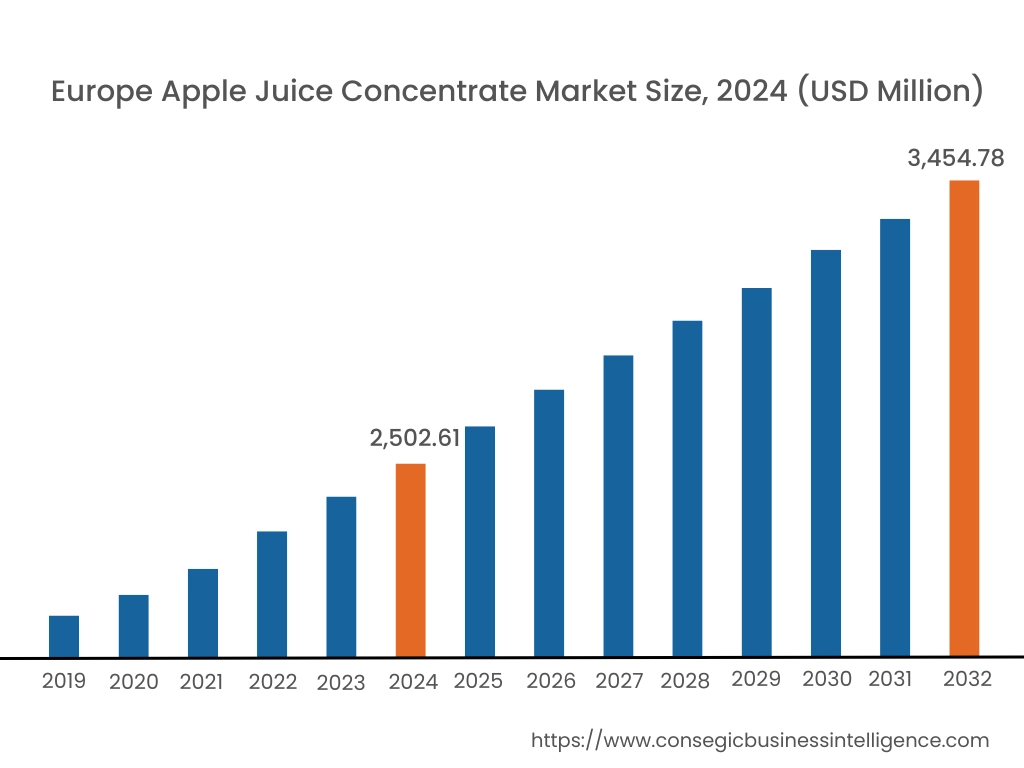
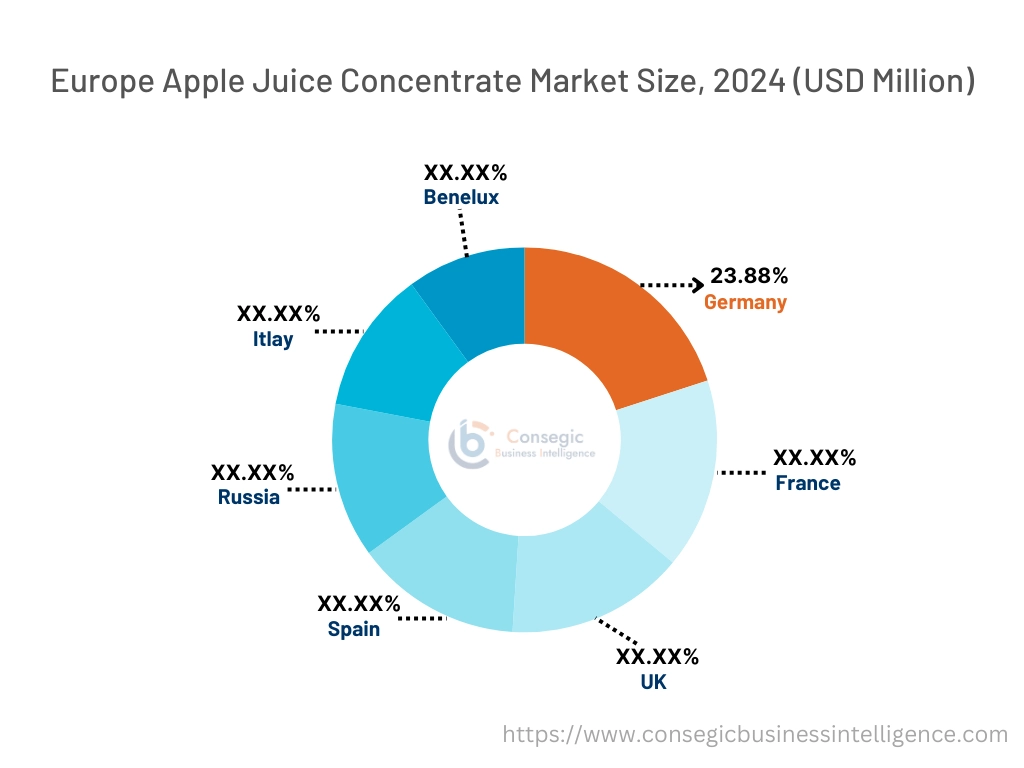
In 2024, Europe accounted for the highest market share at 42.33% and was valued at USD 2,502.61 Million and is expected to reach USD 3,454.78 Million in 2032. In Europe, Germany accounted for the highest market share of 23.88% during the base year of 2024. Apple juice concentrate plays a significant role in the European bakery and confectionery sector, driven by consumer preferences for natural and fruit-derived ingredients. European bakers and confectioners utilize concentrate form of apple juice as a natural sweetener, replacing or reducing the use of refined sugars in products like cakes, pastries, cookies, and candies. This aligns with the growing trend towards healthier and "clean label" products.
For instance,
- According to an article published in Food Manufacture in April 2024, it is stated that consumer demand for clean-label products is increasing by 70%. 99% of European manufacturers see clean-label products as essential to their business strategy.
Thus, as per the apple juice concentrate market analysis, these factors are influencing the growth of the market in this region.
Asia Pacific is experiencing the fastest growth with a CAGR of 6.7% over the forecast period. The Apple Juice Concentrate market trend across the region is attributed to factors such as the presence of major beverage manufacturers. These companies utilize concentrate of apple juice as a key ingredient in their diverse product portfolios, ranging from fruit juices and juice blends to ready-to-drink beverages and other innovative drinks. Additionally, the increasing health consciousness among Asian consumers, coupled with the rising popularity of natural and fruit-based beverages, further supports the apple juice concentrate market growth. As per the market analysis, as these beverage manufacturers continue to expand their product offerings and cater to evolving consumer preferences, the requirement for high-quality juice concentrate is expected to grow in the Asia Pacific region.
North America presents a significant contribution to the apple juice concentrate market analysis. In North America, apple juice concentrate plays a versatile role in the dairy and frozen dessert industry, contributing natural sweetness, flavor, and sometimes even texture to a variety of products. It's used as a natural sweetener in yogurts, ice creams, and frozen desserts, mainly replacing or reducing the need for refined sugars or artificial sweeteners. This aligns with consumer trends favoring cleaner labels and natural ingredients. Beyond sweetness, apple juice concentrate imparts a distinct apple flavor profile to these products, enhancing their overall appeal. In some cases, particularly with cloudy apple juice concentrate, the retained apple pulp contributes to a desirable texture to frozen desserts, adding a layer of complexity and perceived naturalness. This use of apple juice concentrate allows dairy and frozen dessert manufacturers to create products that are both delicious and align with consumer preferences for natural ingredients.
The Middle East and Africa (MEA) region is witnessing notable apple juice concentrate market demand characterized by significant potential. With increasing urbanization and changing lifestyles, the requirement for processed foods and beverages, including juices and juice-based drinks, is rising in the MEA region. This trend drives the market for concentrate of apple juice, including the clarified variety. In MEA region clarified apple juice concentrate is used as a sweetener and flavor enhancer in various food products, such as sauces, dressings, and baked goods, catering to the growing food processing sector.
Latin America is an emerging region in the Apple Juice Concentrate market share, with significant potential for innovation. Online retail of food products, including beverages, is increasing in Latin America. Most online platforms in Latin America that sell apple juice tend to focus on packaged, ready-to-drink apple juice rather than the concentrate itself. Based on the market analysis, as e-commerce continues to grow in the region, more online retailers offer apple juice concentrate, especially for smaller-scale consumers or for those seeking specific types such as organic and cloudy.
Top Key Players and Market Share Insights:
The global Apple Juice Concentrate market is highly competitive with major players providing precise products to the national and international markets. Key players are adopting several strategies in research and development (R&D) and product innovation to hold a strong position in the global Apple Juice Concentrate market. Key players in the Apple Juice Concentrate industry include-
- Nestle (Switzerland )
- ProFruit Limited (United States)
- Coloma Frozen Foods (United States)
- Old Orchard Juices (United States)
- Sunimpex (UAE)
- Pomuna Co. (United States)
- Pilmifresh (Spain)
- Lemonconcentrate S.L.U (Spain)
- Tree Top, Inc. (United States)
- AGRANA Beteiligungs-AG (Austria)
Apple Juice Concentrate Market Report Insights :
| Report Attributes | Report Details |
| Study Timeline | 2018-2032 |
| Market Size in 2032 | USD 8,676.77 Million |
| CAGR (2025-2032) | 5.0% |
| By Type |
|
| By Application |
|
| By Distribution Channel |
|
| By Region |
|
| Key Players |
|
| North America | U.S. Canada Mexico |
| Europe | U.K. Germany France Spain Italy Russia Benelux Rest of Europe |
| APAC | China South Korea Japan India Australia ASEAN Rest of Asia-Pacific |
| Middle East and Africa | GCC Turkey South Africa Rest of MEA |
| LATAM | Brazil Argentina Chile Rest of LATAM |
| Report Coverage |
|
Key Questions Answered in the Report
How big is the Apple Juice Concentrate market? −
In 2024, the Apple Juice Concentrate market is USD 5,912.15 Million.
Which is the fastest-growing region in the Apple Juice Concentrate market? +
Asia-Pacific is the fastest-growing region in the Apple Juice Concentrate market.
What specific segmentation details are covered in the Apple Juice Concentrate market? +
Type, Application, and Distribution Channel segmentation details are covered in the Apple Juice Concentrate market.
Who are the major players in the Apple Juice Concentrate market? +
Nestle (Switzerland), ProFruit Limited (United States), Coloma Frozen Foods (United States), Old Orchard Juices (United States), Sunimpex (UAE), and Pomuna Co. (United States) are some major players in the market.
Overview
Reputation & Certifications


Our Services
- Market Intelligence & Forecasting
- Custom Research Solutions
- Market Entry Strategy
- Competitive Intelligence
- Customer Insights
- Industry Innovation Analysis
- Investment Advisory